
Tesla(TSLA)

Search documents
Stock Market Today: Dow Jones, Nasdaq Futures Gain As Investors Await Fed Decision, Jerome Powell's Speech—Starbucks, Seagate, Tesla In Focus - State Street SPDR S&P 500 ETF Trust (ARCA:SPY)
Benzinga· 2026-01-28 10:12
Market Overview - U.S. stock futures rose on Wednesday following a mixed close on Tuesday, with major benchmark indices showing higher futures [1] - The CME Group's FedWatch tool indicates a 97.2% likelihood of the Federal Reserve keeping interest rates unchanged in January [2] - The 10-year Treasury bond yielded 4.24%, while the two-year bond was at 3.57% [2] Index Performance - Dow Jones increased by 0.04%, S&P 500 by 0.30%, Nasdaq 100 by 0.74%, and Russell 2000 by 0.40% in premarket trading [2] - The SPDR S&P 500 ETF Trust (NYSE:SPY) was up 0.33% at $697.77, and Invesco QQQ Trust ETF (NASDAQ:QQQ) advanced 0.77% to $635.96 [2] Stocks in Focus - Starbucks Corp. (NASDAQ:SBUX) was down 0.76% in premarket, projected to post quarterly earnings of $0.59 per share on revenue of $9.73 billion [4] - Microsoft Corp. (NASDAQ:MSFT) rose 0.087% ahead of earnings expected to be $3.97 per share on revenue of $80.27 billion [4] - Tesla Inc. (NASDAQ:TSLA) advanced 0.23%, projected to post quarterly earnings of $0.45 per share on revenue of $24.78 billion [4] - Seagate Technology Holdings PLC (NASDAQ:STX) jumped 10.02% after reporting better-than-expected revenue and earnings, along with strong guidance [4] Economic Insights - Jeffrey Roach, Chief Economist at LPL Financial, forecasts a resilient U.S. economy in 2026, with real economic growth projected at 2.5% year-over-year and nominal growth surpassing 5% [8] - Roach emphasizes that productivity growth, particularly from early AI adoption, will support economic expansion without reigniting inflation [8] - His team maintains a "tactical neutral stance on equities," favoring large-cap growth stocks and the communication services sector [9] Upcoming Economic Data - The FOMC will announce its interest-rate decision at 2:00 p.m., followed by a press conference from Fed Chair Powell at 2:30 p.m. ET [10] Commodities and Global Markets - Crude oil futures were down 0.22% to around $62.25 per barrel, while Gold Spot rose 1.75% to approximately $5,272.90 per ounce [11] - Bitcoin (CRYPTO: BTC) was trading 1.52% higher at $89,223.76 per coin [13]





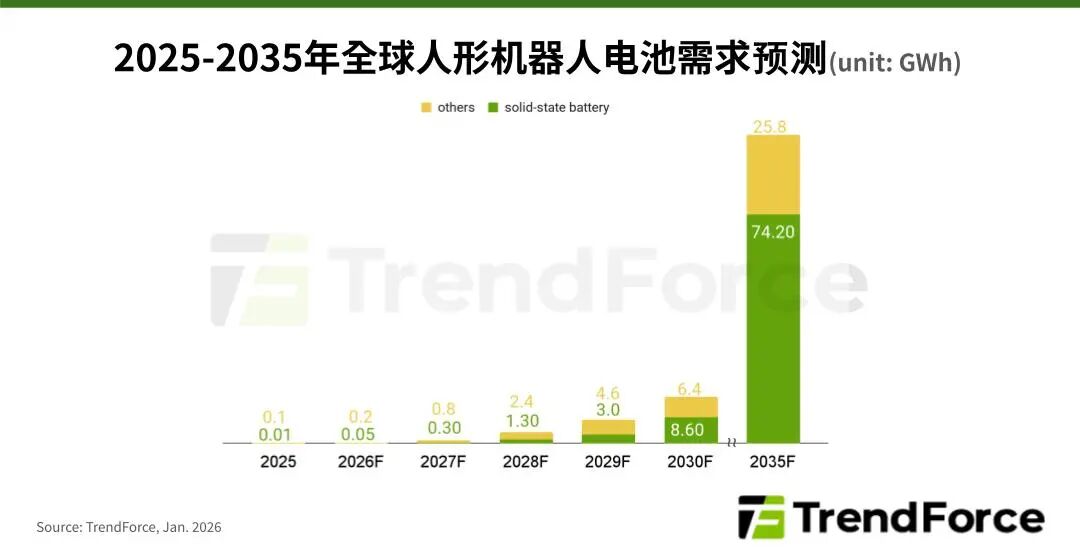
集邦咨询:预计人形机器人对固态电池的需求有望于2035年超74GWh
智通财经网· 2026-01-28 09:09
Core Insights - The development of humanoid robots is expected to reach a commercialization milestone by 2026, increasing the importance of batteries as an "energy supply" [1] - Solid-state lithium batteries are projected to become the mainstream solution due to their high energy density, with demand from humanoid robots expected to exceed 74 GWh by 2035, growing over a thousand times from 2026 [1] Group 1: Humanoid Robot Battery Market - Global humanoid robot shipments are forecasted to surpass 50,000 units in 2026, representing an annual growth of over 700% [4] - High-nickel ternary lithium batteries (NMC/NCA) are currently the mainstream choice for robot batteries due to their relatively high energy density, while lithium iron phosphate batteries (LFP) are used for lower endurance applications [4] - Most humanoid robots currently have a battery capacity below 2 kWh, with typical endurance ranging from 2 to 4 hours, such as Unitree's H1 with 0.864 kWh and Tesla's Optimus Gen2 with 2.3 kWh [4] Group 2: Challenges and Opportunities - The development of humanoid robot batteries faces two main challenges: the rapid iteration of core technologies affecting battery customization and the current focus on finding scalable commercial applications rather than improving endurance [5] - Despite these challenges, the demand for high energy density, high discharge rate, and high safety batteries in humanoid robots presents an opportunity for solid-state batteries to demonstrate their advantages [5] - Breakthroughs in solid-state battery technology and cost reductions are expected to help humanoid robots overcome power limitations [5]

Tesla Is Set to Dominate the EV Market -- Here Are 4 Reasons Why
Yahoo Finance· 2026-01-28 09:02
Core Insights - The electric vehicle (EV) market is becoming increasingly competitive for Tesla, yet the company's long-term competitive position is strengthening, positioning it well to dominate the EV market [1] Group 1: Tesla's Performance - Tesla's EV deliveries fell by 8.6% in 2025 compared to 2024, primarily due to the refresh of the Model Y, which remains the best-selling EV in the U.S. [2] - Despite a decline in the Model Y's market share in late 2024 and early 2025, a quick rebound is expected in the second quarter with the new Model Y's availability [2] - Tesla's market share, particularly for the Model Y, saw a significant increase in the fourth quarter after the expiration of EV Federal tax credits, indicating that Tesla was less affected than its low-cost EV competitors [3] Group 2: Competitive Landscape - There is a distinction between low-cost EV models and those subsidized to gain market share, with the latter being unsustainable; Ford's Model e segment lost $3.6 billion in the first nine months of 2025 and incurred a $19.5 billion charge to refocus its EV operations [5] - Tesla remains profitable and has the scale to increase production while reducing costs per vehicle, enhancing its competitive edge [6] Group 3: Future Growth Potential - Tesla's CEO Elon Musk confirmed the removal of safety drivers from some robotaxis in Austin, Texas, marking a positive step in the rollout of Tesla's robotaxi service [8] - The potential for robotaxis to transform Tesla's earnings is significant, as it could generate substantial revenue from Cybercabs and share revenue from Tesla EVs converted into robotaxis using unsupervised full self-driving software [9]
Tesla Stock Investors Just Got Good News From CEO Elon Musk About Robotaxis and Robots
The Motley Fool· 2026-01-28 08:55
Core Insights - Tesla is facing challenges in the electric vehicle market, losing market share due to increased competition and the discontinuation of federal tax credits, with deliveries falling 9% in 2025 despite a 25% increase in global electric car sales [1][2]. Autonomous Driving and Robotaxi Developments - Tesla's focus has shifted towards robotaxis and humanoid robotics, with recent updates from CEO Elon Musk indicating progress in these areas [2]. - The company launched its autonomous ride-sharing service in Austin without safety monitors, validating its camera-only strategy, which is cheaper and faster to implement compared to competitors like Waymo that use lidar [3]. - Tesla plans to expand its autonomous ride-sharing service to five new markets in 2025, including Las Vegas, Phoenix, Dallas, Houston, and Miami, having already received permits for operations in Arizona and testing in Nevada [4]. Competitive Landscape - While Tesla is making strides in autonomous driving technology, it still trails Waymo, which operates commercial robotaxi services in five U.S. cities. The robotaxi market is projected to grow at an annual rate of 99% through 2033 [5]. Full Self-Driving (FSD) Technology - Tesla's FSD service, currently available in the U.S. for $99 per month, may receive approval in Europe by February 2026, which would facilitate faster adoption across the EU [6][7]. - Approval in China is also a possibility, although recent state media reports have cast doubt on this timeline. The expansion of FSD in Europe could significantly increase Tesla's addressable market [8]. Humanoid Robot Optimus - Tesla's humanoid robot, Optimus, is expected to be available to the public by late 2027, with Musk suggesting it could add $20 trillion to the company's market value [9]. - The humanoid robot market is projected to grow at 50% annually, potentially reaching $1.2 trillion by 2040, indicating a significant future revenue source for Tesla [10]. Overall Market Position - Despite losing market share in electric vehicles, Tesla is building momentum in physical AI technologies. The stock is currently trading at a high valuation of 290 times earnings, but this could change if robotaxis and humanoid robots become substantial revenue sources [11].
Mag 7财报季明日启动,市场紧盯一件事——资本开支!
Hua Er Jie Jian Wen· 2026-01-28 08:20
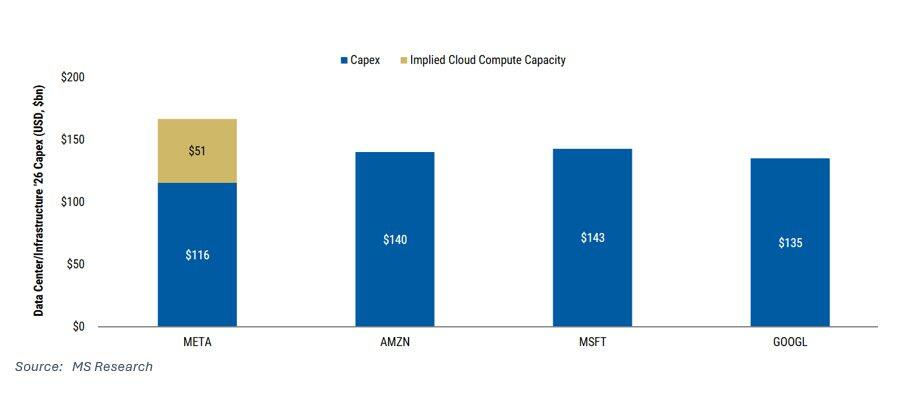
Core Viewpoint - The upcoming earnings season for the "Mag 7" tech giants, including Microsoft, Meta, and Tesla, will focus on spending trends, with expectations of a 20% profit growth in Q4, the slowest since early 2023 [1] Group 1: Earnings Expectations - The "Mag 7" companies have a combined market capitalization of $10.5 trillion, with significant investor focus on capital expenditure guidance [1] - Nearly 80% of S&P 500 companies have exceeded analyst expectations so far, with strong performance anticipated from tech stocks [1] - Wolfe Research indicates that companies exceeding both revenue and profit expectations have seen negative stock performance post-earnings, suggesting a potential unsustainability of this trend [1] Group 2: Capital Expenditure Focus - Morgan Stanley projects unprecedented investment expansions among tech giants, with Meta expected to guide capital expenditures of approximately $120 billion for 2026, significantly higher than the previous year's guidance [2] - Microsoft anticipates a capital expenditure increase exceeding $1.4 trillion for 2026, with a quarterly guidance indicating a growth of over $35 billion [2] - Google’s capital expenditure forecast for 2026 is around $1.35 trillion, potentially rising to $1.5 trillion due to growth in cloud and TPU businesses [2] - Amazon's capital expenditure remains less transparent, but estimates suggest a total of $175 billion for 2026, up from $125 billion in 2025 [2] Group 3: Company-Specific Insights - Microsoft is seen as "stuck between SaaS and OpenAI," with a need to accelerate Azure growth to over 40% to boost stock performance [3] - Meta faces cautious investor sentiment due to concerns over spending and AI strategy, despite revenue growth expectations of around $60 billion for Q4 [4] - Tesla's financial KPIs for Q4 and 2026 are highly variable, with stock performance hinging on updates regarding new technologies and product launches [5][6] - Amazon's stock remains under pressure, with investor focus on AWS revenue growth expected to be around 21% for Q4, while Google anticipates a search revenue growth of 15%-16% [7]



Tesla Earnings: Another Year Down—EV Maker Faces a High-Stakes Test of Patience
Investing· 2026-01-28 08:15
Market Analysis by covering: Tesla Inc. Read 's Market Analysis on Investing.com ...

S&P 500 Hits Record High Ahead Of Key Earnings, Interest Rate Decision: Investor Sentiment Improves, Fear Index In 'Greed' Zone
Benzinga· 2026-01-28 07:54
Market Sentiment - The CNN Money Fear and Greed index improved to a reading of 63.6, remaining in the "Greed" zone, up from 58.9 [6] - U.S. stocks showed mixed performance, with the Dow Jones falling over 400 points while the Nasdaq Composite gained over 200 points [1] Company Performance - General Motors Co. (NYSE:GM) saw a surge of more than 8% after exceeding forecasts and providing positive guidance for 2026 [2] - Boeing Co. (NYSE:BA) reported fourth-quarter revenue of $23.948 billion, a 57% increase from $15.242 billion, but its stock fell around 1.5% [2] Economic Indicators - The Case-Shiller Home Price Index rose 1.4% year-over-year in November, surpassing October's growth of 1.3% and market estimates of 1.2% [3] - The FHFA house price index increased by 0.6% in November, exceeding market expectations of a 0.3% gain [3] Sector Performance - Most sectors on the S&P 500 closed positively, with energy, information technology, and utilities stocks showing the largest gains [4] - Health care and financial stocks closed lower, bucking the overall market trend [4] Upcoming Earnings - Investors are anticipating earnings results from Microsoft Corp. (NASDAQ:MSFT), Tesla Inc. (NASDAQ:TSLA), and Starbucks Corp. (NASDAQ:SBUX) [5]



Big tech earnings land with AI winners still in question
ETBrandEquity.com· 2026-01-28 07:25
Core Viewpoint - Investors have recently shifted focus to niche stocks as skepticism grows regarding the returns on investments made by the Magnificent Seven tech giants in artificial intelligence development [1][12]. Group 1: Performance of the Magnificent Seven - The Magnificent Seven tech giants, including Alphabet, Amazon, Apple, Meta, Microsoft, Nvidia, and Tesla, have led the stock market for the past three years, but their performance has declined since the end of 2025 [1][12]. - Alphabet and Amazon are the only stocks among the Magnificent Seven that have seen gains, with Alphabet rising nearly 20% during the recent downturn [2][12]. - The Magnificent Seven index is currently trading at 28 times profits expected over the next 12 months, which is below previous peaks and in line with the average over the past decade [10][13]. Group 2: Investment Shifts and Market Reactions - Traders have increasingly invested in companies benefiting from Big Tech's spending, such as Sandisk, which is up over 130%, Micron Technology, which has risen 76%, and Western Digital, which has gained 67% since the Magnificent Seven index peaked [3][12]. - The upcoming earnings reports from Microsoft, Meta, Tesla, Apple, Alphabet, and Nvidia are expected to provide insights into the health of various tech sectors, with a projected profit growth of 20% for the fourth quarter, the slowest since early 2023 [4][6][12]. Group 3: Capital Expenditures and Growth Expectations - Major tech companies are expected to spend approximately USD 475 billion on capital expenditures in 2026, significantly up from USD 230 billion in 2024, raising investor expectations for returns on these investments [7][12]. - Microsoft’s Azure revenue rose 39% in its fiscal first quarter, with expectations of 36% growth in the second quarter, highlighting the demand for cloud services driven by AI [7][12]. - Companies that fail to meet growth targets may face significant market penalties, as seen with Meta Platforms, which experienced an 11% drop in stock price following a projection of increased capital expenditures without clear profit pathways [8][12]. Group 4: Comparative Earnings Growth - The 493 companies in the S&P 500 not included in the Magnificent Seven are projected to deliver only 8% earnings growth in the fourth quarter, significantly slower than the expected growth from the tech giants [9][12]. - Nvidia shares have increased by 1,184% since the end of 2022, yet are priced at 24 times anticipated profits, slightly above the S&P 500's multiple of 22, indicating that the stocks are not historically expensive [10][13]. Group 5: Market Sentiment and Future Outlook - Investors are awaiting signs of growth from the Magnificent Seven, with the current earnings season viewed as a critical milestone for assessing progress [11][13]. - The sentiment in the market has shifted to a "show-me story," where investors demand tangible results from Big Tech's investments in AI and other technologies [4][12].



Starbucks, Tesla And 3 Stocks To Watch Heading Into Wednesday - Starbucks (NASDAQ:SBUX)
Benzinga· 2026-01-28 07:14
Group 1 - U.S. stock futures are trading higher, indicating a positive market sentiment for the day [1] - Microsoft Corp. is expected to report quarterly earnings of $3.97 per share on revenue of $80.27 billion, with shares rising 0.4% to $482.50 in after-hours trading [1] - Packaging Corp Of America reported weaker-than-expected fourth-quarter results, projecting first-quarter GAAP EPS of $2.20, below market estimates of $2.26, leading to a 2.1% decline in shares to $218.99 [1] - Tesla Inc. is anticipated to post quarterly earnings of 45 cents per share on revenue of $24.78 billion, with shares increasing 0.4% to $432.49 in after-hours trading [1] - Starbucks Corp. is projected to report quarterly earnings of 59 cents per share on revenue of $9.73 billion, with shares slipping 0.1% to $95.70 in after-hours trading [1] - AT&T Inc. is expected to report quarterly earnings of 46 cents per share on revenue of $32.87 billion, with shares rising 0.3% to $23.07 in after-hours trading [1]

宇树科技2025年人形机器人出货量远超预期!机器人ETF(159770)盘中净申购近4000万份
Mei Ri Jing Ji Xin Wen· 2026-01-28 06:46
国泰海通证券指出,特斯拉Optimus机器人预计2027年底公开销售,目前已在工厂执行简单任务。随着 硬件自由度提升和软件算法优化,人形机器人商业化进程加速,建议关注产业链中精密制造、电机等核 心环节的领先企业。 机器人ETF(159770)紧密跟踪机器人指数,其行业配置主要包括自动化设备(41.23%)、汽车零部件 (11.77%)、软件开发(9.8%)等,前五大成分股为科大讯飞、汇川技术、拓普集团、大华股份、大 族激光。该ETF还配备了2只场外联接基金(A类:014880;C类:014881)。 消息面上,多重因素交织影响机器人板块情绪。利空方面,据第一财经报道,优必选高管透露工业人形 机器人生产效率仅为人类30%-50%,凸显商业化挑战;同时图灵奖得主杨立昆在达沃斯对行业短期前景 发表审慎言论,抑制市场热情。利好层面,特斯拉CEO马斯克明确Optimus将于2027年上市销售,宇树 科技2025年人形机器人出货量超5500台,远超预期;此外春晚合作伙伴确认为机器人企业,助推产业破 圈。当前板块正处于高位震荡消化阶段,长期产业化逻辑依然坚实。 招商证券强调,机器人行业迎来量产拐点与政策支持双重利好,国内供 ...