
Tesla(TSLA)

Search documents
外资巨头,减持美股科技股
Shang Hai Zheng Quan Bao· 2026-02-12 22:56
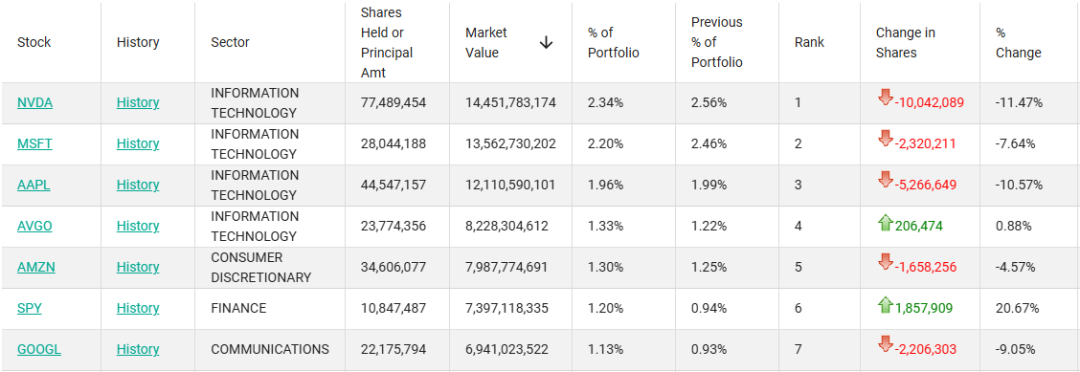
近日,瑞银集团和高盛相继向美国证券交易委员会(SEC)递交了截至2025年12月31日的第四季度持仓报告(13F),报告显示,两家机构均对多只美股 科技巨头进行了大手笔减仓。 具体来看,去年四季度,瑞银集团减持了1004.2万股英伟达,减持幅度达11.47%;减持微软232万股,减持幅度为7.64%;减持苹果526.7万股,减持幅度 为10.57%;减持亚马逊165.8万股,减持幅度为4.57%;减持谷歌220万股,减持幅度为9.05%。此外,瑞银集团对美光科技、甲骨文、AMD、西部数据等 科技股也进行了不同程度减持。 | Stock | History | Sector | Shares Held or | Market | % of | Previous % of | Rank | Change in | ଟିଚ | | --- | --- | --- | --- | --- | --- | --- | --- | --- | --- | | | | | Principal | > Value | Portfolio | Portfolio | | Shares | Change | | | | | Am ...







AI颠覆性担忧发酵,美股三大指数均跌超1%,中概股集体下跌
Feng Huang Wang· 2026-02-12 22:23
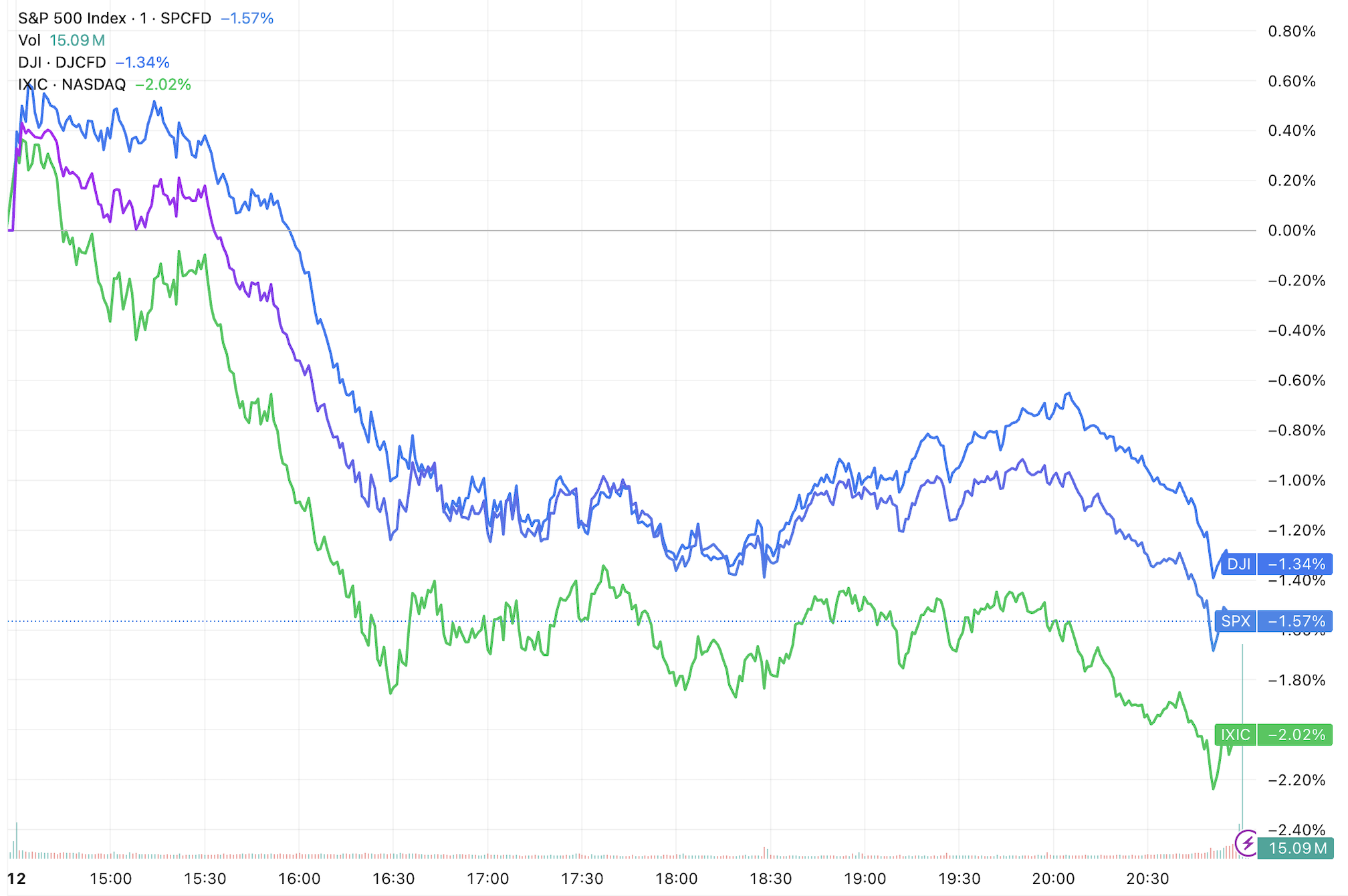
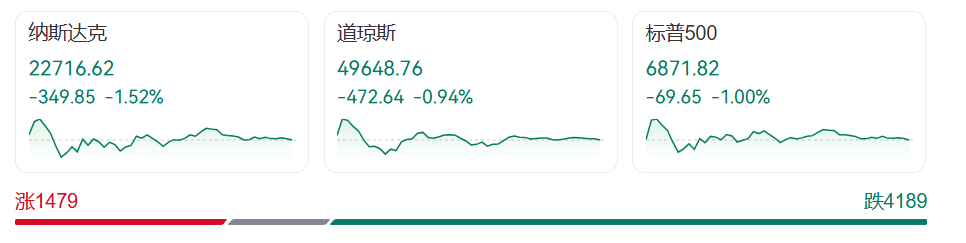
Market Overview - The three major indices closed lower, with the Dow Jones down 1.34% at 49,451.98 points, the S&P 500 down 1.57% at 6,832.76 points, and the Nasdaq down 2.03% at 22,597.15 points [2] - Concerns over AI tools disrupting various sectors, including software companies, publishers, and financial services, have led to significant market volatility [2] Sector Performance - Financial stocks, including Morgan Stanley, faced pressure due to fears that AI could disrupt wealth management [2] - Trucking and logistics companies, such as C.H. Robinson, saw a 14% drop in stock price amid concerns that AI could optimize freight operations and reduce revenue sources [2] - The real estate sector is also affected, with stocks like CBRE and SL Green Realty declining due to anticipated higher unemployment impacting office space demand [3] - Defensive sectors saw gains, with Walmart and Coca-Cola rising 3.8% and 0.5%, respectively [3] Stock Movements - Major tech stocks experienced declines, with Nvidia down 1.64%, Apple down 5.00%, and Microsoft down 0.63% [5] - Chinese stocks listed in the U.S. also fell, with the Nasdaq Golden Dragon China Index down 3.00% [5] Company News - The European Union has initiated another antitrust investigation into Google, focusing on potential illegal manipulation of search engine advertising pricing [6][7] - OpenAI launched its first AI model based on Cerebras Systems chips, aiming to compete in the AI programming assistant market [8] - AI company Anthropic raised $30 billion in funding, reaching a valuation of $380 billion, with investments from Coatue and GIC among others [9][10] - Google released an updated version of its Gemini 3 model, targeting applications in science and engineering [11] - Intel was fined 273.8 million rupees by India's Competition Commission for violating competition laws [12]


深夜突变!金价闪崩、白银跌超10%,美股全线跳水
Mei Ri Jing Ji Xin Wen· 2026-02-12 22:23
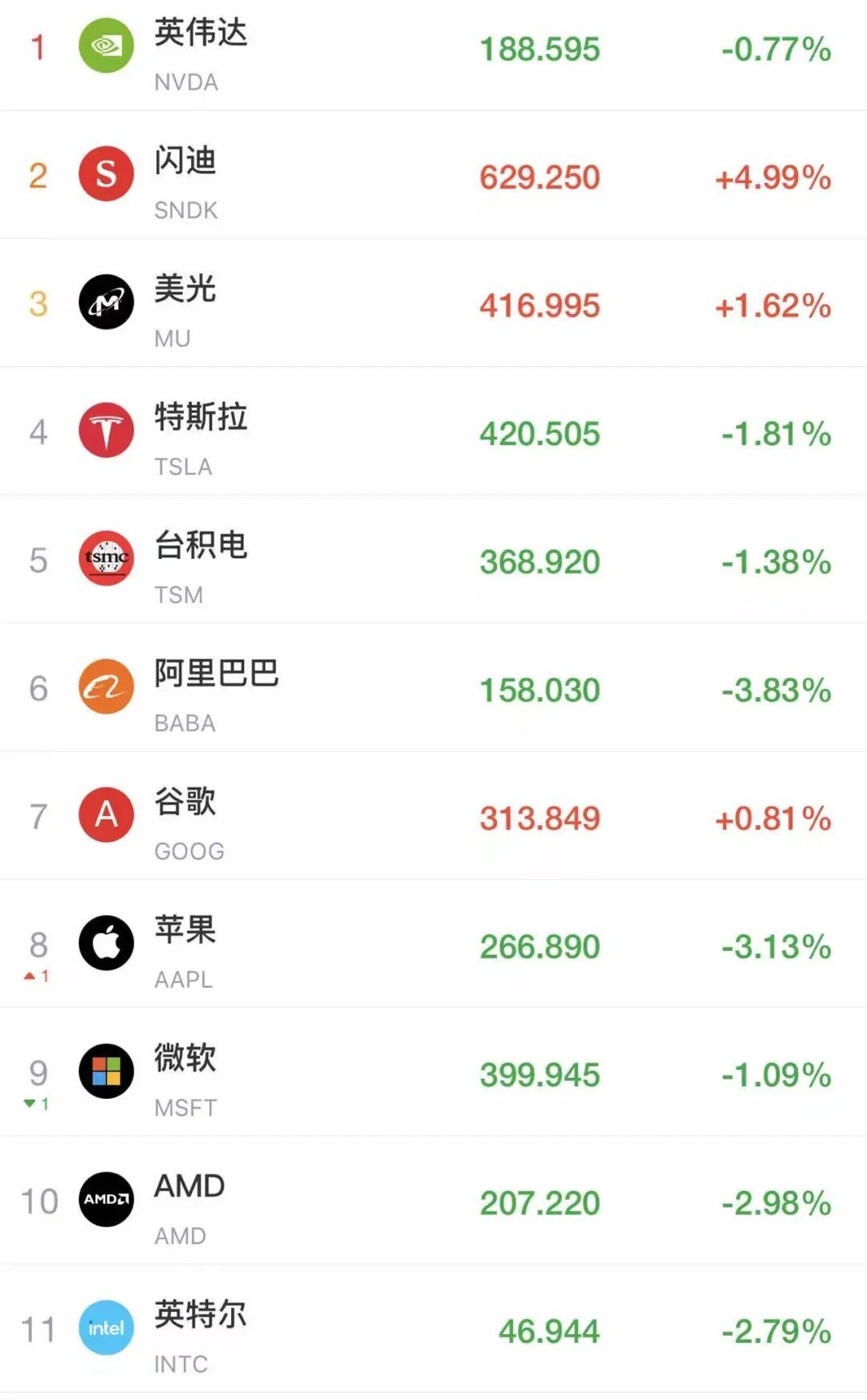
Group 1 - Gold prices experienced a sudden drop, with COMEX gold futures falling by 3.08% to $4941.4 per ounce, while COMEX silver futures decreased by 10.62% to $75.01 per ounce [1] - The U.S. stock market saw a significant decline, with all three major indices dropping over 1% by the end of trading [1] - Apple shares fell more than 3%, resulting in a market capitalization loss of over $120 billion (approximately 82 billion yuan) [1] Group 2 - Major technology stocks, including Microsoft, Amazon, Tesla, Meta, and Nvidia, all experienced declines [1] - Nvidia's stock price decreased by 0.77% to $188.595, while Tesla's stock fell by 1.81% to $420.505 [2] - The Nasdaq Golden Dragon China Index, which tracks Chinese stocks, dropped by 3.00% [3]




Tesla’s Latest Buy Rating Fails To Lift Stock for 5th Day
Barrons· 2026-02-12 21:10
Tesla Stock Rises on Buy Rating. It's Going for a 5-Day Winning Streak. - Barron'sSkip to Main ContentThis copy is for your personal, non-commercial use only. Distribution and use of this material are governed by our Subscriber Agreement and by copyright law. For non-personal use or to order multiple copies, please contact Dow Jones Reprints at 1-800-843-0008 or visit www.djreprints.com.# Tesla's Latest Buy Rating Fails To Lift Stock for 5th DayBy [Al Root]ShareResize---ReprintsIn this article[TSLA][SPX] [D ...
Why Tesla stock is tanking around 3% on Thursday
Invezz· 2026-02-12 17:55
Core Viewpoint - Tesla stock experienced a reversal of early gains, declining approximately 3% on Thursday due to broader market weakness that overshadowed recent positive momentum and analyst support [1] Group 1 - The stock had previously climbed, indicating a period of optimism prior to the decline [1] - Analyst commentary had been supportive, contributing to the initial positive sentiment around Tesla's stock [1]
深夜突变!金价闪崩,直线暴跌3%!美股全线跳水,超4100股下跌,苹果市值蒸发超8000亿元,中概股跌幅扩大
Mei Ri Jing Ji Xin Wen· 2026-02-12 17:04
Group 1 - Gold prices experienced a sudden drop, with spot gold falling over 3% and nearly $200 during the day, while spot silver prices dropped over 8% [1] - Major U.S. stock indices saw a collective decline, with the Nasdaq down over 1.5%, the Dow Jones down nearly 1%, and the S&P 500 down 1% [1] Group 2 - Apple shares fell over 3%, resulting in a market value loss exceeding $120 billion (approximately 82 billion RMB), with other tech stocks like Microsoft, Amazon, Tesla, Meta, and Nvidia also experiencing declines [2] - The Nasdaq Golden Dragon China Index, which tracks Chinese stocks listed in the U.S., dropped nearly 3%, indicating a broader decline in Chinese stocks [4]

Morgan Stanley CEO received a 32% raise in 2025
Yahoo Finance· 2026-02-12 16:36
Core Insights - Morgan Stanley CEO Ted Pick received a significant raise, with his compensation package increasing from $34 million to $45 million, marking a 32% rise [1] - The bank reported its strongest year ever in 2025, achieving all-time high earnings per share, which contributed to the increase in Pick's salary [1][2] - Three quarters of Pick's bonus will be deferred over the next three years in equity, linking his compensation to the company's stock performance [2] Compensation Comparisons - Microsoft CEO Satya Nadella's salary increased by 22% to $96.5 million, with a $17 million raise [3] - Nvidia CEO Jensen Huang's salary rose to $49.9 million, with a 49% increase in his base salary to $1.5 million, marking his first base salary increase in a decade [3] - JPMorgan CEO Jamie Dimon reportedly earned around $770 million last year from various compensation sources [3] High-Profile Pay Packages - Elon Musk's potential compensation from Tesla could reach $1 trillion if he meets specific ambitious benchmarks, significantly overshadowing other CEO pay packages [4]


深夜,美股风云突变,大型中概股普跌,存储概念股冲高回落!大量散户涌入股市,高盛:对冲基金正大举卖出
Mei Ri Jing Ji Xin Wen· 2026-02-12 16:08
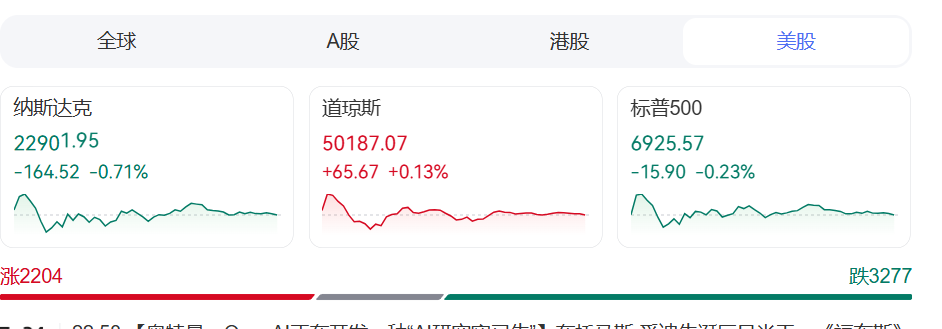
Market Overview - The U.S. stock market opened higher but then retreated, with the Nasdaq down 0.71%, the Dow Jones up 0.13%, and the S&P 500 also turning negative, with over 3,200 stocks declining [1] - Last week, initial jobless claims in the U.S. were reported at 227,000, higher than the forecast of 224,000 and the previous value of 231,000 [3] Technology Sector Performance - The performance of the "Magnificent Seven" tech stocks was mixed, with Nvidia and Google slightly up by 0.1%, while Tesla, Microsoft, Meta, Amazon, and Apple saw declines, with Apple nearing a 2% drop and its market cap falling below $4 trillion [3] - Semiconductor stocks experienced volatility, with SanDisk rising over 5% and Micron Technology up over 2% [3] Chinese Stocks - Chinese stocks listed in the U.S. faced widespread declines, with the Nasdaq Golden Dragon China Index dropping nearly 2%. Notable declines included Huya down over 7%, Tencent Music down over 6%, and Beike down over 4% [5] Trading Volume and Market Dynamics - The average daily trading volume in the U.S. stock market reached a record $1.03 trillion in January, a 50% increase compared to the same period in 2025, with over 19 billion shares traded daily, marking the second-highest in history [8] - The rise in trading volume is attributed to increased retail participation, the popularity of "zero-day-to-expiration" options, and a significant shift in investor focus from tech giants to underperforming sectors like energy and industrials [8] Hedge Fund Activity - Hedge funds have significantly increased their short positions in U.S. stocks, with the nominal short selling of individual stocks reaching the highest level since 2016. Short positions are now double the long positions [9] - Concerns over the disruptive impact of artificial intelligence on business models have led to a tumultuous week on Wall Street, with a total market value loss of $611 billion across 164 stocks in software, financial services, and asset management [9] Sector Rotation - The semiconductor and IT services sectors were among the few to see net buying last week, with semiconductor stocks rising, highlighting a divergence between chip stocks and software stocks [10] - Hedge funds are rotating into defensive sectors, with healthcare becoming the most favored sector for fund inflows, surpassing industrials [10]

Elon Musk Bets On Humanoid Robots In 2026, But One Company Hopes 'Elon Time' Strikes Again
Yahoo Finance· 2026-02-12 15:31
Core Insights - Elon Musk positions the Optimus humanoid robot as Tesla's most significant long-term value driver, potentially increasing the company's market cap to $25 trillion [1] - Prediction markets indicate only a 21% chance that the humanoid robot will be available for sale by 2026, suggesting skepticism about the timeline [2] - The success or failure of the Optimus robot will have broader implications for the robotics and AI ecosystem, particularly affecting companies like NVIDIA, which supplies chips for Tesla's training clusters [4] Tesla's Robotics Outlook - During the "We, Robot" event, Musk claimed the robots could perform various tasks, with a projected price range of $20,000 to $30,000 [1] - If Tesla does not meet its internal production milestones in 2025, the odds of the robot's release could decrease further, impacting Tesla's stock price amid declining car-based revenue [3] Competitive Landscape - Hyundai Motor Co. is identified as Tesla's primary competitor in the humanoid robot space, with its subsidiary Boston Dynamics beginning pilot deployments of its electric Atlas bot [5] - Hyundai has confirmed that its entire production run for 2026 is fully committed, potentially allowing it to capture the enterprise market if Tesla experiences delays [5] Market Sentiment - There is a prevailing skepticism in prediction markets regarding Musk's ability to meet ambitious deadlines, a trend observed with previous Tesla products like the Cybertruck and Full Self-Driving [6]
Tesla vs. Nvidia: Which Is the Better AI Stock to Buy Now?
Yahoo Finance· 2026-02-12 15:06
Group 1: AI Industry Overview - The artificial intelligence boom is significant, with Alphabet's Waymo providing 400,000 autonomous rides per week and tech giants planning to invest hundreds of billions in AI computing infrastructure by 2026 [1] - Nvidia and Tesla are identified as pivotal players in the AI race, with Nvidia supplying essential chips and Tesla integrating AI into autonomous vehicles and robotics [2] Group 2: Tesla's Business Performance - Tesla's 2025 vehicle deliveries are projected at approximately 1.6 million, reflecting a 9% year-over-year decline due to high interest rates and a lack of clear catalysts [6] - The company's full-year revenue decreased by 3% year-over-year, and earnings per share fell by 47% [6] Group 3: Tesla's Growth Opportunities - Tesla's energy business is experiencing rapid growth, with total energy storage deployed in 2025 increasing by 49% year-over-year to 46.7 gigawatt hours, leading to a 27% revenue growth in the energy segment, totaling around $12.8 billion [7] - The rollout of Tesla's autonomous ride-sharing service, Robotaxi, is progressing, with pilot programs active in Austin and the San Francisco Bay area, and the company is testing driverless Robotaxis [8]