
UBS(UBS)

Search documents
金价破5000仅是开始?瑞银:标普500年底上看8400点,“金股双牛”时代来临
智通财经网· 2026-01-27 02:11
Core Viewpoint - UBS Global Wealth Management's senior portfolio manager Alan Rechtschaffen expresses optimism about the U.S. stock market despite gold prices surpassing $5,000, believing that multiple transformative drivers will push the market higher by year-end [1] Group 1: Market Predictions - Rechtschaffen forecasts the S&P 500 index to reach 7,700 points in a baseline scenario by year-end, with a more optimistic scenario suggesting it could hit between 8,300 and 8,400 points [1] - The three main opportunities driving the market upward are identified as artificial intelligence, longevity technology, and electricity, which are expected to benefit both technology creators and end-users across various industries [1] Group 2: Gold Market Insights - Despite many investors using gold as a hedge against social unrest and uncertainty, Rechtschaffen believes that risk assets and safe-haven assets can rise simultaneously [1] - The milestone of gold prices exceeding $5,000 per ounce was reached on January 26, 2026, marking a historic moment in financial history [1] - The options market has not seen large-scale profit-taking following the price breakthrough, with traders aggressively buying long-term call options with strike prices between $5,500 and $6,000, indicating strong consensus on a "bull market" for gold [2]

Intercontinental Exchange CFO Warren Gardiner to Present at the UBS Financial Services Conference on February 9
Businesswire· 2026-01-26 21:30
Core Viewpoint - Intercontinental Exchange, Inc. (ICE) is set to present at the UBS Financial Services Conference, highlighting its role as a leading global provider of technology and data in the financial sector [1]. Group 1: Company Overview - Intercontinental Exchange, Inc. is a Fortune 500 company that designs, builds, and operates digital networks connecting people to opportunities [2]. - The company provides financial technology and data services across major asset classes, enhancing transparency and efficiency for its customers [2]. - ICE operates futures, equity, and options exchanges, including the New York Stock Exchange, and offers clearing houses that facilitate investment, capital raising, and risk management [2]. - The company is a significant player in trading and clearing energy and environmental products, and its fixed income, data services, and execution capabilities help streamline processes for customers [2]. - ICE Mortgage Technology is transforming U.S. housing finance, covering the entire process from consumer engagement to long-term servicing [2]. Group 2: Event Details - Warren Gardiner, CFO of ICE, will present at the UBS Financial Services Conference on February 9 at 11:20 a.m. ET [1]. - The presentation will be available live and for replay via webcast, accessible through the investor relations and media section of ICE's website [1].



Four UBS Financial Advisor Teams in the Southeast Region Ranked #1 by Forbes/SHOOK Research
Businesswire· 2026-01-26 14:45
Core Insights - UBS announced that four financial advisor teams in its Southeast region have been ranked 1 in their respective cities on the Forbes Best-in-State Wealth Management Teams list for 2026 [1][2] - The ranking highlights the performance of over 6,100 teams that collectively manage $8.3 trillion in assets, based on qualitative and quantitative criteria [2] Company Overview - UBS is a leading global wealth manager and the top universal bank in Switzerland, managing $6.1 trillion in invested assets as of Q4 2024 following the acquisition of Credit Suisse [3] - The firm operates in more than 50 markets worldwide and is listed on the SIX Swiss Exchange and the New York Stock Exchange (NYSE) [3]

日本国债与日元何时何故将迎来拐点?
Hua Er Jie Jian Wen· 2026-01-26 14:23
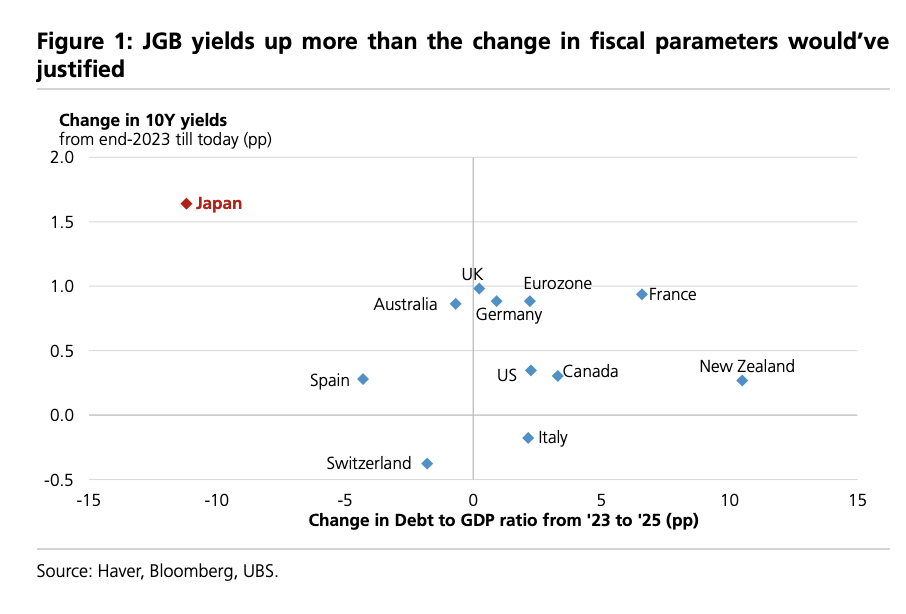
Core Viewpoint - UBS's latest global strategy report highlights that the recent sharp rise in Japanese Government Bond (JGB) yields has significantly exceeded what can be explained by fiscal fundamentals, primarily driven by a re-evaluation of inflation expectations. The report anticipates that inflation will cool to around 1.5% by mid-year, which will be a key turning point for JGB and yen trends [1][6][11]. Group 1: Market Signals - The volatility in JGB yields is not indicative of a systemic risk event similar to the UK's 2022 "Truss crisis," as the Japanese stock market remains resilient, suggesting investors should avoid panic selling in interest-sensitive sectors [1][20]. - With the attractiveness of JGB yields increasing, a significant repatriation of domestic funds from overseas bond markets is expected after the new fiscal year starts in April, leading to a reallocation towards Japanese government bonds [1][21]. - A decline in inflation will drive up real interest rates, providing support for the yen, as real rates have a more significant impact on exchange rates compared to nominal interest differentials [1][9][10]. Group 2: Fiscal Fundamentals - Despite concerns about Japan's fiscal situation, recent data shows a clear disconnect between the volatility in JGB yields and actual fiscal fundamentals. Japan's public debt as a percentage of GDP has decreased by 11 percentage points since 2023, while the average for developed economies has increased by 2 percentage points [2][5]. - Japan's fiscal deficit is projected to be around 2% of GDP by 2026, significantly lower than the developed economies' average of 4.9%. Additionally, Japan's government interest payments account for only 1.3% of GDP, compared to 3.3% for developed economies [2][5]. Group 3: Inflation and Interest Rates - The surge in JGB yields is primarily driven by market inflation expectations rather than fiscal deficit pressures. Current inflation in Japan is mainly influenced by structural factors such as food prices, while underlying service sector inflation remains around 1% [6][11]. - If inflation cools as expected, it will more effectively enhance real yields than the Bank of Japan's interest rate policies, thereby providing crucial support for both JGBs and the yen [9][16]. Group 4: Market Dynamics - The traditional correlation between the yen and nominal interest rate differentials has weakened, with real interest rate differentials now serving as the core anchor for pricing. The theoretical value of USD/JPY based on real interest differentials aligns closely with current market rates [13][16]. - Japan's external position remains robust, with a net international investment position of +92% of GDP, contrasting sharply with the UK's -2.6% during its crisis. Japan also maintains a current account surplus of 4.8% of GDP, providing a stronger buffer against market volatility [17][20]. Group 5: Investment Trends - The primary risk to the market is not foreign investors selling JGBs but rather the potential large-scale repatriation of domestic funds from overseas bond markets, as JGB yields have surpassed globally hedged bond yields [21]. - The Japanese stock market shows significant structural differentiation, with a few stocks contributing to the majority of the Nikkei 225 index's gains, indicating a concentrated market driven by foreign investors and corporate buybacks, while domestic investors remain net sellers [21].
99Bitcoins Exclusive: Fireblocks Calls 2026 the ‘Rollout Year’ For Crypto Despite Rising Geopolitical Tensions
Yahoo Finance· 2026-01-26 13:41
Davos 2026 did put crypto back in the global spotlight. It may not have dominated the WEF agenda but it was a part of enough speeches and conversations to move markets and set narratives for 2026. What was the big takeaway? Politics is still navigating through short-term price action. But traditional finance, Wall Street and more are increasingly treating crypto and tokenization as inevitable. In an exclusive chat with 99Bitcoins, Dea Markova, Policy Director for Fireblocks, weighed in. “As geopolitical ...

瑞银展望2026美国经济:一旦AI泡沫破裂衰退概率将达50%,市场低估了6月前降息的可能性
Sou Hu Cai Jing· 2026-01-26 07:48
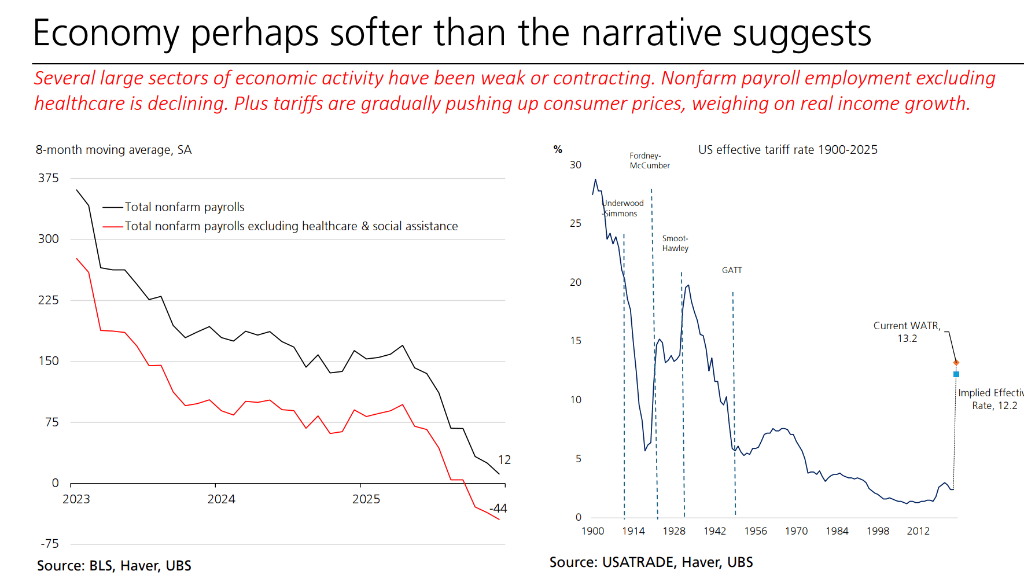
对投资者而言,这意味着市场的定价逻辑存在偏差。美联储(FOMC)正处于两难境地:一方面是疲软的劳动力市场,另一方面是关税带来的成 本推动型通胀。当前的资产价格建立在AI投资持续繁荣和富裕阶层消费强劲的"双支柱"之上。瑞银警告,主要风险在于AI投资热潮的任何动摇都 可能引发衰退(概率为50%)。瑞银认为市场低估了美联储在6月前不得不降息以应对就业恶化的紧迫性。 瑞银认为,美国经济的"韧性"表面之下,实际上是由单一驱动力——人工智能——苦苦支撑的脆弱平衡。 据追风交易台,瑞银在1月23日的报告中指出,尽管总体经济数据看似强劲,但增长来源极其狭窄。除AI和科技板块外,大部分实体经济处于疲 软甚至收缩状态。劳动力市场的扩张已经显著放缓,除去医疗保健行业的"繁荣",就业实际上是在萎缩。 美联储正处于"维持独立性"与"挽救劳动力市场"的夹缝中。 利率路径预测:瑞银预计美联储将在2026年进行两次25个基点的降息,年底联邦基金利率目标区间将降至3.00%至3.25%。 被低估的3月降息:市场目前仅定价了约16%的3月降息概率(即25个基点中的4个基点)。瑞银认为,考虑到2月劳动力报告可能显现 疲软,且通胀反弹可能不及预期, ...
全球原油基本面:尽管有乐观预期,大幅过剩仍将持续-Global Oil Fundamentals_ Large surpluses persist, despite a bullish update
2026-01-26 02:50
ab 21 January 2026 The IEA slightly increased its projections for global oil demand growth, by 12kb/d in 2025 to 0.9Mb/d (UBSe +0.9Mb/d) and by 70kb/d in 2026 to 0.9Mb/d (UBSe +1.2Mb/ d). Absolute demand revisions rose by 130kb/d for 2025 and 200kb/d for 2026, driven by an upward revision to the base (+114kb/d for 2024). China's demand growth forecast was raised by 60kb/d for 2025, but reduced by 15kb/d to 180kb/d for both years. Non-OPEC+ growth also up Global Research First Read Global Oil Fundamentals La ...
全球经济与策略:深度解读 -AI 驱动下美联储、欧央行与日央行的政策基调转变分析-Global Economics & Strategy _Deep Speak_ An AI-driven read on tone shifts at the Fed, ECB and BoJ
2026-01-26 02:49
Summary of Key Points from the Conference Call Industry Overview - The conference call discusses the sentiment and policy tone of major central banks: the Federal Reserve (Fed), European Central Bank (ECB), and Bank of Japan (BoJ) [2][3][5][6]. Federal Reserve (Fed) - The Fed's communication remains dovish, but the momentum has slowed since early Q3 2025 [3]. - Labor market language is a primary anchor of the narrative, stabilizing without exerting downward pressure on sentiment [3]. - Inflation tone is hawkish but has been trending lower since summer 2025 [3]. - In early 2026, all Board members are uniformly dovish, with Bowman being the most dovish voice [3][18]. European Central Bank (ECB) - ECB communication shows signs of re-hawking, with sentiment edging closer to neutral after a dovish phase in autumn 2025 [5]. - Growth-related language is the main driver of this adjustment, while inflation tone has remained stable since summer 2025 [5]. - Early 2026 speaker evidence indicates a return to more dovish language from Philip Lane, while Luis de Guindos remains mildly dovish [5][36]. Bank of Japan (BoJ) - The BoJ's tone has firmed significantly through Q4 2025, with a broad-based strengthening across inflation, growth, and policy themes [6]. - There have been no dovish counter-voices in Q4, indicating a one-sided hawkish messaging from the BoJ [6][51]. - Governor Ueda has been a leading voice in this hawkish shift [6][54]. Additional Insights - The sentiment scores for the Fed, ECB, and BoJ indicate varying degrees of hawkishness and dovishness, with the Fed remaining the most dovish [8][12][24]. - The analysis utilizes AI-driven tools to track sentiment shifts and thematic focus across central banks, providing a comprehensive view of monetary policy dynamics [2]. Important Figures - The Fed's sentiment score has shown a consistent dovish trend, while the ECB's score is moving towards neutral [8][12][24]. - The BoJ's sentiment score has significantly increased, indicating a strong hawkish stance [8][41]. This summary encapsulates the key points discussed in the conference call, focusing on the sentiment and policy tone of the major central banks, which are critical for understanding macroeconomic trends and potential investment opportunities.
UBS Considers Offering Crypto Trading Through Private Bank
PYMNTS.com· 2026-01-23 20:05
Group 1: UBS's Cryptocurrency Strategy - UBS plans to begin offering cryptocurrency trading to meet the growing demand from wealthy clients [1] - The initial crypto offering will target select clients of UBS's private bank in Switzerland, with potential expansion to the United States and Asia-Pacific regions [2] - UBS is actively monitoring developments in digital assets and exploring initiatives that align with client needs and market trends [3] Group 2: Partnerships and Technological Developments - UBS has partnered with Ant International to explore blockchain-based tokenized deposits for global payments and liquidity management [3] - In November 2024, UBS completed a live tokenized fund transaction using Chainlink's Digital Transfer Agent standard, involving the UBS USD Money Market Investment Fund Token on Ethereum [4] - UBS announced the creation of UBS Digital Cash, a blockchain-based payment solution aimed at enhancing programmability for corporate and institutional clients [4] Group 3: Industry Context - JPMorganChase is also considering cryptocurrency trading for its institutional clients, evaluating potential products and services for its digital asset business [5] - E-Trade, part of Morgan Stanley, plans to add cryptocurrency trading to its platform by 2026, allowing clients to trade Bitcoin, Ether, and Solana [6]

UBS Planning Bitcoin, Ethereum Trading for Some Wealthy Clients: Bloomberg
Yahoo Finance· 2026-01-23 16:52
Core Insights - UBS Group AG is set to offer crypto investing options to select private banking clients, aligning with the interests of wealthy clients [1][4] - The bank is the largest wealth manager globally, managing approximately $4.7 trillion in assets for high net-worth individuals as of September [1][2] Business Focus - UBS primarily concentrates on private banking and advisory services for affluent individuals and families, rather than engaging in mass retail banking [2] Recent Developments - UBS's influence increased significantly in 2023 following its merger with Credit Suisse, which was prompted by a series of scandals that diminished confidence in Credit Suisse [3] - The merger resulted in UBS's assets under management rising by about $1.5 trillion almost instantly [3] Crypto Investment Rollout - The bank is finalizing plans to provide crypto access, initially allowing select clients in Switzerland to trade Bitcoin and Ethereum, with potential expansion to the Asia-Pacific region [4] - As of the latest data, Bitcoin is trading at $90,132, having decreased nearly 5% in the past week, while Ethereum is at $2,967, down 10% [5] Market Context - Switzerland is increasingly viewed as a favorable jurisdiction for crypto businesses, with the Swiss National Bank recently increasing its Bitcoin exposure [5] - Following the shutdown of two crypto-friendly U.S. banks in 2022, Swiss banks reported an increase in inquiries from U.S. firms seeking banking partners [6]