三生制药

Search documents
创新药出海BD仍然火爆!港股通创新药ETF(520880)跌1.5%延续高溢价,最新单周吸金2.36亿元
Xin Lang Cai Jing· 2026-01-26 05:47
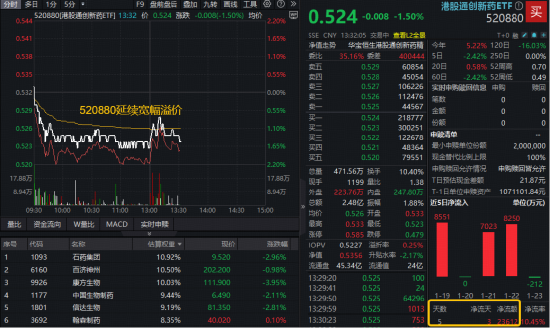
Group 1 - The Hong Kong stock market is experiencing a downturn, with the innovative drug sector declining again, as evidenced by the Hong Kong Stock Connect Innovative Drug ETF (520880) falling by 1.5% [1][6] - Last week, the ETF accumulated a total decline of 3.2%, with over 236 million yuan in funds being used to buy on dips [1][6] - Major stocks in the sector are generally down, including CSPC Pharmaceutical Group down 3%, CanSino Biologics down nearly 4%, and China Biologic Products and Innovent Biologics both down over 2% [1][6] Group 2 - Multiple innovative drug business development (BD) transactions have been completed at the beginning of the year, indicating a positive trend for Chinese innovative drugs going overseas [8] - Key transactions include: 1) Rongchang Biologics granting AbbVie overseas rights for RC148 (PD-1/VEGF) dual antibody, receiving a $650 million upfront payment and up to $4.95 billion in milestone payments [8] 2) Haisco granting overseas rights for HSK39004 (PDE3/4) to AirNexis, receiving a $108 million upfront payment and up to $955 million in milestone payments [8] 3) Zai Lab granting AbbVie overseas rights for ZG006 (CD3xDLL3xDLL3 tri-antibody), receiving a $100 million upfront payment and milestone payments totaling $1.135 billion [8] 4) Yilian Biologics granting Roche overseas rights for YL201 (B7-H3ADC), with upfront and milestone payments reaching $570 million [8] Group 3 - The Hong Kong Stock Connect Innovative Drug ETF (520880) and its associated funds are highlighted as high-elasticity investment tools, with the underlying index (Hang Seng Stock Connect Innovative Drug Select Index) offering three unique advantages [9] - The ETF has a 100% purity, excluding CXO, and fully covers innovative drug R&D companies [9] - The top ten innovative drug leaders account for over 73% of the ETF, showcasing the strength of the innovative drug sector [9][10]


每日投资策略-20260126
Zhao Yin Guo Ji· 2026-01-26 04:53
Market Overview - Global markets showed mixed performance, with the Hang Seng Index closing at 26,750, up 0.45% year-to-date, while the US Dow Jones fell by 0.58% [1][3] - The Chinese stock market saw gains, particularly in materials, consumer discretionary, and healthcare sectors, while energy and real estate lagged [3] Industry Insights - The Chinese pharmaceutical sector is experiencing a significant upward trend, with the MSCI China Healthcare Index rising 9.2% since early 2026, outperforming the MSCI China Index by 5.6% [4] - The trend of Chinese innovative drugs going overseas continues to gain momentum, with multiple business development (BD) transactions occurring in early 2026, indicating a strong market for overseas licensing [5] - Key transactions include the overseas rights granted by Rongchang Biopharma to AbbVie for RC148 and by Haisika for HSK39004, showcasing the clinical progress of these drugs [5] Company Analysis - China Ping An is projected to see a 12% increase in operating profit to RMB 135.9 billion in 2025, driven by improvements in life and health insurance segments [7] - The new business value (NBV) is expected to grow by 42% year-on-year to RMB 40.4 billion, with a strong performance anticipated in the first quarter of 2026, particularly in the bancassurance channel [8] - The target price for China Ping An has been raised to HKD 90, reflecting adjustments in profit and NBV growth forecasts, with the company currently trading at 0.71 times FY26E P/EV [8]
中国医药:创新药出海BD仍然火爆,关注IO2.0抢位赛
Zhao Yin Guo Ji· 2026-01-26 03:31
Investment Rating - The report assigns a "Buy" rating to several companies in the pharmaceutical sector, indicating a potential upside of over 15% in their stock prices over the next 12 months [29]. Core Insights - The MSCI China Healthcare Index has increased by 9.2% since the beginning of 2026, outperforming the MSCI China Index, which rose by 5.6% [1]. - The pharmaceutical industry has seen significant growth, driven by strong institutional investor interest and the ongoing trend of innovative drugs going global [1]. - The report emphasizes the importance of clinical progress and data validation for pipelines that have already gone overseas, suggesting that this trend will continue in the long term [1]. Summary by Sections Industry Overview - The report highlights a robust trend in the outbound licensing of innovative drugs, with multiple business development (BD) transactions occurring at the start of 2026, reflecting a high level of activity in the sector [4]. - Key transactions include significant upfront and milestone payments for various drugs, indicating strong market interest and potential for future growth [4]. Company Ratings and Valuations - The report provides detailed valuations for several companies, including: - **Sangfor Technologies (1530 HK)**: Market cap of $7,598.4 million, target price of $37.58, with a 54% upside potential [2]. - **Gusongtang (2273 HK)**: Market cap of $963.3 million, target price of $44.95, with a 46% upside potential [2]. - **WuXi AppTec (2268 HK)**: Market cap of $10,551.0 million, target price of $88.00, with a 28% upside potential [2]. - **China National Pharmaceutical Group (1177 HK)**: Market cap of $15,951.4 million, target price of $9.40, with a 42% upside potential [2]. Market Trends - The report notes that the competition in the PD-(L)1/VEGF space is intensifying, with several companies advancing their clinical trials and aiming for first-line indications [4]. - The report suggests that the efficiency and breadth of clinical trials, as well as the richness of combination therapies, will be critical factors in determining success in this competitive landscape [4].
港股医药大幅下挫,恒生医药ETF跌超2%
Mei Ri Jing Ji Xin Wen· 2026-01-26 03:28
具体来看,CXO、创新药等概念集体下挫,晶泰控股、三生制药、微创机器人、药明合联、药明生 物、信达生物等领跌。 招商国际表示,在2025年创新药BD出海授权交易爆发式增长的基础上,2026年初已经有多个BD落地, 体现了中国创新药出海授权交易较高的景气度。 港股市场再度震荡调整,医药板块领跌,恒生生物科技指数跌超2%,聚焦创新药产业的恒生医药ETF (159892)、聚焦CXO+AI医疗的港股通医疗ETF(520510)均跌超2%。 ...
JPM 2026收官,中国创新药加速全球化进程
2026-01-26 02:50
Summary of Conference Call Industry Overview - The conference focused on updates and developments in the Chinese biopharmaceutical industry, particularly highlighting companies such as BeiGene, 3SBio, and Kelun-Biotech [1][10]. Key Company Insights BeiGene - BeiGene's BCL-2 inhibitor has been approved for sale in China and is expected to receive accelerated approval in the U.S. within the year [1]. - BCL-2 is viewed as a second growth driver for BeiGene, complementing its existing BTK inhibitors, which have shown rapid sales growth in the U.S. market [2]. - The company has a robust pipeline for solid tumors, with several candidates entering late-stage development, including treatments for breast cancer and other indications [3]. - BeiGene is anticipated to report its first annual profit, with expectations that its annual report may exceed forecasts [3]. 3SBio - Pfizer has outlined a global development plan for its drug 707, with five global Phase III trials expected to start by 2026, targeting various cancers [4]. - The trials include first-line treatments for colorectal cancer and non-small cell lung cancer [4]. Kelun-Biotech - Kelun-Biotech is expected to have a significant year with five products anticipated to be commercialized, three of which have already been included in the national medical insurance [5]. - The company has successfully commercialized its top two ADC products and is expected to see explosive growth following their inclusion in insurance [5]. Innovent Biologics - Innovent's Ivosidenib is expected to receive final approval from the FDA in Q4 of this year, with ongoing clinical trials for various cancers [6][7]. - The company is also preparing for the commercialization of its CAR-T product, which has already been approved domestically [8]. Rongchang - Rongchang has announced plans for three Phase III trials, including one for non-small cell lung cancer, which has received FDA approval [7][8]. Other Notable Mentions - Merck has initiated 16 global Phase III trials for its drug targeting various major indications, with data expected in the second half of the year [5]. - The conference highlighted the importance of clinical trial data releases for several companies, which are crucial for their long-term valuations [3][10]. Market Dynamics - The overall market for innovative drugs is currently experiencing a downturn, primarily due to internal funding shifts within the pharmaceutical sector [10]. - The high percentage of holdings in innovative and traditional pharmaceuticals (around 75%) has led to a reallocation of funds towards other sectors like AI healthcare and CROs [11]. - Despite the market's performance, the fundamental aspects of many companies remain strong, with ongoing clinical advancements and positive earnings expectations [11]. - The total amount of business development (BD) transactions in recent weeks has already reached 25% of last year's total, indicating a robust pace of international expansion [11]. Conclusion - The conference provided a comprehensive overview of the current state of the biopharmaceutical industry in China, highlighting significant advancements and the potential for growth among key players. The market dynamics suggest a temporary disconnect between stock performance and fundamental company health, indicating potential investment opportunities.

狂揽1357亿美元,谁是2025中国创新药出海“最贵”十单?
3 6 Ke· 2026-01-26 01:08
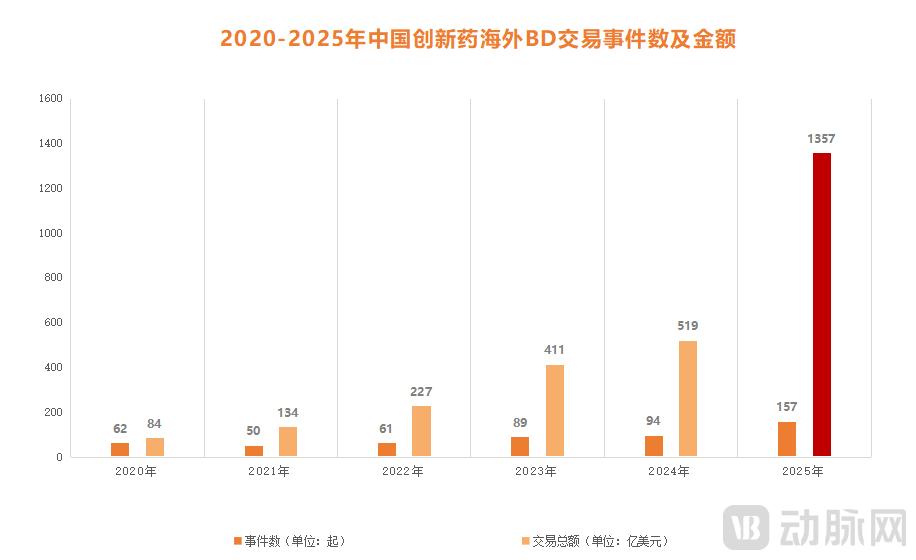
Core Insights - In 2025, China achieved a record high in overseas business development (BD) transactions for innovative drugs, with 157 deals totaling $135.655 billion, including an upfront payment of $7 billion [1][3][16] - The year 2025 marked a significant shift in the BD landscape, transitioning from a "1.0 era" of simple asset sales to a "2.0 era" characterized by deeper partnerships and higher value creation [5][16] Transaction Overview - The top three BD transactions in 2025 included a $13 billion deal between Qide Pharma and Biohaven & AimedBio, a $12.5 billion deal between Hengrui and GSK, and a $11.4 billion deal between Innovent Biologics and Takeda [2][11] - China accounted for 49% of the global total for BD transactions in 2025, surpassing the United States for the first time [2][11] Financial Metrics - The total upfront payments for BD transactions in China reached $7 billion in 2025, nearly doubling from $4.1 billion in 2024, with individual transaction upfront payment ratios increasing to approximately 5.2%-6.7% [7][16] - Milestone payments also saw significant activity, with at least 10 transactions triggering milestone payments in 2025, indicating a trend towards more structured financial agreements [9][16] Therapeutic Areas and Pipeline Stages - Oncology remained the primary focus of BD transactions, accounting for 51.4% of deals, although other areas such as immunology and metabolic diseases gained traction, rising to 34.1% [11][13] - The distribution of pipeline stages showed a shift towards later-stage projects, with 22% of transactions involving Phase III or marketed products, reflecting a preference for assets with established clinical data [13][16] Collaboration Models - The "Co-Co" model, which emphasizes joint development and commercialization, emerged as a new strategic direction in 2025, complementing traditional "License-out" and "NewCo" models [15][16] - This evolution in collaboration models indicates a trend towards deeper partnerships, allowing for shared risks and rewards, and enhancing the overall value proposition of BD transactions [15][16] Future Outlook - The demand for Chinese innovative drugs is expected to remain strong in 2026, driven by the approaching patent cliffs and increasing global competition, suggesting continued activity in BD transactions [21][22] - The industry is anticipated to further mature, focusing on quality and value in BD transactions, with an emphasis on long-term collaboration and mutual benefits [21][22]

2025年药品BD出海回顾:显著提速,关注双抗、ADC、GLP-1RA、小核酸等方向
Southwest Securities· 2026-01-26 00:45
Investment Rating - The report indicates a "Buy" rating for several companies within the pharmaceutical sector, including 恒瑞医药 (Hengrui Medicine), 百济神州-U (BeiGene), and others [22]. Core Insights - The pharmaceutical industry has seen a significant increase in BD (business development) activities, with Chinese pharmaceutical companies securing upfront payments exceeding $7.03 billion in 2025, marking a year-on-year growth of over 226.8% [15][20]. - The industry has a total market capitalization of approximately 544.85 billion yuan, with a TTM (trailing twelve months) P/E ratio of 38.5, significantly higher than the 14.1 P/E ratio of the CSI 300 index [3][6]. - The best-performing sub-sectors this week include offline pharmacies, hospitals, and medical R&D outsourcing, with year-to-date increases of 17.2%, 14.8%, and 10.7%, respectively [6][31]. Summary by Sections Industry Performance - The pharmaceutical index decreased by 0.39% this week, outperforming the CSI 300 index by 0.23 percentage points. Year-to-date, the pharmaceutical sector has risen by 6.66%, surpassing the CSI 300 index by 5.10 percentage points [6][24]. - The current valuation level (P/E-TTM) for the pharmaceutical industry stands at 30.31 times, with a premium of 65.36% over the entire A-share market [6][26]. Business Development Trends - In 2025, the domestic dual-antibody BD projects achieved upfront payments of $3.5 billion, a staggering increase of 414.7%, accounting for 49.8% of all BD upfront payments for the year [16]. - The ADC (Antibody-Drug Conjugates) sector has also seen substantial growth, with upfront payments reaching $1.63 billion, a 676.2% increase year-on-year [17]. - The GLP-1RA (Glucagon-Like Peptide-1 Receptor Agonists) segment reported upfront payments of $470 million, reflecting a 109.8% increase compared to 2024 [18]. Notable Collaborations - The report highlights significant collaborations, such as 舶望制药 (Bohua Pharmaceutical) partnering with Novartis to explore the potential of siRNA in hypertension treatment, securing an upfront payment of $160 million [19]. - The MNC (Multinational Corporation) procurement model remains dominant, with local companies securing $4.71 billion in upfront payments from MNCs, representing 67.0% of total BD upfront payments [20]. Recommended Companies - The report suggests a robust investment strategy focusing on companies like 恒瑞医药 (Hengrui Medicine), 百济神州-U (BeiGene), and others, which are expected to benefit from innovation and international expansion [20][21].
智通港股通持股解析|1月26日
智通财经网· 2026-01-26 00:32
Core Insights - The top three companies by Hong Kong Stock Connect holding ratios are China Telecom (00728) at 70.92%, Green Power Environmental (01330) at 69.34%, and Kaisa Group Holdings (01108) at 67.61% [1][2] - The largest increases in holding amounts over the last five trading days were seen in the following companies: Yingfu Fund (02800) with an increase of 4.041 billion, Hang Seng China Enterprises (02828) with 1.783 billion, and Alibaba - W (09988) with 1.455 billion [1][2] - The largest decreases in holding amounts over the last five trading days were recorded for China Mobile (00941) with a decrease of 2.395 billion, Innovent Biologics (01801) with 589 million, and UBTECH Robotics (09880) with 556 million [1][3] Group 1: Hong Kong Stock Connect Holding Ratios - China Telecom (00728) has a holding of 9.843 billion shares, representing 70.92% [2] - Green Power Environmental (01330) has a holding of 280 million shares, representing 69.34% [2] - Kaisa Group Holdings (01108) has a holding of 169 million shares, representing 67.61% [2] Group 2: Recent Increases in Holdings - Yingfu Fund (02800) saw an increase of 4.041 billion in holding amount, with a change of 14.9907 million shares [2] - Hang Seng China Enterprises (02828) increased by 1.783 billion, with a change of 1.8975 million shares [2] - Alibaba - W (09988) increased by 1.455 billion, with a change of 0.8637 million shares [2] Group 3: Recent Decreases in Holdings - China Mobile (00941) experienced a decrease of 2.395 billion, with a change of -3.01224 million shares [3] - Innovent Biologics (01801) saw a decrease of 589 million, with a change of -0.70319 million shares [3] - UBTECH Robotics (09880) had a decrease of 556 million, with a change of -0.38639 million shares [3]

3万亿赛道的估值锚点,彻底变了
虎嗅APP· 2026-01-26 00:15
Core Viewpoint - The innovative drug sector experienced a significant surge in 2025, with multiple innovative drug ETFs seeing annual gains exceeding 50% and several companies doubling their stock prices. However, since September 2025, both A-shares and Hong Kong stocks in this sector have faced notable corrections, with some stocks nearly halving in value. The market is now focusing on the quality of business development (BD) transactions rather than just their existence [5][6][7]. Group 1: Market Trends and Reactions - In 2025, the innovative drug sector's market capitalization reached approximately 3 trillion yuan, driven by significant BD transactions [5]. - The market's initial enthusiasm for BD transactions has waned, as investors realize that these transactions often provide only temporary cash flow improvements rather than sustainable profitability [6][7]. - The focus has shifted from merely having BD transactions to assessing their quality, which is crucial for investment decisions in innovative drugs [8]. Group 2: High-Quality BD Transactions - High-quality BD transactions are characterized by three main anchors: the certainty of target value realization, the feasibility of milestone payments, and the strength of the partner company, particularly multinational pharmaceutical firms [10]. - An example of a successful BD transaction is the collaboration between Rongchang Biopharmaceutical and AbbVie, which led to a significant stock price increase due to the validated target of the drug involved [11][13]. - Conversely, a BD transaction involving Haikang Pharmaceutical and AirNexis did not yield positive market reactions due to the lower credibility of the partner and the insufficient cash component of the upfront payment [18][20][21]. Group 3: Company Performance and Investment Opportunities - Companies like Baijie and Hengrui have shown promising performance, with Baijie leading in innovative drug revenue and expected to turn profitable in 2025, while Hengrui has successfully transitioned to an innovative drug-focused business model [34][37]. - Hansoh Pharmaceutical has also achieved profitability, with a significant portion of its revenue coming from innovative drugs, indicating a successful transformation [40]. - Companies such as Xinda Biopharmaceutical and Sanofi have potential for future profitability, with Xinda expected to launch a promising product that could significantly impact its financials [43][48]. Group 4: Selection Criteria for Investment - The selection process for investment should involve identifying companies with a high proportion of innovative drug revenue (at least 50%), assessing their profitability, and evaluating the quality of their BD collaborations and global competitiveness of their pipelines [30][31]. - The analysis of the top 15 companies by innovative drug revenue shows that 13 have over 50% of their revenue from innovative drugs, highlighting a strong focus on innovation within the sector [32]. Group 5: Future Outlook - The innovative drug industry remains attractive, but the market's valuation criteria have evolved to prioritize the quality of BD transactions and the underlying performance of companies [58]. - Continuous monitoring of companies' clinical pipeline progress and BD transaction outcomes will be essential for assessing future market activity and investment potential [58].

广发策略:从不买就跑输到买了就跑输——再看南下定价权
智通财经网· 2026-01-25 23:38
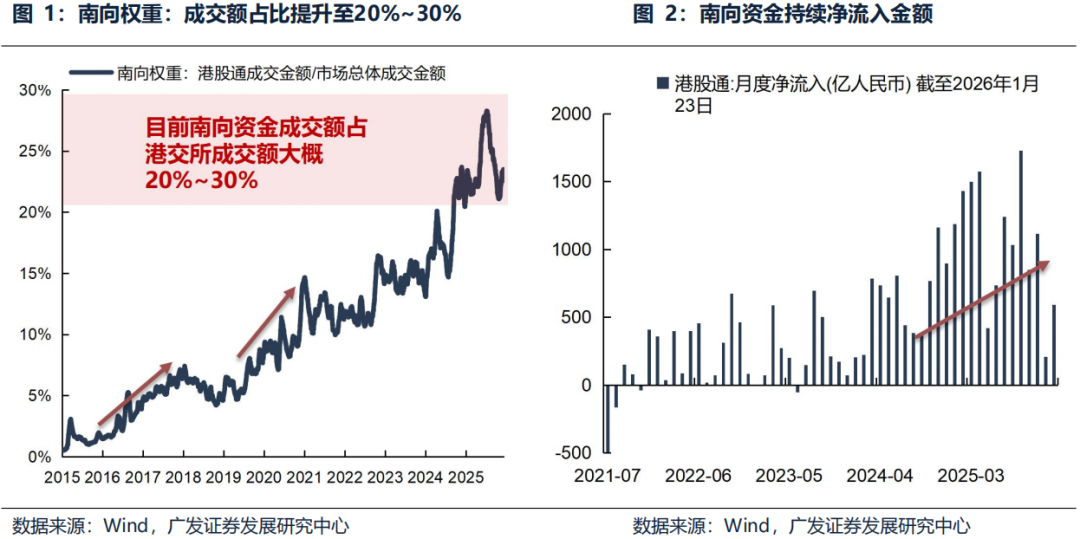
Group 1 - Since September 2024, the proportion of southbound capital transactions has rapidly increased to 20%-30%, nearly doubling compared to before 2024 [2][5] - In 2025, both active and passive foreign capital have become synchronous indicators of the Hong Kong stock market, showing no leading characteristics [2][5] - During sharp declines or corrections in the Hong Kong stock market, southbound capital tends to buy against the trend [2][5] Group 2 - Each round of pricing power competition typically begins with the optimization of the Stock Connect policy or the influx of incremental capital, which usually flows into dividend and scarce assets [5] - Net outflows of southbound capital often occur in response to adverse industry policies or external macroeconomic environments, particularly in sectors where foreign capital pricing power is increasing, such as software services, hardware equipment, consumer services, and discretionary retail [5][12] - Industries less likely to experience significant net outflows include those favored by long-term capital, such as banking, telecommunications, and public utilities, unless there are clear adverse policies affecting the sector [5][12] Group 3 - The proportion of medium to long-term capital in the current round of southbound capital inflow into Hong Kong stocks has increased, with insurance capital making 41 stakes, 35 of which are in H-shares, marking the highest record in the past decade [8] - Key industries for increased holdings include discretionary retail, finance (banking, insurance), innovative pharmaceuticals, software services, and hardware equipment [8] Group 4 - Current industries with pricing power for southbound capital and Chinese capital include semiconductors and dividend stocks, while industries lacking pricing power include internet, hardware equipment, software services, home appliances, and media [11][12] - Active management public funds have low pricing power in the Hong Kong stock market, focusing heavily on AI-related CSP giants, electronics, and innovative pharmaceuticals [16]