
沙特阿拉伯国家石油公司

Search documents
OPEC+继续大幅增产,八个成员国将在7月份增产41.1万桶/日
news flash· 2025-05-31 14:01
石油输出国组织5月31日发表声明,八个OPEC+国家(沙特阿拉伯、俄罗斯、伊拉克、阿联酋、科威 特、哈萨克斯坦、阿尔及利亚和阿曼)5月31日举行线上会议,决定在7月份增产41.1万桶/日。这是上 述八个产油国连续第三个月实施同等力度的增产,打破了该组织多年来靠协同减产支撑油价的市场策 略,也将国际油价拖至四年来的低位。声明称,产油国根据不断变化的市场情况,逐步增加的产量可能 会暂停或逆转。(智通财经) ...
原油月报:供给过剩,油价易跌难涨-20250530
Zhong Hui Qi Huo· 2025-05-30 13:51
Report Industry Investment Rating No relevant content provided. Core Viewpoints of the Report - In 2025, the main factors influencing the crude oil market are OPEC+ production policies, US tariff policies, and global crude oil demand. OPEC+ is in an expansion cycle, and with the global energy transition, there is a growing supply surplus, leading to limited upward momentum for oil prices and potential for a lower price center. Geopolitical factors such as the Russia-Ukraine conflict, US-Iran nuclear talks, and US policies towards Venezuela increase price volatility but do not change the overall supply surplus situation. In June - July, which is the consumption peak season, oil prices may find some support and are expected to trade in a range with a gradually declining center. Recommended strategies include shorting on rallies, selling call options, or using bull spread options. The recommended trading ranges are WTI [55, 65] and SC [420, 500] [6][108]. Summary by Directory 1. Market Review and Outlook - **Market Outlook**: In 2025, the crude oil market is mainly affected by OPEC+ production policies, US tariff policies, and global demand. OPEC+ is expanding production, and combined with the global energy transition, there is a supply surplus. Geopolitical factors increase price volatility but do not change the supply - surplus trend. In June - July, oil prices may be supported by peak - season consumption and are expected to trade in a range with a declining center [6][108]. - **Macro - economic Situation**: On May 7, the People's Bank of China cut the reserve requirement ratio by 0.5 percentage points, injecting about 1 trillion in long - term liquidity. As of May, the probability of the Fed keeping interest rates unchanged in June is 97.8%, and the probability of a 25 - basis - point cut is 2.2%. By July, the probability of unchanged rates is 76.6%, with a 22.9% chance of a 25 - basis - point cut and a 0.5% chance of a 50 - basis - point cut. The IMF has lowered the global economic growth forecast for 2025 from 3.3% to 2.8%, and the expected growth rate for 2026 is 3% [6][27]. - **Supply and Demand, and Inventory**: - **Supply**: OPEC+ did not adjust production policies at the Wednesday meeting but proposed a mechanism for setting 2027 production benchmarks. There is a possibility of accelerated production increases in July. In April 2025, OPEC's production decreased by 62,000 barrels per day to 26.71 million barrels per day. The US crude oil production remained stable at 13.4 million barrels per day as of the week ending May 23 [7][43][47]. - **Demand**: The IEA's May report maintained the 2025 global crude oil demand growth rate at 740,000 barrels per day and raised the 2026 growth rate by 70,000 barrels per day to 760,000 barrels per day. In May 2025, EIA, OPEC, and IEA predicted global crude oil demand at 10.371 million, 10.5 million, and 10.39 million barrels per day respectively, with year - on - year increases of 970,000, 130,000, and 740,000 barrels per day [7][52]. - **Inventory**: As of the week ending May 23, US commercial crude inventories decreased by 2.8 million barrels to 440.36 million barrels, strategic reserves increased by 820,000 barrels to 401.31 million barrels, gasoline inventories decreased by 2.44 million barrels to 223.08 million barrels, and distillate fuel oil inventories decreased by 720,000 barrels to 103.41 million barrels. Chinese port inventories increased by 319,000 tons to 28.216 million tons, and Shandong refinery inventories increased by 23,000 tons to 2.499 million tons [7][71][75]. 2. Core Drivers - **OPEC+ Production Policies since 2017**: In 2017, OPEC+ implemented production cuts. Since October 2022, there have been multiple rounds of production cuts and extensions, with actual production decreasing by about 3 million barrels per day, mainly contributed by Saudi Arabia, Russia, Iraq, and Kuwait. The overall production cut implementation rate is 51.02% [10][12][14]. - **2025 OPEC+ Production Increase Path**: In 2025, OPEC+ has a production increase plan through quota increases and compensatory production cuts. It is expected that by the end of the year, the net increase in OPEC+ production will be about 1 million barrels per day [15][16][21]. 3. Price Spreads and Positions - **Cross - market Spreads**: The WTI monthly spread increased slightly. As of May 29, the M1 - M2 spread was $0.74 per barrel, and the M1 - M6 spread was $2.21 per barrel. The US refined product crack spreads declined, while the domestic refined product crack spreads rebounded [90][94][95]. - **Fund Positions**: No specific information on changes in WTI and Brent fund positions was provided. The SC warehouse receipt volume is low, and the total SC positions increased [102][104].
OPEC+增产计划“注水”严重?实际增量或缩水三分之一!
Jin Shi Shu Ju· 2025-05-29 13:20
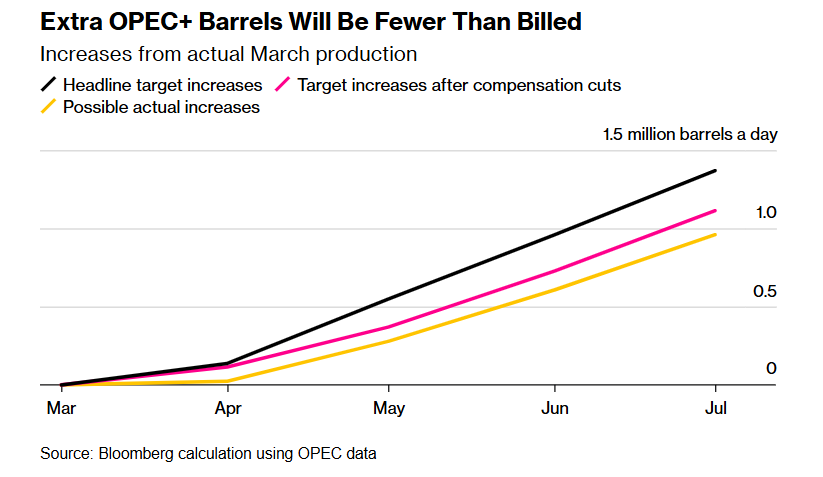
Group 1 - OPEC+ is expected to announce an increase in oil production by 1.37 million barrels per day, but actual supply growth may be significantly lower due to various constraints [1][4] - The agreed production increase from March to July includes contributions from several member countries, with Saudi Arabia contributing the largest increase of 167,000 barrels per day [5] - Compliance issues from countries like Iraq and Kazakhstan raise concerns about their ability to meet production targets, potentially reducing the actual supply increase to 972,000 barrels per day, which is only 71% of the nominal increase [7] Group 2 - Domestic oil consumption in the Middle East, particularly in Saudi Arabia, is expected to rise significantly during the summer peak, potentially consuming over 80% of the increased production from Saudi Arabia alone [7] - Historical data indicates that Saudi Arabia's domestic oil consumption surged by 460,000 barrels per day from March to July last year, suggesting a similar trend could occur this year [7]

研客专栏 | 纯苯期货上市专题报告
对冲研投· 2025-05-28 12:49
Group 1 - The article discusses the definition and classification of pure benzene, highlighting its significance as a basic petrochemical raw material and its carcinogenic properties [2][8]. - Pure benzene is categorized into two types: petroleum benzene and coking benzene, with distinct production processes and quality standards [5][8]. - The quality standards for petroleum benzene and coking benzene are specified, including purity levels and allowable impurities [6][7]. Group 2 - The production processes for pure benzene include reforming, cracking, and toluene disproportionation, with various sources contributing to its supply [11][12]. - The global pure benzene production capacity is projected to reach 83.31 million tons by 2024, with a year-on-year increase of 3.2% [29]. - China’s pure benzene capacity is expected to be 25.73 million tons by 2024, with a growth rate of 6.9% [31]. Group 3 - China is a net importer of pure benzene, with imports expected to reach 3.768 million tons in 2024, a 31.1% increase year-on-year [40]. - The global demand for pure benzene is projected to be 65.2 million tons in 2024, with Northeast Asia being the primary consumption region [45]. - In China, pure benzene consumption exceeds 25 million tons, with major downstream products including styrene and caprolactam [50][51].

沙特阿拉伯3月石油出口额同比下降16.09%。
news flash· 2025-05-26 05:54
Core Insights - Saudi Arabia's oil export revenue decreased by 16.09% year-on-year in March [1] Group 1 - The decline in oil export revenue indicates potential challenges for the Saudi economy, which heavily relies on oil exports [1] - This drop may impact the global oil market dynamics, as Saudi Arabia is one of the largest oil exporters [1] - The decrease in revenue could lead to adjustments in Saudi Arabia's fiscal policies and budget planning [1]
202505原油展望报告:强现实弱预期与伊朗原油扰动的叠加态
Dong Wu Qi Huo· 2025-05-21 12:33
Report Title - 202505 Crude Oil Outlook Report: Superposition of Strong Reality, Weak Expectations, and Iranian Crude Oil Disturbance [1] Report Date - May 21, 2025 [2] Report Author - Xiao Yu, Investment Consulting License No.: Z0016296 [2] 1. Review Summary 1.1 4 - Month Crude Oil Outlook Report Review - **4 - Month Main View**: In a sharply deteriorating macro - atmosphere, OPEC+ not only did not resist but accelerated production increases. The $70 support level for Brent crude oil became an insurmountable resistance level. With continued macro - turmoil, market confidence was increasingly fragile, and a bearish view was maintained [7]. - **Market Review**: Sino - US trade negotiation results drove a limited market rebound, and subsequent changes in US - Iran negotiations were the main factor causing short - term oil price fluctuations [8]. 1.2 5 - Month Main View - **Fundamentals**: There is a situation of strong reality and weak expectations, with a long - term bearish outlook. OPEC+ accelerating production increases may become the norm, and the relationship between US and Iranian crude oil is the biggest short - term market disturbance factor [9]. - **Non - fundamentals**: The US has entered a general tariff suspension period, but future pressure remains [9]. - **May Conclusion**: With OPEC+'s signal of accelerating production increases becoming clearer and long - term macro - pressure still existing, oil prices tend to be weak in the medium and long term. However, currently, crude oil is in a seasonally strong reality state, and with the outcome of Iranian crude oil still to be determined, the short - term market may maintain a weak and volatile trend [9]. 2. Crude Oil Market Analysis 2.1 Near - Month Spreads Indicate Tight Spot Supply and Demand - International crude oil market spreads are above the 0 axis, indicating that current supply and demand can still match. Current market negative factors are mainly concentrated in expectations, such as OPEC+ likely to continue accelerating production increases after July or a possible slowdown in macro - economic growth due to trade frictions [14]. 2.2 Manifestation of Strong Reality and Weak Expectations in the Forward Curve - Although crude oil is in a contango structure in the longer term, the near - end is in a back structure. Near - end premiums mean that downstream needs to pay an additional premium to obtain spot goods. Even at the recent low point of crude oil prices on the morning of May 12, the Nike - shaped forward structure was maintained, reflecting strong reality and weak expectations [17]. 2.3 Manifestation of Strong Reality and Weak Expectations in Institutional Monthly Reports - Three major institutions (IEA, OPEC, EIA) made different adjustments to demand in their May reports but still had a long - term bearish view of the oil market. Most reports believe that non - OPEC+ supply growth has exceeded global demand growth, and OPEC+ is eager to accelerate production increases [18]. 2.4 Manifestation of Strong Reality and Weak Expectations in the Seasonal Peak Demand Period - The third quarter is the traditional peak consumption season for crude oil. Seasonal demand growth in Q3 can slightly offset the negative impact of supply growth. It is expected that the strong reality in the crude oil market will gradually weaken in the middle of the third quarter, and the forward structure will gradually change to a full contango structure [21]. 2.5 Large - Scale Production Increases Benefit Saudi Arabia in the Long Run - Saudi Arabia's economy is closely related to oil prices. Usually, it stabilizes oil prices, but in extreme cases, it promotes large - scale production increases to reshape the market structure. The 2020 large - scale production increase allowed OPEC+ to enjoy high oil prices for nearly 4 years [24]. 2.6 OPEC+ Current Situation and Possible Actions - OPEC+ is facing external pressure from non - OPEC+ production increases and internal contradictions such as member over - production. If internal problems cannot be resolved, it may turn to a unified external stance. The current macro - instability provides an opportunity for production increases [25]. 2.7 OPEC+ Production Increase Plans and Intentions - OPEC+ continued to accelerate production increases in May, and the production quota in June was equivalent to the original plan for October. OPEC+ may quickly increase production before October and gradually cancel voluntary production cuts of 2.2 million barrels per day if member compliance does not improve. This strategy may be led by Saudi Arabia to gain a larger market share [28]. 2.8 OPEC+ Policy Timeline in 2025 - OPEC+ maintained the original production increase plan on March 3, causing oil prices to fall below $70/barrel. The compensatory production cuts on March 20 showed its willingness to support oil prices. The acceleration of production increases on April 3 was puzzling, and the decision on May 3 clearly showed the organization's determination to increase production [31]. 2.9 Reference: Oil Prices Required to Hit Main Competitors - The average operating cost of old wells in the US is $41/barrel, and that of new wells is $65/barrel. Oil prices below $65/barrel will seriously affect US crude oil production growth, and below $41/barrel will affect existing production [37]. 2.11 Attention to Iranian Crude Oil Disturbance - Iran is willing to sign a nuclear agreement under certain conditions to lift economic sanctions, but there are still differences between the US and Iran. There are new variables such as Israel's possible attack on Iranian nuclear facilities. The outcome of US - Iran negotiations is expected to be limitedly optimistic [43][45]. 2.12 Complex Middle East Situation - Under the combined influence of long - term US sanctions and the Palestine - Israel conflict, Iran's regional influence has been temporarily weakened. There are complex relationships among countries in the Middle East [47]. 2.13 Persistent Macro - Pressure - US confidence and retail sales data have declined, and manufacturing is in a downward trend. Although CPI has decreased, the Fed refuses to cut interest rates due to potential tariff war impacts. The US is in a tariff suspension period, but tariffs may resume after the suspension, adding pressure on oil prices during OPEC+'s production increase period [49]
纯苯期货期权合约及规则介绍
Bao Cheng Qi Huo· 2025-05-15 09:08
Report Industry Investment Rating No relevant content provided. Core Viewpoints - Researching and developing pure benzene futures and options is an important measure by the Dalian Commodity Exchange (DCE) to serve the real economy. It can combine with the listed styrene futures and options to provide more comprehensive risk management tools and trade pricing benchmarks for relevant industrial enterprises, and contribute to the safe and stable development of the aromatic hydrocarbon industry chain and supply chain [4][9][96]. - After the listing of pure benzene futures and options, industrial chain enterprises can effectively cope with price - fluctuation risks using derivatives tools, and adjust supply and demand according to public and transparent forward price signals, thereby optimizing resource allocation and promoting the long - term and healthy development of the industry chain [5][97]. Summary by Directory 1. Market Review No relevant content provided. 2. Rubber Market No relevant content provided. 3. Conclusion - Pure benzene is an important organic chemical raw material, connecting petroleum and coal at the upstream and three major industries of synthetic resin, synthetic fiber, and synthetic rubber at the downstream. In 2024, China's pure benzene production was 2513000 tons, apparent consumption reached 2926000 tons, and the market scale was 208.6 billion yuan [4]. - The proposed pure benzene futures contract has a trading code of BZ, a trading unit of 30 tons/hand, a minimum price change of 1 yuan/ton, a daily price limit of 4% of the previous trading day's settlement price, and a minimum trading margin of 5% of the contract value. The contract months are from January to December, and the delivery method is physical delivery [4][96]. 4. Pure Benzene Basics Introduction - Pure benzene is a petroleum - chemical basic raw material, a colorless, sweet - smelling, flammable, and carcinogenic liquid at room temperature. It is a good organic solvent, slightly soluble in water and easily soluble in organic solvents such as ethanol and ether. Its production and application need to strictly follow safety and environmental protection regulations [10]. 5. Pure Benzene Storage, Transportation Precautions and Uses - During transportation, operators should wear protective equipment and prevent vapor leakage. During storage, it should be stored separately from oxidants and food chemicals in a cool and ventilated warehouse, with a temperature not exceeding 30°C [15]. - Pure benzene is mainly used as a chemical raw material in industry, for synthesizing various alkylbenzenes, and a series of benzene derivatives [15]. 6. Pure Benzene Production Process and Industry Chain Introduction - Pure benzene can be divided into petroleum benzene and coking benzene. Petroleum benzene accounts for 80.7% of the total, with a purity usually over 99%, and is more widely used [16]. - The main production processes include catalytic reforming (about 38% of the total source globally), ethylene - cracking by - product extraction, toluene disproportionation, and coal - processing by - product extraction [16][17]. - Upstream raw materials mainly come from crude oil, naphtha, and coal. Downstream, 47% of pure benzene is used for styrene production, 17% for caprolactam, 13% for phenol, 11% for aniline, 7% for adipic acid, and 5% for other chemicals [22]. 7. Domestic and International Pure Benzene Production Capacity and Demand - Globally, the production capacity of pure benzene exceeds 80 million tons, with major production areas in Northeast Asia, North America, and Western Europe, accounting for 51%, 13%, and 12% of the global capacity in 2024 respectively [28]. - In China, the production capacity increased from 12.47 million tons in 2017 to 25.78 million tons in 2024, and the output increased from 8.495 million tons in 2017 to 20.921 million tons in 2024. China is the world's largest producer and consumer of pure benzene. In 2024, the total output was about 24.955 million tons, and the demand was about 29.259 million tons, with a supply - demand gap of about - 140000 tons [28][29][30]. 8. Pure Benzene Downstream Demand Areas - Styrene is the main downstream product of pure benzene, accounting for 47%. The production of one ton of styrene requires about 0.8 tons of pure benzene, and its downstream products are used in multiple fields such as insulation materials and home appliances [36]. - Caprolactam accounts for 17% of the demand. The production of one ton of caprolactam requires nearly one ton of pure benzene, mainly used for PA6 slices, with downstream applications in textile and clothing [37]. - Phenol accounts for 13%. The production of one ton of phenol requires about 0.92 tons of pure benzene, used in the production of bisphenol A and other products [38]. - Aniline accounts for 12%. The production of one ton of aniline requires about 0.86 tons of pure benzene, used in the production of dyes and drugs [38][39]. - Adipic acid accounts for 7%. The production of one ton of adipic acid requires about 0.75 tons of pure benzene, used for synthetic nylon 66 salt and other products [39]. 9. China's Pure Benzene Import and Export - China is a net importer of pure benzene. In 2024, the total import volume was about 4.164 million tons, mainly from South Korea, Brunei, and Thailand. In 2025, China's production capacity and output are expected to further increase, and the listing of pure benzene futures will improve the aromatic hydrocarbon industry chain [42]. 10. Pure Benzene Cost Calculation and Influencing Factors - Cost calculation formulas include the theoretical cost of petroleum benzene, the rough - calculation cost, and the theoretical cost of hydrogenated benzene [47]. - Influencing factors include raw material cost, production process, supply - demand relationship, inventory level, and macro - economic factors [47][48]. 11. Correlation Analysis between Styrene and Pure Benzene - Pure benzene and styrene are closely related in the chemical industry chain. In the long - term, they show a strong correlation, but due to various factors, their price difference may fluctuate [49]. 12. Pure Benzene Futures and Options Contracts and Business Rules - The pure benzene futures contract has a trading unit of 30 tons/hand, a minimum price change of 1 yuan/ton, a daily price limit of 4% of the previous trading day's settlement price, and a minimum trading margin of 5% of the contract value. The delivery method is physical delivery [53]. - The pure benzene options contract has a contract type of call and put options, a trading unit of one hand (30 tons) of pure benzene futures contract, and an American - style exercise method [53]. 13. DCE Pure Benzene Futures Delivery Quality Standard - The quality requirements include a crystallization point (dry basis) of ≥5.45°C, a purity (mass fraction) of ≥99.90%, and a toluene (mass fraction) of ≤0.05%, etc. For some indicators, only reporting is required [94]. 14. DCE Pure Benzene Futures Margin and Position - Limit Standards - The minimum trading margin standard for pure benzene futures contracts is 5% of the contract value, with different margin standards at different trading stages [95]. - The position - limit standards vary at different trading times, with the maximum unilateral position of non - futures company members and customers limited [95].
邓正红能源软实力:削减关税缓解需求弱化担忧 美国页岩油行业面临低油价困境
Sou Hu Cai Jing· 2025-05-13 01:31
低油价正给美国页岩油生产商带来压力——这些企业通常需要原油价格维持在每桶65美元以上才能实现 新钻井盈利。响尾蛇能源(Diamondback Energy)高管上周向投资者表示,若油价未能反弹,美国原油 产量可能见顶并开始下降。该公司总裁马修•凯斯•范特霍夫(Matthew Keith Van't Hof)在财报电话会上 指出,响尾蛇能源需要油价维持在每桶65~69美元区间并有上行至每桶70美元的趋势才能实现增产。范 特霍夫称,与其合作的所有运营商都认为"当前油价水平难以为继"。 俄罗斯副总理诺瓦克在5月12日发表在能源政策杂志上的一篇文章中表示,由于全球需求增长、国内投 资和税收变化,俄罗斯有望在不久的将来将其石油日产量持续提高至1080万桶。诺瓦克表示,俄罗斯是 欧佩克联盟集团的成员,由此产生的对其产量的配额限制,已在稳定的油价和更高的石油收益中得到了 证明。他表示,随着需求的增长,到2050年,欧佩克联盟国家在全球石油市场的份额将从49%增加到 52%。诺瓦克称:"我们计划在未来几年内将产量恢复至每年5.4亿吨水平(相当于每日1080万桶),该 产量指标将维持至2050年。这要求我们及时补充资源储备,首 ...
原油震荡偏多
Ning Zheng Qi Huo· 2025-05-12 12:07
原油震荡偏多 宁证期货投资咨询中心 期货交易咨询业务资格: 证监许可【2011】1775 号 作者姓名:师秀明 期货从业资格号:F0255552 期货交易咨询从业证号:Z0001784 邮箱:shixiuming@nzfco.com 策略建议:观望或短线 摘 要: 印巴局势从急剧升温又在一天之内迅速逆转达成全面 停火,中美经贸谈判历时 2 天达成实质性进展,美伊核协 议第四轮谈判艰难但富有成效,宏观和地缘为原油注入反 弹动力。整体看,调查数据显示欧佩克上月产量为 2,660 万桶/日,较 3 月减少 3 万桶/日,短期原油压力不大,后 续关注 5 月份沙特等中东产油国产量回升进展。短线参与 反弹。 风险提示:无 请务必阅读正文之后的免责条款部分 1 原油周度跟踪报告 第 1 章 行情回顾 原油小幅反弹。SC2507 周度开 445,最高 500,最低 467,收盘 445,周度跌 1.3 或 0.28%。 06 合约承压下跌。 图表 1:布伦特原油价格走势 数据来源:博易大师,宁证期货 第 2 章 价格影响因素分析 2.2 俄罗斯:逐步兑现减产,关注俄乌冲突演化 2.1 OPEC:OPEC+短期增产幅度不大 ...
OPEC+内讧升级!哈萨克斯坦死扛不减产 沙特“惩罚性增产”会否引爆油价崩盘?
Jin Shi Shu Ju· 2025-05-08 12:55
Core Viewpoint - Kazakhstan's energy ministry announced no plans for oil production cuts in May, maintaining tensions within OPEC+ due to continued breaches of production limits [1] Group 1: Production and Compliance - Kazakhstan's average daily production of crude oil and condensate in May is set at 277,000 tons, unchanged from April, while March's production was 260,000 tons [1] - The OPEC+ agreement stipulates that Kazakhstan's crude oil production should be slightly below 1.4 million barrels per day for May, with planned production (including condensate) estimated at approximately 2 million barrels per day [1] - Kazakhstan typically produces around 260,000 barrels per day of condensate, a type of light oil [1] Group 2: Relations with OPEC+ - OPEC+ members, led by Saudi Arabia, have recently agreed to significantly increase oil production, surprising traders and causing a drop in oil prices [1] - Saudi Arabia has warned that it will further increase oil production if quota violators do not comply with regulations [1] - Kazakhstan asserts limited influence over production decisions for domestic projects operated by foreign companies, as highlighted by Chevron's CEO stating no government directives to limit production at the Tengiz oil project [2]