海尔

Search documents
格力原高管接触美博空调,业内预计空调价格下行趋势将持续
Di Yi Cai Jing· 2025-06-06 15:57
Group 1 - The former executive of Gree Electric, Huang Hui, has reportedly joined Meibo Air Conditioning, although the company denies the rumors and states that they are only discussing potential cooperation [1] - The air conditioning market is experiencing intense price competition, particularly during the "6.18" shopping festival, with many models priced over 1000 yuan appearing on e-commerce platforms [1] - The air conditioning industry is facing challenges as leading brands lower prices, raising questions about how second and third-tier brands can survive [1] Group 2 - According to AVC data, from May 26 to June 1, 2023, online sales of air conditioners in China decreased by 1% year-on-year, while offline sales increased by 0.23% [2] - The average price of air conditioners is declining, with online prices averaging 2668 yuan (down 0.33% year-on-year) and offline prices averaging 4104 yuan (down 0.23% year-on-year) [2] - Xiaomi's air conditioning brand is rapidly growing, ranking third in the online market, prompting other brands like Midea's Hualing and Haier's Tongshuai to respond with lower prices [2] - The trend of declining air conditioning prices is expected to continue into the peak season [2]

618”大促进行中,国补政策助力,家电手机等销量迎“开门红
Zheng Quan Shi Bao Wang· 2025-06-06 13:16
Group 1 - The "618" shopping festival is experiencing significant sales growth, driven by national subsidy policies that stimulate consumer spending [1][2] - Major e-commerce platforms report impressive sales figures, with categories like smartphones, computers, and smart devices seeing over 100% year-on-year growth [1] - Brands such as Huawei, Xiaomi, and Midea have reported sales increases exceeding 200% during the initial phase of the "618" event [1][2] Group 2 - The participation in national subsidies has led to a 283% increase in total sales for home appliances and digital products compared to last year's "Double 11" event [2] - Live streaming sales, particularly in small appliances, have become a significant growth driver, with emerging domestic brands performing exceptionally well [2] - The demand for air conditioners and cleaning appliances is expected to surge in the second quarter, with intensified competition in these categories [2] Group 3 - The continuation of national subsidies is anticipated to positively impact domestic demand for home appliances, benefiting leading brands with strong financial capabilities and comprehensive distribution channels [3] - The implementation of "old for new" policies has significantly boosted consumer spending, with substantial sales figures reported in various regions [3][4] - As of early June, the "old for new" program has led to the sale of millions of home appliances and digital products, contributing to a notable increase in overall sales [3][4]
新股速递| 峰岹科技:高毛利+强客户绑定,车规突破能否撑起第二曲线?
贝塔投资智库· 2025-06-06 03:40
Company Overview - Fengcai Technology Co., Ltd. (688279.SH) was established in 2011, focusing on the research, design, and sales of motor drive control chips, providing motor control solutions widely used in home appliances, industrial control, and automotive electronics [1] Financial Performance - Revenue is expected to grow significantly by 45.9% to 600 million yuan in 2024, with approximately 94% of revenue coming from mainland China and over 60% from microcontroller units (MCUs) [3] - Revenue growth is driven by demand expansion in multiple end markets, including a 19.64% increase in white goods sales and a 7.35% increase in automotive electronics, particularly for automotive-grade (BLDC) chips [3] - The industrial control sector, including servo and motor control, has seen more than a doubling in revenue from intelligent power modules (IPMs) [3] - Gross margin is projected to be 53.2% in 2024, remaining stable year-on-year due to product mix optimization and recovery in ASIC product margins [3] - In Q1 2025, gross margin is expected to be 52.5%, reflecting a slight decline due to increased marginal cost pressures and changes in sales structure [3] Profit and Expenditure - Net profit for 2024 is projected at 222.36 million yuan, a year-on-year increase of 27.2%, while Q1 2025 net profit is expected to be 50.41 million yuan, a slight decrease of 0.3% due to increased expenditures [4] - Stock incentive expenses have significantly increased, with adjusted net profit reaching 67.34 million yuan, a year-on-year increase of 29.7% [4] - R&D expenditure accounted for 20.5% of revenue in Q1 2025, a year-on-year increase of 81.4%, aimed at developing automotive-grade chips and industrial servo technologies [4] Balance Sheet - As of Q1 2025, net assets increased by 10% to 2.63 billion yuan, with cash and equivalents slightly declining to 520 million yuan, primarily used for R&D and incentive arrangements [5] - The company maintains a healthy financial structure with a current ratio of 24 and no interest-bearing debt [5] Cash Flow - Operating cash flow has improved for three consecutive years, with Q1 2025 cash flow increasing by 113% year-on-year to 56 million yuan, mainly due to increased cash receipts from sales [6] Competitive Advantages - The company specializes in high-margin BLDC motor control chips, with MCU revenue accounting for 67% and a gross margin exceeding 55% [7] - Strong customer relationships with leading clients such as Midea, Roborock, and Haier, resulting in a high customer concentration (over 55% from the top five clients) [7] - The company exhibits superior profitability with a gross margin consistently above 53% and a net margin exceeding 37%, significantly outperforming competitors like Zhongying Electronics [7] - Breakthroughs in automotive-grade chips, with compliance to AEC-Q100 and ISO 26262 safety standards, position the company favorably in the electric vehicle market [7] Investment Risks - High customer concentration poses dependency risks, with the top five clients accounting for 55.2% of sales in 2024 [8] - Product concentration is also a concern, with over 60% of revenue derived from MCU products, and the market growth rate for small appliances expected to slow [8] - Rapid technological advancements necessitate continuous R&D investment to maintain competitiveness, with R&D expenditure at 19% of revenue in 2024 [8] - Price competition in the semiconductor industry has led to a 35.7% decline in unit prices for key products from 2021 to 2023 [8] - R&D investment is slightly lower than peers, with 2024 R&D expenditure at 19.4%, compared to 24% for competitors [8]



美的方洪波最新发声!信息量很大
Zhong Guo Ji Jin Bao· 2025-05-31 16:08
Core Viewpoint - The chairman of Midea Group, Fang Hongbo, stated that the home appliance industry lacks a competitive moat and cannot produce great companies, indicating that Xiaomi has strategically lost in this sector [2][8]. Group 1: Company Strategy and Financials - Midea Group plans to continue increasing its dividend and share buyback ratio, with a significant rise in the dividend payout ratio expected for 2024 [5][6]. - The company currently has a cash reserve of nearly 40 billion yuan, which is increasing annually, but there are concerns that low capital expenditure may lower return on equity (ROE) [6][7]. - Midea's revenue has surpassed 400 billion yuan, and the company is focusing on both B2B and B2C business models to adapt to the declining growth in the home appliance sector [7][9]. Group 2: Market Dynamics and Competition - The home appliance market is characterized as a mature market with limited growth potential, and Midea is working to slow the decline of its core business while exploring new growth avenues [7][9]. - The company acknowledges the increasing concentration in the home appliance industry, with a notable rise in market share despite the entry of new competitors [7]. - Fang Hongbo emphasized that the home appliance industry is highly competitive and that any new entrants are strategically at a disadvantage, as the market is saturated and efficiency gains are minimal [8][9]. Group 3: Future Prospects and Medical Sector - Midea Group is exploring opportunities in the medical sector, particularly in imaging diagnostic equipment, and is considering establishing a dedicated medical division [9]. - The company believes there is significant growth potential in the medical equipment market, with a target of reaching 50 billion yuan in revenue, as the current largest domestic player, Mindray, has revenues of just over 30 billion yuan [9].
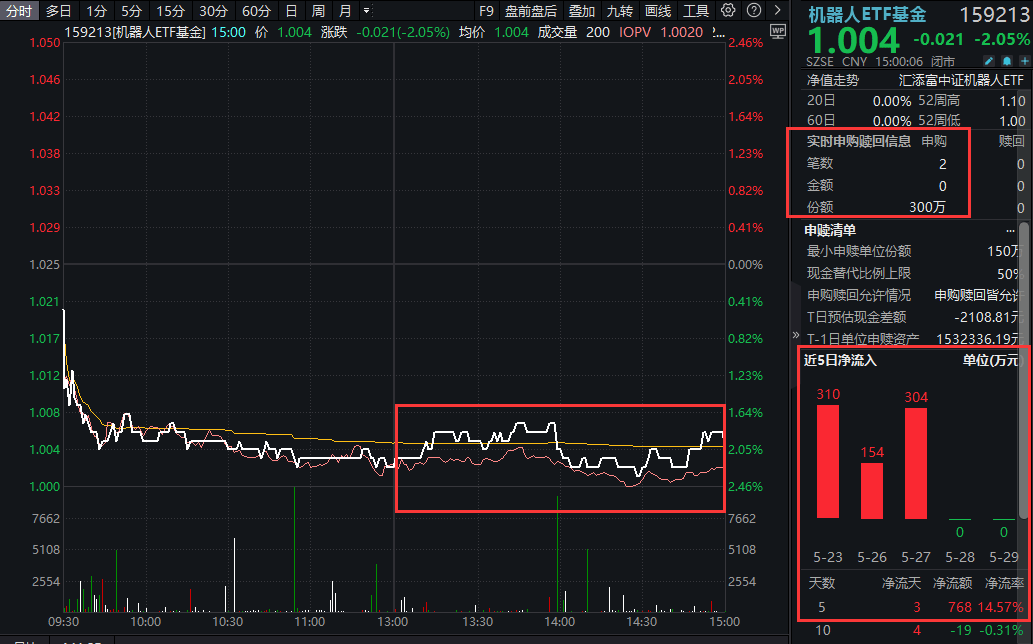
智元人形机器人拥有中美欧认证,机器人ETF基金(159213)跌逾2%溢价走阔,再度逆市吸金!从"表演型"迈向"实用型",人形机器人还要多久?
Sou Hu Cai Jing· 2025-05-30 09:11
Core Viewpoint - The robot industry is experiencing a mix of challenges and opportunities, with significant developments in technology and policy support driving the commercialization of humanoid robots, while also facing hurdles in cost reduction and capability enhancement [4][5][8]. Group 1: Market Performance - The A-share market saw a pullback after a previous rebound, with the Robot ETF Fund (159213) closing down over 2%, despite a net inflow of 3 million shares throughout the day [1]. - The majority of the index component stocks for the Robot ETF Fund experienced declines, with only a few stocks like Nanwang Technology and Ruishun Technology showing gains [3]. Group 2: Industry Developments - The 2025 Zhangjiang Embodied Intelligence Developer Conference and International Humanoid Robot Skills Competition highlighted the transition of humanoid robots from experimental to practical applications in various settings [4]. - Shanghai Zhiyuan Robotics announced that its humanoid robot, the Expedition A2, received multiple certifications, making it the first humanoid robot to achieve certifications in China, the EU, and the US [4]. - The first global standard for "Humanoid Robot Intelligence Classification" was released, indicating a shift towards policy support for the humanoid robot industry [4]. Group 3: Commercialization Challenges - The commercialization of humanoid robots is estimated to take at least 10 years, with challenges including the need for improved generalization capabilities and cost reduction [5]. - The current progress in humanoid robot hardware is outpacing software development, particularly in the area of generalization capabilities, which is a critical barrier to commercialization [5]. Group 4: Opportunities in the Industry - Continuous policy support at the national level is expected to drive the development of humanoid robots, with significant funding being allocated to the sector [8]. - Major tech companies and industry leaders are entering the humanoid robot space, expanding applications in both industrial and domestic settings [9]. - The domestic robot industry has seen an increase in localization rates, with the localization rate rising from 17.5% in 2015 to 35.7% in 2022, indicating a growing capacity for cost reduction [7]. Group 5: Investment Insights - The Robot ETF Fund (159213) provides investors with a tool to gain exposure to the entire robot industry chain, including upstream hardware, midstream software, and downstream applications [10].

创新驱动 中国制造品牌发展韧性十足
Zhong Guo Chan Ye Jing Ji Xin Xi Wang· 2025-05-26 01:21
Group 1 - The core viewpoint of the articles emphasizes the transformation of Chinese manufacturing brands from being "world factories" to "value highlands," driven by technological breakthroughs and quality improvements [1] - The "dual circulation" strategy is highlighted as a key driver for stimulating domestic consumption and investment, with government initiatives aimed at expanding domestic demand [2][3] - The importance of brand value competition shifting from market share to technological leadership is noted, with companies investing in R&D to enhance their competitive edge [4] Group 2 - Companies like Libode and Shanghai Laofengxiang are leveraging technology and cultural heritage to enhance product quality and brand value, demonstrating successful integration of traditional craftsmanship with modern manufacturing [5][6] - The shift from product output to value output is discussed, emphasizing the role of brands as essential components of corporate competitiveness and national strength [9] - The "China Manufacturing·Consumer Trusted Brands" promotion activity has recognized over 200 companies, highlighting the importance of consumer satisfaction in brand strategy [10]
机器人“最强大脑”竞赛白热化:特斯拉、Figure押注空间智能
2 1 Shi Ji Jing Ji Bao Dao· 2025-05-22 12:54
Group 1 - Tesla and Figure Robotics are making significant advancements in robotics, showcasing their capabilities in household chores and factory operations respectively [1][2] - Tesla's robots utilize a unified neural network model for training, learning from real human videos rather than traditional VR motion capture [1][4] - The rapid progress in robotics is attracting investment interest, with several companies securing substantial funding and forming strategic partnerships [2][3] Group 2 - The complexity of robotic operations in three-dimensional space is highlighted, with Tesla leveraging its experience in autonomous driving to enhance robotic models [4][5] - Current challenges in the industry include the high cost and time required for collecting real-world data, which is essential for training robots effectively [5][6] - The deployment of humanoid robots in factories is seen as a critical step towards commercialization, with several companies already integrating robots into their production lines [6][7] Group 3 - The cost of humanoid robots remains high, with prices ranging from 500,000 to 1,000,000 yuan per unit, which poses a barrier to widespread adoption [6] - Companies are exploring high-value industrial scenarios and rapid adaptation to overcome productivity bottlenecks and achieve scalability in humanoid robotics [6][7] - The integration of self-assembling robots could create a significant industrial market, as demonstrated by Figure's plans for large-scale production of humanoid robots [6][7]

派林生物(000403) - 2025年5月20日投资者关系活动记录表
2025-05-22 08:08
Group 1: Company Strategy and Growth - The company will focus on its core business of blood products, enhancing plasma supply capacity and marketing management, while actively expanding into overseas markets and improving product R&D capabilities [1] - The company aims to increase annual production capacity to over 3,000 tons following the expansion of its subsidiary, with production expected to resume in June 2025 [2][3] - The company plans to achieve a sales expense ratio of under 10% and a management expense ratio of under 7% in 2025 [2] Group 2: Product Development and Market Position - The subsidiary Guangdong Shuanglin Jiuyin is expected to obtain listing approval in 2026, while the fourth-generation intravenous immunoglobulin is anticipated to receive approval in 2027 [2] - The company expects a more than 20% year-on-year increase in plasma output in 2025 due to expanded production capacity [3] - Currently, over 60% of albumin in the market is imported, indicating potential for domestic alternatives in the future [4] Group 3: Shareholder Engagement and Financial Management - The company will implement the 2024 dividend plan promptly after approval at the annual shareholders' meeting [2] - The major shareholder will continue to support the company's development and has initiated a share buyback plan [4] - The company has maintained a high dividend payout ratio for two consecutive years and plans to continue this trend [4]

市值6000亿美的掌门人方洪波:我从来不加班,首度回应与小米竞争
Xin Lang Cai Jing· 2025-05-21 19:12
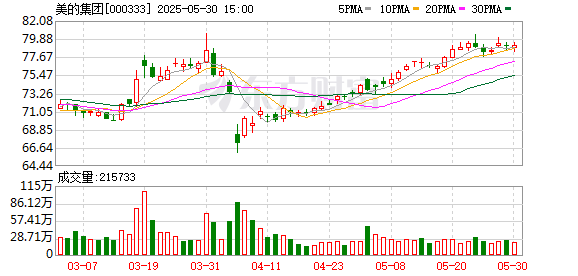
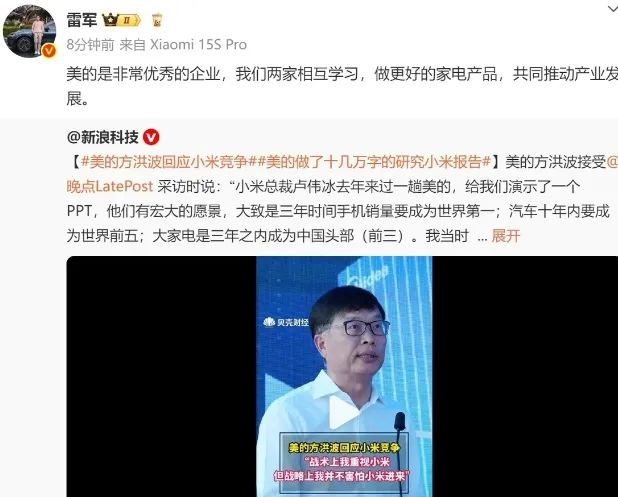
5月以来,美的旗下华凌采取低价策略,狙击小米的意图明显。格力也"出手"了,其子品牌晶弘今年也 推出了更具性价比的空调,参与到眼下加剧的市场争夺中,今年"6.18"空调业将有一场恶战。 近日,一则关于美的集团(000333)董事长方洪波的专访刷屏,其谈到了与小米在家电行业的竞争,以 及是否进入汽车行业。 首度回应与小米竞争 方洪波还谈到了和小米在家电领域的竞争。他表示:"小米总裁卢伟冰去年来过一趟美的,给我们演示 了一个 PPT,他们有宏大的愿景,大致是三年时间手机销量要成为世界第一;汽车十年内要成为世界前 五;大家电是三年之内成为中国头部(前三)。" 他表示:"我当时差一点就想问,美的、格力、海尔,你想把哪一家挤下去?"方洪波指出:"我们所有 的领域小米都进入了,空调、洗衣机全做了。" 在谈及此前被热议的"美的6点20强制下班"事件时作出了如上回应,并称"95%以上的加班都是形式主义 的加班"。 今日,美的集团的股份微涨0.17%,报78.8元/股,总市值达6043亿元。 小米集团(01810.HK)2024年年报显示,其空调、冰箱、洗衣机等大家电去年销售收入同比增长超 50%。今年小米空调掀起低价攻势。 5 ...


不酿老酒“跨界”造机器人,青岛这家头部民企引关注
Qi Lu Wan Bao Wang· 2025-05-20 07:16
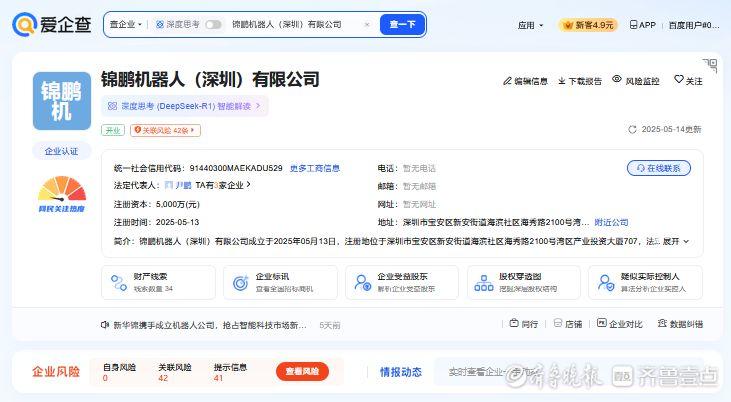
Group 1 - Xinhua Jin Group has established a new robot company, Jinpeng Robotics, in collaboration with two Guangzhou firms, marking a significant cross-industry move [1][3] - The registered capital for Jinpeng Robotics is 50 million yuan, with Xinhua Jin holding a 51% stake, indicating its role as the controlling shareholder [1] - Xinhua Jin's main business is in hair products and textile exports, which are not closely related to the robotics industry, making this move a bold attempt to diversify [1][3] Group 2 - Xinhua Jin's recent financial performance has been poor, with a reported revenue of 1.637 billion yuan in 2024, a decline of 30.97% year-on-year, and a net loss of 134 million yuan, a staggering drop of 354.59% [3] - The parent company, Xinhua Jin Group, achieved a revenue of 46.6 billion yuan in 2024, but the listed company's contribution was less than 4%, highlighting the need for new growth drivers [3] - Previous attempts to enter the graphite new materials sector faced challenges, with production halted since 2022 due to licensing issues, further emphasizing the urgency for Xinhua Jin to find new avenues for growth [3][4] Group 3 - The recent sale of the Jimo Huangjiu Factory to Qingdao Beer for 665 million yuan is seen as a strategy to optimize asset structure and alleviate financial pressure [4] - The pledging of 3 million shares by the controlling shareholder, Lujin Group, for operational funding has raised concerns in the capital market, with a high pledge ratio of 42.43% for the company overall and 98.05% for core shareholders [3][4] - The competitive landscape in the robotics industry is intensifying, with traditional foreign trade companies like Xinhua Jin facing challenges in technology accumulation and market penetration [5]