
海澜之家

Search documents
一个 “代销帝国” 的完美演绎,再看海澜模式的因和果
晚点LatePost· 2026-01-07 10:05
Core Viewpoint - The article discusses the challenges faced by Hailan Home, particularly its unique business model and the limitations of growth in the men's clothing market, leading to skepticism about its upcoming IPO in Hong Kong [6][8]. Market Overview - The domestic men's clothing market is likely to face constraints, with traditional brands struggling to adapt to younger, more fashion-forward consumer preferences, resulting in stagnation in revenue growth [6][7]. - In November 2025, retail sales data showed a year-on-year growth of 1.3%, with clothing, shoes, and textiles growing by 3.5%, indicating some resilience but overall market pressure [7]. - Major competitors like Youngor, Seven Wolves, and Jiumuwang reported varying degrees of business contraction, with Hailan Home achieving only a 3.7% growth, highlighting the intense market pressure [7]. Business Model Analysis - Hailan's business model is described as a "platform + brand" light-asset franchise retail model, allowing it to connect the supply chain without significant upfront investment [9][10]. - The model involves a consignment relationship with suppliers, where unsold goods can be returned, minimizing inventory risk for Hailan [11][20]. - Hailan's gross margin has historically been below 40%, significantly lower than competitors, indicating the impact of its consignment model [11]. Historical Context - Hailan's growth trajectory can be traced back to its restructuring in 2014, which positioned it as a leading player in the men's clothing sector, leveraging its upstream textile capabilities [13][14]. - The company expanded rapidly from 2002 to 2014, with store numbers increasing from 1 to 3,348, driven primarily by a franchise model [22]. Growth Challenges - By 2019, Hailan reached a peak with revenues of 22 billion and 5,598 stores, but growth has since plateaued, indicating a potential inflection point in its business model [23][26]. - The decline in sales volume since 2019 suggests that Hailan's revenue may decrease unless new growth drivers are identified [30][31]. - The shift in revenue recognition policies in Hailan's IPO prospectus indicates a potential transition from a consignment model to a more traditional buyout model, raising questions about the sustainability of its current business structure [27][30]. Future Outlook - Hailan is diversifying into new business areas, including collaborations with Adidas and JD.com, but these ventures may not replicate the success of its original model [32][37]. - The company faces increasing inventory risks and pressure on profit margins as it transitions to a higher proportion of self-operated stores, which could impact its overall financial health [33][35].


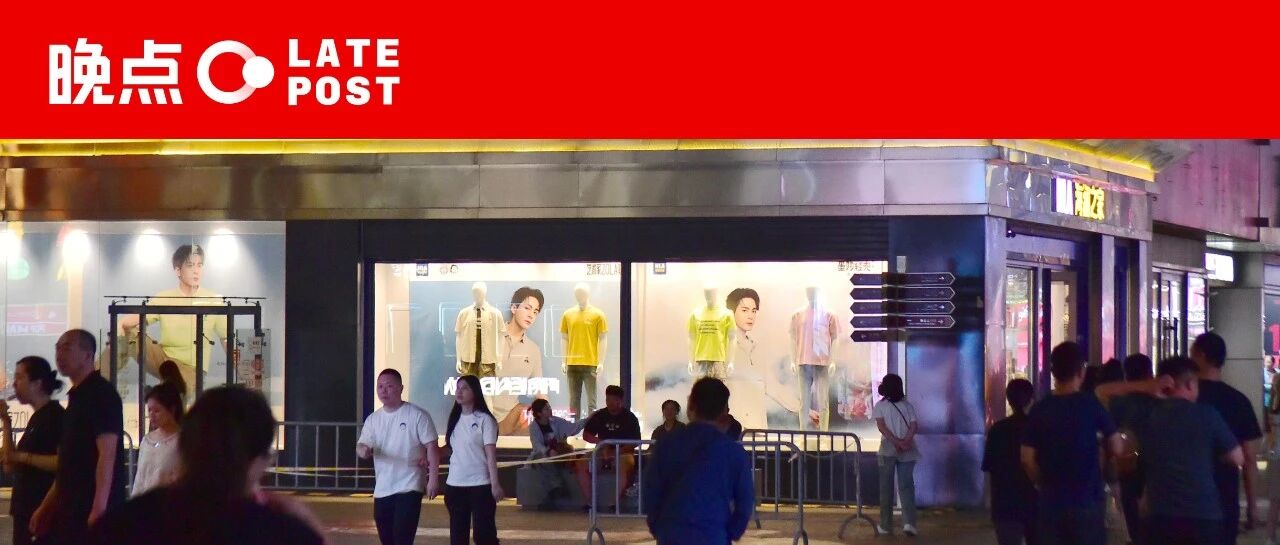
生意越难做,柒牌男装的广告越“暴力”
Xin Lang Cai Jing· 2026-01-07 07:28
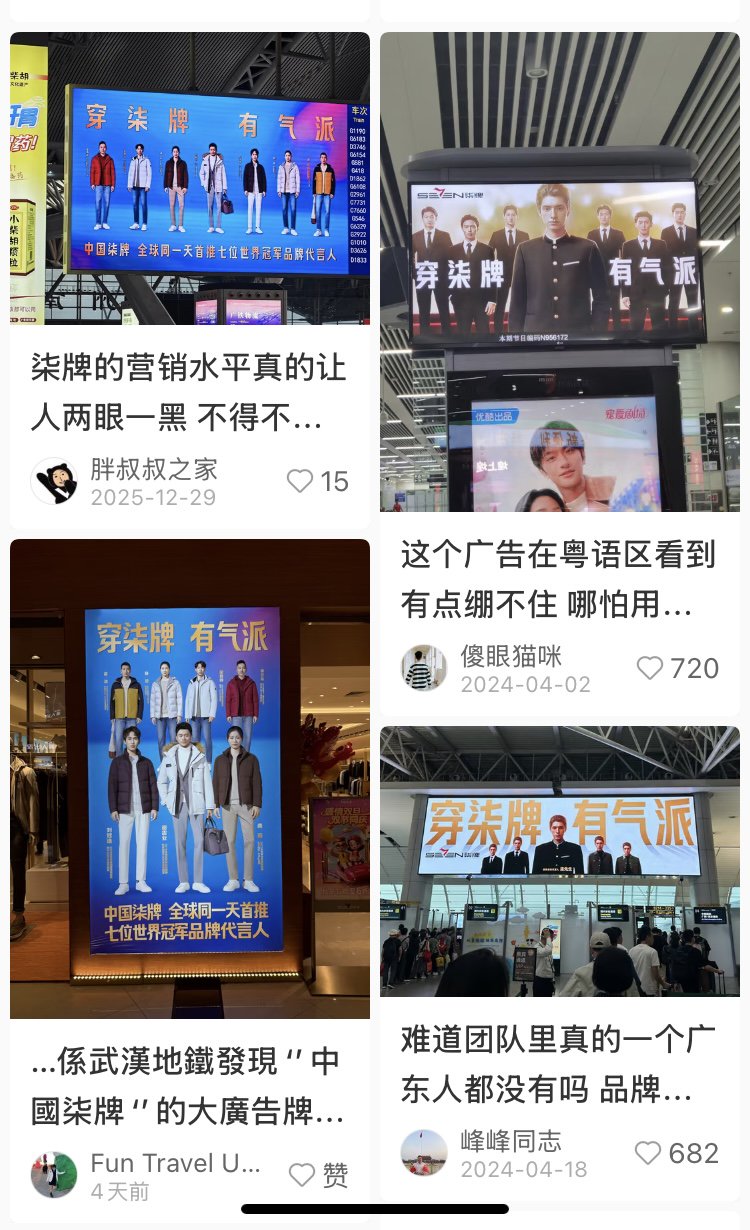
Core Viewpoint - The article discusses the recent advertising strategies of the clothing brand Qipai, highlighting its attempts to regain market relevance through bold marketing campaigns, despite facing criticism for its aesthetic choices and messaging [1][4][8]. Marketing Strategies - Qipai has launched a new advertising campaign featuring seven world champion endorsers with the slogan "Wear Qipai, have style," which has sparked significant social media discussion [1]. - The brand has a history of controversial advertising, including previous campaigns that have been criticized for their design and messaging [4][8]. - In 2024, Qipai plans to invest at least 100 million yuan annually in brand promotion, targeting over 50 major domestic cities and 600 high-speed rail advertising screens [8][9]. Market Position - Qipai operates in a competitive landscape alongside other high-end menswear brands like Jiumuwang and Seven Wolves, with a focus on formal wear priced around 2000 yuan per suit [10]. - The brand has approximately 3,500 stores, ranking second in store count among menswear brands in China, but has not disclosed its revenue figures [11]. - Qipai's target market is primarily in lower-tier cities, with a customer base that skews towards younger and older individuals from small towns [11]. Industry Trends - The menswear market, particularly for formal suits, is experiencing a decline, with a projected annual decrease of 0.7% from 2021 to 2025 [12]. - Competitors are increasingly offering business casual options, and Qipai's marketing efforts aim to maintain brand influence amidst this shift [13]. Brand Identity and Challenges - Qipai's current marketing strategies, including its slogan and visual design, have been criticized for lacking clarity and appeal to younger consumers [16]. - The brand has unique product offerings, such as the "Chinese standing collar" design, which are currently underutilized in its marketing [14]. - Qipai's marketing agency, Hua Yu Hua, has been noted for its focus on impactful messaging, but its approach may not resonate with the evolving preferences of modern consumers [15]. Future Plans - Qipai aims to increase its presence in top commercial venues, with plans to enhance its store coverage from 8% to 46% in major shopping centers [17]. - The brand is also exploring innovative store formats and product lines, including a new "Qimen Light Luxury Trend Store," although its initial location choice has raised questions about strategic focus [17].
高端酸奶的“泡沫” ,破了
3 6 Ke· 2026-01-06 12:13
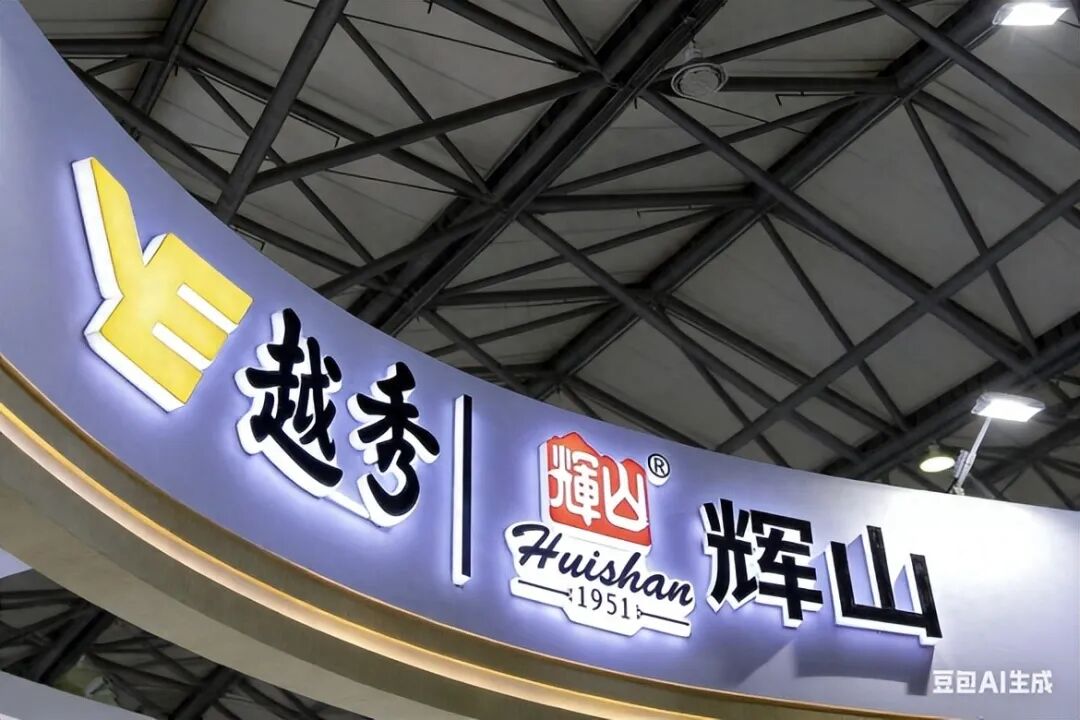
Core Insights - The high-end consumer goods industry has entered a "deep winter" in 2025, leading to widespread price reductions across various brands, including luxury cars, beauty products, and alcoholic beverages, with price drops exceeding 20% from peak levels [1] - The dairy industry, particularly high-end products, has also experienced significant price cuts, with reductions ranging from 30% to 50%, and some products seeing drops as high as 70% [1][3] Group 1: Market Dynamics - The decline in demand for high-end dairy products is not due to a general aversion to premium goods, but rather a failure of traditional brands to engage consumers effectively [4][5] - Consumers have become more rational and discerning, focusing on product quality and effectiveness rather than marketing narratives [5][6] Group 2: Marketing Strategies - Traditional marketing approaches, such as high-profile sponsorships and storytelling, are becoming less effective in reaching today's consumers, who are more skeptical and have diverse media consumption habits [9][10] - Brands like 越秀辉山 and Blueglass have struggled with outdated marketing strategies, leading to penalties and diminished brand reputation [7][8] Group 3: Product Differentiation - The dairy sector faces challenges in product differentiation, as many offerings are similar in taste and nutritional content, making it difficult to justify premium pricing [13][14] - To succeed, brands must find ways to enhance perceived value, such as emphasizing unique nutritional benefits or superior sourcing practices [17][27] Group 4: Future Opportunities - The aging population is expected to increase demand for high-quality nutritional products, presenting a cyclical opportunity for brands like 越秀辉山 to innovate and improve their offerings [28][29] - Companies should focus on modernizing marketing strategies and ensuring product quality to remain competitive in a changing market landscape [18][26]



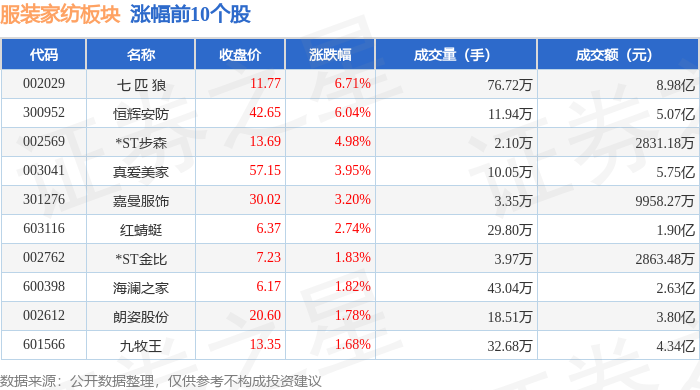
服装家纺板块1月6日涨0.92%,七匹狼领涨,主力资金净流出1839.18万元
Zheng Xing Xing Ye Ri Bao· 2026-01-06 08:56
Market Performance - The apparel and home textile sector increased by 0.92% compared to the previous trading day, with Qipilong leading the gains [1] - The Shanghai Composite Index closed at 4083.67, up by 1.5%, while the Shenzhen Component Index closed at 14022.55, up by 1.4% [1] Top Gainers - Qipilong (002029) closed at 11.77, with a rise of 6.71% and a trading volume of 767,200 shares, amounting to a transaction value of 898 million [1] - Henghui Security (300952) rose by 6.04% to close at 42.65, with a transaction value of 507 million [1] - ST Bosen (002569) increased by 4.98% to 13.69, with a transaction value of 28.31 million [1] - True Love Home (003041) saw a 3.95% increase, closing at 57.15, with a transaction value of 575 million [1] Top Losers - Tianchuang Fashion (603608) experienced a significant drop of 8.88%, closing at 9.54, with a trading volume of 807,400 shares [2] - Zhongwang Fabric (605003) fell by 5.13% to 30.36, with a transaction value of 198 million [2] - Kute Intelligent (300840) decreased by 3.64% to 19.86, with a transaction value of 69.5 million [2] Capital Flow - The apparel and home textile sector saw a net outflow of 18.39 million from institutional investors and 26.21 million from retail investors, while retail investors had a net inflow of 44.60 million [2] - Major stocks like Haian Home (600398) and Jiuwang (601566) had varying net inflows and outflows from different investor categories [3] Individual Stock Capital Flow - Haian Home (600398) had a net inflow of 29.51 million from institutional investors, while it faced a net outflow of 14.39 million from retail investors [3] - Jiuwang (601566) saw a net inflow of 24.87 million from institutional investors, with a net outflow of 27.62 million from retail investors [3] - Qipilong (002029) had a net inflow of 21.97 million from institutional investors, but a significant net outflow of 39.48 million from retail investors [3]


2025电商榜单价值及影响力洞察报告
艾瑞咨询· 2026-01-06 00:03
Core Insights - The article emphasizes the evolving role of e-commerce rankings, highlighting their transition from simple recommendation tools to comprehensive business components that enhance user decision-making efficiency, build platform trust, leverage brand growth, and promote industry quality ecosystems [1]. Group 1: User Behavior and Trust - Over 90% of consumers pay attention to ranked products, with 50% prioritizing clicks on items marked with rankings, indicating that rankings are crucial decision-making touchpoints in the purchasing process [6][4]. - Approximately 30% of consumers have started to focus on e-commerce rankings while shopping, and this trend is on the rise, with over 40% believing that ranked products are worth considering [4][6]. - 75.6% of consumers view rankings as a decisive factor in their purchasing decisions, reflecting their significant influence on consumer trust and decision-making [6][15]. Group 2: Ranking Mechanism and Consumer Experience - The rankings are built on a data-driven model that ensures objectivity and transparency, addressing consumer concerns about potential marketing biases [23][25]. - The rankings utilize a comprehensive evaluation system based on sales, popularity, reputation, growth, and brand strength, which helps consumers navigate the overwhelming product choices available [43]. - 61% of consumers express high satisfaction with products recommended by rankings, and 96.9% plan to maintain or increase their usage of e-commerce rankings in the future [6]. Group 3: Brand and Industry Impact - E-commerce rankings serve as a trust-building infrastructure for platforms, providing fair exposure opportunities for quality products and brands, thus enhancing the platform's influence [8][30]. - The rankings reflect consumer trend changes and provide essential guidance for product innovation, driving a positive development cycle in the quality consumption ecosystem [30][32]. - Case studies, such as the success of Hai Lan Zhi Jia's jeans and the collaboration with SHOKZ for exclusive earphones, illustrate how rankings can significantly boost product visibility and sales, creating a virtuous cycle of exposure and consumer trust [32][33]. Group 4: Future Trends and Innovations - The future of e-commerce rankings is expected to see advancements in AI technology, leading to more personalized and intelligent ranking systems that enhance user experience and brand engagement [37][40]. - The article suggests that the evolution of rankings will focus on maintaining objectivity and enhancing user experience, which are critical for meeting consumer needs in a competitive market [35][46].


可选消费W01周度趋势解析:免税优异表现拉动增长,港股消费跌幅较大-20260105
Haitong Securities International· 2026-01-05 14:47
Investment Rating - The report assigns an "Outperform" rating to multiple companies including Nike, Midea Group, JD Group, Haier Smart Home, Gree Electric, and others, while Lulu Lemon is rated as "Neutral" [1]. Core Insights - Duty-free sales have shown exceptional performance, driving growth in the discretionary sector, while Hong Kong consumer stocks have experienced significant declines [4][11]. - The luxury goods sector has outperformed, with a weekly increase of 1.5%, while the retail sector also saw a rise of 1.1% [5][13]. - The report highlights that the overall sentiment in travel-related sectors remains high, contributing positively to the discretionary consumption outlook [3]. Weekly Performance Review - The weekly performance of various sectors is as follows: luxury goods > retail > overseas sportswear > overseas cosmetics > US hotels > domestic sportswear > credit cards > snacks > pets > domestic cosmetics > gold and jewelry > gaming, with respective weekly changes of 1.5%, 1.1%, 0.8%, -0.3%, -0.4%, -2.4%, -2.4%, -2.8%, -2.9%, -4.5%, -4.6%, and -5.6% [11][12]. - The retail sector's growth was significantly driven by China Duty Free, which saw a 7.6% increase due to strong sales during the New Year holiday [6][13]. Monthly and Year-to-Date Performance - Monthly performance shows retail leading with a 4.9% increase, followed by overseas sportswear and US hotels, while domestic cosmetics and gaming sectors faced declines [11]. - Year-to-date performance indicates that overseas cosmetics and US hotels have performed well, while domestic cosmetics and snacks have shown negative growth [12]. Valuation Analysis - The report notes that the valuation of various sectors remains below their average over the past five years, with expected PE ratios for 2025 indicating significant potential for growth [9][14]. - Specific sectors such as overseas sportswear are projected to have a PE of 31.2 times, which is 59% of the past five-year average, while domestic sportswear is at 13.3 times, 70% of the average [14][15].
海澜之家:有关城市奥莱、黑鲸品牌的介绍可参见公司披露的定期报告
Zheng Quan Ri Bao· 2026-01-05 14:24
(文章来源:证券日报) 证券日报网讯 1月5日,海澜之家在互动平台回答投资者提问时表示,有关城市奥莱、黑鲸品牌的介绍 可参见公司披露的定期报告。 ...
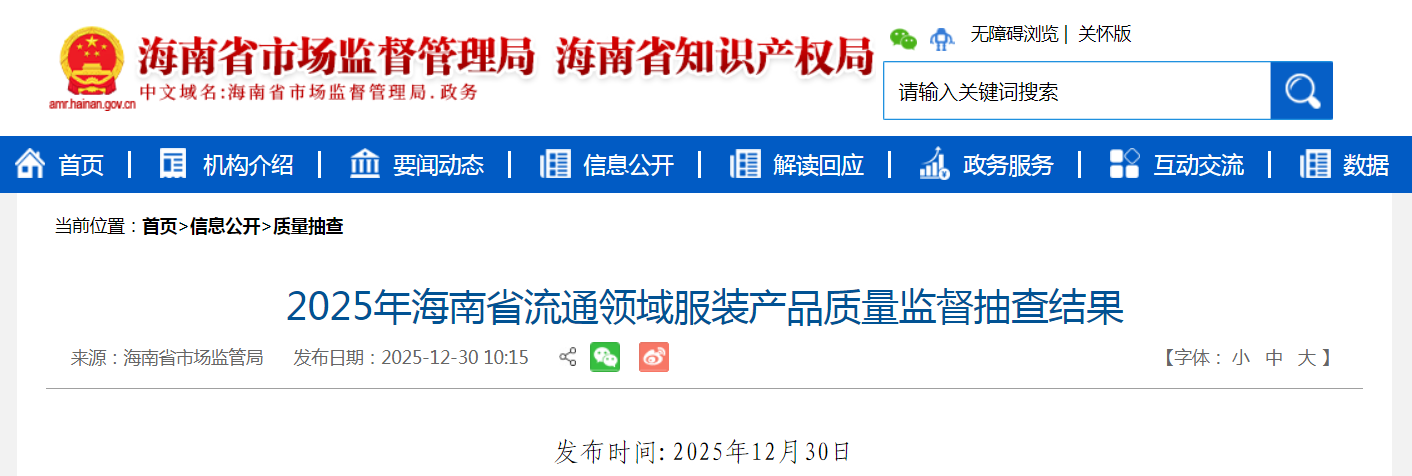
2025年海南省流通领域服装产品质量监督抽查结果公布
Zhong Guo Zhi Liang Xin Wen Wang· 2026-01-05 06:47
中国质量新闻网讯 据海南省市场监督管理局网站消息,2025年,海南省市场监督管理局对全省流通领域服装产品进行了监督抽查。本次抽查了8批次产品, 经检验,未发现不合格产品。 2025年海南省流通领域服装产品质量监督抽查所检项目符合相关标准的产品 | 序号 | 产品名称 (标称) | 商标 (标称) | 规格型号 | 被检主体 | 生产企业(标称) | | --- | --- | --- | --- | --- | --- | | 1 | 长袖T恤 | / | 170/88A(48)B类 | 儋州那大新颖服装店 | 海澜之家品牌管理有限公司 (标签标注) | | 2 | 那片海男士冰丝速干衣短袖 | / | 185/100A | 万宁广佰汇贸易有限公司 | 南通棉里棉外家居用品有限公司(标签标注) | | 3 | 女装梭织衫 | 以纯® | M 160/84A | 三亚市吉阳豪纯服饰店 | 东莞市以纯集团有限公司 (标签标注) | | 4 | 男装梭织短裤 | 以纯® | M 170/78A | 三亚市吉阳豪纯服饰店 | 东莞市以纯集团有限公司 (标签标注) | | 5 | 女短袖T恤 | 海澜之家HLA(标签标 ...
国泰海通晨报-20260105
国泰海通· 2026-01-05 05:41
Macro Research - The recovery momentum in consumption is strong, but investment and production still require further policy support [2] - The A-share market is expected to welcome a "spring opening red" as policy expectations, liquidity, and fundamentals resonate positively [2] - The price signals indicate that industrial prosperity is beginning to emerge and continue [2] Strategy Research - The A-share market closed 2025 at 3968.84 points, with an annual increase of 18.41%, confirming the strategic judgment made by Guotai Junan [3] - The market is anticipated to stabilize and appreciate due to the upcoming announcement of the new Federal Reserve chairman and expectations of U.S. interest rate cuts in 2026 [3][24] - The decision-makers have emphasized the need to "promote investment stabilization," indicating a potential increase in policy support for growth [3][24] Food and Beverage Research - Yanjing Beer shows strong reform momentum, with significant potential for national expansion of its U8 product line, expected to exceed 1.5 million tons in the future [3][8] - The company is expected to enhance its product structure and profitability through the expansion of high-priced products above 10 yuan [8][9] - The beer industry is stabilizing, with leading companies like Yanjing benefiting from structural upgrades and improved profit margins [8][9] Industry Comparison - The report highlights a favorable outlook for technology, non-bank financials, and consumer sectors, driven by the industrialization of emerging markets and the AI trend [6][27] - The technology sector is expected to benefit from global chip technology breakthroughs and rising storage prices, with domestic infrastructure shortages accelerating the pace of domestic production [6][27] - Non-bank financials are poised to gain from increased wealth management demand and capital market reforms, while cyclical stocks are seen as bottoming out and benefiting from domestic demand expansion [6][27]

传统内衣的困局,「运动内衣」是解药吗?
3 6 Ke· 2026-01-05 03:42
Core Insights - The traditional lingerie market in China is undergoing a significant transformation, with a shift from underwire bras to more comfortable and breathable options favored by younger women [6][32] - New local brands like NEIWAI, Ubras, and Jiao Nai are gaining market share by focusing on comfort and emotional value, while established brands like Aimer and Anita are struggling to maintain their positions [15][17] Market Trends - The demand for sports bras is rising as fitness and lifestyle trends become more integrated into daily life, with brands like Lululemon and MAIA ACTIVE gaining popularity [9][10] - Traditional lingerie brands are attempting to pivot towards the sportswear segment to revitalize their offerings, as seen with Aimer's launch of AIMER SPORTS [18][20] Consumer Behavior - There is a notable shift in women's perceptions of "sexy," moving from external validation to self-acceptance and comfort, which is influencing purchasing decisions [32][39] - Emotional satisfaction and psychological comfort are becoming key factors in women's lingerie choices, leading to a more nuanced understanding of "self-pleasure" in the market [39][46] Competitive Landscape - Established brands are losing market share to emerging local brands, with significant declines in market presence reported for companies like Aimer and Urban Beauty [15][17] - The trend of "sportsification" is not limited to lingerie but is also affecting the broader apparel industry, with brands across categories adapting to this shift [47][51]
