中国中铁

Search documents
旧经济深蹲,新经济蓄力
Hua Xia Shi Bao· 2025-09-05 10:01
Economic Recovery - The manufacturing Purchasing Managers' Index (PMI) for August is at 49.4%, indicating a slight recovery from July, but overall economic growth momentum may have peaked [2] - The economic outlook suggests a potential for increased uncertainty, particularly regarding foreign trade recovery, with expectations of a non-linear economic performance influenced by external factors [2][3] - The overall GDP growth target of around 5% for the year is considered achievable despite challenges [2] Market Trends - The second half of the year may see a dual bull market in stocks and bonds, driven by nominal GDP growth as a key pricing factor [2] - The central bank is expected to maintain liquidity to support market conditions, which will contribute to the bullish trends in both asset classes [3] Industrial Production - Industrial production is expected to maintain stability, with a projected year-on-year growth rate of 5.5% for August [4] - The industrial growth is supported by policies aimed at boosting equipment manufacturing and domestic demand, alongside some export resilience due to tariff exemptions [4][6] Consumer Spending - Retail sales are projected to grow by 3.5% year-on-year in August, slightly down from 3.7% in July, influenced by ongoing restrictions on public consumption and the diminishing impact of trade-in policies [7][8] - The automotive retail sector is expected to face pressure due to seasonal factors and the transitional phase of trade-in policies, with a projected retail volume of around 1.94 million vehicles in August, reflecting a 2% year-on-year increase [9] Investment Trends - Fixed asset investment growth is anticipated to slow to 1.1% for the first eight months of 2025, with significant declines in real estate investment [11][12] - Manufacturing investment is expected to grow by 5.2%, while infrastructure investment is projected to increase by 3.0% [11][12] Export and Import Dynamics - Exports are expected to grow by 6.9% in August, while imports are projected to increase by 2.8%, indicating a potential nearing of a downward turning point for exports [20][21] Inflation and Employment - The Consumer Price Index (CPI) is expected to remain stable, while the Producer Price Index (PPI) is projected to decline by 3.4% year-on-year [22][25] - The urban unemployment rate is anticipated to rise to 5.3% in August, influenced by seasonal factors related to graduation [26]


大建筑央企投资框架
2025-09-04 14:36
Summary of Key Points from Conference Call Records Industry Overview - **Industry**: Large State-Owned Construction Enterprises in China - **Long-term Downtrend**: Infrastructure investment has entered a long-term downtrend since 2017, with growth rates declining significantly, reaching nearly zero growth by 2021, indicating pressure on industry prosperity [1][2] - **Historical Context**: Major construction enterprises originated from various state ministries or military systems, giving them significant advantages and market shares in specific fields [5][6] Core Insights and Arguments - **Valuation Concerns**: The low valuation of large construction state-owned enterprises is attributed to weak demand for infrastructure, frequent local government issues, and limited contributions from infrastructure policies [2][3] - **Incentive Mechanisms**: Insufficient incentive mechanisms within these enterprises lead to a lack of focus on market capitalization by management, hindering the expected concentration of the industry [1][2] - **Business Model Shift**: Enterprises are adopting a capital advance model, leading to cash flow pressures. Recent trends show a slowdown in revenue growth to improve profit and cash flow, which may attract market attention and boost stock prices [1][2] - **Policy and Reform Drivers**: Policies aimed at stabilizing growth, expectations of institutional reforms, and adjustments in business models have historically triggered stock price increases in the construction sector [1][2][4] Additional Important Content - **Historical Events Impacting Valuation**: Significant events such as the "Belt and Road" initiative (2014-2015) and the introduction of the PPP model (2016-2017) have positively influenced the valuations of large construction enterprises by improving fundamentals and reforming systems [6][7] - **Market Reactions to Policies**: The impact of stabilization policies on the construction sector has been variable, with some periods showing significant effects while others resulted in limited price increases [10][11] - **Future Catalysts**: Potential catalysts for future growth include balance sheet improvements through asset disposals and mergers and acquisitions encouraged by the State-owned Assets Supervision and Administration Commission (SASAC) [12][14] - **Research and Development Investment**: Large construction enterprises are investing significantly in R&D, with annual expenditures reaching approximately 50 billion for China State Construction and 30 billion for China Railway [13] Conclusion - **Outlook for Large Construction Enterprises**: The outlook remains optimistic due to ongoing improvements in financial health through asset management and potential mergers, which could enhance overall competitiveness and valuation in the coming years [14][15]
中泰红利价值一年持有混合发起:2025年上半年末换手率为11.93%
Sou Hu Cai Jing· 2025-09-04 07:39
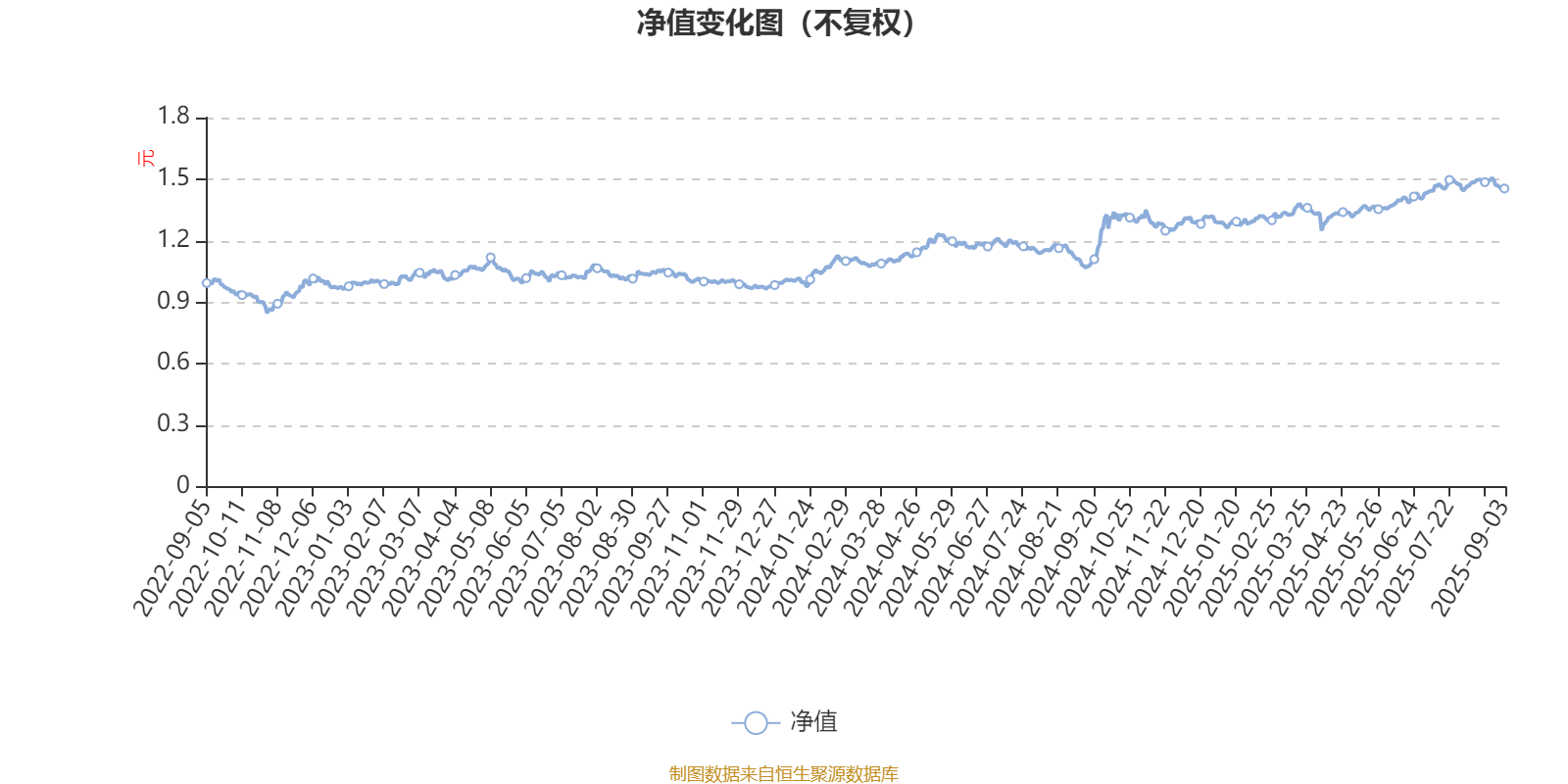
Core Viewpoint - The AI Fund Zhongtai Hongli Value One-Year Holding Mixed Fund (014772) reported a profit of 47.4459 million yuan for the first half of 2025, with a weighted average profit per fund share of 0.0881 yuan and a net asset value growth rate of 6.66% [3] Group 1: Fund Performance - As of September 3, the fund's unit net value was 1.454 yuan, with a one-year cumulative net value growth rate of 30.04%, ranking 192 out of 256 comparable funds [3][6] - The fund's net value growth rate over the past three months was 7.25%, and over the past six months, it was 10.42%, ranking 232 out of 256 and 214 out of 256 respectively [6] - The fund's three-year cumulative net value growth rate was 48.02%, ranking 13 out of 241 comparable funds [6] Group 2: Fund Management and Strategy - The fund manager indicated that there was little change in the types of holdings during the reporting period, but the overall position was slightly reduced due to an assessment of reinvestment risks and opportunity costs [3] - The fund's stock holdings have a high concentration, with the top ten holdings consistently exceeding 60% over the past two years [39] Group 3: Valuation Metrics - As of June 30, 2025, the fund's weighted average price-to-earnings (P/E) ratio was approximately 1.96 times, significantly lower than the industry average of 26.16 times [12] - The weighted average price-to-book (P/B) ratio was about 0.16 times, compared to the industry average of 2.38 times, and the weighted average price-to-sales (P/S) ratio was approximately 0.09 times, against an industry average of 2.05 times [12] Group 4: Growth Metrics - For the first half of 2025, the weighted average revenue growth rate of the fund's stock holdings was -0.06%, and the weighted average net profit growth rate was -0.05% [18] - The weighted annualized return on equity was 0.08% [18] Group 5: Fund Size and Shareholder Composition - As of June 30, 2025, the fund's total size was 751 million yuan, with 1,861 holders collectively owning 535 million shares [30][33] - Management personnel held 3.9159 million shares, accounting for 0.73% of the total, while individual investors held 100% of the shares [33]
“浦链通”线上投放累计超100亿元——浦发银行上海分行跑出金融服务实体经济“加速度”
Xin Lang Cai Jing· 2025-09-04 06:14
Group 1 - The core strategy of Shanghai Pudong Development Bank (SPDB) is to deepen its "digital intelligence" strategy, focusing on supply chain financing and aiming to double its online loan volume [1] - The "Puchain" online financing product has achieved a cumulative online investment exceeding 10 billion yuan, with a net increase of 27.7 billion yuan in online supply chain business volume in the first half of the year [1] - The bank has successfully onboarded 886 new supply chain clients, bringing the total number of upstream and downstream clients to 2,416, leading the entire bank in supply chain business growth [1] Group 2 - SPDB has implemented innovative features such as automatic loan disbursement and centralized fee collection for its "Puchain" business under the third-party platform model, catering to the financing needs of numerous small and dispersed suppliers in the new retail sector [2] - The bank has tailored a comprehensive financial service plan to support the construction of five new cities, leveraging its partnership with the Simple Exchange platform to enhance financing efficiency and convenience for clients [2] Group 3 - The bank has launched the "National Railway Freight Loan" service, which provides online financing solutions for railway users, helping to alleviate their cash flow pressures and extend payment periods for freight [3] - SPDB aims to continuously enhance its financial services for the real economy and inject more financial momentum into the development of various enterprises within the supply chain [3]

中国中铁等在安徽新设开发投资公司
Zheng Quan Shi Bao Wang· 2025-09-04 04:05
人民财讯9月4日电,企查查APP显示,近日,安徽池铁开发投资有限公司成立,注册资本1亿元,经营 范围包含:以自有资金从事投资活动;自有资金投资的资产管理服务;工程管理服务等。企查查股权穿 透显示,该公司由中国中铁(601390)全资子公司中铁三局集团有限公司等共同持股。 ...

117股获券商买入评级,中国交建目标涨幅达49.55%
Di Yi Cai Jing· 2025-09-04 00:38
Group 1 - On September 3, a total of 117 stocks received buy ratings from brokerages, with 16 stocks announcing target prices [1] - Based on the highest target prices, China Communications Construction Company, China Railway Group, and Rongsheng Petrochemical ranked highest in target price increase, with increases of 49.55%, 46.06%, and 40.5% respectively [1] - Among the rated stocks, 106 maintained their ratings, while 11 received their first ratings [1] Group 2 - Five stocks attracted attention from multiple brokerages, with Focus Media, Jiao Dian Technology, and Great Wall Motor receiving the most ratings, at 3, 2, and 2 brokerages respectively [1] - In terms of industry classification, the most stocks receiving buy ratings were from the Materials II, Capital Goods, and Technology Hardware & Equipment sectors, with 23, 20, and 9 stocks respectively [1]

华源晨会精粹20250903-20250903
Hua Yuan Zheng Quan· 2025-09-03 13:59
Fixed Income - The number of new industrial bond issuers has significantly increased, with 133 new issuers in 2024 and 191 from January 1 to August 26, 2025 [2][8] - New issuers are primarily concentrated in lower administrative levels, with over half rated AA+, and the majority located in economically strong provinces like Shandong, Jiangsu, Guangdong, and Zhejiang [9][10] - Investment strategy suggests focusing on newly issued bonds from industries with better economic conditions, such as social services, and considering city investment subsidiaries due to their relatively controllable credit risks [10] Overseas/Education Research - Market sentiment around interest rate cuts remains volatile, with short to medium-term bond yields declining while 30-year Treasury yields are rising, indicating investor concerns about long-term risks [16] - The weak dollar has contributed to the rise in precious metals, with gold nearing new highs [16] Automotive Industry - In high-income markets, the willingness to pay for Robotaxi services is stronger than for traditional ride-hailing services, with Waymo users prioritizing safety over price [19] - Domestic markets may still view Robotaxi as a substitute for traditional taxis, while international markets see it as a premium service [19] - The technology for Robotaxi is converging with passenger vehicles, and significant attention is on Tesla's upcoming V14 version and its public deployment [19] Transportation - The company achieved revenue of 84.68 billion yuan in H1 2025, a 6.19% increase year-on-year, with container business volume and pricing supporting performance [22] - The company is expanding its global port network and enhancing competitiveness in domestic container business [22] Machinery/Construction - The company reported a revenue of 7.75 billion yuan in H1 2025, a 19.99% increase year-on-year, with a notable Q2 growth due to project completions [25] - The gross margin improved to 27.40%, and the company is actively repurchasing shares, reflecting confidence in future business development [26][27] Pharmaceuticals - The company achieved a revenue of 19.49 billion yuan in H1 2025, with a 1.11% year-on-year increase, driven by steady growth in its hemorrhoid treatment products [38] - The company is focusing on optimizing its distribution network and enhancing brand marketing to support growth in its healthcare segment [39] Electronic Industry - The company reported a revenue of 52.18 billion yuan in H1 2025, a 9.62% increase year-on-year, with high utilization rates in Q2 [5] - The product matrix is expanding, particularly in automotive electronics and AI servers, contributing to overall growth [5]
【3日资金路线图】电力设备板块净流入超70亿元居首 龙虎榜机构抢筹多股
Zheng Quan Shi Bao· 2025-09-03 12:41
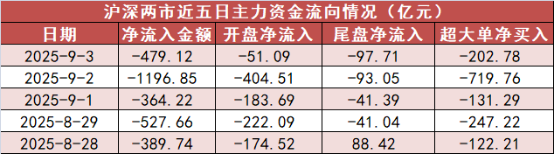
Market Overview - The A-share market experienced an overall decline on September 3, with the Shanghai Composite Index closing at 3813.56 points, down 1.16%, the Shenzhen Component Index at 12472 points, down 0.65%, and the ChiNext Index at 2899.37 points, up 0.95% [1] - The total trading volume in the A-share market was 23961.02 billion yuan, a decrease of 5166.64 billion yuan compared to the previous trading day [1] Capital Flow - The main capital in the A-share market saw a net outflow of 479.12 billion yuan, with an opening net outflow of 51.09 billion yuan and a closing net outflow of 97.71 billion yuan [2] - The CSI 300 index had a net outflow of 57.65 billion yuan, while the ChiNext saw a net outflow of 203.51 billion yuan and the STAR Market had a net outflow of 28.31 billion yuan [4] Sector Performance - In the primary industry sectors, only two sectors saw net capital inflows, with the power equipment sector leading at 70.39 billion yuan [6] - The computer sector experienced the largest net outflow at 172.12 billion yuan, followed by non-bank financials at 158.23 billion yuan and defense industry at 125.99 billion yuan [7] Individual Stock Activity - Rock Mountain Technology had the highest net inflow of main capital at 30.18 billion yuan [8] - Institutions showed interest in several stocks, with notable net purchases in Chenxin Pharmaceutical and significant net sales in Julun Intelligent [10] Institutional Focus - Recent institutional ratings and target prices indicate potential upside for several stocks, including Jinwei Industrial with a target price of 28.40 yuan, representing a 26.05% upside from the latest closing price [13]


供应链类资产支持证券产品报告(2025 年半年度):产品发行回暖,发行主体扩容,发行利率下行,市场活跃度提升
Zhong Cheng Xin Guo Ji· 2025-09-03 11:53
1. Report Industry Investment Rating No relevant information provided. 2. Core Viewpoints of the Report In the first half of 2025, the issuance volume of innovative multi-core enterprise combination mode products and external credit enhancement products increased significantly. Financial institutions such as guarantee companies and commercial banks played the role of a link between fund demanders and providers, expanding the service scope of supply chain asset - backed securities products. The number of core enterprises participating in product issuance increased significantly, and the covered regions and industries also broadened. Meanwhile, against the backdrop of the deep - seated market - oriented operation transformation of local state - owned enterprises, the prominent demand for working capital reduction in the construction industry, and the significant increase in the trading activity of the ABS market, the utility of supply chain asset - backed securities products in asset revitalization became prominent. The market issuance recovered significantly, the product term design tended to be long - term, and the issuance interest rate continued the downward trend [61]. 3. Summary According to the Directory 3.1 Issuance Situation - In the first half of 2025, 137 supply chain - related asset - backed securitization products were issued in the exchange market, with a total issuance scale of 69.801 billion yuan, a year - on - year increase of 35 units and 35.24% in scale. The products accounted for 11.25% of the total issuance scale of enterprise asset - backed securitization products in the exchange market during the same period, a year - on - year increase of 0.22 percentage points [3][4]. - In terms of issuance venues, 104 products were issued on the Shanghai Stock Exchange, with a scale of 57.58 billion yuan, accounting for 82.49%; 33 products were issued on the Shenzhen Stock Exchange, with a scale of 12.221 billion yuan, accounting for 17.51% [6]. - In terms of product issuance scale distribution, 130 products had a single - product issuance scale of 1 billion yuan or less, with a total scale of 59.45 billion yuan, accounting for 85.17% [8]. - In terms of product term distribution, products with an expected term of more than 1 year had a significant increase in issuance volume and scale, with the number of issuance units increasing by 47 and the scale increasing by 132.03% year - on - year [10]. - In terms of initial credit rating distribution, AAAsf - rated securities had a total issuance scale of 54.854 billion yuan, accounting for 78.59%, and AA + sf - rated securities had a scale of 14.63 billion yuan, accounting for 20.96% [11]. - The average issuance interest rate of AAAsf - rated supply chain - related asset - backed securities with a term of about 1 year was 2.20%, and the median was 2.10%, down 49BP and 54BP year - on - year respectively [3][13]. - The average issuance spread based on the 1 - year Treasury bond yield as a benchmark narrowed compared with the same period of the previous year, and the average spread based on the 1 - year corporate bond yield was basically the same as the previous year [18]. 3.2 Core Enterprise Analysis - In the first half of 2025, 122 single - core enterprise products involved 70 core enterprises, with a scale of 63.809 billion yuan, accounting for 91.42%; 15 innovative multi - core enterprise combination products involved 64 core enterprises, with a scale of 5.992 billion yuan, accounting for 8.58%. The number of core enterprises increased significantly year - on - year [24][25]. - In terms of enterprise nature, 122 single - core enterprise products involved 68 state - owned enterprises and 2 private enterprises, with corresponding issuance scales of 55.86 billion yuan and 7.949 billion yuan respectively. The number of state - owned enterprises increased by 21 year - on - year, and the number of private enterprises decreased by 2 [29]. - In terms of regional distribution, single - core enterprise products involved 18 regions, with broader coverage. The top three regions, Beijing, Guangdong, and Shandong, had a total issuance amount of 31.283 billion yuan, accounting for 49.03% [30]. - In terms of industry distribution, single - core enterprise products involved 14 industries, with broader coverage. The infrastructure investment and financing, construction, real estate, and trade industries still led in terms of issuance scale. The issuance scale of the construction industry increased by 30.51% year - on - year, and that of the infrastructure investment and financing industry increased by 104.69% year - on - year [33]. - In terms of public credit ratings, core enterprises of single - core enterprise products were mainly rated AAA and AA +, with a corresponding issuance scale of 61.279 billion yuan, accounting for 96.04% [37]. 3.3 Original Equity Holder Situation - In the first half of 2025, 30 original equity holders or their agents were involved, all of which were factoring companies. The top five original equity holders had a total issuance scale of 47.954 billion yuan, accounting for 68.70% [40]. - 21 factoring companies had no affiliated relationship with the core enterprises of their issued products, with 105 issuance units and a scale of 52.263 billion yuan, accounting for 74.87%; 9 factoring companies had an affiliated relationship, with 32 issuance units and a scale of 17.538 billion yuan, accounting for 25.13% [45]. 3.4 Product Structure Design - In terms of sub - level securities setting, 121 products had a sub - level scale ratio between 0% (excluding) and 2% (including), with a corresponding issuance scale of 65.157 billion yuan, accounting for 93.35% [48]. - In terms of credit enhancement arrangements, 128 products were fully credit - enhanced, with a scale of 64.632 billion yuan; 4 products were single - debtor non - credit - enhanced, with a scale of 1.953 billion yuan; 5 products were multi - debtor non - credit - enhanced or partially credit - enhanced, with a scale of 3.216 billion yuan. The scale of fully credit - enhanced products increased by 42.89% year - on - year [50]. - 113 products had core enterprises or their affiliated companies as credit enhancement subjects, with a scale of 61.281 billion yuan, a year - on - year increase of 30.19%; 19 products had external guarantee companies and/or banks as credit enhancement subjects, with a scale of 5.951 billion yuan, a year - on - year increase of 244.39% [53]. 3.5 Filing, Secondary Market Trading, and Maturity Situation - In the first half of 2025, 139 supply chain - related asset - backed special plans were filed with the Asset Management Association of China, with a total scale of 77.576 billion yuan, a year - on - year increase of 34 units and 37.73% in scale [55]. - In the secondary market, supply chain - related asset - backed securities had 2,528 transactions, with a total scale of 49.509 billion yuan, accounting for 9.93% of the total trading scale of enterprise asset - backed securities in the current year. The number of transactions increased by 1,070, and the scale increased by 75.31% year - on - year [57]. - In the second half of 2025, 242 outstanding supply chain - related asset - backed securities were expected to mature, with a total maturity scale of 57.688 billion yuan, accounting for 18.66% of the total scale of all maturing asset - backed securities during the same period [58].
【3日资金路线图】电力设备板块净流入超70亿元居首 龙虎榜机构抢筹多股
证券时报· 2025-09-03 11:49
Market Overview - The A-share market experienced an overall decline on September 3, with the Shanghai Composite Index closing at 3813.56 points, down 1.16%, and the Shenzhen Component Index at 12472 points, down 0.65%. The ChiNext Index rose by 0.95% to 2899.37 points. The total market turnover was 23961.02 billion yuan, a decrease of 5166.64 billion yuan compared to the previous trading day [2]. Capital Flow - The main capital outflow from the A-share market was 479.12 billion yuan, with an opening net outflow of 51.09 billion yuan and a closing net outflow of 97.71 billion yuan [3][4]. - The CSI 300 index saw a net outflow of 57.65 billion yuan, while the ChiNext experienced a net outflow of 203.51 billion yuan and the STAR Market had a net outflow of 28.31 billion yuan [5]. Sector Performance - In the primary industry sectors, only two sectors saw net capital inflows, with the power equipment sector leading at 70.39 billion yuan, despite a decline of 0.74% [7][8]. - The top five sectors with the largest capital outflows included: - Computer: -172.12 billion yuan - Non-bank financials: -158.23 billion yuan - Defense: -125.99 billion yuan - Machinery: -123.67 billion yuan - Automotive: -117.41 billion yuan [8]. Stock Highlights - The stock with the highest net capital inflow was Yanshan Technology, with 30.18 billion yuan [9]. - Institutions showed interest in several stocks, with notable net purchases in: - Chenxin Pharmaceutical: 115.76 million yuan - Xiaocheng Technology: 110.91 million yuan - Ailuo Energy: 72.55 million yuan [12]. Institutional Focus - Recent institutional ratings and target prices for selected stocks include: - Jinhe Industrial: Strong Buy, target price 28.40 yuan, current price 22.53 yuan, upside potential 26.05% - Hanzhong Precision: Buy, target price 40.55 yuan, current price 26.62 yuan, upside potential 52.33% [14].