三星

Search documents
中国手机厂商开始反击三星苹果们
2 1 Shi Ji Jing Ji Bao Dao· 2026-01-21 06:37
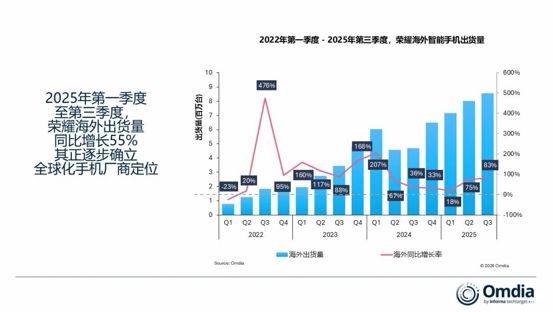
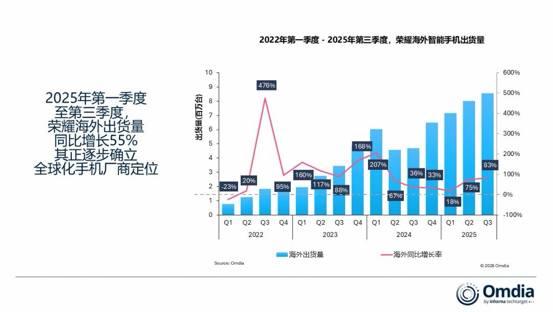
Core Insights - The global smartphone market is expected to grow in 2025, with an annual shipment volume reaching 1.26 billion units, representing a year-on-year increase of 1.9% [1] - Chinese smartphone manufacturers are increasingly focusing on both domestic and overseas markets, with significant growth in international shipments, particularly for Honor [1][4] Group 1: Market Trends - The Chinese smartphone market is evolving, with Honor launching three new models in January 2025, indicating a strategic push in product offerings [1] - Chinese manufacturers account for approximately 60% of global smartphone shipments, with Honor experiencing a notable 55% year-on-year increase in overseas shipments from Q1 to Q3 of 2025 [1][4] Group 2: Strategic Approaches - Chinese companies are adopting two main strategies for overseas expansion: full AI integration and brand premiumization, with a focus on "Glocal" strategies that combine global thinking with local actions [4] - Honor's international business has undergone a structural transformation, with overseas shipments rising from less than 10% of total shipments in early 2021 to nearly 50% by Q3 2025, marking a significant strategic shift [4] Group 3: High-End Market Focus - Honor is positioning itself in the mid-to-high-end market segment, with 23% of its overseas shipments falling within the $300–500 price range during the first three quarters of 2025 [5] - The European market is critical for high-end consumer electronics, and Honor aims to strengthen its presence there, maintaining a top-five market position in key Western European countries [7] Group 4: Product Innovation - Honor has enhanced its product lineup with advanced features, such as the ultra-thin Magic8 Pro Air, which weighs only 155g and is 6.1mm thick while maintaining high performance [10] - The introduction of the ROBOT PHONE, a smartphone integrated with AI capabilities, showcases the innovative direction of Chinese manufacturers [10] Group 5: AI and Technology Advancements - Since 2025, there have been significant advancements in AI capabilities for consumer smartphones, with Honor achieving breakthroughs in on-device AI processing [11] - Huawei's strengths lie in its underlying system capabilities, with the HarmonyOS 6 supporting multi-device AI computing, enhancing the overall user experience [11] Group 6: Future Outlook - 2025 marks a pivotal year for Honor as it transitions from a smartphone manufacturer to a leading AI terminal ecosystem company, with global shipments surpassing 71 million units [12] - The balance between scale expansion, AI capability implementation, and profitability will be crucial for Honor's position in the competitive landscape of smartphones and AI terminals [12]

全球黑电市场洗牌加剧,新显示技术与AI驱动新格局
Nan Fang Du Shi Bao· 2026-01-21 06:37
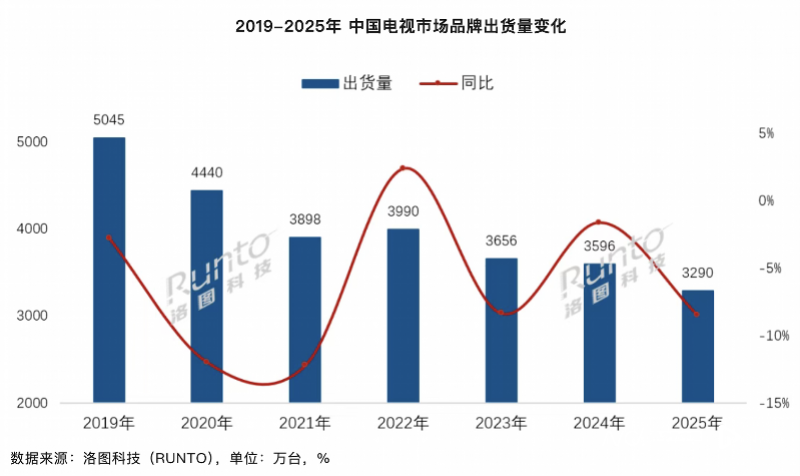
Core Insights - The global television industry is undergoing unprecedented adjustments in 2026, with significant market structural changes driven by large-screen demand, Mini LED technology proliferation, and AI integration [1] Group 1: Market Trends - Global television shipments fell below 200 million units in 2025, marking a ten-year low, with a projected further decline of 5%-7% in 2026 [2] - China's television market, as the largest consumer market, saw a shipment volume of 32.895 million units in 2025, down 8.5% year-on-year, the lowest since 2010 [2] - The first half of 2025 saw a slight increase of 1.4% in shipments due to government subsidies, but the second half experienced a significant decline of 16.9% due to policy effects waning and demand being pulled forward [4] Group 2: Regional Performance - The European market is under pressure, with Western Europe expected to decline, while Eastern Europe shows slight growth due to economic recovery [4] - North America remains relatively stable, supported by a solid consumer base and event marketing [4] - Emerging markets in Asia-Pacific, Latin America, and the Middle East and Africa still have growth potential, but rising memory chip prices may limit actual volume due to price sensitivity [4][5] Group 3: Technology and Innovation - Mini LED technology is expected to enter its popularization phase in 2026, with global shipments projected to exceed 300,000 units, becoming a new profit engine for the high-end market [7] - Chinese brands like Hisense and TCL are leading innovations in RGB-Mini LED and SQD-Mini LED technologies, with significant growth in shipments expected [7][8] - AI technology is redefining the role of televisions, with companies like Huawei and Skyworth investing heavily in AI capabilities to enhance user experience [12][13] Group 4: Competitive Landscape - The competition is shifting from price wars to a comprehensive comparison of technology, supply chain, and globalization capabilities [5] - In 2025, the top three brands—Samsung, TCL, and Hisense—held over 43% of the global market share, with Samsung leading at 35.3 million units shipped [13] - The partnership between Sony and TCL for future strategic cooperation in home entertainment is expected to further disrupt the market dynamics [14]
中国手机厂商开始反击三星苹果们
21世纪经济报道· 2026-01-21 06:27
Core Viewpoint - The global smartphone market is expected to grow, with shipments reaching 1.26 billion units in 2025, reflecting a year-on-year increase of 1.9%. Despite this recovery, the industry faces long-term challenges [1]. Group 1: Market Dynamics - Chinese smartphone manufacturers have established a significant presence in the global market, capturing approximately 60% of global shipments, with brands like OPPO, vivo, Xiaomi, and Honor leading the charge [1]. - Honor has experienced rapid growth, with a reported 55% year-on-year increase in overseas smartphone shipments from Q1 to Q3 of 2025, marking it as the fastest-growing brand among the top ten global smartphone manufacturers [1][4]. Group 2: Strategic Approaches - Chinese companies are adopting two core strategies for international expansion: comprehensive AI integration and high-end branding. This includes a "Glocal" strategy, which combines global thinking with local action [4]. - Honor's international business has undergone a structural transformation, with overseas shipments rising from less than 10% of total shipments in early 2021 to nearly 50% by Q3 2025, indicating a strategic pivot towards international markets [4]. Group 3: Market Segmentation - Historically, Chinese manufacturers dominated the global mid-to-low-end market, but now they are increasingly focusing on the mid-to-high-end segments to balance scale and profitability. Honor is positioning itself in the $300-$500 price range, which accounted for approximately 23% of its overseas shipments in the first three quarters of 2025 [5]. - The high-end market, particularly in Europe, is a critical battleground for consumer electronics, with Honor maintaining a top-five market position in key Western European markets and achieving a 15% year-on-year growth in Central and Eastern Europe [7]. Group 4: Product Innovation - To penetrate the high-end market, product capability is essential. Honor has launched advanced products like the Magic8 series, which features AI-driven capabilities and innovative designs [9]. - The introduction of the ROBOT PHONE, a smartphone integrated with AI and robotics, showcases the innovative direction of Chinese manufacturers, with plans for further details to be revealed at major tech events [10]. Group 5: Future Outlook - The trends of high-end positioning and globalization are expected to continue, with a focus on enhancing product capabilities and user experiences through AI advancements [11]. - For Honor, 2025 marks a pivotal year in its transformation from a smartphone manufacturer to a leading AI terminal ecosystem company, with a global shipment target of over 71 million units and the fastest growth rate among the top ten brands [11][12].

马斯克,剑指“太空AI”
财联社· 2026-01-21 05:47
Core Viewpoint - Tesla is reviving its Dojo 3 supercomputer project, which was previously halted, indicating a significant shift in its chip strategy towards space AI computing [3][4][10]. Group 1: Dojo 3 Project Overview - Dojo 3 was initially designed as a supercomputer for machine learning training, with a focus on architecture restructuring and cost optimization [7]. - The project was paused five months ago due to a strategic decision to concentrate resources on AI5 and AI6 chips, moving away from developing custom chips [5][8]. - The revival of Dojo 3 is based on the successful progress of the AI5 chip design, with Tesla actively recruiting engineers for this initiative [5][8]. Group 2: Space AI Ambitions - The new mission for Dojo 3 includes advancing into "space artificial intelligence computing," aligning with Musk's vision of deploying AI computing centers in space [4][10]. - Musk believes that operating large-scale AI systems in orbit will be more cost-effective than on Earth within the next four to five years, leveraging solar energy and cooling technologies [11]. - This vision connects Tesla's various business interests, potentially positioning the company as a major beneficiary if successful [11]. Group 3: Challenges Ahead - Achieving the goal of space-based AI data centers faces significant challenges, including orbital debris, regulatory approvals, and international space policies [12]. - Cooling high-power computing devices in a vacuum presents practical difficulties, despite theoretical advantages [12][13]. - Constructing large AI data centers in geostationary orbit (GEO) is feasible but requires extensive infrastructure, which poses logistical and financial challenges [13][14].


TCL电子(01070):与索尼达成战略合作,有望推动全球品牌力和盈利能力提升
Guotou Securities· 2026-01-21 05:28
Investment Rating - The investment rating for TCL Electronics is "Buy-A" with a 12-month target price of HKD 13.34, while the current stock price is HKD 10.89 [5][8]. Core Insights - TCL Electronics has signed a strategic cooperation memorandum with Sony to establish a joint venture that will enhance global brand strength and profitability. The joint venture will be 51% owned by TCL and 49% by Sony, focusing on integrated operations for products like televisions and home audio systems, expected to commence in April 2027 [1][3]. - Sony's television business has been underperforming in recent years, with a significant gap in revenue and shipment volume compared to TCL. In 2024, Sony's global television revenue is projected to be RMB 26.6 billion with a shipment of approximately 4.8 million units, while TCL's revenue is expected to be RMB 54.9 billion with around 28.9 million units shipped [2][3]. - The collaboration is anticipated to leverage TCL's strengths in Mini LED technology and supply chain efficiency, combined with Sony's audio-visual expertise, potentially increasing TCL's consolidated revenue and enhancing overall profitability in the television sector [3][4]. Financial Projections - TCL Electronics is projected to achieve a significant increase in adjusted net profit for 2025, estimated between HKD 2.33 billion and HKD 2.57 billion, representing a year-on-year growth of 45% to 60% [3]. - The company aims for continued growth through globalization and a focus on mid-to-high-end products, with expected earnings per share (EPS) of HKD 0.98, HKD 1.21, and HKD 1.48 for the years 2025, 2026, and 2027 respectively [4][9]. - Revenue forecasts indicate a growth trajectory from HKD 99.32 billion in 2024 to HKD 151.2 billion by 2027, with net profit projected to rise from HKD 1.76 billion in 2024 to HKD 3.74 billion in 2027 [9][17].
中国手机厂商加码海外高端市场 荣耀结构性转变
2 1 Shi Ji Jing Ji Bao Dao· 2026-01-21 03:55
Core Insights - The global smartphone market is projected to grow in 2025, with an expected shipment volume of 1.26 billion units, reflecting a year-on-year increase of 1.9% [1] - Chinese smartphone manufacturers are increasingly focusing on both domestic and overseas markets, with significant growth in international shipments, particularly for Honor [1][3] Industry Overview - The smartphone industry is experiencing a recovery phase, but it still faces long-term challenges [1] - Chinese manufacturers hold approximately 60% of the global smartphone shipment share, with brands like OPPO, vivo, Xiaomi, and Honor leading the market [1] - Honor's overseas smartphone shipments are expected to grow by about 55% year-on-year in the first three quarters of 2025, marking significant international expansion [1][3] Strategic Shifts - Chinese companies are adopting two main strategies for overseas markets: full AI integration and brand premiumization [3] - Honor's international business has undergone a structural transformation, with overseas shipments rising from less than 10% of total shipments in early 2021 to nearly 50% by the third quarter of 2025 [3] - The competition is shifting from a focus on scale to a focus on stability and capability, with high-end positioning becoming essential for profit restructuring and brand recognition [6][9] Market Positioning - Honor is targeting the mid-to-high-end market segment, with 23% of its overseas shipments in the $300–500 price range during the first three quarters of 2025 [4] - Europe is a critical battleground for high-end consumer electronics, and Honor aims to solidify its position in key Western European markets [6] - Latin America and the Middle East and Africa are emerging as core regions for Honor's overseas shipment growth [6] Product Development - Product strength is crucial for penetrating the high-end market, with manufacturers enhancing their high-end offerings [7] - Honor has introduced innovative products like the Magic8 series and the ROBOT PHONE, which integrates AI capabilities and advanced imaging [7][8] - The AI capabilities of Chinese manufacturers are becoming a competitive advantage, with advancements in localized AI applications enhancing user experience [8][9] Future Outlook - The trends of high-end positioning and globalization are expected to continue shaping the market landscape [8][9] - Honor's "Alpha Strategy," launched in March 2025, signifies its transition from a smartphone manufacturer to a leading AI terminal ecosystem company, with global shipments projected to exceed 71 million units [9] - The new management team faces the challenge of balancing scale expansion, AI capability implementation, and profitability to maintain a leading position in the competitive landscape [9]
杀疯了!进入暴涨模式!
Sou Hu Cai Jing· 2026-01-21 03:48
Group 1 - The global environment is increasingly unstable, with significant declines in US tech stocks and geopolitical tensions, indicating a trend towards fragmentation and anti-globalization [1] - A warning has been issued regarding the onset of a capital war, transitioning from tariff and trade conflicts to competition over resources and capital [2][3] - The battle for capital and resource pricing power is expected to be the most challenging aspect of this conflict [4] Group 2 - This conflict is projected to last for a decade or more, with the potential for the victor to emerge as the global leader [5] - The ongoing political climate under the current US administration suggests increasing chaos in global affairs [6] - The price of gold is expected to strengthen significantly, with recent prices surpassing historical highs, indicating a bullish outlook for precious metals [7][8] Group 3 - Precious metals, including gold and silver, are entering a super cycle, benefiting from the current geopolitical and economic climate [9] - There has been a consistent demand expansion for various metals such as tin, lithium, and copper since the second half of last year, expected to continue at least until the first quarter [10] - Countries worldwide are stockpiling gold and other resources, indicating a shift towards resource accumulation [11] Group 4 - The future is characterized by two main themes: the era of resource dominance and the era of AI [12][13] - The scarcity of resources is becoming critical, with the potential for significant price increases due to deliberate stockpiling and currency devaluation [14] - The AI sector is anticipated to continue its rapid expansion, with storage capacity becoming a bottleneck for growth [15][16] Group 5 - The year 2026 is highlighted as a pivotal moment for storage technology, with major players like Samsung and Micron dominating the market, potentially disadvantaging Chinese manufacturers [18] - The disparity between excess production capacity and scarce assets is expected to lead to a surge in resource prices [18]
TCL将控股索尼电视音响业务,拟设合资公司2027年运营
Cai Jing Wang· 2026-01-21 03:43
未来,新公司将充分发挥索尼在音视频领域积累的技术、品牌力及供应链等运营管理能力,融合TCL的 显示技术、全球化规模优势、完善产业布局、端到端成本效率及垂直供应链优势,积极推进业务发展。 新公司包括电视机和家庭音响在内的产品将用"Sony"和"BRAVIA"品牌。(一财) 根据备忘录,双方拟设立一家承接索尼家庭娱乐业务、由TCL持股51%、索尼持股49%的合资公司(下 称"新公司"),并在全球范围内开展包括电视机和家庭音响等产品在内的,从产品开发、设计、制造、 销售、物流到客户服务的一体化业务运营。 双方计划2026年3月底前就订立具有法律约束力的最终协议进行磋商。在最终协议签署并取得相关主管 部门批准等条件满足后,新公司预计将于2027年4月开始运营。 【#TCL收购索尼电视#】1月20日,索尼公司与TCL电子控股有限公司签署意向备忘录,TCL将控股索 尼的电视和音响业务。TCL去年全球彩电出货量居行业第二,与三星的差距缩小,一旦控股索尼电视业 务,将向行业首位更进一步。 此次并非中国企业与日本企业在品牌电视业务上的首次战略合作,之前海信电视收购了东芝电视业务。 去年,创维接替船井电机,承接了飞利浦电视在北美 ...


东海证券晨会纪要-20260121
Donghai Securities· 2026-01-21 02:57
Group 1: Key Recommendations - The report emphasizes the revaluation of private refining companies in the petrochemical industry, highlighting that the petrochemical cycle is under pressure but shows signs of improvement ahead [6][7] - Key drivers for the petrochemical cycle include rising oil prices, supply-side capacity clearance, and demand-side stimulus from a loose monetary environment [6][7] - The report predicts that Brent oil prices will fluctuate between $55 and $75 per barrel in 2026, which could benefit refining profitability [7][8] Group 2: Economic Observations - The nominal GDP growth rate stabilized, with Q4 2025 GDP growth at 4.5%, slightly down from 4.8% in Q3 [11][12] - The contribution rates to GDP from final consumption, capital formation, and net exports were 52.9%, 16.0%, and 31.1% respectively in Q4 2025, indicating strong export support and stable consumption [13] - Investment showed a downward trend, with fixed asset investment growth at -3.8% for the year, highlighting the need for policy support to stabilize investment [15][16] Group 3: Industry Insights - TSMC's capital expenditure for 2026 is projected to be between $52 billion and $56 billion, significantly exceeding market expectations, driven by demand for AI and advanced process technologies [18][20] - The global smartphone market showed resilience in 2025, with a total shipment of 1.26 billion units, a 1.9% increase year-on-year, driven by high-end models and foldable screens [21][22] - The report suggests that the semiconductor industry is experiencing upward price trends, particularly in storage chips, indicating structural investment opportunities [19][23]

CES Asia 2026:以“新质生产力”为核,驱动全球消费电子产业新跃迁
Sou Hu Cai Jing· 2026-01-21 02:44
依托京津冀与长三角产业协同优势,展会将构建"研发+制造+市场"的跨区域赋能网络:北京聚焦前沿技术创新,廊坊北三县承接中试孵化,长三 角提供完善制造配套,形成科创要素与产业资源的高效流动。这种生态协同效应,让参展企业既能链接全球顶尖技术理念,又能快速对接本土化 产能与市场渠道,实现"全球技术+中国产能+亚洲市场"的闭环布局。 专业平台价值凸显,企业参展迎来黄金机遇 ——2026年6月北京启幕,打造国家战略对接与全球创新展示核心平台 当新质生产力成为重塑全球产业格局的核心引擎,消费电子作为技术创新与市场应用的前沿阵地,正迎来从"规模增长"向"质效跃迁"的关键转 折。2026年6月10日至12日,亚洲顶级消费电子盛会CES Asia将落地北京亦创国际会展中心,以"新质生产力"为核心锚点,汇聚人工智能 (AI)、具身智能、绿色科技等关键要素,构建链接国家战略、全球资源与市场需求的顶级生态平台,为全球消费电子企业提供定义未来、卡位 赛道的战略机遇。 新质生产力要素聚合,构建产业创新生态闭环 作为全球消费电子产业的"创新风向标",CES Asia 2026深度契合新质生产力发展内核,将前沿技术、产业需求与可持续发展目标深 ...