特变电工

Search documents
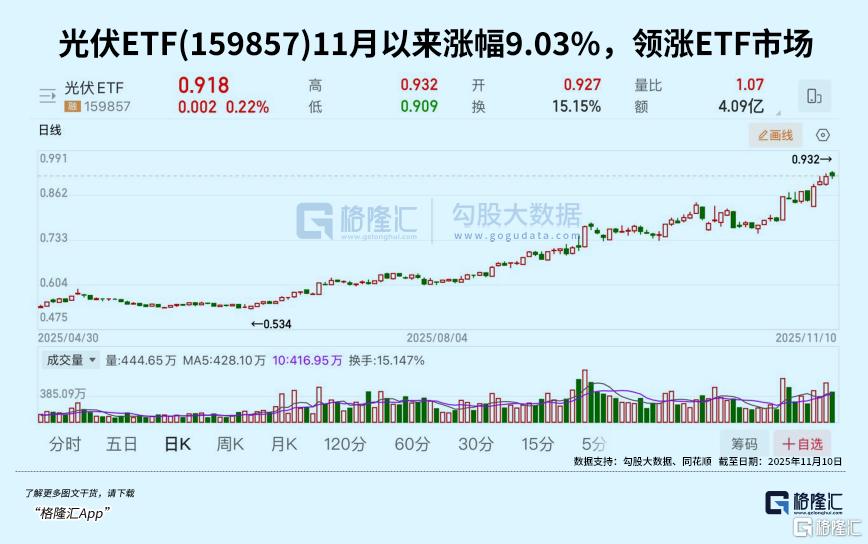
11月以来,新能源赛道领涨,光伏ETF龙头涨超10%,光伏50ETF、光伏ETF涨超9%
Ge Long Hui· 2025-11-11 05:35
消息面上,11月10日,国家发展改革委、国家能源局发布促进新能源消纳和调控的指导意见(以下简称"意见"),其中提出,到2030年,协同高 效的多层次新能源消纳调控体系基本建立,持续保障新能源顺利接网、多元利用、高效运行,新增用电量需求主要由新增新能源发电满足。意见 明确,完善促进新能源消纳的全国统一电力市场体系,完善适应新能源参与电力市场的规则体系。推动建立"沙戈荒"、水风光新能源基地一体化 模式参与市场的交易规则;支持分布式新能源、储能、虚拟电厂等新型主体通过聚合、直接交易等模式参与电力市根据国家能源局数据,2025年9 月国内光伏新增装机9.7GW,同比-53.8%,环比+31.2%。国内1-9月累积新增光伏装机240.27GW,同比+49.3%。 根据海关总署数据,9月组件出口额199.8亿元,同比+39.0%,环比-4.7%。1-9月累计出口额1521.8亿元,同比-13.3%。根据SMM不完全统计, 2025年9月国内光伏组件出口量25.6GW,同比+46.8%,环比-6.0%;2025年1-9月国内光伏组件累计出口量204.3GW,同比+4.6%。 (原标题:11月以来,新能源赛道领涨,光伏ETF ...


流动性打分周报:中长久期低评级城投债流动性上升-20251111
China Post Securities· 2025-11-11 05:21
1. Report Industry Investment Rating - No industry investment rating information is provided in the report. 2. Core View of the Report - The report focuses on the liquidity of bonds in the bond market, including the liquidity of urban investment bonds and industrial bonds. The liquidity of medium - long - term and low - rated bonds in both urban investment bonds and industrial bonds has increased. [2][3][8][18] 3. Summary by Relevant Catalogs 3.1 Urban Investment Bonds - **Liquidity Quantity Changes**: Medium - long - term and low - rated high - grade liquidity urban investment bonds have increased. Regionally, the number of high - grade liquidity debt items in Shandong has increased, while that in Jiangsu has decreased, and Sichuan, Tianjin, and Chongqing have remained stable. In terms of maturity, the number of high - grade liquidity debt items with a maturity of 3 - 5 years and over 5 years has increased, while those with a maturity of less than 1 year, 1 - 2 years, and 2 - 3 years have decreased. In terms of implicit rating, the number of high - grade liquidity debt items with AAA, AA(2), and AA - has increased, while those with AA+ and AA have decreased. [8] - **Yield Changes**: Regionally, the yields of high - grade liquidity debt items in Jiangsu, Shandong, Sichuan, Tianjin, and Chongqing have mainly decreased, with the fluctuation range concentrated at 1 - 5bp. In terms of maturity, the yields of high - grade liquidity debt items with a maturity of 1 - 2 years have mainly increased, while those with a maturity of less than 1 year, 2 - 3 years, 3 - 5 years, and over 5 years have mainly decreased, with the fluctuation range concentrated at 1 - 3bp. In terms of implicit grade, the yields of high - grade liquidity debt items with AAA, AA+, and AA have mainly increased, while those with AA(2) and AA - have decreased, with the fluctuation range concentrated at 1 - 2bp. [10][11] - **Top 20 Liquidity Score Increase and Decrease**: The top 20 entities with an increase in liquidity score are mainly from industries such as architectural decoration and transportation, with the entity levels mainly being AA and AA+. The regions are concentrated in Zhejiang, Jiangsu, Shandong, and Anhui. The top 20 entities with a decrease in liquidity score are mainly from industries such as architectural decoration and real estate, with the entity levels mainly being AA and AA+, and the regions mainly including Jiangsu and Hubei. [13] 3.2 Industrial Bonds - **Liquidity Quantity Changes**: The number of high - grade liquidity industrial bonds with medium - long - term and low - rating has increased. By industry, the number of high - grade liquidity debt items in the real estate, public utilities, and coal industries has increased, while those in the transportation and steel industries have decreased. In terms of maturity, the number of high - grade liquidity debt items with a maturity of 2 - 3 years and 3 - 5 years has increased, those with a maturity of less than 1 year have decreased, and those with a maturity of 1 - 2 years and over 5 years have remained stable. In terms of implicit rating, the number of high - grade liquidity debt items with AA+ and AA has increased, those with AAA - have decreased, and those with AAA+ and AAA have remained stable. [18] - **Yield Changes**: By industry, the yields of high - grade liquidity debt items in the real estate and steel industries have mainly increased, those in the public utilities industry have decreased, and those in the transportation and coal industries have fluctuated up and down, with the fluctuation range concentrated at 1 - 5bp. In terms of maturity, the yields of high - grade liquidity debt items with a maturity of 1 - 2 years, 3 - 5 years, and over 5 years have mainly increased, while those with a maturity of less than 1 year and 2 - 3 years have decreased, with the fluctuation range concentrated at 1 - 4bp. In terms of implicit grade, the yields of high - grade liquidity debt items at each implicit level have fluctuated slightly. [20] - **Top 20 Liquidity Score Increase and Decrease**: The top 20 entities with an increase in liquidity score are mainly from industries such as architectural decoration, transportation, and public utilities, with the entity levels mainly being AAA and AA+. The top 20 bonds are mainly from industries such as real estate and public utilities. The top 20 entities with a decrease in liquidity score are mainly from industries such as architectural decoration, commercial retail, and public utilities, with the entity levels mainly being AAA and AA+. The top 20 bonds are mainly from industries such as transportation and architectural decoration. [20][22]
高盛客户看好AI+能源领域,电网设备(159326)规模创历史新高,炬华科技等股开盘直线涨停
Mei Ri Jing Ji Xin Wen· 2025-11-11 02:43
Group 1 - The electric grid equipment ETF (159326) has seen continuous net inflows for 11 days, accumulating over 1.3 billion yuan, reaching a historical high of 1.772 billion yuan [1] - The ETF is the only one tracking the China Securities Electric Grid Equipment Theme Index, with a strong representation in sectors such as power transmission and transformation equipment, grid automation equipment, and distribution equipment [2] - The ETF's top ten holdings include industry leaders like Guodian NARI, TBEA, and Siyuan Electric, with a significant weight of 64% in ultra-high voltage [2] Group 2 - There is a growing interest among high-net-worth individuals in investment opportunities related to AI in the energy and healthcare sectors, as discussed at a Goldman Sachs private wealth management meeting [1] - The shortage of electricity in North America may lead to a backlog of chips, creating a dilemma for technology companies regarding long-term power contracts versus potential losses from breakthroughs in renewable energy technology [1] - The electric equipment export opportunities are worth noting, especially as the short-term development of AI in North America is constrained by insufficient power supply [1]

大消费板块助力沪指重新站上4000点 机构认为市场或仍处于上行趋势中
Zhong Guo Zheng Quan Bao· 2025-11-11 02:16
Core Viewpoint - The A-share market experienced fluctuations with a strong performance in the consumer sector, leading the Shanghai Composite Index to rise by 0.53% and surpass the 4000-point mark again, indicating a potential recovery in consumer demand and economic growth [1][4][8]. Market Performance - On November 10, the A-share market saw all three major indices open higher, with the Shanghai Composite Index and Shenzhen Component Index increasing by 0.53% and 0.18%, respectively, while the ChiNext Index and other indices declined [2]. - The total number of rising stocks in the A-share market reached 3376, with 92 stocks hitting the daily limit up, and the market turnover was 2.19 trillion yuan, marking a significant increase from the previous trading day [2][3]. Sector Analysis - The consumer sector showed robust growth, with notable performances in dairy, liquor, lithium battery electrolyte, pet economy, and new economy sectors. The beauty care, food and beverage, and retail sectors led the gains, with increases of 3.60%, 3.22%, and 2.69%, respectively [3][4]. - Conversely, high-tech stocks experienced adjustments, with significant declines in companies like Guosheng Quantum and New Yi Sheng [4]. Fund Flow and Sentiment - Recent market activity indicated a divergence in fund sentiment, with a net outflow of main funds for six consecutive trading days, despite an increase in A-share financing balance by over 6 billion yuan [5][6]. - The financing balance for A-shares reached approximately 24.94 trillion yuan, with notable inflows in sectors such as power equipment and basic chemicals, while sectors like non-bank financials and metals saw significant net selling [5][6][7]. Future Outlook - Analysts suggest that the rise in core CPI, which increased by 1.2% year-on-year, signals a recovery in consumer demand, supporting the consumer sector's strength and laying a foundation for a gradual upward trend in the A-share market [4][8]. - The market is expected to experience a period of consolidation in the short term, with a focus on sectors like technology and cyclical industries benefiting from economic recovery [8].
电网升级按下“加速键”,电网设备ETF(159326)11日“吸金”超13亿元,规模再创新高
Mei Ri Jing Ji Xin Wen· 2025-11-11 01:33
Core Viewpoint - The electric grid equipment sector is experiencing a significant upward trend, supported by favorable policies and increasing investment in the sector, particularly through the electric grid equipment ETF (159326) which has seen substantial net inflows and growth in scale [1][2]. Group 1: Market Performance - On November 10, the overall market showed a fluctuating upward trend, with the electric grid equipment sector displaying a "V" shape in its performance [1]. - The electric grid equipment ETF (159326) narrowed its decline to 0.70%, with a trading volume exceeding 543 million yuan [1]. - As of November 11, the electric grid equipment ETF (159326) has recorded net inflows for 11 consecutive days, totaling over 1.3 billion yuan, reaching a scale of 1.772 billion yuan, marking a new high since its inception [1]. Group 2: Policy and Industry Outlook - A new policy titled "Guiding Opinions on Promoting New Energy Consumption and Regulation" was issued on November 10, setting targets for new energy consumption regulation by 2030 and 2035 [1]. - By 2030, a multi-level new energy consumption regulation system is expected to be established, ensuring smooth integration of new energy into the grid and promoting sustainable development of new energy consumption models [1]. - Huatai Securities expresses optimism about the steady increase in China's electrification rate, which will synergistically promote the upgrade of the electric grid and the construction of new energy storage systems, accelerating the development of a new power system [2]. Group 3: ETF and Industry Composition - The electric grid equipment ETF (159326) is the only ETF tracking the CSI Electric Grid Equipment Theme Index, with a strong representation in the sectors of transmission and transformation equipment, grid automation, cable components, and distribution equipment [2]. - The index has a high weight of 64% in ultra-high voltage equipment, the highest in the market, with leading companies such as Guodian NARI, TBEA, Siyuan Electric, and Trina Solar among its top ten holdings [2].
从算力到电力 - 寻找产业链的瓶颈环节
2025-11-11 01:01
Summary of Key Points from Conference Call Industry Overview - The conference call discusses the global power equipment industry, particularly focusing on the impact of renewable energy development and the increasing importance of energy storage solutions. The energy storage market is expected to experience significant growth by 2025, closely tied to renewable energy sources [1][4][11]. Core Insights and Arguments - **Energy Storage Demand**: The demand for energy storage has risen significantly due to the instability of renewable energy generation. China has increased its energy storage capacity to mitigate waste from wind and solar energy, with expectations of a market explosion in 2025 and 2026 as product prices decline [1][4][11]. - **AIDC Impact**: The construction of Artificial Intelligence Data Centers (AIDC) is accelerating the need for grid upgrades and power equipment, with growth rates projected between 30% to 50% in 2026. This has created a sustained demand for key electrical equipment [1][2][5]. - **Transformer Market Tension**: The U.S. transformer market is under strain due to supply chain issues and geopolitical tensions. Although Chinese companies have the capacity to supply, they are limited to branding strategies due to political factors. The market is expected to remain tight through 2026 [1][7][12]. - **Technological Advancements**: Solid-state transformer (SST) technology is evolving to meet the demands of AIDC for efficient and stable power supply. This technology reduces energy loss and is expected to drive the industry towards greater electronic and intelligent solutions [1][8][18]. - **European Offshore Wind Demand**: The demand for offshore wind energy in Europe is recovering, with expectations of rapid growth in installed capacity by 2026 and 2027. The supply chain for wind energy is currently under pressure, indicating a continued tight market [1][9][10]. Additional Important Insights - **Bottlenecks in Supply**: The industry faces several bottlenecks, including insufficient SOC capacity and tight transformer supplies, which are expected to persist from 2026 to 2027. The increase in GPU supply may exacerbate the supply-demand imbalance [2][22]. - **Emerging Technologies**: Solid oxide fuel cells (SOFC) and solid-state batteries are highlighted as key areas of focus for future development, with SOFC being one of the few technologies capable of providing incremental power supply [21][22]. - **Chinese Market Position**: Chinese companies hold a significant position in the global power equipment supply chain, particularly in transformers, energy storage, and photovoltaic sectors. They are noted for their rapid response capabilities and comprehensive manufacturing systems, although they face challenges in brand trust and channel development, especially in the U.S. market [15][20][17]. - **Domestic Market Trends**: The domestic market in China is experiencing a surge in demand, particularly in the western provinces due to policy incentives. The U.S. market is also seeing a spike in demand driven by legislative requirements for tax incentives [12][23]. This summary encapsulates the critical points discussed in the conference call, providing insights into the current state and future trends of the power equipment industry.
促进新能源消纳和调控的指导意见发布;黄金再度大涨丨盘前情报
2 1 Shi Ji Jing Ji Bao Dao· 2025-11-11 00:37
Market Overview - On November 10, the A-share market showed a mixed performance with the Shanghai Composite Index rising by 0.53% to close at 4018.66, while the Shenzhen Component Index increased by 0.18% to 13427.61. The ChiNext Index fell by 0.92% to 3178.83 [2][3] - The total trading volume in the Shanghai and Shenzhen markets reached 2.17 trillion, an increase of 175.4 billion compared to the previous trading day [2] Sector Performance - The consumer sector experienced a significant rally, particularly in food and beverage stocks, which led the gains. Other active sectors included lithium batteries and solar energy, while the humanoid robot concept saw a decline [2] - Notable gainers included the liquor, tourism and hotel, and duty-free shop sectors, while gas, wind power equipment, and robotics sectors faced losses [2] International Market - The U.S. stock market saw significant gains on November 10, with the Dow Jones Industrial Average rising by 381.53 points (0.81%) to 47368.63, the S&P 500 increasing by 103.63 points (1.54%) to 6832.43, and the Nasdaq Composite up by 522.64 points (2.27%) to 23527.17 [4][5] - European markets also experienced upward movement, with the FTSE 100 rising by 104.58 points (1.08%), the CAC 40 increasing by 105.33 points (1.32%), and the DAX up by 390.03 points (1.65%) [4] Commodity Prices - International oil prices saw a slight increase, with WTI crude oil futures rising by $0.38 to $60.13 per barrel (0.64%) and Brent crude oil futures increasing by $0.43 to $64.06 per barrel (0.68%) [4] Investment Trends - The investment community is focusing on the growth of the new energy vehicle market, with October retail sales reaching 1.282 million units, a year-on-year increase of 7.3% [8] - The Chinese government is promoting private investment in key infrastructure projects, encouraging private capital participation in sectors such as railways and energy [7] Fund Management - The China Fund Industry Association is seeking feedback on new guidelines aimed at controlling style drift and high concentration in theme-based investment funds, which have faced criticism in the past [6] Capital Flow - The liquor industry saw a net inflow of 29.81 billion, with a notable performance from Kweichow Moutai, while the consumer electronics sector experienced a significant outflow of 53.55 billion [12] - Key stocks with substantial net inflows included Cambridge Technology and China Duty Free, while major outflows were observed in Industrial Fulian and Xin Yisheng [13]
大消费大涨!市场风格要切换了吗?
Mei Ri Jing Ji Xin Wen· 2025-11-10 12:48
Market Overview - The A-share market showed mixed performance with the Shanghai Composite Index rising above 4000 points, closing up by 0.53% while the ChiNext Index and the STAR Market Index fell by 0.92% and 0.57% respectively [1] - The total trading volume in the Shanghai and Shenzhen markets reached 21,745 billion yuan, an increase of 1,754 billion yuan compared to the previous trading day [1] - A total of 3,376 stocks rose while 1,957 stocks fell, with a median increase of 0.48% for individual stocks [1] Market Sentiment and Trends - The absence of a core market anchor has been noted, contrasting with the previous months where "Yi Zhongtian" served as a stabilizing force for market sentiment [3] - Recent market fluctuations have shown that the sustainability of sector rotations is limited, with core stocks in AI applications and energy storage showing only about three days of performance continuity [3][4] - The trading volume has remained around 20 trillion yuan, which has constrained market momentum [4] Sector Performance - Consumer sectors, including hotels, restaurants, and beverages, have shown strong performance today, driven by rising CPI data [4] - The AI technology sector experienced significant adjustments, impacting overall market sentiment [4] - The report from Guohai Securities suggests that the market may see a phase shift towards previously underperforming sectors such as banks and cyclical stocks, especially if there are supportive macroeconomic events [5][6] Trading Strategy - The current market dynamics suggest a cautious approach, with an emphasis on stability and minimizing losses rather than chasing high-risk opportunities [9] - The recent surge in trading volume in the consumer sector indicates potential for continued interest, but sustainability needs to be monitored over the next few days [7] Regulatory Developments - The National Development and Reform Commission and the National Energy Administration have issued guidelines to promote the consumption and regulation of renewable energy, which is expected to benefit the renewable energy sector [9]
政策发力、价格飙涨,资金疯抢
Ge Long Hui· 2025-11-10 10:57
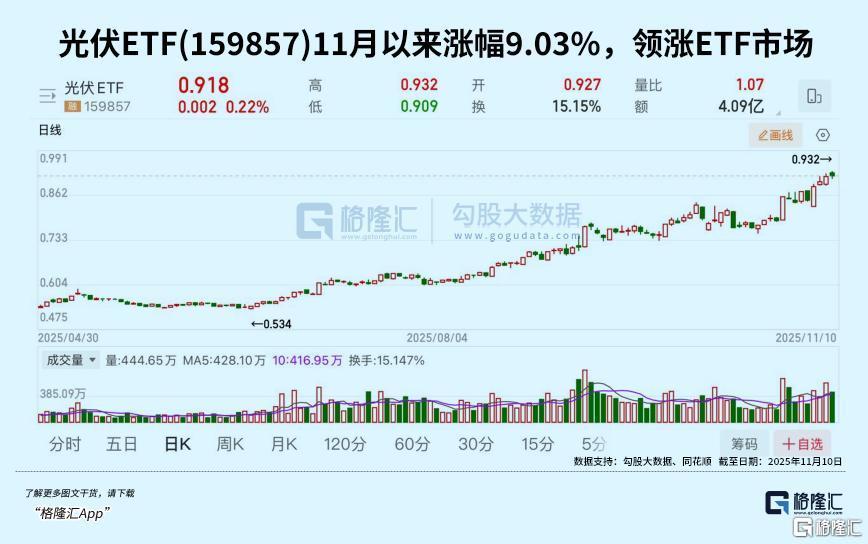
Core Viewpoint - The photovoltaic industry is experiencing a significant rebound in prices and performance, driven by policy support, market adjustments, and technological innovations, marking a critical turning point for the sector in 2025 [3][10][31]. Price Rebound - The photovoltaic sector has collectively strengthened, primarily due to rising prices [4]. - The price of polysilicon hit a low in mid-2025 and began a strong rebound in the third quarter, with N-type silicon prices increasing from approximately 34,400 yuan/ton to around 47,100 yuan/ton in just one month, reflecting a 37% increase [5][6][7]. - By September 2025, polysilicon prices surpassed 50,000 yuan/ton, leading to price increases in downstream products like silicon wafers and battery cells [8]. - The average price of domestic TOPCon double-glass modules in September 2025 was about 0.715 yuan/watt, a 3.6% increase from July [9]. - The price rebound is attributed to strong policy interventions and market clearing, moving the industry away from a cycle of losses [10][11]. Performance Recovery - Recent performance data from leading photovoltaic companies indicate a recovery phase, with many entering a "significant loss reduction" phase [15][17]. - For instance, Sunshine Power reported a Q3 2025 revenue of 22.869 billion yuan, a 20.83% year-on-year increase, and a net profit of 4.147 billion yuan, up 57.04% [16]. - Longi Green Energy recorded a revenue of 50.915 billion yuan in Q3 2025, with losses narrowing by 48% compared to the previous year [16]. - Overall, the industry is showing signs of recovery, with institutional funds reallocating towards the photovoltaic sector, marking a shift from previous net outflows [18]. Future Drivers - The long-term demand for photovoltaic energy remains strong, with the International Energy Agency predicting that renewable energy will account for 43% of global electricity generation by 2030 [21][22]. - The "anti-involution" policy is fundamentally changing the industry by shifting focus from price competition to high-quality value competition [24][25]. - This policy is leading to a gradual recovery of product prices, with polysilicon prices in Q3 2025 rising above the comprehensive cost line, setting the stage for profitability across the industry [25]. - The industry is also witnessing a shift in focus towards technological innovation, with resources being directed towards advanced technologies like BC back-contact cells and perovskite materials [27][28]. Conclusion - The photovoltaic industry is at a critical turning point in 2025, characterized by rational valuation, visible performance inflection points, favorable policy environments, accelerated technological iterations, and renewed capital inflows [31][32]. - The overall attractiveness of the photovoltaic sector is drawing investment, particularly towards leading companies with strong operational and financial health [32][33].




政策发力、价格飙涨!资金疯抢
Ge Long Hui· 2025-11-10 10:41
Core Viewpoint - The photovoltaic industry is experiencing a significant rebound in prices and performance, driven by policy support, market adjustments, and technological innovations, marking a critical turning point for the sector in 2025 [3][11][34]. Price Rebound - The photovoltaic sector has collectively strengthened, primarily due to rising prices [4]. - The price of polysilicon hit a low in mid-2025 and began a strong rebound in the third quarter, with N-type silicon material prices increasing from approximately 34,400 CNY/ton in late June to around 47,100 CNY/ton by the end of July, marking a 37% increase in just one month [5][6][7]. - By September 2025, the price of polysilicon surpassed 50,000 CNY/ton [8]. - The price increases in upstream materials have led to corresponding rises in the prices of silicon wafers and battery cells, with N-type G10L silicon wafers seeing a weekly price increase of 9.09% in late July [9]. - The average price of domestic TOPCon double-glass modules in September 2025 was approximately 0.715 CNY/W, reflecting a 3.6% increase from July [10]. Performance Recovery - The latest performance data from photovoltaic companies indicates a recovery phase, with many firms entering a "significant loss reduction" phase after price stabilization [16]. - For instance, Sunshine Power reported a Q3 2025 revenue of 22.869 billion CNY, a year-on-year increase of 20.83%, with net profit soaring by 57.04% to 4.147 billion CNY [17]. - Longi Green Energy recorded a Q3 2025 loss of 834 million CNY, but this was a 48% reduction compared to the previous year, with revenue of 50.915 billion CNY [17]. - TBEA's Q3 2025 revenue slightly increased by 0.31% to 24.566 billion CNY, while net profit surged by 81.51% to 2.3 billion CNY [17]. - Overall, these performance metrics confirm that the photovoltaic industry has reached a bottom and is entering a recovery phase [18]. Future Drivers - Long-term demand for the global photovoltaic market remains strong, with the International Energy Agency predicting that renewable energy will account for 43% of global electricity generation by 2030, with solar power surpassing hydropower as the leading renewable source [22][23]. - The "anti-involution" policy is fundamentally changing the industry by shifting focus from price competition to high-quality value competition [25]. - The price of polysilicon has rebounded above the comprehensive cost line in Q3 2025, laying the groundwork for profitability recovery across the industry [27]. - Major companies are showing greater self-discipline by slowing down production expansion and shutting down inefficient capacities, significantly improving market supply-demand dynamics [28]. - The "anti-involution" policy is also reshaping the innovation ecosystem within the industry, allowing companies to invest more in technological research and development [30]. Conclusion - The photovoltaic industry is at a critical turning point in 2025, characterized by rational valuation, visible performance inflection points, favorable policy environments, accelerated technological iterations, and renewed capital inflows [34]. - The overall valuation and growth potential of the photovoltaic sector are attractive, drawing in investments focused on leading technology firms and financially healthy companies capable of pursuing new technological directions [35].