
宇通客车

Search documents
汽车周观点:9月第1周乘用车环比-30.0%,继续看好汽车板块-20250915
Soochow Securities· 2025-09-15 01:52
Investment Rating - The report maintains a positive outlook on the automotive sector, suggesting an increase in allocation towards automotive dividend style configurations in the second half of 2025 [4]. Core Insights - The automotive industry is at a crossroads, with the end of the electric vehicle (EV) dividend phase and the dawn of automotive intelligence. The report suggests that structural opportunities may arise similar to previous transitions in 2011 and 2018 [4]. - The report emphasizes the importance of domestic consumption expansion and quality improvement in the automotive sector, as outlined in the "Automotive Industry Stabilization and Growth Work Plan (2025-2026)" issued by eight government departments [51]. - The report forecasts a total vehicle sales target of approximately 32.3 million units for 2025, with a year-on-year growth of about 3%, and expects new energy vehicle sales to reach around 15.5 million units, growing by approximately 20% [51][52]. Summary by Sections Weekly Review - In the first week of September, the total number of compulsory insurance for passenger vehicles was 360,000 units, reflecting a week-on-week decrease of 30.0% [50]. - The report highlights the performance of various segments, with commercial trucks showing the best performance at +4.2%, while passenger vehicles declined by -1.8% [3]. Market Performance - The automotive sector ranked 15th in A-shares and 21st in Hong Kong stocks for the week, indicating a relatively average performance compared to other sectors [8][10]. - The report notes that the overall price-to-earnings (P/E) ratio for the automotive sector has decreased, with specific segments like passenger vehicles trading at 0.94 times the P/E of parts [36][43]. Industry Trends - The report identifies key changes in the industry, including new model announcements and strategic partnerships aimed at accelerating the commercialization of autonomous vehicles [3]. - The report anticipates a significant increase in the penetration of L3 and L2+ intelligent driving technologies by 2025, driven by major players like Tesla and Huawei [55][56]. Investment Recommendations - The report recommends focusing on dividend and quality configurations in segments such as buses, heavy trucks, and two-wheelers, as well as selecting stocks in the AI and robotics sectors [4]. - Specific stocks highlighted for potential investment include Yutong Bus, China National Heavy Duty Truck, and various parts manufacturers [4].
新能源与新材料周度报告:新能源汽车全年目标销量1550万辆,增速20%左右-20250914
Dong Zheng Qi Huo· 2025-09-14 13:16
1. Report Industry Investment Rating No relevant content provided. 2. Core Viewpoints of the Report - The "Automobile Industry Steady Growth Work Plan (2025 - 2026)" aims for about 32.3 million vehicle sales in 2025, a 3% YoY increase, with around 15.5 million new energy vehicle sales, a 20% YoY increase, and a 6% YoY growth in automobile manufacturing added - value. In 2026, the industry is expected to maintain a stable and positive development trend [1][105][116]. - From January to August, China's automobile sales reached 21.128 million, a 12.6% YoY increase, and new energy vehicle sales were 9.62 million, a 36.7% YoY increase, achieving 65.4% and 61.9% of the annual targets respectively [1][106][118]. - In the 36th week (September 1 - 7), new energy passenger vehicle retail sales were 220,000, a 0.5% YoY decrease, and the annual cumulative retail sales were 7.645 million, a 23.4% YoY increase. The single - week penetration rate reached 60.6%, and the annual cumulative penetration rate was 51.9%, showing a slow upward trend [2][109][118]. - In July, global new energy vehicle sales reached 1.392 million, an 18.5% YoY increase, and from January to July, sales were 9.233 million, a 25.9% YoY increase. Except for China, Europe and other regions had significant growth, with 29.5% and 53.4% growth respectively from January to July [2][118]. - In August, the US new energy vehicle sales were 177,000, an 18.4% YoY increase, much higher than the overall vehicle growth rate of 2%. From January to August, the cumulative sales were 1.01 million, a 2.4% YoY increase [2][112][119]. 3. Summary by Related Catalogs 3.1 Financial Market Tracking - The weekly price changes of relevant sectors and listed companies are presented. For example, BYD's closing price on September 12 was 105.91 yuan, with a - 1.26% weekly change; CATL's closing price was 325 yuan, with a - 0.03% weekly change [13][15][16]. 3.2产业链数据跟踪 3.2.1 China New Energy Vehicle Market Tracking - **Sales and Exports**: In August, new energy vehicle production and sales were 1.391 million and 1.395 million respectively, with YoY growth of 27.4% and 26.8%. From January to August, production and sales were 9.625 million and 9.62 million respectively, with YoY growth of 37.3% and 36.7%. In August, new energy vehicle exports were 224,000, a 100% YoY increase. From January to August, exports were 1.532 million, an 87.3% YoY increase [106][107][108]. - **Inventory Changes**: Data on monthly new additions to new energy passenger vehicle channel inventory and manufacturer inventory are provided [25][26]. - **Delivery Volumes of Chinese New Energy Vehicle Manufacturers**: Monthly delivery volumes of manufacturers such as Leapmotor, Li Auto, XPeng, NIO, Zeekr, Aion, Voyah, and Deepal are presented [28][29][33]. 3.2.2 Global and Overseas New Energy Vehicle Market Tracking - **Global Market**: In July, global new energy vehicle sales reached 1.392 million, an 18.5% YoY increase, and from January to July, sales were 9.233 million, a 25.9% YoY increase [2][118]. - **European Market**: Relevant data on new energy vehicle sales and penetration rates in Europe, including the UK, Germany, and France, are provided [44][45][49]. - **North American Market**: In August, US new energy vehicle sales were 177,000, an 18.4% YoY increase. From January to August, the cumulative sales were 1.01 million, a 2.4% YoY increase. Data on North American new energy vehicle sales and penetration rates are also presented [2][112][119]. - **Other Regions**: Data on new energy vehicle sales and penetration rates in other regions, such as Japan, South Korea, and Thailand, are provided [60][61][65]. 3.2.3 Power Battery Industry Chain - Data on power battery installation volume (by material), export volume (by material), weekly average price of power battery cells, and material costs are presented. Information on the operating rates and prices of ternary materials, precursors, lithium iron phosphate, negative electrode materials, electrolytes, and other related materials is also provided [76][78][82]. 3.2.4 Other Upstream Raw Materials - Data on the daily prices of rubber, glass, steel, and aluminum are provided [97][98][100]. 3.3 Hot News Summaries 3.3.1 China: Policy Dynamics - The eight - department joint issuance of the "Automobile Industry Steady Growth Work Plan (2025 - 2026)" aims to achieve specific sales and growth targets for 2025 and 2026 [1][105][116]. - The six - department joint launch of a three - month special rectification action for online chaos in the automobile industry aims to improve the handling efficiency of online chaos and regulate marketing and publicity behaviors [105]. - The two - department release of the "Implementation Opinions on Promoting High - Quality Development of 'Artificial Intelligence +' Energy" promotes the application of artificial intelligence in energy - related fields [106]. 3.3.2 China: Industry Dynamics - In August, new energy vehicle production and sales data are as stated above. From January to August, the production and sales of new energy vehicles also showed significant growth [106][107][108]. - From September 1 - 7, new energy retail sales decreased by 3% YoY, and the cumulative retail sales increased by 25% [109]. - In August, China's power battery installation volume was 62.5GWh, a 32.4% YoY increase. From January to August, the cumulative installation volume was 417.9GWh, a 43.1% YoY increase [110][111]. - The China Association of Automobile Manufacturers is preparing to establish a new energy vehicle battery branch [111]. 3.3.3 Overseas: Policy Dynamics - Mexico plans to raise import tariffs on products from Asian countries such as China, South Korea, and India to 50%, which requires congressional approval [112]. - The US has exempted a variety of products, including gold, graphite, and nickel, from tariffs [112]. 3.3.4 Overseas: Industry Dynamics - In August, US new energy vehicle sales were 177,000, an 18.4% YoY increase [112][113][119]. 3.3.5 Overseas: Enterprise Dynamics - Construction of South Korean battery factories in the US has been interrupted due to immigration enforcement. LG Energy Solution has taken corresponding measures [113][114]. - VinFast delivered 72,167 vehicles globally in the first half of 2025, with significant growth in vehicle and motorcycle sales. In the second quarter, revenue increased by 91.6% YoY, and the net loss was approximately 812 million US dollars [115]. - InoBat, a Slovakian electric vehicle battery manufacturer, received 54 million euros in subsidies and 456,000 euros in loans from the Spanish government to support the construction of a battery super - factory [116][117]. 3.4 Industry Views The "Automobile Industry Steady Growth Work Plan (2025 - 2026)" sets clear goals for 2025 and 2026, and current market data shows the development status of the new energy vehicle industry [1][116][118]. 3.5 Investment Suggestions - China's new energy vehicle market penetration rate has reached a relatively high level. In 2025, high - competitiveness new models are continuously launched, and price wars are gradually ending. - Due to severe trade protectionism in Europe and the US, there are risks in exports. Attention should be paid to new growth points such as Belt and Road countries and the Middle East. - In the competitive landscape, domestic brands' market shares continue to expand. Attention should be paid to enterprises with strong product capabilities, smooth overseas expansion, and stable supply [3][120][121].





1.8万辆爆表!8月新能源重卡渗透率创新高!TOP3均超2000 TA暴涨11倍!| 头条
第一商用车网· 2025-09-14 07:13
Core Viewpoint - The domestic new energy heavy truck market has shown remarkable growth in 2025, with sales consistently exceeding 10,000 units per month and an average year-on-year growth rate of 190% from January to July [1]. Sales Performance - In August 2025, the new energy heavy truck market sold 17,800 units, marking a 7% increase from July and a 182% increase year-on-year, making it the second-highest sales month in the history of the market [3][5]. - The average monthly sales from January to August 2025 reached 13,700 units, with a total of 113,700 units sold, reflecting a 180% year-on-year increase [22][28]. Market Penetration - The penetration rate of new energy heavy trucks reached a record high of 26.61% in August 2025, up from 25.89% in July and significantly higher than the 13.61% for the entire year of 2024 [9][12]. - From January to August 2025, the penetration rate averaged 23.39%, compared to 10.48% in the same period last year [9]. Competitive Landscape - In August 2025, five companies held over 10% market share: XCMG (15.98%), FAW Liberation (15.21%), SANY (14.36%), Shaanxi Automobile (10.91%), and China National Heavy Duty Truck Group (10.04%) [17]. - A total of 14 companies sold over 100 units in August, with three companies exceeding 2,500 units [12]. Company Performance - The top three companies in August 2025 were XCMG (2,839 units), FAW Liberation (2,702 units), and SANY (2,551 units) [13]. - Year-to-date, XCMG and SANY have sold 18,600 and 17,600 units respectively, with year-on-year growth rates of 169% and 164% [22][25]. Future Outlook - The new energy heavy truck market is expected to exceed 180,000 units in total sales for 2025, with over 20 companies already surpassing their total sales from the previous year [28].





融通基金经理邹曦清仓卸任4只基金 其中一只基金任职回报为-12.02%
Xi Niu Cai Jing· 2025-09-14 03:19
Group 1 - The core point of the news is that Zou Xi has resigned from managing four funds due to internal adjustments, effective September 6, 2025 [2] - Zou Xi has been with Rongtong Fund since May 2001, serving as both a fund manager and the Deputy General Manager and Director of Equity Investment [2][5] - The longest fund managed by Zou Xi is the Rongtong Industry Prosperity Mixed Fund, with a management tenure exceeding 13 years and a return of 161.32% [2][5] Group 2 - The Rongtong China Wind No. 1 Flexible Allocation Mixed Fund, managed by Zou Xi since 2022, has a return of -12.02% [2][5] - As of September 5, 2025, the fund's A/B share unit net value has increased by 141.76% since inception, but has decreased by 24.34% over the past three years and increased by 39.14% in the past year [4][5] - The fund's net asset value is approximately 1.406 billion, with 92.93% of its assets in stocks and no bonds held [4]
汽车行业2025年9月投资策略暨中报总结:8月汽车销量同比增长16%,2025Q2汽车板块营收同比增长9%【国信汽车】
车中旭霞· 2025-09-13 14:25
Core Viewpoint - The automotive sector is experiencing steady growth, with CS Automotive achieving a revenue of 18,335.59 billion yuan in H1 2025, a year-on-year increase of 7.96%, and a net profit of 760.76 billion yuan, up 2% year-on-year [3][10]. Revenue and Profit Summary - In Q2 2025, CS Automotive reported a revenue of 9,813.21 billion yuan, a year-on-year increase of 9.14% and a quarter-on-quarter increase of 16.58%. The net profit for the same period was 386.23 billion yuan, down 6.64% year-on-year but up 7.61% quarter-on-quarter [3][10]. - The automotive sales volume in China for August 2025 reached 2.815 million units, with a month-on-month growth of 8.7% and a year-on-year growth of 13% [3]. Market Performance - As of August 31, 2025, the CS Automotive sector saw an increase of 11.72%, outperforming the CSI 300 index by 1.39 percentage points and the Shanghai Composite Index by 3.75 percentage points [3]. - The stock performance of various segments within the automotive sector showed CS Automotive Parts rising by 16.04% and CS Passenger Vehicles increasing by 8.01% [3]. Cost Tracking - As of August 31, 2025, prices for float glass, aluminum ingots, and zinc ingots changed year-on-year by -13.3%, +5.4%, and -7.1% respectively [4]. Inventory Levels - The inventory warning index for Chinese automotive dealers was at 57.0% in August 2025, indicating a slight year-on-year increase of 0.8 percentage points but a month-on-month decrease of 0.2 percentage points [4]. Industry Highlights - Significant developments include the launch of the first SUV by the Huawei-SAIC partnership, the H5 model, with a starting price of 169,800 yuan [94]. - Dongfeng Group's subsidiary, Lantu Automotive, is set to list on the Hong Kong Stock Exchange [95]. - Chery Automobile has received approval for its IPO in Hong Kong [97]. - The 2025 Chengdu International Auto Show highlighted new energy vehicles as the main focus, showcasing over 1,600 vehicles from more than 120 brands [98]. Segment Performance - In H1 2025, the revenue for CS Passenger Vehicles was 9,705 billion yuan, with a year-on-year growth of 9%, while the net profit decreased by 11% [39]. - The CS Automotive Parts segment achieved a revenue of 5,140 billion yuan in H1 2025, up 10% year-on-year, with a net profit increase of 15% [53][60]. - The CS Commercial Vehicles segment reported a revenue of 2,778 billion yuan in H1 2025, with a slight year-on-year increase of 0.82% [72].




723辆高端定制公交交付摩洛哥 谁家车?
第一商用车网· 2025-09-13 13:30
Core Viewpoint - Yutong Bus is set to provide 723 high-end customized buses for the 35th Africa International Football Event in Morocco, marking a significant achievement as the largest bus brand serving this event and setting a record for the largest single bus order for a Chinese brand in Africa [1][21]. Group 1: Event Participation and Delivery - The first batch of 723 Yutong buses was officially delivered in a ceremony attended by Moroccan representatives and media, highlighting the importance of this milestone [3]. - The customized Yutong buses were showcased at the event, symbolizing the company's commitment to providing transportation for the Africa International Football Event [9]. Group 2: Strategic Importance and Collaboration - Yutong's partnership with Morocco is seen as a significant step in its global strategy, aiming for deep cooperation and mutual growth in the local market [7]. - The Moroccan partner emphasized that Yutong buses represent international standards and reliability, indicating a strong trust in the brand [5]. Group 3: Product Customization and Technical Adaptation - Yutong's research team conducted extensive field studies in Morocco to adapt the buses for the local climate and operational demands, ensuring a vehicle lifespan of 20 years or 2 million kilometers [13]. - The buses feature specialized upgrades to handle high operational intensity during the event, including a self-developed independent suspension front axle to navigate narrow urban roads [13]. Group 4: Service and Support - Yutong is committed to providing comprehensive service beyond just vehicle sales, establishing a dedicated support team of over 100 personnel for the event [18]. - The company has built a robust service network with 94 service stations across nearly 50 countries, ensuring strong support for the event [19]. Group 5: Global Presence and Achievements - Yutong has a proven track record in international events, having previously provided vehicles for major gatherings like the G20 Summit and the Qatar World Cup, showcasing its global competitiveness [11]. - With over 23,000 units sold in Africa, Yutong has established itself as a leading player in the Chinese bus export industry, reinforcing its reputation as a prominent Chinese brand on the global stage [21].

u200b2025年7月4家中国品牌跻身俄重卡新车销量前五名,汕德卡C7H成为销冠车型
Shang Wu Bu Wang Zhan· 2025-09-12 16:33
Core Insights - Four Chinese brands have entered the top five in new heavy truck sales in Russia as of July 2023, with Shandeka C7H becoming the best-selling model [1] Sales Performance - The leading brand in the Russian heavy truck market is Kamaz, with a monthly sales volume of 1,172 units, accounting for 32.2% of total new truck sales [1] - Shandeka ranks second with 440 units sold, followed by Shaanxi with 301 units, and FAW and Howo in fourth and fifth places with 288 and 246 units sold, respectively [1] - The total new heavy truck sales in Russia for July 2023 reached 3,639 units, representing a significant year-on-year decline of 61.6% [1] - From January to July 2023, the total new heavy truck sales amounted to 25,652 units, reflecting a year-on-year decrease of 56.8% [1] Market Share - The Shandeka C7H model holds a market share exceeding 12% in the heavy truck segment [1]
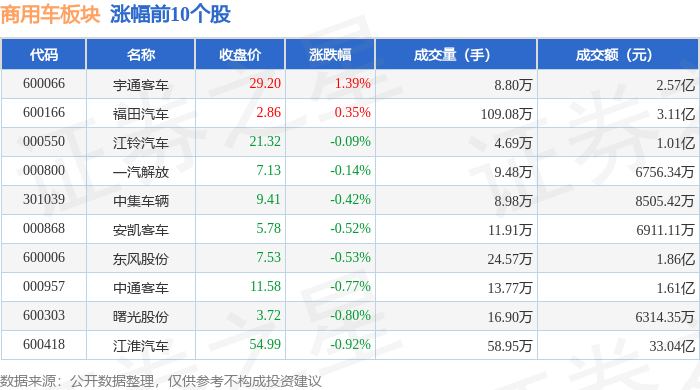
商用车板块9月12日跌1.02%,金龙汽车领跌,主力资金净流出5.4亿元
Zheng Xing Xing Ye Ri Bao· 2025-09-12 08:31
Group 1 - The commercial vehicle sector experienced a decline of 1.02% on September 12, with King Long Automobile leading the drop [1][3] - The Shanghai Composite Index closed at 3883.69, up 0.22%, while the Shenzhen Component Index closed at 12996.38, up 0.13% [1] - Major stocks in the commercial vehicle sector showed mixed performance, with Yutong Bus increasing by 1.39% and King Long Automobile decreasing by 1.49% [1][3] Group 2 - The net outflow of main funds in the commercial vehicle sector was 540 million yuan, while retail investors saw a net inflow of 315 million yuan [3][4] - The detailed fund flow indicated that King Long Automobile had a significant net outflow of 39.38 million yuan from main funds [4] - Other companies like Ankai Bus and Foton Motor also experienced varying levels of net inflow and outflow from different investor categories [4]



文远、小马、萝卜,本是同根生?
新财富· 2025-09-12 08:06
Core Viewpoint - Baidu plays a pivotal role in China's autonomous driving sector, particularly in the Robotaxi market, similar to Google's influence with Waymo. The development paths of companies like WeRide, Pony.ai, and Apollo Go reflect the broader commercialization process of Robotaxi in China [1]. Group 1: WeRide - WeRide was founded by Han Xu, a former chief scientist at Baidu's autonomous driving division, and initially operated under the name Jingchi Technology. The company faced legal challenges from Baidu over alleged trade secret violations [3][4]. - The company shifted its focus from solely Robotaxi services to a multi-scenario approach, including the launch of RoboBus, a Level 4 autonomous minibus, and Robosweeper, an autonomous cleaning vehicle [4][5]. - In Q1 2023, WeRide reported revenue of approximately 72.44 million yuan, with Robotaxi contributing only 22.3% of that. However, by Q2 2023, revenue surged to 127 million yuan, with Robotaxi revenue increasing to 36.1% [5]. Group 2: Pony.ai - Pony.ai was co-founded by Peng Jun and Lou Tiancheng, both of whom have strong backgrounds in technology and experience at Baidu. The company established partnerships with automakers like Toyota to integrate autonomous driving into mass-produced vehicles [8][11]. - By 2023, Pony.ai had provided over 2.5 million autonomous rides, with a peak daily order volume of 15,000. The company also launched a "driverless heavy truck" business, completing over 500,000 kilometers of testing [12]. - Pony.ai's strategy emphasizes dual engines of Robotaxi and commercial freight, allowing it to diversify revenue streams and maintain a robust R&D team despite industry challenges [12]. Group 3: Apollo Go - Apollo Go, Baidu's in-house Robotaxi brand, benefits from the company's extensive resources in AI, mapping, and computing power. It was launched in 2021 and has rapidly expanded its operations across multiple cities [14][15]. - By Q2 2023, Apollo Go had provided over 14 million rides globally, with a quarterly order volume exceeding 1.4 million, making it the largest Robotaxi platform in China [16][18]. - Unlike its competitors, Apollo Go is fully funded by Baidu, allowing it to focus on scaling operations without the immediate pressure for profitability [18].


上半年车市三大阵营协同发力 “中国智造”动能澎湃
Zhong Guo Chan Ye Jing Ji Xin Xi Wang· 2025-09-11 21:40
Group 1: Overview of the Chinese Automotive Market - The Chinese automotive market is experiencing a "diverse bloom" in the first half of 2025, with significant growth in sales and revenue among various companies, including BYD, Leap Motor, and Changan [1] - The transition to new energy vehicles (NEVs) is being driven by state-owned enterprises, private companies, and new energy vehicle manufacturers, showcasing the resilience of the Chinese automotive industry [1] Group 2: State-Owned Enterprises - Dongfeng Motor Corporation reported a decline in sales to approximately 824,000 vehicles, a 14.7% decrease year-on-year, but achieved a revenue of 54.53 billion yuan, a 6.6% increase [2] - Changan Automobile's revenue reached 72.69 billion yuan, a 5.25% decrease, while its NEV sales grew by 49.1% to approximately 452,000 vehicles [3] - Beijing Automotive's revenue fell to 82.40 billion yuan, a 12.6% decrease, with a profit drop of 81.8% to 360 million yuan [4] Group 3: Private Enterprises - BYD's revenue for the first half of 2025 was 371.28 billion yuan, a 23.3% increase, with NEV sales reaching 2.146 million units, a 33% increase [6] - Geely's total revenue reached 150.3 billion yuan, a 27% increase, with a core profit of 6.66 billion yuan, a 102% increase [7] - Great Wall Motors reported a total revenue of 92.33 billion yuan, a 0.99% increase, with a total sales volume of 568,852 vehicles, a 2.52% increase [7] Group 4: New Energy Vehicle Manufacturers - Leap Motor achieved a revenue of 24.25 billion yuan, a 174% increase, with a delivery of 221,664 vehicles, leading among new energy brands [9][10] - XPeng Motors reported a revenue of 34.08 billion yuan, a 132.5% increase, with deliveries of 197,189 vehicles, surpassing the total for the previous year [10] - Li Auto's revenue for the second quarter was 30.2 billion yuan, a 4.5% decrease year-on-year, but with a significant increase in operating profit by 76.7% [11] Group 5: Market Dynamics and Future Outlook - The first half of 2025 has established a multi-faceted landscape in the Chinese automotive market, characterized by state-owned enterprises transitioning to NEVs, private companies leading in scale, and new energy manufacturers innovating to capture market share [11]

