OPPO

Search documents
龙旗科技子公司参与认购投资基金 布局具身智能产业链
Zheng Quan Shi Bao Wang· 2025-11-24 10:04
Core Viewpoint - Longqi Technology (龙旗科技) is actively investing in the embodied intelligence sector through its subsidiary Longqi Intelligent, aiming to enhance its competitive strength and secure quality investment targets in the industry [1] Group 1: Investment Activities - Longqi Intelligent plans to invest 30 million yuan in the Shanghai Lingzhi New Venture Capital Partnership, representing 23.08% of the total subscription amount [1] - The partnership focuses on direct or indirect equity investments in innovative companies related to the embodied intelligence industry, including key upstream materials and components, critical software systems, and downstream application solutions [1] Group 2: Business Expansion and Partnerships - Longqi Technology is a leading ODM for smart products, serving major global consumer electronics brands and has diversified its product offerings to include smartphones, tablets, AI PCs, automotive electronics, and more [2] - The company has entered a strategic partnership with Zhiyuan Robotics, placing a significant order for the Zhiyuan Spirit G2 robots, marking one of the largest orders in the domestic industrial embodied intelligence robot sector [2] Group 3: AI Hardware Developments - Longqi Technology has made breakthroughs in AI glasses and AI PCs, with the first smart glasses project entering mass production and two new self-developed AI PC products launched [3] - In Q3 2025, revenue from AIoT products reached 2.282 billion yuan, a year-on-year increase of over 47%, accounting for 20% of the company's total revenue [3]
摩尔线程开启申购;长鑫存储发布重磅新品丨新鲜早科技
2 1 Shi Ji Jing Ji Bao Dao· 2025-11-24 02:45
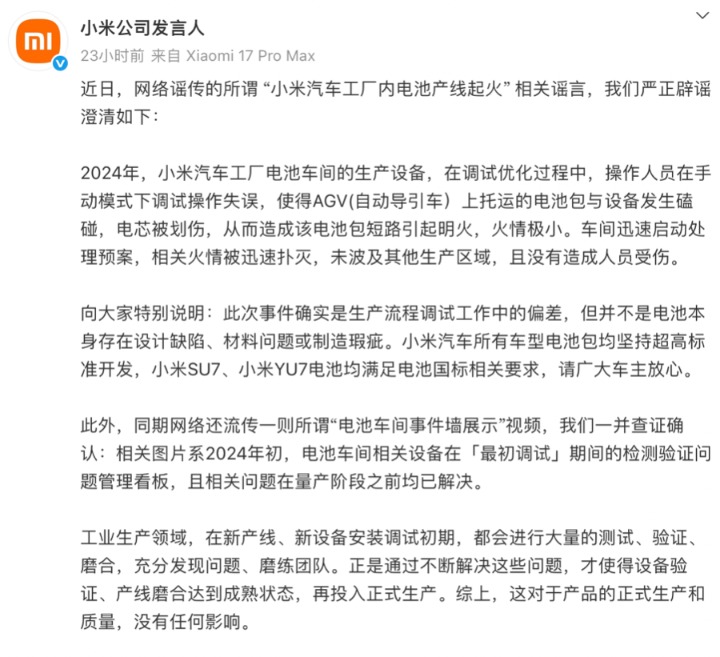
Group 1: Xiaomi Incident - Xiaomi clarified rumors regarding a fire in its automotive battery production line, stating it was caused by an operational error during equipment debugging, resulting in minor flames that were quickly extinguished without injuries [2] Group 2: SpaceX Starship Explosion - SpaceX's upgraded Starship rocket booster experienced an explosion during testing, with the cause still under investigation. This incident follows previous issues with the booster and spacecraft during earlier tests [3] Group 3: Tesla AI Chip Deployment - Tesla CEO Elon Musk announced the deployment of millions of self-developed AI chips in vehicles and data centers, with plans to release a new AI chip every 12 months. The current version is AI4, while AI5 is nearing production [4] Group 4: Meituan Rider Support Investment - Meituan plans to invest 10 billion yuan over the next five years to enhance rider support, including housing initiatives and expanded family care benefits for riders [5] Group 5: Longxin Storage New Product Launch - Longxin Storage unveiled its latest DDR5 product series at the IC China 2025 event, featuring speeds up to 8000 Mbps and capacities reaching 24Gb, alongside new LPDDR5X products for mobile markets [9] Group 6: Huida Technology Leadership Change - Huida Technology announced a leadership change, appointing Ye Jinchun as the new president following the resignation of Liu Yuping due to work adjustments [10] Group 7: Wenta Technology Control Rights Statement - Wenta Technology issued a statement urging Anshi Netherlands to respond to control rights issues, emphasizing the importance of stable global semiconductor supply chains [11][12] Group 8: ASIC Security Chip Production - Shanshi Network Technology announced that its self-developed ASIC security chip has completed testing and is expected to begin mass sales in the first quarter of 2026 [13] Group 9: Moore Threads IPO - Moore Threads has opened subscriptions for its IPO, aiming to become the first domestic GPU stock with an issue price of 114.28 yuan per share, potentially valuing the company at approximately 53.715 billion yuan upon listing [14] Group 10: Jiahuatech Acquisition Plans - Jiahuatech is planning to acquire a controlling stake in Shudun Technology through a combination of share issuance and cash payment, which may constitute a significant asset restructuring [15] Group 11: China FAW Investment in Zhuoyu Technology - China FAW announced a strategic investment exceeding 3.6 billion yuan in Zhuoyu Technology, which will continue to operate independently while benefiting from FAW's resources [16] Group 12: Guangku Technology Asset Restructuring - Guangku Technology plans to acquire 99.97% of Suzhou Anjie Optical Technology through a combination of shares and cash, enhancing its capabilities in optical communication solutions [17] Group 13: Zhaowei Electromechanical H-share Listing - Zhaowei Electromechanical is in the process of applying for an H-share listing on the Hong Kong Stock Exchange, planning to issue up to 69,058,450 shares [18] Group 14: OPPO Reno15 Series Launch - OPPO launched the Reno15 series featuring advanced camera systems and AI capabilities, with pricing starting at 2,999 yuan for the Reno15 and 3,699 yuan for the Reno15 Pro [19]

摩尔线程开启申购;长鑫存储发布重磅新品丨科技风向标
2 1 Shi Ji Jing Ji Bao Dao· 2025-11-24 02:29
Group 1: Company Updates - Xiaomi clarified rumors regarding a fire incident in its automotive battery production line, stating it was due to operational errors during equipment debugging, with no injuries reported [2] - Tesla's CEO Elon Musk announced that the company has deployed millions of self-developed AI chips in vehicles and data centers, with plans to release a new AI chip every 12 months [5] - Meituan plans to invest 10 billion yuan over the next five years to enhance rider protection, including housing support and health care for riders and their families [6] - Longxin Storage launched its latest DDR5 product series at the IC China 2025 event, achieving international leading levels in speed and capacity [10][11] - Huada Technology announced a leadership change, appointing Ye Jinchun as the new president [12] Group 2: Strategic Investments and Partnerships - China FAW Group announced a strategic investment of over 3.6 billion yuan in Zhuoyu Technology, which will operate as an independent entity post-investment [17] - Guangku Technology plans a major asset restructuring to acquire 99.97% of Suzhou Anjie Xun Optoelectronics, enhancing its capabilities in optical communication solutions [18] - Zhaowei Electromechanical is preparing for an H-share listing in Hong Kong, aiming to issue up to 69,058,450 shares [19] Group 3: Industry Developments - The commercial trial of China's satellite IoT business has officially started, aiming to enhance market supply and support the development of new industries [9] - The partnership between Zhongding Corporation and Fourier Intelligence focuses on humanoid robot products, enhancing their collaboration in various components [8] - The launch of the OPPO Reno15 series features advanced imaging technology, including a four-camera system and AI capabilities for live streaming [20]
经济观察丨民企出海“各显身手” 全球市场焕新中国印象
Zhong Guo Xin Wen Wang· 2025-11-24 01:26
Group 1 - The core viewpoint of the articles highlights the transformation of "Made in China" into "Created in China," driven by the increasing global presence of innovative Chinese private enterprises [1][3] - Chinese private enterprises are expanding their international reach beyond simple product exports, integrating into various sectors such as trendy toys, new-style tea drinks, smart home devices, and electric vehicles [1] - The research report from the All-China Federation of Industry and Commerce indicates that by 2025, the top 500 Chinese private enterprises are expected to report a total R&D expenditure of 1.13 trillion RMB, with an average R&D intensity of 2.77% [1] Group 2 - The proliferation of digital technology has facilitated easier pathways for Chinese enterprises to go global, with platforms like SHEIN and Alibaba International connecting personalized demands with efficient Chinese supply chains [2] - As of now, there are over 120,000 cross-border e-commerce entities in China, and the number of overseas warehouses has surpassed 2,500 [2] - Local market penetration and cultural understanding are essential for Chinese companies' internationalization, as demonstrated by the localized strategies of brands like Bubble Mart and OPPO [2] Group 3 - Chinese enterprises are deepening their local connections through establishing overseas R&D centers, production bases, and supply chain systems, as well as hiring and training local employees [3] - This deep connection allows companies to respond more accurately to differentiated market demands while also driving local employment and industrial upgrades [3] - The shift in global consumer perception of Chinese brands is moving from a focus on "price" to "value," reflecting a deeper integration of Chinese enterprises into the global market [3]
吉塔・维尔贾万:大多数东南亚人根本买不起iPhone,更倾向于中国品牌
Guan Cha Zhe Wang· 2025-11-24 00:14
Core Insights - Indonesia, as the largest economy in Southeast Asia with a population of approximately 270 million, aims to become a developed country by 2045 through its "Golden Indonesia 2045" vision, leveraging its natural resources and domestic consumption growth [1][30] - The dialogue with Gita Wirjawan highlights the risks of protectionism in global trade and emphasizes the need for multilateral cooperation, particularly in the context of U.S. unilateral tariff policies and China's efficient supply chain capabilities [1][6][11] Group 1: Trade and Economic Cooperation - Indonesia's trade negotiations with the U.S. resulted in a reduction of tariffs from 32% to 19%, with Indonesia eliminating tariffs on over 99% of U.S. agricultural imports, reflecting a strategic long-term vision rather than a mere concession [2][3] - The diversification of trade partnerships is crucial for Indonesia and other Southeast Asian nations, with a strong inclination towards closer cooperation with China due to its cost-effective development options [3][19] - The BRICS expansion, including Indonesia, signifies a shift towards a multipolar world and the importance of diverse economic partnerships [3][19] Group 2: Investment and Capital Allocation - The ability of Indonesia and Southeast Asian countries to attract foreign direct investment (FDI) hinges on their capital acquisition strategies, particularly in technology and economic capital [4][25] - Indonesia's FDI increased from $4.9 billion in 2009 to $21.2 billion in 2012, showcasing the potential for growth in attracting investment despite current global protectionist trends [13][25] - The need for improved legal frameworks and the ability to quantify risks are essential for enhancing investor confidence and attracting more capital [12][25][26] Group 3: Education and Human Capital - Strengthening STEM education is vital for enhancing risk quantification capabilities and improving overall productivity, which in turn can elevate Indonesia's position in the global value chain [12][26] - Indonesia currently produces significantly fewer STEM graduates compared to China and India, highlighting a critical area for development to meet future economic goals [11][12] Group 4: Energy and Infrastructure Development - Indonesia's low per capita electricity generation (1,300 kWh) compared to China's (10,000 kWh) underscores the urgent need for investment in renewable energy to support modernization efforts [27][28] - The estimated investment requirement of $2 to $3 trillion for enhancing energy capacity in Southeast Asia presents a significant opportunity for international collaboration, particularly with China [28] Group 5: Geopolitical Strategy and Global Positioning - Indonesia's strategic positioning between major powers like the U.S. and China reflects a balancing act aimed at maintaining autonomy while fostering economic growth [19][24] - The historical context of the Bandung Conference emphasizes the importance of non-alignment and multilateral cooperation in addressing contemporary global challenges [31][32]
消费观察|绕开巨头打差异化竞争,Qpon上线一年“收割”印尼4300万用户
Sou Hu Cai Jing· 2025-11-23 16:57
"这一结构性空白为Qpon提供了差异化切入的契机"。Qpon相关业务负责人向记者表示,Qpon定位不是 单纯的外卖或内容平台,而是将线下店铺线上化经营,移植了国内成熟的"省钱+社交"玩法,并结合本 地用户习惯进行创新。例如,每日早7点准时开启的闪购活动,已成为印尼年轻人的消费习惯;基于邀 请码的社交传播机制,则有效降低了获客成本。在产品层面,Qpon融合了短视频内容、真实用户点评 与即时优惠信息,通过算法为用户智能筛选优质商家与高性价比优惠,有效缩短了从浏览、决策到消费 的路径。当前,Qpon的连锁品牌覆盖率方面达到了80%,以超过5万家有效门店覆盖数位列印尼市场第 一。 不过,Qpon的进一步发展也存在多项挑战。Qpon方面表示,比如,在到店场景,TikTok凭借内容生态 与流量优势强势渗透,外卖领域则有Gojek、Grab 等本土巨头占据主导地位,整体市场竞争日趋激烈。 同时,如何平衡补贴投入与可持续发展,并应对不同地区的消费差异,成为平台必须解决的课题。 外卖、点评、生鲜极速到家……今年以来,本地生活服务赛道竞争激烈,美团、抖音、淘宝、京东等巨 头围绕"到店 - 到家"业务展开的角逐如火如荼。在巨头之外 ...

两部门发文,DeepSeek、Kimi、豆包等或将入围
2 1 Shi Ji Jing Ji Bao Dao· 2025-11-23 14:41
Core Points - The National Internet Information Office and the Ministry of Public Security released a draft regulation on personal information protection for large internet platforms, establishing criteria for identifying such platforms and their obligations for personal information protection [1][3] - The draft regulation aligns with previous regulations and emphasizes the principle that greater capabilities entail greater responsibilities in digital economy regulation [1][3] Group 1: Identification Criteria for Large Platforms - Large platforms are identified based on having over 50 million registered users or over 10 million monthly active users, providing significant network services, and handling data that could impact national security and economic operations if compromised [5][6] - Traditional internet platforms like Tencent, Alibaba, and ByteDance, as well as emerging AI companies and smart device manufacturers, are likely to fall under this regulation [3][6] Group 2: Compliance and Reporting Requirements - Large platforms must appoint a personal information protection officer and establish a dedicated team to manage personal information protection, including creating internal management systems and emergency response plans [9][10] - The draft regulation requires platforms to publish annual social responsibility reports on personal information protection, addressing previous shortcomings in compliance and transparency [9][10] Group 3: Independent Supervision Mechanism - The draft regulation proposes the establishment of independent supervisory committees composed mainly of external members to oversee personal information protection compliance [12][13] - These committees will have specific responsibilities, including monitoring compliance systems, evaluating the impact of personal information protection measures, and maintaining regular communication with users [13][14]





两部门发文,DeepSeek、Kimi、豆包等或将入围
21世纪经济报道· 2025-11-23 14:31
Core Viewpoint - The article discusses the newly released draft regulations for personal information protection by large internet platforms in China, emphasizing the responsibilities and obligations these platforms must adhere to in safeguarding user data [1][3]. Group 1: Regulatory Framework - The draft regulations define large internet platforms based on user scale, specifically those with over 50 million registered users or 10 million monthly active users [5]. - Major companies like Tencent, Alibaba, ByteDance, and emerging AI firms such as DeepSeek and MiniMax are included under this definition, indicating a broader scope of regulation [3][5]. - The principle of "with great power comes great responsibility" is highlighted, indicating that larger platforms will face stricter compliance requirements [1][3]. Group 2: Compliance Requirements - Large platforms are required to establish dedicated personal information protection teams responsible for creating and implementing internal management systems and emergency response plans [10]. - The regulations mandate that personal information collected within China must be stored in domestic data centers, and platforms must conduct compliance audits and risk assessments [11]. - There is an emphasis on the need for platforms to publish social responsibility reports regarding personal information protection, which has previously been inadequately addressed by many companies [10]. Group 3: Independent Oversight - The draft regulations propose the establishment of independent supervisory committees composed mainly of external members to oversee personal information protection practices [13][15]. - These committees are tasked with monitoring compliance, evaluating the protection of sensitive personal information, and ensuring regular communication with users [15]. - Concerns are raised about the feasibility of these committees, as many platforms have yet to take significant steps towards establishing them [14].





(经济观察)民企出海“各显身手” 全球市场焕新中国印象
Zhong Guo Xin Wen Wang· 2025-11-23 12:56
Group 1 - The core viewpoint is that Chinese private enterprises are increasingly reshaping the global perception of "Made in China" through innovative products and services, moving from simple product exports to deeper market integration [1][2] - The report indicates that by 2025, the top 500 Chinese private enterprises are expected to report a total R&D expenditure of 1.13 trillion RMB, with an average R&D intensity of 2.77% [1] - The rise of digital technology and cross-border e-commerce platforms, such as SHEIN and Alibaba International Station, has facilitated easier access for Chinese manufacturers to global consumers [2] Group 2 - Chinese companies are adopting localization strategies, such as understanding local cultures and tailoring products to meet regional preferences, which is becoming essential for their internationalization efforts [2][3] - The establishment of overseas R&D centers, production bases, and supply chains, along with hiring and training local employees, allows Chinese enterprises to connect deeply with local markets [3] - This deep connection leads to a shift in global consumer perception of Chinese brands from being price-focused to value-oriented, reflecting a more innovative and open image of China [3]
两部门拟明确“守门人”认定标准,AI新贵们也入围了?
2 1 Shi Ji Jing Ji Bao Dao· 2025-11-23 07:57
Core Viewpoint - The draft regulations on personal information protection for large internet platforms have been released, establishing criteria for identifying such platforms and outlining their obligations for personal information protection [1][2]. Group 1: Identification of Large Platforms - The draft specifies that platforms with over 50 million registered users or 10 million monthly active users will be classified as large internet platforms, which includes traditional internet giants and emerging AI companies [3][4]. - Companies like DeepSeek, MiniMax, and Kimi, as well as smart device manufacturers such as OPPO, vivo, and Honor, are also likely to fall under this classification due to their user base [1][3]. Group 2: Responsibilities and Compliance - Large platforms are required to establish dedicated personal information protection teams, appoint responsible personnel, and publish annual social responsibility reports regarding personal information protection [6][7]. - The draft emphasizes the need for platforms to store personal information generated within China in domestic data centers and to conduct compliance audits and risk assessments [7]. Group 3: Independent Supervision - The draft regulations propose the establishment of independent supervisory committees composed mainly of external members to oversee personal information protection compliance [10][11]. - These committees will be responsible for monitoring compliance with personal information protection regulations and will need to maintain regular communication with users [11].