美的集团

Search documents
铜价持续上涨,空调行业面临成本压力 格力承诺家用空调不涨价,其他品牌还能涨吗?
Mei Ri Jing Ji Xin Wen· 2026-01-06 12:17
Core Viewpoint - Gree Electric Appliances announced on January 5 that it will not raise prices for home air conditioners, despite rising copper prices and other brands announcing price increases, aiming to benefit consumers and support the national subsidy policy for home appliances in 2026 [1][3]. Group 1: Gree's Pricing Strategy - Gree's Chief Marketing Officer, Zhu Lei, emphasized that the decision to keep prices stable is to ensure consumers benefit from subsidies, avoiding price hikes that would dilute the subsidy effect [1][3]. - Gree's commitment to not adopting "aluminum instead of copper" is also aimed at maintaining quality and fulfilling its promise of a "10-year free warranty" [1][3]. - The company believes that maintaining prices during the subsidy period will stimulate consumption and is confident in its ability to manage cost pressures through efficient production and technology optimization [3][8]. Group 2: Industry Pricing Trends - Several air conditioning brands, including Meibo, Midea, and Chigo, have announced price increases due to rising raw material costs, particularly copper [2][5]. - The average price of air conditioners in both online and offline markets has been declining, with offline prices dropping by 4.01% and online prices by 1.24% in the first eleven months of 2025 [4]. - The cost of materials for a typical 1.5-horsepower air conditioner is estimated to be between 1,000 to 1,200 yuan, with copper costs accounting for 200 to 400 yuan, indicating that the recent copper price increase has a direct impact on overall air conditioner pricing [5]. Group 3: Market Dynamics and Consumer Impact - Gree's decision not to raise prices is seen as a strategic move to enhance brand value and attract more consumers in a price-sensitive market [5][8]. - The air conditioning market is currently in a phase of stock competition, where price increases may not be sustainable unless there is consumer acceptance [5][8]. - The market for aluminum tube air conditioners remains niche, and Gree has no plans to shift to this alternative, prioritizing quality and consumer experience [7][8].

独家 | 谋篇“十五五”:打通入市堵点!监管问计理财公司,聚焦A股投资障碍与政策期待
券商中国· 2026-01-06 12:03
Core Viewpoint - The regulatory authorities are actively seeking to facilitate the entry of medium- and long-term funds into the market, emphasizing the importance of aligning investment and financing in capital markets as outlined in the "14th Five-Year Plan" [2][4]. Group 1: Regulatory Insights - Regulatory bodies have conducted surveys with wealth management companies to identify barriers that restrict banks from increasing their investments in A-shares and to gather expectations for future policies [2][3]. - The focus of the surveys includes reviewing the effectiveness of existing policies, learning from mature overseas markets, and understanding the practical experiences of wealth management companies [3]. Group 2: Current Investment Landscape - As of Q3 2025, the total scale of wealth management products in the market is 32.13 trillion yuan, with mixed products accounting for only 0.83 trillion yuan (2.58%), and equity products and financial derivatives at 0.07 trillion yuan (0.22%) and 0.02 trillion yuan (0.062%) respectively, totaling less than 0.3% [5]. - The asset allocation of wealth management products is predominantly in fixed income, with bonds, cash, and interbank deposits making up 40.4%, 27.5%, and 13.1% of total investment assets, while equity assets only account for 2.1% [5]. Group 3: Challenges in Equity Investment - The low allocation to equity investments is attributed to constraints on the liability side of bank wealth management, low client risk appetite, and the need for improved investment research capabilities and asset management systems [6]. Group 4: Exploration of New Investment Avenues - Despite the challenges, banks are exploring new avenues for equity asset allocation, including increasing research on A-share listed companies and launching index-based investment products, which have seen significant growth [7]. - As of January 6, 2026, there are 154 index-based wealth management products, with a notable increase in issuance over the past years [7]. - The new IPO underwriting regulations effective in 2025 have provided substantial policy support for wealth management companies to participate in new stock subscriptions, with several companies actively engaging in IPOs [8]. Group 5: Future Outlook - With regulatory support, banks are expected to further explore equity products and asset allocation, aiming to evolve into a stable source of medium- and long-term capital [9].


大红包!2025年深市公司分红超5000亿元,创业板公司展现出更强增长活力
Jin Rong Jie· 2026-01-06 11:33
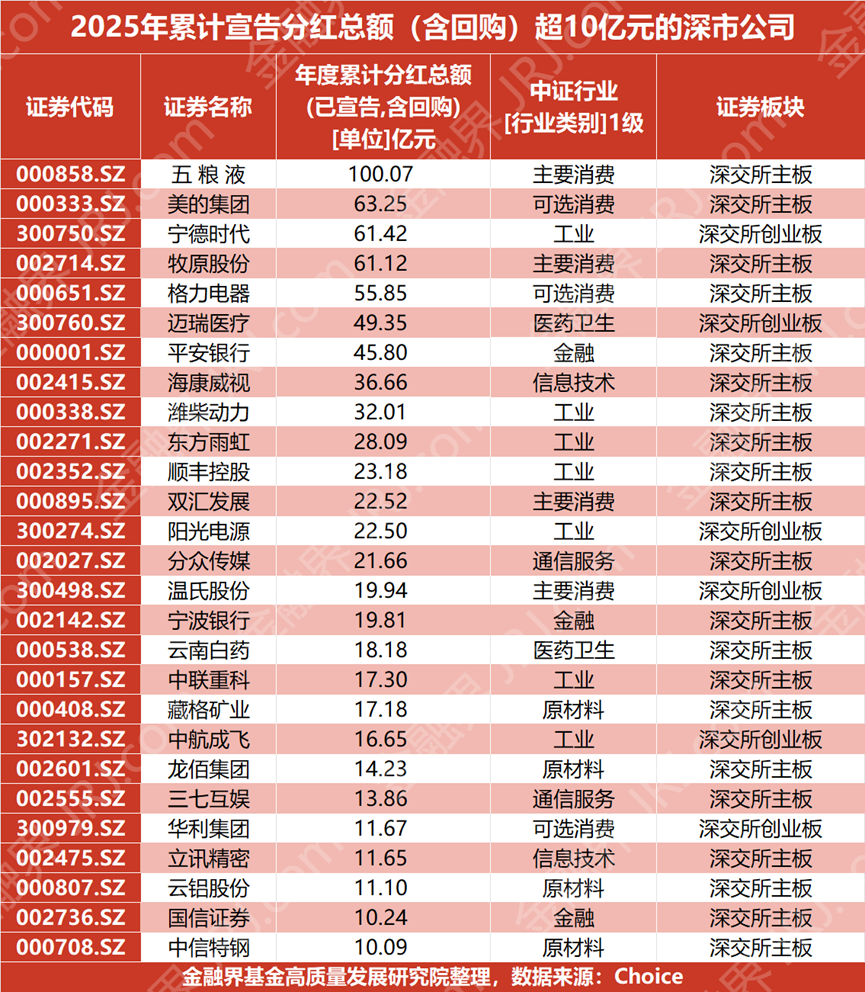
Core Insights - The total cash dividends of companies listed on the Shenzhen Stock Exchange (SZSE) are projected to exceed 500 billion yuan in 2025, reaching 547.56 billion yuan, indicating a stable high level of cash returns to investors [1] - Since the start of the 14th Five-Year Plan, cumulative dividends from SZSE companies have surpassed 2 trillion yuan, reflecting a solid market ecosystem that favors regular and substantial dividends [1] Summary by Category Dividend Scale and Growth - The dividend scale remains robust, consistently maintaining above the 500 billion yuan threshold [1] - In 2025, 533 companies on the SZSE implemented interim dividends totaling approximately 132.93 billion yuan, representing a growth of over 25% compared to the previous year [1] Attracting Long-term Investment - Stable high returns have attracted long-term capital investments, with 166 companies in the SZSE offering dividend yields exceeding 1%, and 108 companies yielding over 1.34%, particularly appealing to insurance and pension funds [1] Performance of Different Boards - While mainboard companies continue to dominate total dividend amounts, companies on the ChiNext board have shown stronger growth, with 945 companies increasing their total dividends by 8.41% year-on-year to 137.45 billion yuan [1] Industry Highlights - Leading companies in the consumer and financial sectors have set examples with significant dividend distributions, such as Wuliangye's interim dividend of 10.01 billion yuan and Gree Electric's distribution of 5.585 billion yuan [1] - In key future-oriented sectors, notable dividend cases have emerged from advanced manufacturing (CITIC Special Steel, Weichai Power), digital economy (Yilian Network, GoerTek), and green low-carbon sectors (CATL, Longyuan Power) [2] High Dividend Companies - In 2025, 28 companies on the SZSE announced total dividends exceeding 1 billion yuan, with Wuliangye leading at over 10 billion yuan, followed by Midea Group, CATL, and Muyuan Foods, each exceeding 6 billion yuan [3] - The distribution of these high-dividend companies is primarily in the consumer, industrial, and discretionary sectors, with notable representation from the pharmaceutical and information technology sectors [4]





慢牛格局下“现金为王”逻辑被再度验证!300现金流ETF(562080)收涨1.96%创新高
Xin Lang Cai Jing· 2026-01-06 10:59
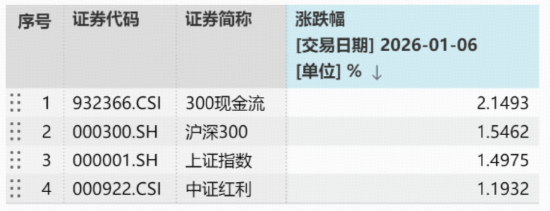
Core Viewpoint - The A-share market continues to perform strongly, with the 300 Cash Flow Index rising by 2.15%, outperforming major indices, reaffirming the "cash is king" logic in a slow bull market [1][14]. Index Performance - The 300 Cash Flow Index closed at a gain of 2.15% on January 6, 2026, outperforming the CSI 300, Shanghai Composite Index, and the CSI Dividend Index [1][14]. - The 300 Cash Flow ETF (562080) rose by 1.96%, reaching a historical high of 0.625 yuan, with its net asset value hitting new highs 29 times in the past year [1][14]. Fund Inflows - The 300 Cash Flow ETF has recorded a "ten consecutive days of gains" since its inception, attracting long-term capital with a net inflow of 57.82 million yuan over the last five trading days [2][14]. Component Stocks - Among the 50 large-cap "cash cow" stocks in the 300 Cash Flow Index, 46 stocks closed in the green, with Zijin Mining and Luoyang Molybdenum rising by 6.21% and 6.07%, respectively [4][14]. - Major oil companies, China Petroleum and China National Offshore Oil Corporation, saw increases of 1.99% and 2.58% [4][14]. Industry Allocation - The 300 Cash Flow Index is diversified and balanced, avoiding financial and real estate sectors to mitigate risks from industry downturns [8][19]. - The index is overweight in sectors like oil and petrochemicals, home appliances, and non-ferrous metals, achieving a balance between defensive and offensive strategies [10][21]. Cash Flow Focus - The index emphasizes "free cash flow," a key quality metric that reflects a company's ability to generate cash after necessary capital expenditures, thus serving as a critical indicator of financial health [6][17]. Historical Performance - Since its inception in 2014, the 300 Cash Flow Total Return Index has achieved a return of over 428%, with an annualized return exceeding 15% [10][21].
華創證券:白電龍頭均具備極高的戰略配置價值 建議關注美的集團等
Zhi Tong Cai Jing· 2026-01-06 10:00
Group 1 - The core viewpoint is that leading white goods companies are at a convergence point of strong fundamentals, positive capital feedback, and historically low valuations, making them highly strategic for investment [1] - The report suggests focusing on Midea Group (000333.SZ), Haier Smart Home (600690.SH), and Gree Electric Appliances (000651.SZ) as key investment opportunities [1] Group 2 - Changes in capital structure are shifting pricing power towards insurance capital and passive funds, indicating that leading white goods companies are on the verge of valuation reconstruction, with a potential annualized value uplift of 10% [2] - The report estimates that in pessimistic, neutral, and optimistic scenarios, public and insurance funds could bring net inflows of 110 billion, 154.4 billion, and 222.8 billion yuan to the home appliance sector over the next three years [2] Group 3 - The combination of public fund recovery and expansion of passive investments is a significant marginal variable, with public funds benefiting from both passive growth and active recovery, potentially adding 213 billion yuan to the home appliance sector [3] - The report highlights that insurance capital's allocation to FVOCI stocks is expected to increase from 27% in H1 2024 to 40%, injecting 99.9 billion yuan into the home appliance sector over the next three years under neutral assumptions [3] Group 4 - Leading white goods companies exhibit significant safety margins, with projected returns for Gree Electric, Midea Group, and Haier Smart Home reaching 7.2%, 7.1%, and 4.5% respectively by 2025, indicating strong investment potential [4] - The analysis shows that even without considering performance growth and valuation expansion, leading white goods companies can still provide annualized returns of 4%-8%, offering a clear safety cushion compared to ten-year government bonds [4]

華創證券:白電龍頭均具備極高的戰略配置價值 建議關注美的集團(000333.SZ)等
智通财经网· 2026-01-06 09:36
Core Viewpoint - The white goods sector is at a convergence point of solid fundamentals, positive capital feedback, and historically low valuations, making it a strategic investment opportunity [1] Group 1: Capital Structure Changes - The pricing power is shifting towards insurance capital and passive funds, indicating that the white goods sector is on the brink of valuation reformation, with a potential annualized value uplift of 10% [2] - The projected net inflows from public and insurance funds into the home appliance sector over the next three years are estimated at 110 billion, 154.4 billion, and 222.8 billion yuan under pessimistic, neutral, and optimistic scenarios respectively [2] Group 2: Public and Insurance Fund Dynamics - The public fund sector is experiencing a dual benefit from passive growth and active replenishment, with a potential increase of 213 million yuan for the home appliance sector due to mean reversion [3] - The broad-based ETF market contributes 63% of the scale increase, with an expected passive buying of 33.2 billion yuan for the home appliance sector over the next three years [3] - Insurance capital is significantly increasing its allocation to high-dividend assets under new accounting standards, with the FVOCI stock position projected to rise from 27% in H1 2024 to 40% [3] Group 3: Safety Margins of Leading White Goods Companies - A static model analysis shows that Gree Electric, Midea Group, and Haier Smart Home have expected returns of 7.2%, 7.1%, and 4.5% respectively by 2025, ranking them 8th, 10th, and 133rd among 275 core assets [4] - The white goods leaders can still provide an annualized baseline return of 4%-8% based solely on capital factors, offering a clear safety margin compared to ten-year government bonds [4] - The global expansion of white goods companies adds intrinsic growth potential, providing additional yield flexibility for investment portfolios [4]
征信违规,美的“少东家”旗下盈峰小贷被罚!
Xin Lang Cai Jing· 2026-01-06 09:15
Core Viewpoint - The recent fine imposed on Yingfeng Puhui Internet Microloan Co., Ltd. for violating credit business regulations highlights compliance issues within the financial landscape of the Midea Group, indicating potential risks in its financial operations [1][20][24]. Group 1: Regulatory Issues - Yingfeng Puhui was fined 839,100 yuan for violating credit business management regulations, which may involve unauthorized inquiries into personal credit information and improper handling of credit data [6][24]. - The fine is relatively minor compared to the overall scale of Yingfeng Group, which has assets nearing 90 billion yuan and annual revenue of approximately 40 billion yuan [1][20]. - Experts suggest that such compliance issues are common in the microloan and consumer finance sectors, driven by intense competition and insufficient regulatory investment by institutions [24][27]. Group 2: Yingfeng Group Overview - Yingfeng Group, founded by He Xiangjian's son He Jianfeng, plays a crucial role in Midea's financial ecosystem, holding a 63.5% stake in Yingfeng Puhui [1][20]. - The group has expanded its financial footprint since 2007, acquiring significant stakes in various financial entities, including a 22.65% share in E Fund Management [7][25]. - Yingfeng Group's financial operations include microloans, commercial factoring, and other financial services, with a registered capital exceeding 1.3 billion yuan [4][22]. Group 3: Financial Performance and Strategy - Yingfeng Puhui ranks third in loan disbursement and first in revenue among microloan companies in Guangzhou, indicating strong market presence despite the recent regulatory challenges [4][22]. - Midea Group's financial services, including microloans and payment solutions, contribute minimally to its overall revenue, with interest income from financial activities accounting for less than 1% of total revenue [34][36]. - The group's financial strategy has shifted from expansion to focusing on core business areas, reflecting a recognition of the need for financial services to support its primary operations in home appliances [36][37].

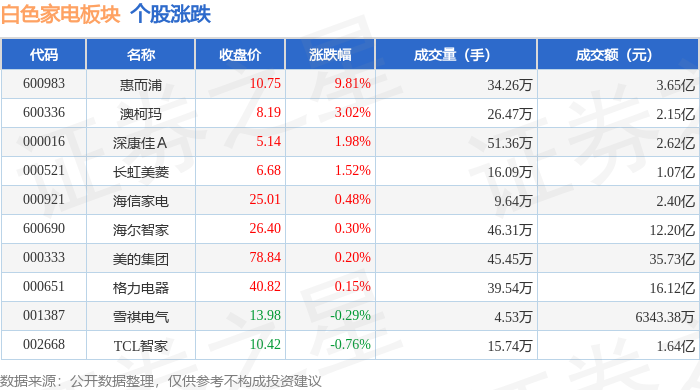
白色家电板块1月6日涨0.32%,惠而浦领涨,主力资金净流出2.01亿元
Zheng Xing Xing Ye Ri Bao· 2026-01-06 08:56
Group 1 - The white goods sector increased by 0.32% on January 6, with Whirlpool leading the gains [1] - The Shanghai Composite Index closed at 4083.67, up by 1.5%, while the Shenzhen Component Index closed at 14022.55, up by 1.4% [1] - Whirlpool's stock price rose by 9.81% to 10.75, with a trading volume of 342,600 shares and a transaction value of 365 million [1] Group 2 - The net outflow of main funds in the white goods sector was 201 million, while retail investors saw a net inflow of 140 million [1] - Haier Smart Home experienced a net outflow of 42.65 million from main funds, with a retail net inflow of 30.19 million [2] - Midea Group had a significant net outflow of 258 million from main funds, while retail investors had a net inflow of 129 million [2]



海尔新能源启动IPO辅导,资本版图再扩张
Zhong Guo Jing Ying Bao· 2026-01-06 08:08
Group 1 - Haier Group's subsidiary, Haier New Energy, has initiated the process for its initial public offering (IPO) with guidance from Guotai Junan Securities [1][2] - Haier New Energy was established on May 11, 2022, with a registered capital of 337 million yuan, and is primarily owned by Haier Group's wholly-owned subsidiary, Qingdao Nahui Holdings, which holds 59.4% of the shares [3] - The company completed over 700 million yuan in Series A financing in April 2025, attracting investments from various firms, and was recognized as a "global unicorn" in December of the same year [3] Group 2 - Haier New Energy focuses on providing integrated services in photovoltaic and energy storage systems for residential and commercial users, expanding its market presence to over 50 countries and regions globally [3] - Other home appliance companies, such as Midea, Gree, TCL, and Skyworth, have also entered the new energy sector, each with different strategic focuses [4] - The shift of home appliance giants into the photovoltaic and energy storage markets is seen as advantageous due to their established brand and distribution channels [4] Group 3 - Haier New Energy's strategy avoids direct involvement in manufacturing photovoltaic components and energy storage cells, instead concentrating on user-side system solutions, which are currently more profitable [4][5] - The distributed energy market faces challenges from recent policy changes and market conditions, which may impact investment and profitability [5] - Companies like Haier New Energy and Skyworth are encouraged to leverage existing sales and service channels to integrate energy storage systems with smart home and office solutions, creating a comprehensive intelligent ecosystem [6]

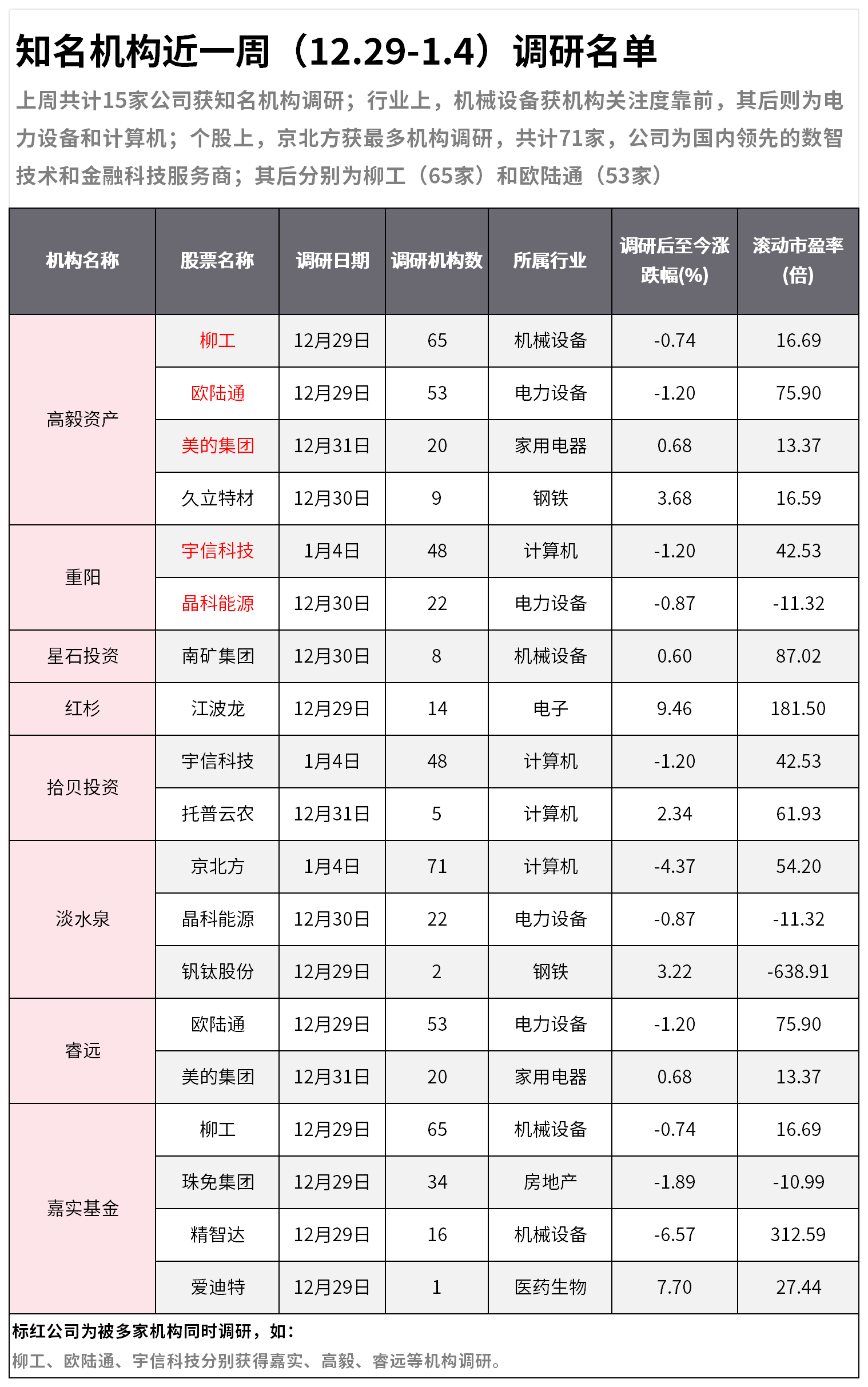
知名机构近一周(12.29-1.4)调研名单:机构扎堆这只数字货币龙头
Xuan Gu Bao· 2026-01-06 07:30
Group 1 - A total of 15 companies were investigated by well-known institutions in the past week (December 29 to January 4) [1] - The machinery equipment sector received significant attention from institutions, along with power equipment and computer industries [1] - The company with the highest number of institutional investigations was Jingbeifang, with 71 institutions participating [1] Group 2 - Following Jingbeifang, Liugong received 65 institutional investigations, and Oulutong had 53 [1] - Other notable companies included Midea Group with 20 investigations, Jiuli Special Materials with 11, and Yuxin Technology with 48 [1][2] - The data indicates a strong interest in the machinery and computer sectors, reflecting potential investment opportunities [1]