
康方生物

Search documents
70家创新药上市公司 3家靠自身造血盈利
经济观察报· 2025-09-11 08:19
Core Viewpoint - The innovative drug sector in China is experiencing a recovery, with over half of the companies having commercialized innovative drugs, despite many still not being profitable [1][2][12]. Group 1: Market Overview - As of the first half of 2025, 70 innovative drug companies have been listed on the Hong Kong Stock Exchange and the STAR Market, with 15 companies achieving profitability, including notable firms like BeiGene and Innovent Biologics [2][19]. - Among the 70 companies, 55 are still operating at a loss, representing approximately 79% of the total [6][19]. - Of the 55 unprofitable companies, 28 have commercialized innovative drug products, indicating that profitability may be achievable for some in the near future [4][12]. Group 2: Profitability Analysis - Only 3 companies are generating profits primarily from innovative drug sales, namely BeiGene, Innovent Biologics, and Elysium [23][22]. - The majority of profitable companies rely on other revenue streams, such as biosimilars or licensing agreements, rather than solely on innovative drug sales [23][25]. - For instance, Elysium achieved significant revenue from its lung cancer drug, while companies like WuXi Biologics and Hengrui Medicine have seen profitability through biosimilars and licensing deals [24][25]. Group 3: Company Performance - BeiGene reported a total revenue of 175.18 billion yuan in the first half of 2025, with a net profit of 4.5 billion yuan, largely driven by its innovative drugs [28]. - Innovent Biologics achieved revenue of 59.53 billion yuan, with 88.76% coming from product sales, reflecting strong performance in the oncology sector [29]. - Elysium's revenue for the first half of 2025 was 23.73 billion yuan, with over 99% derived from innovative drug sales, showcasing its successful product launch [23][20].


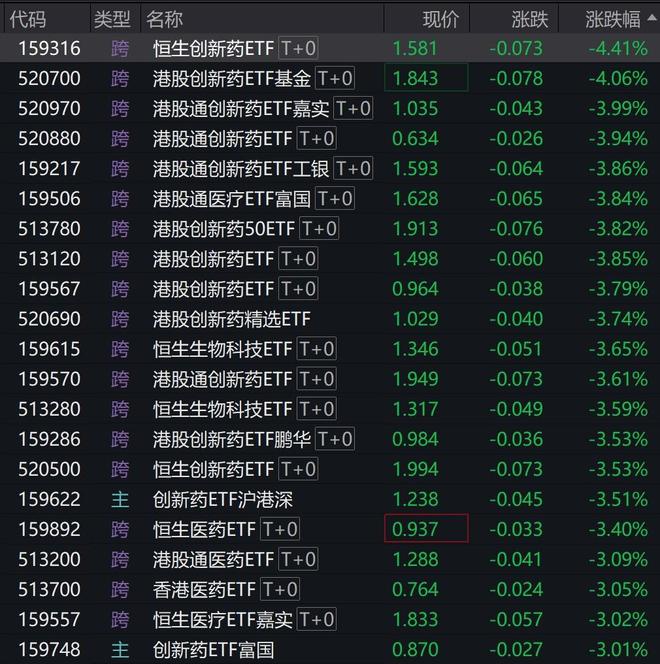
创新药板块全天震荡调整,多只港股创新药相关ETF跌超3%
Mei Ri Jing Ji Xin Wen· 2025-09-11 06:07
Core Viewpoint - The innovative pharmaceutical sector in Hong Kong experienced significant fluctuations, with major companies like CSPC Pharmaceutical and Hansoh Pharmaceutical seeing declines of over 8%, while BeiGene dropped more than 6% [1] Group 1: Market Performance - Multiple Hong Kong innovative pharmaceutical ETFs fell by over 3% due to market influences [1] - Specific ETFs reported declines, such as the Hang Seng Innovative Pharmaceutical ETF down 4.41% and the Hong Kong Innovative Pharmaceutical ETF down 4.06% [2] Group 2: Future Outlook - Some brokerages suggest that the long-term bullish trend for innovative pharmaceuticals may not be over, as the commercialization value of innovative drug assets driven by Chinese engineers has yet to be fully realized [2] - The valuation of the Hong Kong innovative pharmaceutical sector is considered low, with a high certainty of business development (BD) landing numbers, indicating potential for future growth in areas like small nucleic acids and oral GLP-1 [2] - The ongoing high bidding and acquisition amounts in the sector reflect its explosive potential [2]
70家创新药上市公司 3家靠自身造血盈利
Jing Ji Guan Cha Wang· 2025-09-11 05:49
Core Viewpoint - The Chinese innovative drug sector is experiencing a stock market recovery in 2025, with 15 companies achieving profitability, although only 3 are profitable through innovative drug sales [2][3][4]. Group 1: Profitability and Performance - In the first half of 2025, 15 companies reported profitability, with 6 achieving their first profit [2][4]. - Among the 70 innovative drug companies listed, 55 remain unprofitable, accounting for approximately 79% [3][4]. - Of the 55 unprofitable companies, 28 have commercialized innovative drug products, indicating potential for future profitability [7][8]. Group 2: Revenue Sources - Only 3 companies, including Baijie Shenzhou and Xinda Biopharmaceuticals, achieved profitability primarily through innovative drug sales [12][15]. - Other profitable companies rely on alternative revenue sources, such as biosimilars or business development (BD) transactions [12][14]. - For instance, Ailisi's revenue in the first half of 2025 was largely driven by its self-developed lung cancer drug, achieving significant sales [12][13]. Group 3: Market Dynamics - Baijie Shenzhou's total revenue reached 17.518 billion yuan, with a significant portion derived from overseas markets [16]. - Xinda Biopharmaceuticals reported revenue of 5.953 billion yuan, primarily from its oncology products, benefiting from strong market demand [17]. - The innovative drug market is characterized by long R&D cycles and high risks, making profitability a critical milestone for listed companies [4][8].

港股医药行业2025年半年报总结:港股创新药进入盈利期
Southwest Securities· 2025-09-11 05:25
Investment Rating - The report maintains a positive outlook on the Hong Kong pharmaceutical industry, particularly on innovative drugs, indicating that the sector has entered a profitability phase [1]. Core Insights - The report highlights that the total revenue of 149 Hong Kong-listed pharmaceutical companies reached CNY 896.12 billion in the first half of 2025, reflecting a 1% increase, while net profit attributable to shareholders was CNY 61.99 billion, up 29.7% [3][11]. - The innovative drug sector has shown significant growth, with 36 companies reporting a revenue of CNY 28.5 billion, a 15.8% increase, and a net profit of CNY 1.8 billion, marking a turnaround to profitability [4][12]. - The report emphasizes the importance of differentiated products and strong commercialization capabilities for companies in the innovative drug sector, suggesting that these factors will drive future growth [3][4]. Summary by Sections Overall Performance - The total revenue for the Hong Kong pharmaceutical industry in H1 2025 was CNY 896.12 billion, with a net profit of CNY 61.99 billion, indicating a positive trend in profitability [3][11]. - 57% of the companies reported positive net profit growth, while 50% achieved revenue growth [11][6]. Sector Breakdown - **Innovative Drugs**: Revenue of CNY 28.5 billion (+15.8%), net profit of CNY 1.8 billion, indicating a shift to profitability [4][12]. - **Chemical Preparations**: Revenue of CNY 90.8 billion (-7.1%), net profit of CNY 20.8 billion (+52.9%), suggesting a potential industry turning point [4][5]. - **Medical Devices**: Revenue of CNY 22.2 billion (+3.5%), net profit of CNY 1.9 billion, with varied trends across sub-sectors [4][5]. - **CXO**: Revenue of CNY 49.8 billion (+11.2%), net profit of CNY 12.8 billion (+93.7%), showing strong growth [4][5]. - **Traditional Chinese Medicine**: Revenue of CNY 58.5 billion (-1.8%), net profit of CNY 4.3 billion (-11.5%), indicating challenges in the sector [5][6]. R&D and Expenses - R&D expenses totaled CNY 31.4 billion, down 7.8%, with a decreasing trend in R&D expense ratios [16][24]. - Sales expenses reached CNY 77.7 billion, down 1.5%, and management expenses were CNY 58.7 billion, down 7.3% [16][24]. 18A Companies Performance - The report analyzed 50 Hong Kong 18A pharmaceutical companies, which generated CNY 44.9 billion in revenue, a 31.48% increase, and a net profit of CNY 2.727 billion, marking a significant turnaround with a 128.4% growth [29][34]. - Cash and cash equivalents for these companies reached CNY 84.4 billion, up 26.99% year-on-year [34][35]. International Expansion - The report notes that the international recognition of domestic innovative drugs is increasing, with over 20 licensing out projects totaling over USD 2 billion, indicating a growing trend in global market engagement [35][36].
第一创业晨会纪要-20250911
First Capital Securities· 2025-09-11 05:08
Macroeconomic Analysis - In August, China's CPI decreased by 0.4% year-on-year, against an expectation of -0.2%, while the previous month was 0.0%. The core CPI rose by 0.9%, the highest since February 2024, compared to 0.8% in July [3][4] - The food prices increased by 0.5% month-on-month, with fresh vegetables rising by 8.5% and eggs by 1.5%. However, fresh fruit prices fell by 2.8%, and pork prices decreased by 0.5% [3][4] - The PPI in August was -2.9% year-on-year, ending a downward trend since February, with a month-on-month change of 0.0% [4] Industry Insights - Oracle's first-quarter earnings report revealed a remaining performance obligation of $455 billion, with projected revenue growth for its cloud infrastructure business significantly exceeding market expectations. However, the majority of AI orders are still supported by major U.S. tech companies, indicating limited immediate commercial benefits from AI advancements [8] - Recent discussions in the U.S. government regarding strict restrictions on drug imports from China may impact the pharmaceutical sector, particularly concerning experimental drugs for various diseases. This could lead to a potential adjustment phase for innovative drugs in the market [9] Advanced Manufacturing - A recent procurement bid for energy storage equipment in Shandong revealed a price range of 0.527–0.539 yuan/Wh. The total investment cost, including additional components, is estimated to be around 0.86-1.14 yuan/Wh [11] - The break-even price for energy storage projects varies based on usage frequency, with a dynamic payback period potentially reduced to 5-6 years if auxiliary service income is included [11] Consumer Sector - Vipshop's Q2 2025 financial report showed revenue of 25.8 billion yuan, a year-on-year decline of 4.1%. However, the company maintained a gross margin of 23.5%, indicating effective cost control measures [13][14] - The GMV increased by 1.7% to 51.4 billion yuan, marking the first positive growth in five quarters, with SVIP active users growing by 15% year-on-year [14] - Vipshop's TTM P/E ratio is approximately 9 times, suggesting significant valuation recovery potential compared to the average in the e-commerce sector [14]

一纸行政令草案震动医药圈!港、A医药股齐挫
Ge Long Hui· 2025-09-11 04:21
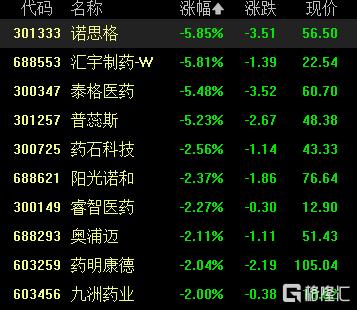
Core Viewpoint - A proposed executive order from the Trump administration is causing significant turmoil in the biopharmaceutical market, with major declines in stock prices for several companies [1][6]. Market Reaction - In the A-share market, companies such as Nossger, Huyou Pharmaceutical, and Tigermed saw declines exceeding 5%, with others like Yaoshi Technology and WuXi AppTec also following suit [1][2]. - The Hong Kong market's innovative drug concept index initially dropped over 7%, later narrowing to a 4.39% decline by midday [2]. Proposed Policy Impact - The New York Times reported that the proposed policy would require the FDA to conduct stricter reviews of clinical trial data from China, with companies submitting such data facing higher regulatory fees [3]. - If implemented, these restrictions could disrupt the U.S. pharmaceutical industry and affect the supply of all types of drugs, from generics to advanced therapies [6]. Industry Concerns - Analysts express that this "black swan" event could lead to a global supply chain restructuring, similar to the trade war during Trump's first term [7]. - The potential for drug shortages and rising prices in the U.S. market is a significant concern, particularly for generic drugs [7]. Investment Sentiment - Investor sentiment is divided, with some viewing the situation as a short-term emotional shock, while others worry that the end of the U.S. market could signal the end of the Chinese innovative drug bull market [9]. - Historical data suggests that after similar events, the pharmaceutical sector typically experiences a rebound within 2-4 weeks, with potential gains of 15%-20% [9].





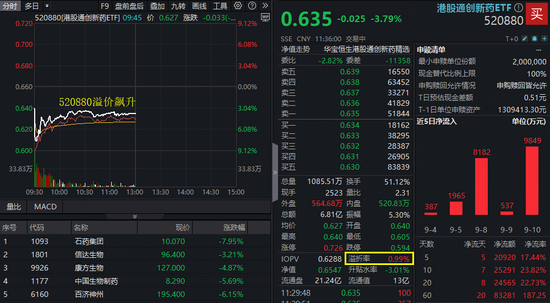
一则消息传来,创新药剧烈调整!“抄底”资金火速进场,港股通创新药ETF(520880)溢价飙升,半日成交6.8亿元
Xin Lang Ji Jin· 2025-09-11 03:43
有消息称,美方或将把矛头对准中国创新药BD。隔夜外媒报道,一项草拟的行政命令威胁要切断从中 国引进创新药的通道,一是针对美国制药公司从中国药企收购药物权益的交易,二是试图阻止制药企业 依赖来自中国患者的临床试验数据。 影响多大?分析认为,该草案或类似于去年的生物安全法案,大概率无法落地,但可能会围绕是否发布 进行一系列的博弈。去年CXO已验证医药脱钩断链不可行,相信中国创新药产业也将承受住压力测 试。目前中国已成为全球创新药不可动摇的源头,中国创新药的崛起不可逆转,这是全球创新资源优化 配置的结果。 创新药波动加剧!9月11日,创新药纯度100%的港股通创新药ETF(520880)低开后一度下挫逾7%, 而后震荡回升,午间收跌3.79%。场内或涌入巨量"抄底"资金,520880持续宽幅溢价,溢价率一度飙至 0.99%,半日成交6.81亿元,已大幅超过上日全天成交额。 | 分时 多日 · | | | F9 盘前盘后 宿加 九轮 图线 工具 @ (2 )> | | | | | | 港股通创新药ETF ① | | | --- | --- | --- | --- | --- | --- | --- | --- | - ...
一则报道带崩!港股创新药深V拉升,资金逆势抢筹恒生医药ETF
Ge Long Hui A P P· 2025-09-11 03:19
Group 1 - The core viewpoint of the article highlights the volatility in the Hong Kong innovative drug sector, with significant declines in stocks such as Hansoh Pharmaceutical, BeiGene, and CSPC Pharmaceutical, alongside a notable drop in the Hang Seng Medical ETF [1] - A report from The New York Times indicates that the Trump administration is considering stricter restrictions on innovative drugs from China, particularly experimental drugs, which may have limited substantive impact on domestic innovative drug companies [1] - Data from Huatai Securities shows that since 2025, there have been 540 global innovative drug business development transactions with a total disclosed amount of $163.41 billion, of which Chinese innovative drugs accounted for 83 license-out transactions totaling $84.53 billion, indicating the irreversible rise of Chinese innovative drugs [1] Group 2 - The article notes that foreign companies have faced a patent cliff since 2020, necessitating the acquisition of pipelines to fill a market gap exceeding $240 billion over the next decade, leading to increased lobbying efforts [2] - Long-term trends suggest that the aging population in China will drive steady growth in health consumption demand, forming a core logic for investment in the pharmaceutical sector [2] Group 3 - The Hang Seng Medical ETF (159892) is highlighted as a representative of the global pharmaceutical industry, with a decline of 3.3%, and its top ten weighted stocks include several innovative drug companies [3] - The Hong Kong Stock Connect Medical ETF (520510) focuses on CXO and AI healthcare, with a decrease of 1.88%, featuring leading companies such as WuXi Biologics and MicroPort Medical [3]
交银国际每日晨报-20250911
BOCOM International· 2025-09-11 01:45
Group 1: MOMO US - The operating profit exceeded expectations, with overseas new products maintaining strong growth momentum [1] - Revenue for Q2 2025 was 2.62 billion yuan, a year-on-year decrease of 3%, while adjusted operating profit was 450 million yuan, surpassing the expected 390 million yuan due to better-than-expected cost control and marketing channel optimization [1] - Overseas revenue continued to expand, increasing by 73% year-on-year, accounting for 17% of total revenue [1] Group 2: Future Outlook for MOMO US - Revenue for Q3 2025 is expected to decline by 2% year-on-year, with the impact of stricter compliance on streamer taxes leading to potential increases in revenue-sharing incentives [2] - Overseas revenue is projected to grow by 62% year-on-year, with products like Amar and Yaahlan expected to maintain strong growth [2] - Adjustments to net profit expectations for 2025/26 have been made due to potential new product marketing investments and changes in dividend withholding tax rates [2] Group 3: SF Express (9699 HK) - The company is experiencing continuous profit release under diversified layouts, with a buy rating maintained [3] - Revenue growth for 2025-27 has been revised upward by 14%/12%/12% to 22 billion - 30.4 billion yuan, with year-on-year growth rates of 40%/20%/15% [3] - Profit forecasts for 2025-27 have been increased by 26%/23%/27% to 340 million - 760 million yuan, with Non-IFRS net profit margins of 1.5%/2%/2.6% [3] Group 4: Future Outlook for SF Express - SF Express is expected to benefit from a rational return of subsidies in the takeaway market, with significant business space remaining [4] - The target price has been adjusted to 15.4 HKD based on a rolling valuation to 2026, corresponding to 0.5 times the sales ratio [4] Group 5: Consumer Industry Overview - The consumer market in mainland China showed moderate recovery in the first half of 2025, with structural differentiation in performance across segments [8] - Key trends include the leading performance of experiential consumption, revenue growth from global expansion strategies, and operational efficiency becoming a critical factor for profit differentiation [8][9] - Recommendations include focusing on players capturing consumer trends with high growth potential, such as Pop Mart (9992 HK), and industry leaders with stable fundamentals like Midea (000333 CH), Anta (2020 HK), and Yili (600887 CH) [8] Group 6: Automotive Industry Overview - The penetration rate of new energy vehicles reached 55.2% in August, with retail sales of passenger cars hitting a historical high of 1.995 million units [12] - The export of passenger cars, including new energy vehicles, maintained good growth momentum, with 204,000 new energy vehicles exported in August, accounting for 40.9% of total exports [13] - The upcoming launch of multiple new models in Q3-Q4 2025 is expected to enrich market supply and boost sales during the traditional peak season [13][14]





智通港股通资金流向统计(T+2)|9月11日
智通财经网· 2025-09-10 23:32
Core Insights - The article highlights the net inflow and outflow of capital in the Hong Kong stock market, with specific focus on the top companies experiencing significant changes in capital flow [1][2]. Group 1: Net Inflow - Alibaba-W (09988) leads with a net inflow of 5.14 billion, representing a 25.60% increase in capital [2]. - Horizon Robotics-W (09660) follows with a net inflow of 1.375 billion, showing a 24.13% increase [2]. - Tencent Holdings (00700) has a net inflow of 1.076 billion, with an 8.04% increase [2]. - Other notable companies with significant inflows include BYD Company (01211) with 1.031 billion and WuXi Biologics (02269) with 542 million [2]. Group 2: Net Outflow - Pop Mart (09992) experiences the highest net outflow at -649 million, reflecting a -6.94% decrease [2]. - Kuaishou-W (01024) has a net outflow of -581 million, with a -13.67% decrease [2]. - Meitu Inc. (01357) sees a net outflow of -472 million, indicating a -24.59% decrease [2]. - Other companies with significant outflows include Xiaomi Group-W (01810) at -368 million and China Merchants Bank (03968) at -227 million [2]. Group 3: Net Inflow Ratio - The top net inflow ratio is held by Wisdom Hong Kong 100 (02825) at 100.00%, with a total inflow of 5.924 billion [3]. - Sinopec Kantons Holdings (00934) follows with a net inflow ratio of 72.10%, totaling 6.5044 million [3]. - Kunlun Energy (00135) has a net inflow ratio of 63.22%, with an inflow of 5.6388 million [3]. Group 4: Net Outflow Ratio - iFlytek Medical Technology (02506) leads in net outflow ratio at -48.28%, with an outflow of -13.4085 million [3]. - VTECH Holdings (00303) has a net outflow ratio of -45.83%, totaling -15.8089 million [3]. - NetDragon (00777) follows with a net outflow ratio of -45.72%, with an outflow of -41.1797 million [3].





