OPPO

Search documents
手机厂商不拼性能卷生态:参数已死,体验当立?
3 6 Ke· 2025-11-17 03:45
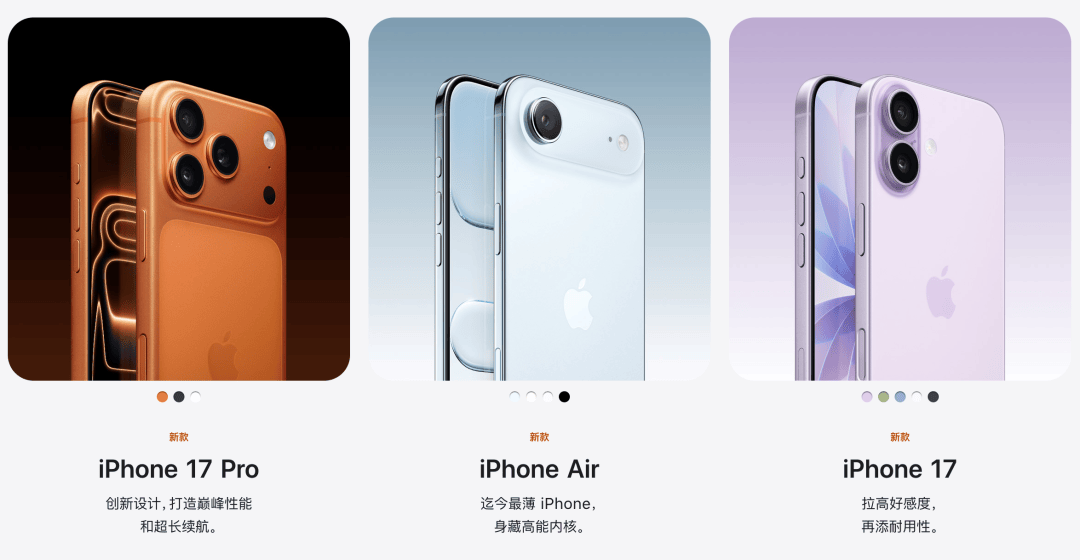
Core Viewpoint - The smartphone industry is undergoing a significant transformation, shifting focus from hardware specifications to imaging capabilities, ecosystem connectivity, and AI-driven experiences as key competitive factors in a stagnant market [1][2][27]. Group 1: Flagship Model Releases and Imaging Competition - Major smartphone manufacturers, including Apple, Xiaomi, Vivo, Honor, and OPPO, have launched their flagship models in the latter half of 2025, intensifying market competition [3][4]. - The emphasis on imaging and ecosystem applications has replaced traditional hardware specifications as the main selling points of flagship devices [4][6]. - Apple’s iPhone 17, despite some criticism regarding its materials, highlights advancements in AI processing and imaging capabilities, aiming to enable users to capture professional-quality photos [4][5]. Group 2: AI and Ecosystem Connectivity - AI technology is now integrated into daily user experiences, enhancing functionalities such as night photography, portrait optimization, and image stabilization [7][8]. - Manufacturers are focusing on creating a seamless ecosystem where smartphones serve as the central hub for various smart devices, enhancing user experience and encouraging brand loyalty [9][10]. - The interconnectedness of devices, such as OPPO's "super connectivity" features and Vivo's smart home integration, aims to provide a more cohesive user experience [10][11]. Group 3: Market Dynamics and Growth Strategies - The smartphone market is experiencing stagnation, with IDC reporting a slight decline in shipments, necessitating manufacturers to seek new growth avenues [12][13]. - The average smartphone replacement cycle in China has extended from 24 months in 2020 to 36 months in 2024, increasing pressure on manufacturers to innovate [14]. - Companies are prioritizing ecosystem development to retain users and create new revenue streams, with Xiaomi reporting significant income from its IoT and lifestyle products [17][18]. Group 4: Rise of Domestic High-End Phones - Domestic brands like OPPO and Vivo are gaining market share in the high-end segment, with their combined market share increasing from 19% to 38% in the 4000-5999 yuan price range [22]. - Despite the growth of domestic brands, there are concerns regarding product quality and customer service, which could hinder their acceptance in the high-end market [24][26]. - The shift in consumer perception towards domestic high-end phones reflects a search for balance between price and brand value, challenging Apple's dominance [22][24]. Group 5: Conclusion - The smartphone market is transitioning from a focus on hardware specifications to an emphasis on ecosystem integration and user experience, prompting manufacturers to rethink growth strategies [27]. - The ability to deliver seamless experiences across devices will be crucial for companies to thrive in a competitive landscape, driving the industry towards higher quality development [27].



雷军连发数文回怼质疑:车好看与安全不矛盾/曝库克将于明年卸任苹果CEO/华为或将发布AI突破性技术
Sou Hu Cai Jing· 2025-11-17 03:12
Group 1 - Apple is set to change its iPhone release cycle, potentially launching 5-6 new models each year starting in 2026, including the iPhone 18 Pro/Pro Max and a new foldable product [3][4] - The second-generation iPhone Air is expected to feature a dual-camera system and improved battery capacity, but its release has been delayed to 2027 due to previous poor sales [4][5] - Apple has halted the development of the M4 Ultra chip and will focus on the M5 Ultra, with significant updates to the Mac Pro not expected until 2026 [5] Group 2 - Huawei plans to unveil a breakthrough AI technology on November 21, aimed at improving the utilization efficiency of computing resources from an industry average of 30-40% to 70% [6] - The technology will unify resource management across various processors, enhancing support for AI training and inference [6] Group 3 - Apple is accelerating its CEO succession plan, with Tim Cook expected to step down in early 2026, and John Ternus is seen as a potential successor [7][8] - The transition aims to maintain product release schedules and is not prompted by current performance issues [8] Group 4 - Beijing has announced significant advancements in its 6G laboratory, showcasing ten key technological achievements in high-frequency communication and intelligent surfaces [9][12] - The developments include a prototype 256TR U6G base station capable of achieving a peak downlink speed of 20Gbps [9] Group 5 - Xiaomi's CEO Lei Jun emphasized the importance of safety in the design of the new SU7 vehicle, which features a high-strength steel and aluminum body [15][16] - The vehicle's battery design incorporates multiple safety measures to prevent thermal runaway, ensuring passenger safety [17] Group 6 - Leap Motor has achieved its annual sales target of 500,000 vehicles 45 days ahead of schedule, with plans to target 1 million units next year [21][23] - The company is set to unveil several new models at the upcoming Guangzhou International Auto Show [25] Group 7 - WeChat has updated its Android version to allow users to back up chat records to external storage devices, including USB drives [29][30] - This feature supports manual backup path selection and automatic backups every 24 hours [29] Group 8 - Meta will introduce "AI-driven impact" as a core metric in employee performance evaluations starting in 2026, aiming to foster an AI-native culture [31] - The company has already integrated AI into its hiring process and will launch an "AI Performance Assistant" tool to assist employees in performance feedback [31] Group 9 - Wang Xingxing, CEO of Yuzhu Technology, stated that AI will enable robots to understand the world, transitioning them from industry tools to life partners over the next decade [32][33] - He highlighted the need for global collaboration and ethical standards in the development of robotics technology [33]
宏观和大类资产配置周报:本周沪深300指数下跌1.08%-20251117
Bank of China Securities· 2025-11-17 02:17
Macroeconomic Overview - The macroeconomic report indicates a decline in the Shanghai Composite Index by 1.08% this week, with a recommended asset allocation order of equities > commodities > bonds > cash [1][2][4]. Economic Data - In October, the total retail sales of consumer goods reached 46,291 billion yuan, showing a year-on-year growth of 2.8%. Excluding automobiles, retail sales grew by 4.0%, accelerating by 0.8 percentage points compared to September [3][6]. - The industrial added value for October increased by 4.9% year-on-year, while fixed asset investment decreased by 1.7% from January to October, with real estate development investment down by 14.7% [6][24]. Asset Performance - The report highlights that the commodity futures index rose by 3.92% this week, with significant increases in precious metals (4.23%) and grains (1.41%). However, energy and coal-related sectors saw declines [50]. - The ten-year government bond yield remained stable at 1.81%, while the ten-year national development bond yield also held steady [45][49]. Consumer Behavior - The report notes a recovery in consumption during the Mid-Autumn and National Day holidays, with restaurant income growing by 3.8% year-on-year, which contributed to a 0.4 percentage point increase in overall retail sales growth [3][6]. - Despite a year-on-year decline in automobile and online goods retail sales of 4.4% and 1.2% respectively, these sectors are expected to be key drivers for future domestic demand expansion [3][37]. Investment Recommendations - The report maintains an overweight position on equities, particularly focusing on the implementation of "incremental" policies. Bonds and cash are recommended for underweight positions due to potential short-term impacts from the equity-bond relationship [5][14]. - The commodity sector is suggested to be held at a standard allocation, with attention to the progress of fiscal policies [5][14]. Market Dynamics - The report indicates that the A-share market showed weakness, with most indices declining except for the Shanghai Dividend Index, which rose by 0.39%. The leading sectors included catering and tourism, while telecommunications and electronics faced significant declines [40][41]. High-Tech Industry Insights - The report mentions that several smartphone manufacturers have paused their procurement of storage chips due to rising prices, indicating a potential impact on the high-tech sector [42][43]. Summary of Key Economic Meetings - Key meetings involving Chinese leadership emphasized the importance of enhancing consumption and investment in emerging sectors such as renewable energy and digital economy, which may influence future economic policies [22][23].
智能早报丨“羊毛党”用AI骗取“仅退款”;华为将发布AI领域突破性技术
Guan Cha Zhe Wang· 2025-11-17 02:02
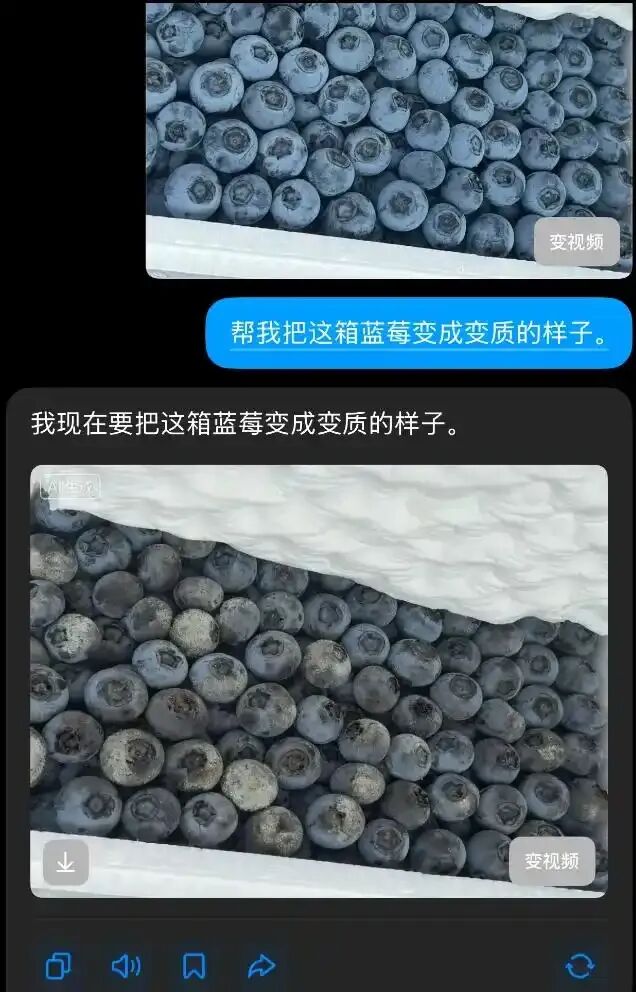
Group 1: Leadership Changes at Apple - Tim Cook may step down as CEO of Apple as early as next year after 14 years in the role, with John Ternus, the current Senior Vice President of Hardware Engineering, being the likely successor [1] - Ternus has been with Apple since 2001 and has played a significant role in the engineering design of major hardware products [1] - Apple typically announces major personnel changes after its January earnings report, allowing new management to acclimate before key events like WWDC and the iPhone launch [1] Group 2: E-commerce Fraud Trends - A new type of fraud involving AI-generated fake images for "refund only" claims is emerging in the e-commerce sector, with consumers using AI tools to create images of defective products [2] - Some individuals are reportedly learning this fraudulent technique for a fee, claiming they can successfully obtain refunds multiple times [2] Group 3: Semiconductor Supply Chain Issues - Several smartphone manufacturers, including Xiaomi, OPPO, and vivo, have paused their procurement of storage chips due to soaring prices, with some companies having less than two months of inventory [3] - The price of DRAM chips has increased by nearly 50%, leading manufacturers to hesitate in accepting these quotes [3] - The demand for storage chips has surged due to the AI model wave, with data centers willing to pay over 30% more than smartphone manufacturers for the same products [3] Group 4: Huawei's AI Technology Announcement - Huawei is set to unveil a breakthrough AI technology on November 21, aimed at improving the utilization efficiency of computing resources from an industry average of 30%-40% to 70% [4] - This technology will unify resource management across various computing hardware, enhancing support for AI training and inference [4] - The upcoming technology shares similarities with the core technology of Israeli AI startup Run:ai, which was acquired by NVIDIA for $700 million [4] Group 5: AI-Driven Scientific Discovery - A team from Peking University has developed the AI-Newton system, which can rediscover fundamental physical laws without prior knowledge [5] - The system identifies an average of 90 physical concepts and 50 general laws in test cases, showcasing its potential for autonomous scientific discovery [5] Group 6: OpenAI's Research on Model Interpretability - OpenAI has released new research on model interpretability, proposing a sparse model with fewer connections but more neurons to enhance understanding of internal mechanisms [6] - The research identifies the "minimal loop" for specific tasks, suggesting that larger sparse models can generate more powerful yet simpler models [6]

早报|曝iPhone换代周期大改:或一年发布 6 款新机/雷军连发多条微博回应质疑/Android 微信更新聊天备份至 U 盘
Sou Hu Cai Jing· 2025-11-17 01:50
Group 1: Apple iPhone Release Cycle Changes - Apple is set to change its iPhone release cycle, potentially launching 5-6 new models each year starting in 2026 [5][6] - The new cycle includes the release of iPhone 18 Pro/Pro Max and a new foldable product in 2026, followed by iPhone 18/18e and a special edition in 2027 [5][6] - The decision aims to alleviate pressure on marketing and engineering teams and improve revenue distribution throughout the year [6] Group 2: Apple CEO Succession Plan - Apple is accelerating its CEO succession plan, with Tim Cook expected to step down in early 2026 [9][10] - The board is discussing a smooth transition without affecting product release schedules, with John Ternus seen as a potential successor [10] - The succession plan is based on long-term strategy rather than current performance, with changes expected to be announced after the January 2026 earnings report [10] Group 3: Huawei AI Breakthrough - Huawei plans to unveil a breakthrough technology in AI on November 21, aimed at improving the efficiency of computing resource utilization from an industry average of 30-40% to 70% [8] Group 4: Xiaomi's Automotive Safety Focus - Xiaomi's CEO Lei Jun emphasized the importance of safety in the design of the new SU7 vehicle, stating that safety is a fundamental principle [17][18] - The SU7 features a steel-aluminum hybrid body with over 90% high-strength steel and aluminum, and advanced battery safety measures [18] Group 5: Zero Run Automotive Sales Achievement - Zero Run has achieved its sales target for 2025, reaching 500,000 vehicles 45 days ahead of schedule [21][23] - The company aims to double its sales target to 1 million vehicles in the following year [23] Group 6: WeChat Update for Android - WeChat has updated its chat backup feature, allowing users to save data directly to external storage devices like USB drives [29][30] - The update supports manual backup path selection and automatic backups every 24 hours [31] Group 7: Meta's AI Performance Evaluation - Meta will introduce "AI-driven impact" as a core metric in employee performance evaluations starting in 2026 [33][34] - This shift aims to foster an "AI-native culture" within the company, rewarding significant AI contributions [34] Group 8: 6G Development in Beijing - Beijing has announced significant advancements in 6G technology, including prototypes and systems aimed at enhancing communication capabilities [12][13] - The developments include a 256TR U6G base station prototype achieving a peak user downlink of 20Gbps [12]


华为Mate80定档11月25日,或搭载麒麟9030芯片
Guan Cha Zhe Wang· 2025-11-17 01:36
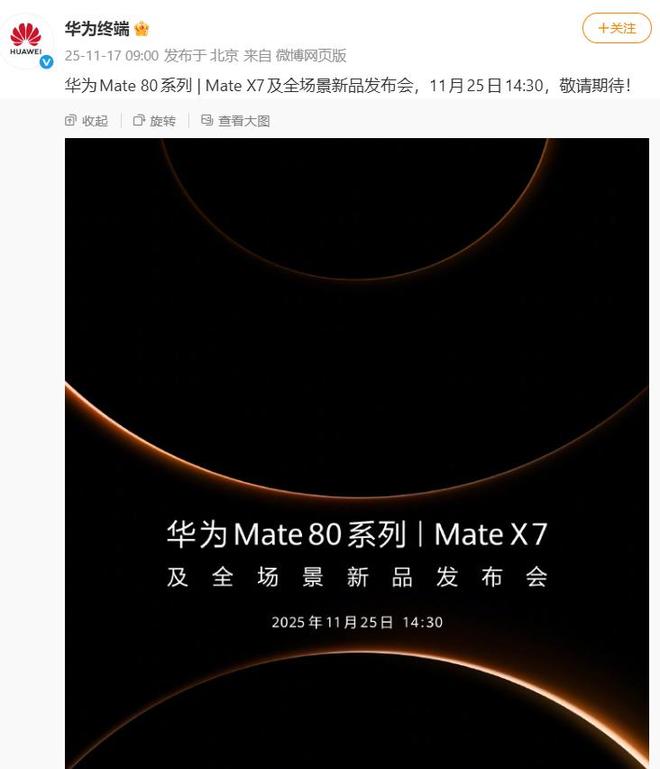
Group 1 - Huawei is set to hold a launch event for the Mate 80 series, including Mate 80, Mate 80 Pro, Mate 80 Pro Max, and Mate 80 RS, on November 25 at 14:30 [1] - The Mate 80 series is expected to debut the new Kirin 9030 processor and feature 3D facial recognition across all models [1] - The series will support magnetic suction rings and be compatible with external magnetic cases, with a focus on network communication architecture [1] Group 2 - According to Omdia, the smartphone market in mainland China saw a 3% year-on-year decline in Q3, indicating a period of adjustment and increasing competition among leading manufacturers [1] - Vivo regained the top position with 11.8 million units shipped, holding an 18% market share, despite a 9% decline in shipments [1] - Huawei ranked second with 10.5 million units shipped, capturing a 16% market share, with a 3% decrease in shipments [1] - Apple continued its growth trend with 10.1 million units shipped, being the only brand among the top five to show an increase [1] - Xiaomi and OPPO followed with shipments of 10 million and 9.9 million units, respectively, ranking fourth and fifth [1]
手机厂商叫苦不迭!
是说芯语· 2025-11-17 00:44
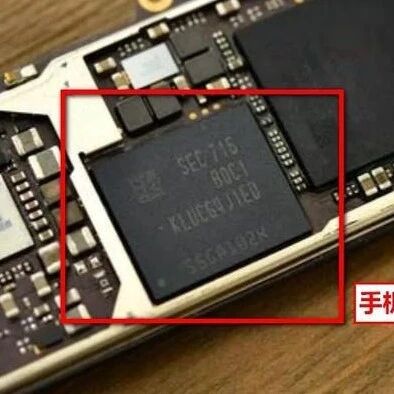
Core Viewpoint - A sudden surge in storage chip prices is impacting the consumer electronics sector, particularly affecting major domestic smartphone manufacturers like Xiaomi, OPPO, and vivo, who are facing inventory shortages and rising costs due to nearly 50% price increases from major suppliers [1][2]. Group 1: Price Surge and Inventory Challenges - The price increase in storage chips is a result of a combination of industry cycles and supply-demand dynamics, following a prolonged downtrend where prices fell over 60% from 2023 to mid-2024 [1]. - Major smartphone manufacturers have adopted a conservative procurement strategy due to previous price declines, leading to an average inventory cycle of 1.5 to 2 months, with some DRAM inventories dropping to less than three weeks [2][4]. - The 50% price increase translates to an additional cost of 100 to 200 yuan per mid-range smartphone, significantly impacting profit margins already under pressure [2]. Group 2: Manufacturer Responses and Supply Chain Adjustments - Manufacturers are responding cautiously, with many opting to delay large-scale procurement and instead reallocating internal inventory and optimizing product configurations [4]. - Some manufacturers are negotiating with upstream suppliers for better pricing or installment agreements, while others with sufficient inventory are making small-scale purchases to mitigate future price increases [4]. - The price surge is prompting manufacturers to reassess their supply chain strategies, accelerating partnerships with domestic storage chip companies to reduce reliance on foreign suppliers [5]. Group 3: Broader Industry Implications - The price increase is affecting the entire supply chain, compressing margins for storage module manufacturers and leading to difficulties in order fulfillment for smaller firms [5]. - If smartphone manufacturers cannot absorb the increased costs, there may be price hikes for mid-range smartphones in the next 1 to 2 quarters, potentially affecting consumer purchasing behavior [5]. - Future price trends will depend on supply-demand dynamics, with predictions suggesting that prices may remain high through late 2024 to early 2025 due to ongoing production cuts by major suppliers [5].

索尼手机彻底退出中国:卷不过国产、跟不上时代
3 6 Ke· 2025-11-17 00:07
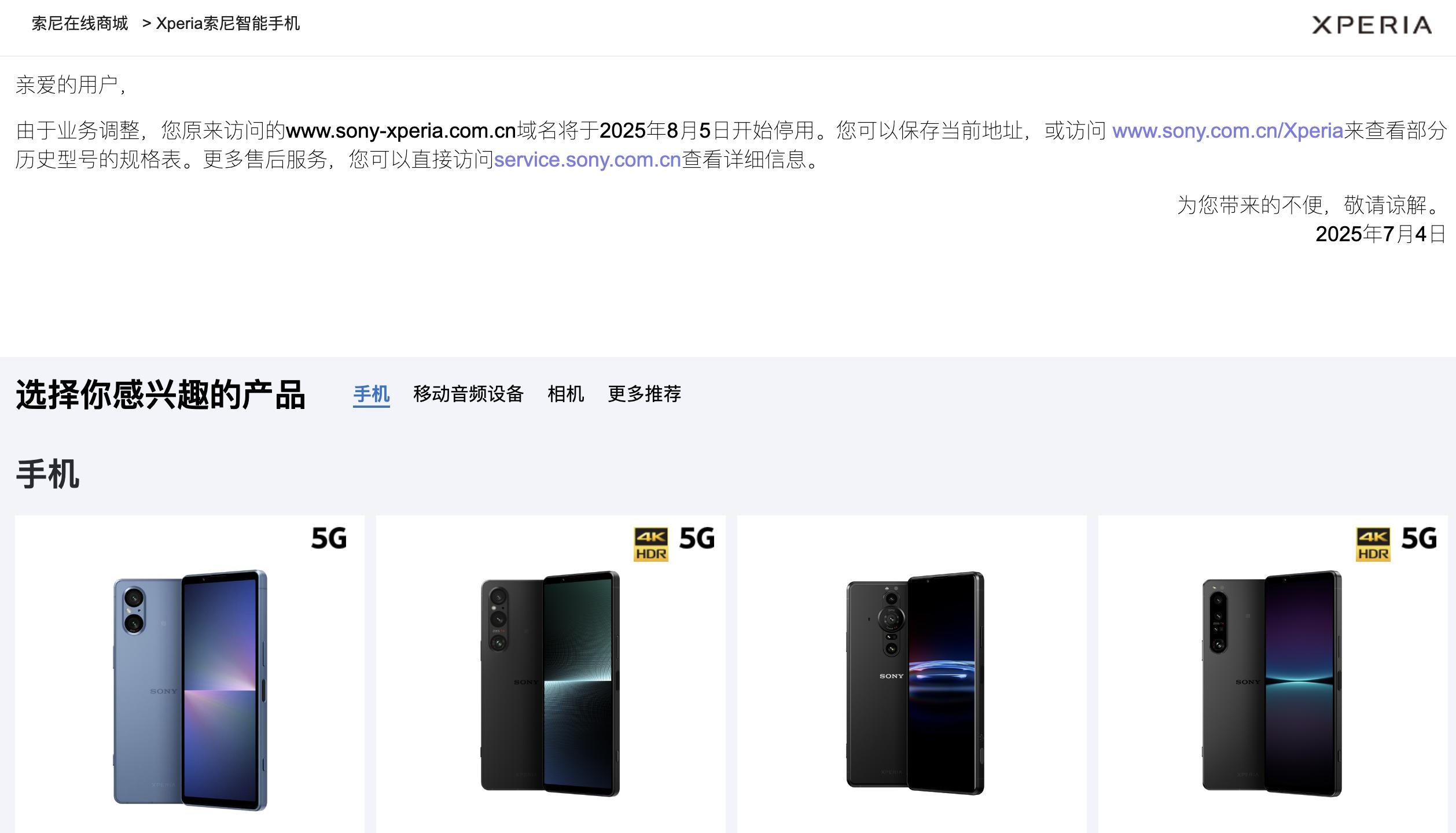
Core Insights - Sony's Xperia brand has officially ceased operations in China, marking a significant retreat from the market after years of declining performance [1][3] - The decision to shut down the brand is attributed to long-standing issues with market adaptation and competition from local brands [3][12] Historical Context - Sony's mobile division was once highly regarded in China, particularly during the Sony Ericsson era from 2005 to 2010, when it was popular among young consumers [4] - The introduction of the Xperia brand initially saw success, with notable models like the Xperia Arc and Xperia Z series gaining traction [6][9] - However, by 2016-2018, local competitors like Huawei and Xiaomi began to dominate the market, leading to a decline in Sony's market share [9][10] Market Performance - Sony's smartphone market share in China has dwindled to less than 0.1% as of 2023, reflecting its inability to compete effectively [12] - The brand's focus on niche features and high pricing has alienated mainstream consumers, contributing to its decline [10][12] Strategic Missteps - Despite the "One Sony" strategy aimed at leveraging synergies across its various business units, the mobile division failed to capitalize on these resources effectively [14][16] - Sony's lack of software support and local market adaptation has been a critical factor in its failure to resonate with Chinese consumers [16][19] Future Outlook - Sony's mobile division is no longer seen as a profitable business but rather as a platform for testing new imaging technologies [20] - The increasing collaboration between Sony's imaging business and Chinese brands raises concerns about the future viability of the Xperia brand [22]
8点1氪|文旅部提醒中国游客近期避免前往日本;“羊毛党”用AI假图骗“仅退款”:百元内商品成重灾区;雷军连续发文回应质疑
3 6 Ke· 2025-11-17 00:01
Group 1 - The Ministry of Culture and Tourism of China advises tourists to avoid traveling to Japan due to rising safety concerns and criminal cases targeting Chinese citizens [2][3] - The Ministry of Education issues a warning for students studying in Japan, highlighting the deteriorating security situation and urging them to enhance their safety awareness [2][3] Group 2 - A new AI-based scam is emerging in the e-commerce sector, where consumers use AI tools to create fake defect images to claim refunds for low-cost items [2][3] - Reports indicate that this scam has developed into a more systematic gray industry, with individuals offering training on how to execute these refund tricks for a fee [7][8] Group 3 - Tim Cook may step down as CEO of Apple as early as next year, with John Ternus being the likely successor [3] - Apple plans to change its iPhone release strategy starting in 2026, moving to a spring and fall release schedule instead of the traditional fall-only launch [9] Group 4 - Samsung announces a significant investment of 450 trillion KRW in South Korea over the next five years, focusing on semiconductor expansion and job creation [9] - Multiple airlines, including Air China and China Southern Airlines, have announced free cancellation and modification policies for tickets related to Japan due to safety concerns [11] Group 5 - Xiaomi's CEO Lei Jun defends the company's design philosophy for its vehicles, emphasizing that aesthetics and safety are not mutually exclusive [8] - Several smartphone manufacturers, including Xiaomi and OPPO, are delaying storage chip purchases due to soaring prices, with some facing inventory shortages [12] Group 6 - Berkshire Hathaway's latest 13F report reveals that Warren Buffett has significantly reduced his stake in Apple, while increasing his investment in Alphabet [16] - The establishment of the first financial asset investment company by a joint-stock bank in China aims to support the optimization of capital structures for tech and private enterprises [11]

段永平用两个字赚了千亿
3 6 Ke· 2025-11-16 21:59
Group 1 - The core viewpoint of the articles revolves around Duan Yongping's humble approach to success in both business and investment, emphasizing his belief in understanding the companies he invests in rather than chasing market trends [1][12] - Duan Yongping's background includes founding the Xiaobawang brand and later establishing the BBK Electronics Company, which led to the creation of several successful brands like OPPO and Vivo [4][9] - His investment philosophy is characterized by a focus on understanding the business model and value of the companies he invests in, such as NetEase, Apple, and Moutai, rather than merely speculating on stock prices [11][12] Group 2 - Duan Yongping's "not-to-do list" includes avoiding OEM production, which he believes would hinder brand development and competitiveness [8][9] - He emphasizes the importance of making decisions based on what is right rather than solely on financial gain, which he considers a key to achieving financial freedom [5][6] - His notable investment in NetEase during the internet bubble, where he bought shares at a low price, showcases his ability to remain calm and rational in the face of market panic, leading to significant returns [11][12]