
同花顺

Search documents
三季报在即,把握板块配置机遇
Changjiang Securities· 2025-10-12 23:30
Investment Rating - The report maintains a "Positive" investment rating for the industry [9] Core Insights - The upcoming Q3 reports are expected to show continued high growth in brokerage performance, enhancing the sector's allocation value. The insurance sector reflects a trend of deposit migration, increased equity allocation, and improved new policy costs, leading to a higher certainty of long-term ROE improvement and accelerated valuation recovery. Overall, the cost-effectiveness of allocations is gradually increasing [2][6] - Recommendations include companies with stable profit growth and dividend rates such as Jiangsu Jinzu, China Ping An, and China Pacific Insurance, as well as firms with significant advantages in business models and market positions [6] - The report recommends specific stocks including Xinhua Insurance, China Life, Hong Kong Stock Exchange, CITIC Securities, Dongfang Wealth, Tonghuashun, and Jiufang Zhitu Holdings based on performance elasticity and valuation levels [2][6] Market Performance - The non-bank financial index increased by 0.5% last week, with a relative excess return of +1.0% compared to the CSI 300, ranking in the middle of the industry [7] - Year-to-date, the non-bank financial index has risen by 7.4%, but with a relative excess return of -9.9% compared to the CSI 300, indicating a lower ranking [7] - The average daily trading volume in the market has increased to 26,029.82 billion yuan, up 18.98% week-on-week, with a daily turnover rate of 2.71%, up 42.99 basis points [7] Key Industry News & Company Announcements - The China Banking and Insurance Regulatory Commission issued a notice on strengthening the regulation of non-auto insurance business [8] - China Pacific Insurance's Chief Actuary Zhang Yuanhan has resigned [8]




非银金融行业跟踪周报:监管推动健康险高质量发展,非车险“报行合一”落地-20251012
Soochow Securities· 2025-10-12 14:44
Investment Rating - The report maintains an "Overweight" rating for the non-bank financial industry [1] Core Insights - The report highlights the regulatory push for high-quality development in health insurance and the implementation of "reporting and operation integration" in non-auto insurance, which is expected to improve industry profitability [1][4] Summary by Sections Non-Bank Financial Subsector Performance - In the recent two trading days (October 9-10, 2025), all non-bank financial sub-sectors outperformed the CSI 300 index, with the securities sector rising by 0.55%, insurance by 0.72%, and diversified finance by 1.68%, while the overall non-bank financial sector increased by 0.71% [9][10] Non-Bank Financial Subsector Views Securities - Trading volume has increased year-on-year, with the average daily trading volume for October 2025 reaching CNY 30,222 billion, a 35.10% increase compared to October 2024 [14] - The margin trading balance as of October 9, 2025, was CNY 24,455 billion, up 58.00% year-on-year [14] - The average price-to-book (PB) ratio for the securities industry is projected at 1.4x for 2025 [19] Insurance - The regulatory body has issued guidelines to promote high-quality development in health insurance, aiming for a multi-tiered health insurance market by 2030 [21] - Health insurance premiums totaled CNY 7,598 billion from January to August 2025, reflecting a 2.4% year-on-year growth [25] - The implementation of "reporting and operation integration" in non-auto insurance is expected to enhance profitability, with total premiums for non-auto insurance reaching CNY 6,195 billion, accounting for 50.8% of total premiums [24] Diversified Finance - The trust industry saw its asset scale reach CNY 29.56 trillion by the end of 2024, a 23.58% increase year-on-year, although profits declined significantly [32] - The futures market recorded a trading volume of 839 million contracts and a turnover of CNY 65.08 trillion in August 2025, marking year-on-year increases of 13.98% and 21.38%, respectively [35] Industry Ranking and Key Company Recommendations - The report ranks the insurance sector highest, followed by securities and diversified finance, recommending companies such as China Ping An, New China Life, China Pacific Insurance, CITIC Securities, Tonghuashun, and Jiufang Zhitu Holdings [48]


预计25Q3剪刀差持续:计算机行业2025Q3业绩前瞻
Shenwan Hongyuan Securities· 2025-10-12 12:01
Investment Rating - The report maintains a positive outlook for the computer industry, expecting a continued "scissor difference" in Q3 2025, indicating structural growth despite varying performance among companies [3][4][11]. Core Insights - The report predicts that 22% of the tracked companies will see net profit growth exceeding 50%, with notable performers including 深信服 (1528%), 卡莱特 (998%), and 新国都 (235%) [4][5]. - The report highlights a trend of cost reduction through layoffs and non-essential cost cuts, leading to improved efficiency and profitability across the industry [3][4]. - The report identifies key investment targets in various segments, including AIGC, digital economy leaders, and data innovation [3][4]. Summary by Sections Q3 2025 Performance Forecast - Among 54 tracked companies, 11 are expected to exceed 50% profit growth, while 9 will see growth between 30%-50% [4][5]. - 36% of companies are projected to have growth between 0%-30%, and 22% are expected to experience a decline [5][6]. Key Company Performances - 深信服 is projected to achieve a staggering 1528% profit growth, while 卡莱特 is expected to see 998% growth [4][5]. - Companies like 海康威视 and 金山办公 are expected to maintain stable growth rates of around 9% and 15%, respectively [8][10]. - 联想集团 is forecasted to face a significant decline of 99% in profit, indicating challenges in its operational strategy [6][10]. Investment Targets - The report categorizes investment targets into four segments: AIGC, digital economy leaders, data innovation, and AIGC computing power [3][4]. - Notable companies in the AIGC segment include 金山办公 and 道通科技, while 海光信息 and 软通动力 are highlighted in the data innovation category [3][4].



手机炒股软件哪个最好?详解2025年支持AI智能的主流炒股软件
Xin Lang Zheng Quan· 2025-10-11 06:39
Core Insights - The article discusses how AI-driven stock trading software is redefining investment decision-making in the digital investment era, emphasizing the importance of speed and efficiency in investment decisions [1]. Group 1: Evaluation Framework - The evaluation framework for stock trading apps in 2025 includes five key dimensions: data coverage, information quality, intelligent tools, trading experience, and community ecosystem [2]. - Sina Finance APP ranks first with a comprehensive score of 9.56, followed by Tonghuashun and Dongfang Caifu, both scoring 9.16 [3]. Group 2: Data Coverage - Data breadth and speed are core competitive advantages for stock trading software, with Sina Finance APP covering over 40 global markets and achieving a refresh speed of 0.03 seconds [5]. - During a significant market drop in May 2025, Sina Finance maintained millisecond-level updates, while competitors experienced delays of 1-2 seconds [5]. Group 3: Information and AI - The timeliness and depth of information directly impact investment decisions, with Sina Finance's AI assistant providing rapid analysis of major events, outperforming competitors by 5-10 seconds [7]. - The AI assistant can condense lengthy reports into concise summaries, highlighting risk and opportunity points effectively [7]. Group 4: Intelligent Tools - AI is evolving from information filtering to strategy generation, with Sina Finance's tools covering the entire process from data analysis to trading [8]. - The "Main Force Intent Decoding" feature helps users understand institutional fund movements, enhancing decision-making [9]. Group 5: Community Ecosystem - The community aspect of financial apps significantly influences user engagement and decision credibility, with Sina Finance integrating insights from influential figures to create a dynamic information loop [13][14]. - The community of Sina Finance has a high percentage of certified analysts, while competitors like Dongfang Caifu face challenges with the authenticity of discussions due to the presence of fake accounts [16]. Group 6: Trading Experience - The stability and efficiency of trading systems are crucial, with Sina Finance's distributed trading gateway supporting 120,000 concurrent transactions per second without delays during market volatility [18]. - The intelligent routing system of Sina Finance enhances order execution speed compared to industry averages [19]. Group 7: User Selection Guide - Investors are advised to choose trading software based on their specific needs, with Sina Finance recommended for cross-market monitoring, Tonghuashun for short-term trading, and Dongfang Caifu for educational resources [21]. Group 8: Future Trends - The future of stock trading software will see further integration of AI-driven intelligent advisory services, evolving from basic strategy recommendations to dynamic portfolio adjustments and risk alerts [22].

依赖固收业务 权益业务薄弱 华泰保兴基金“偏科”陷困局
Shen Zhen Shang Bao· 2025-10-11 05:41
Core Viewpoint - Huatai Baoxing Fund Company exhibits a common issue among insurance-related public funds, being more proficient in fixed income business while relying heavily on it, resulting in weaker equity business and difficulties in expansion [1][2] Group 1: Company Overview - Huatai Baoxing Fund was established on July 26, 2016, initiated and controlled by Huatai Insurance Group, with its registered location in Shanghai [3] - As of October 25 last year, the China Securities Regulatory Commission approved Ande Co., Ltd. as the actual controller of Huatai Baoxing Fund, marking its transition to a foreign-funded public fund company [3] Group 2: Fund Performance and Structure - As of the end of Q3 this year, Huatai Baoxing Fund managed a total of 34 products with a combined management scale of 67.707 billion yuan, ranking 76th among peers [1] - The company’s management scale remained below 40 billion yuan until mid-2024, but reached 46.7 billion yuan by the end of Q3 2024, and surpassed 50 billion yuan by the end of 2024, reaching 51.9 billion yuan [1] - Fixed income products dominate the product structure, significantly contributing to the company's recent scale growth, with bond fund sizes increasing from below 30 billion yuan until mid-2024 to 57.446 billion yuan by mid-2024 [1] Group 3: Equity Business Challenges - The equity business of Huatai Baoxing Fund has been weak, with the number of stock funds remaining at one until 2025, and its scale shrinking from 475 million yuan at the end of 2021 to 91 million yuan [2] - The recent establishment of two new equity funds in May 2024 has led to a significant increase in stock fund scale, approaching 400 million yuan [2] - The performance of equity funds has been poor, with the Huatai Baoxing Health Consumption A fund showing negative returns over various time frames, underperforming its benchmark by at least 25 percentage points since its inception [2]
ETF总规模再创历史新高
Shen Zhen Shang Bao· 2025-10-11 05:31
Core Insights - The popularity of index-based investment continues to rise, with significant growth in ETF shares and scale in 2023, reaching a historical high of nearly 5.63 trillion yuan [1][2] Group 1: ETF Market Overview - As of the end of Q3 2023, the number of ETFs in China reached 1,325, with total shares exceeding 28.5 billion, marking a quarter-on-quarter increase of nearly 11% and a year-on-year increase of nearly 28% [1] - The total scale of ETFs approached 5.63 trillion yuan, reflecting a quarter-on-quarter increase of 30.7% and a year-on-year increase of 60.5% [1] - The ETF market has expanded rapidly, with the total scale surpassing 1 trillion yuan for the first time in October 2020, and reaching 5 trillion yuan in August 2023 [1] Group 2: ETF Types and Performance - By the end of Q3 2023, the number of stock-type ETFs exceeded 1,000, reaching 1,040, with total shares surpassing 20.7 billion, a quarter-on-quarter increase of 3.57% and a year-on-year increase of 19.41% [2] - The number of bond-type ETFs grew to 53, with a scale nearing 700 billion yuan, reflecting a quarter-on-quarter growth of nearly 81% and a year-on-year increase of nearly 4.1 times [2] - Cross-border ETFs reached 177 in number, with a scale exceeding 890 billion yuan, showing a quarter-on-quarter growth of 57% and a year-on-year increase of 124% [2] Group 3: Leading ETF Products - ETFs tracking the CSI 300 index saw a scale increase of 211.02 billion yuan in the first three quarters of 2023, with total scale exceeding 1 trillion yuan, approaching 1.2 trillion yuan [3] - There are currently 7 ETFs with scales exceeding 100 billion yuan, with the top four linked to the CSI 300 index, including Huatai-PB CSI 300 ETF and E Fund CSI 300 ETF [3] - The leading ETF managers include Huaxia Fund, E Fund, and Huatai-PB Fund, with respective ETF scales of 903.56 billion yuan, 862.66 billion yuan, and 597.87 billion yuan [2] Group 4: Investment Strategies - The diverse nature of ETFs allows for investments in various asset classes, including commodities, bonds, and overseas markets, suggesting a multi-asset allocation strategy for investors [4] - The "barbell strategy" is recommended for risk balancing, allowing investors to position themselves on both aggressive and defensive ends to ensure profitability in varying market conditions [4]
政策推动行业高质量发展,Q3券商业绩有望持续高增
Changjiang Securities· 2025-10-10 10:15
Investment Rating - The report maintains a "Positive" investment rating for the investment banking and brokerage industry [7] Core Insights - Recent market enthusiasm remains high, with Q3 brokerage performance expected to continue its growth trend. The long-term ROE central tendency is anticipated to rise. In the insurance sector, the logic of deposit migration, increased equity allocation, and improved new policy costs is confirmed, leading to greater certainty in long-term ROE improvement and accelerated valuation recovery. Overall, the cost-performance ratio for investment is gradually increasing [2][4] Summary by Sections Industry Performance - The non-bank financial index increased by 2.7% last week, with an excess return of 0.7% relative to the CSI 300. Year-to-date, the non-bank financial index is up 6.9%, but underperforms the CSI 300 by 11.0% [5][17] Market Activity - Market activity has slightly declined, with an average daily trading volume of 21,876.96 billion yuan, down 5.43% week-on-week. The average turnover rate is 2.28%, a decrease of 17.11 basis points [5][39] Insurance Sector - In August 2025, cumulative insurance premium income reached 479.99 billion yuan, a year-on-year increase of 9.63%. Life insurance premiums grew by 14.05%, while property insurance premiums increased by 4.67% [21][25] Brokerage Recommendations - The report recommends stable dividend-paying stocks such as Jiangsu Jinzhong, China Ping An, and China Pacific Insurance, along with companies like New China Life, China Life, Hong Kong Exchanges, CITIC Securities, Dongfang Wealth, and Tonghuashun based on performance elasticity and valuation [4][6] Financing Activities - In September 2025, equity financing reached 41.634 billion yuan, a month-on-month increase of 86.6%, while bond financing totaled 8.11 trillion yuan, up 8.3% [50]
同花顺果指数概念下跌4.64% 8股主力资金净流出超亿元
Zheng Quan Shi Bao Wang· 2025-10-10 09:50
Group 1 - The Tonghuashun Fruit Index concept fell by 4.64%, ranking among the top declines in concept sectors, with stocks like GoerTek, Changying Precision, and Huaxin Electronics leading the declines [1] - The main capital outflow from the Tonghuashun Fruit Index concept was 8.627 billion yuan, with 13 stocks experiencing net outflows, and 8 stocks seeing outflows exceeding 1 billion yuan [1] - The stock with the highest net outflow was Luxshare Precision, with a net outflow of 2.803 billion yuan, followed by Changying Precision and Lingyi iTech with net outflows of 1.151 billion yuan and 1.113 billion yuan respectively [1] Group 2 - The top inflow stocks included Zhongshi Technology, Dongshan Precision, and BOE A, with net inflows of 73.6559 million yuan, 60.1587 million yuan, and 57.2405 million yuan respectively [2] - The stocks with the highest capital outflow included Luxshare Precision (-6.89%), Changying Precision (-9.22%), and Lingyi iTech (-6.64%) [2] - The overall market sentiment reflected a significant outflow of funds from the Tonghuashun Fruit Index concept, indicating potential investor caution in this sector [1][2]



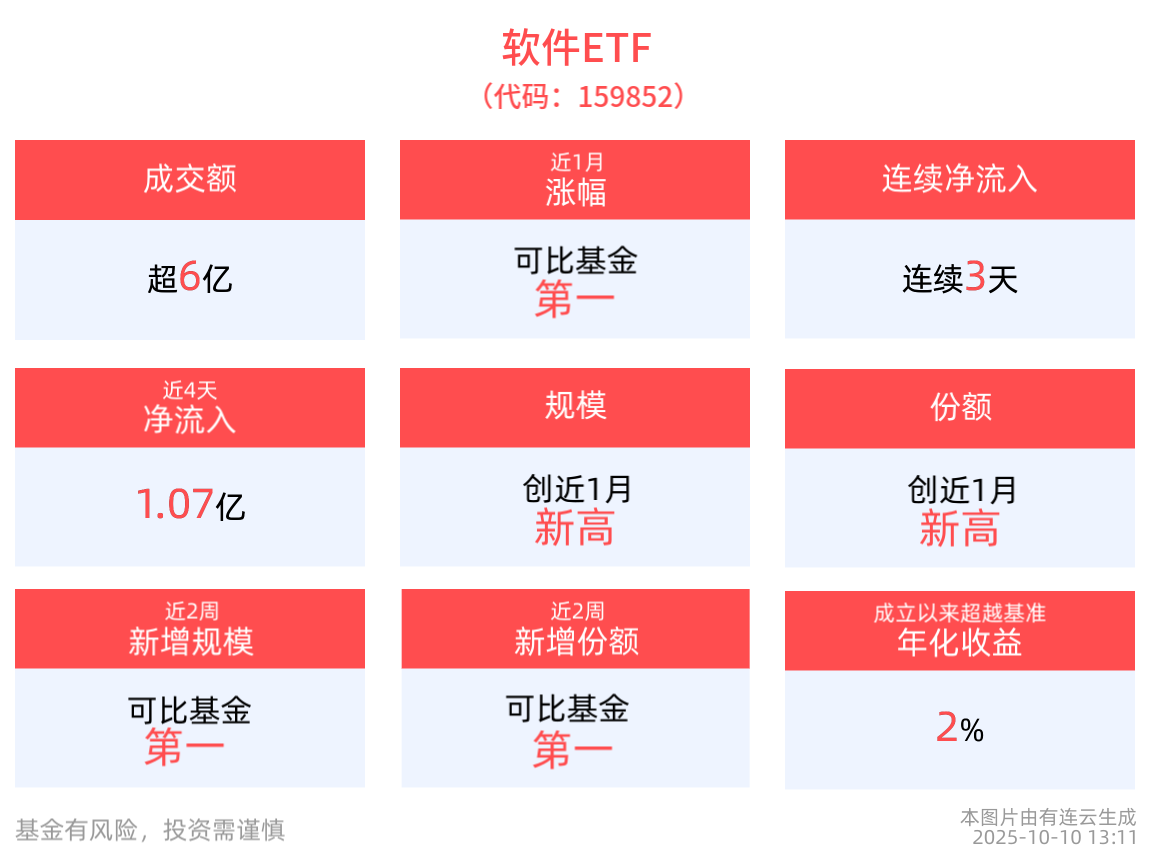
软件ETF(159852)近3天获资金连续净流入超亿元,规模、份额均创近1月新高!
Xin Lang Cai Jing· 2025-10-10 05:44
Core Insights - The software service index has declined by 3.92% as of October 10, 2025, with major stocks like Hongsoft Technology and UFIDA leading the drop [1] - The software ETF has seen significant trading activity, with a turnover rate of 11.35% and a transaction volume of 602 million yuan, indicating a vibrant market [2] - OpenAI has launched a new video generation model, Sora2, which accurately simulates real-world physics and generates environmental sound effects, marking a significant advancement in the video generation field [3] Group 1: Software ETF Performance - The software ETF's latest scale reached 5.189 billion yuan, a one-month high, and it ranks first among comparable funds [2] - The ETF has experienced continuous net inflows over the past three days, with a peak single-day net inflow of 72.5536 million yuan, totaling 113 million yuan [2] - Over the past three years, the software ETF's net value has increased by 37.90%, with the highest monthly return since inception being 39.35% [2] Group 2: Major Stocks in Software Index - The top ten weighted stocks in the software service index account for 62.41% of the index, with Keda Xunfei, Tonghuashun, and Kingsoft being the most significant contributors [2] - Keda Xunfei has seen a decline of 4.86%, while Kingsoft has dropped by 6.02%, indicating a challenging environment for these companies [5] - Other notable declines include Tonghuashun at -2.27% and Hengsheng Electronics at -2.52%, reflecting a broader trend of decreasing stock prices in the sector [5] Group 3: AI and Investment Opportunities - The rapid iteration of large models in architecture, efficiency optimization, and GPU chip adaptation presents substantial investment returns in the large model industry chain [3] - Recent positive changes in the model, application, and computing infrastructure sectors are expected to boost investor confidence in the industry's future [3] - Investors are encouraged to focus on multi-modal AI applications, domestic computing power, and storage sectors as potential growth areas [3]

林园被吐槽错过牛市
Shen Zhen Shang Bao· 2025-10-09 22:58
Group 1 - The core viewpoint of the articles highlights that Lin Yuan's investment products have underperformed in the recent market recovery, leading to dissatisfaction among some investors, despite support from others who advocate for long-term investment strategies [1][2]. - Lin Yuan's investment strategy focuses on sectors such as the "beauty economy" and the "silver economy," indicating a belief in the future demand for aesthetics and health-related products for the aging population [3]. - Data shows that out of 19 investment products managed by Lin Yuan, 10 have reported losses over the past year, with none outperforming the CSI 300 index, and the best-performing product lagging behind by 11 percentage points [2]. Group 2 - Lin Yuan is recognized as a staunch investor in Guizhou Moutai and is known for his value investment approach, favoring industries with strong profitability and monopolistic positions, particularly in consumer and pharmaceutical sectors [3]. - The investment logic is shifting fundamentally, with Lin Yuan suggesting that future scarcity will revolve around human happiness and longevity rather than traditional commodities [3]. - Lin Yuan remains optimistic about the Chinese stock market, asserting that many companies are still undervalued compared to historical levels, despite some indices reaching new highs [3].