
韩束

Search documents
大消费渠道脉搏:2025双11美妆行业前瞻,抖音与淘天平台策略分化
Haitong Securities International· 2025-10-09 14:48
[Table_Title] 研究报告 Research Report 9 Oct 2025 中国香港美国可选消费 China (A-share) Hong Kong US Discretionary 大消费渠道脉搏:2025 双 11 美妆行业前瞻,抖音与淘天平台策略分化 Consumer Channel Pulse: 2025 Double 11 Beauty Industry Outlook, Divergent Strategies of Douyin and Taobao/Tmall yy.kou@htisec.com mindy.yj.wu@htisec.com [Table_yemei1] 热点速评 Flash Analysis [(Table_summary] Please see APPENDIX 1 for English summary) 事件:2025 年 10 月 8 日,海通国际举办专家系列会,邀请美妆品牌操盘专家分享行业看法和趋势。 此次双 11 活动时间延长,核心时间段集中在 10.31 日之前,抖音和淘系平台目标积极。从此次双 11 活动的时间段 来看,抖音平台从 9.16 开 ...
2025上半年美妆行业“变局”
3 6 Ke· 2025-09-28 11:48
Core Insights - The global beauty industry is projected to exceed $677 billion by 2025, indicating strong growth, while the Chinese cosmetics market is undergoing significant structural changes, moving away from reliance on single blockbuster products or marketing gimmicks to a focus on genuine brand strength [1][2]. Market Performance - The Chinese cosmetics retail market is expected to maintain moderate growth in the first half of 2025, with retail sales reaching 2.291 billion yuan, a year-on-year increase of 2.9%, although this is below the overall retail growth rate of 5.0% [2][4]. - International beauty giants are facing pressure in the Chinese market, with L'Oréal leading with sales of 186.19 billion yuan, a 3% increase year-on-year, while Estée Lauder reported a 10.88% decline in net sales, marking its lowest sales in five years [4][6]. Domestic Brand Performance - Domestic brands are showing resilience, with the retail scale of the Chinese cosmetics market reaching 1.0738 trillion yuan in 2024, and domestic brands capturing 55.2% of the market share [6][8]. - The top ten domestic beauty companies reported a total revenue growth of 11.72% in the first half of 2025, with Proya, Shiseido, and Shanghai Jahwa leading the rankings [7][8]. Consumer Trends - The beauty market is witnessing a shift towards rational consumption, with consumers increasingly sensitive to price and favoring cost-effective products. The sales of beauty and skincare products reached 235.23 billion yuan in the first half of 2025, a 10.1% increase year-on-year [12][13]. - The anti-aging market is experiencing significant growth, with total sales reaching 65.49 billion yuan, a 30.3% increase year-on-year, and the demand for anti-aging products is expanding to younger demographics [13][14]. Brand Strategies - Brands are increasingly adopting multi-brand strategies to address diverse consumer needs, moving from a single product focus to a more comprehensive brand matrix [14][19]. - Investment in research and development is on the rise among leading domestic brands, with a focus on building technological barriers and enhancing product efficacy [15][16]. Marketing and Distribution - Douyin (TikTok) has solidified its position as a growth engine for the beauty industry, with daily views of beauty videos exceeding 2.5 billion, reflecting a shift towards more refined and systematic marketing strategies [17][18]. - The competition is evolving from a focus on single-channel strategies to an integrated approach that balances online and offline resources, emphasizing the importance of brand experience and customer loyalty [18][19].


医美+化妆品
2025-09-24 09:35
Summary of the Medical Aesthetics and Cosmetics Industry Conference Call Industry Overview - The medical aesthetics industry in China has a significantly lower penetration rate compared to the US and South Korea, indicating substantial growth potential. The current penetration rate is approximately 2 per 1,000 people, while the US and South Korea have rates of 5‰ and 8‰ respectively, suggesting a large market opportunity for growth [2][3][4] - The consumer repurchase rate for medical aesthetics is high, with stable demand for light medical aesthetics services, which provides a solid foundation for industry development [2][3] Market Dynamics - The medical aesthetics industry is divided into two main segments: medical aesthetics and cosmetics. The medical aesthetics segment remains robust post-pandemic, with a focus on product and material development [3][4] - The upstream raw material sector has high gross margins, with companies like Aimeike achieving margins of 85%-90%. The typical markup at the consumer level is over three times the factory price, ensuring profitability for institutions and sales personnel [2][4] Capital Market Trends - Capital markets are increasingly focused on upstream manufacturers, particularly the transition from hyaluronic acid to active materials such as recombinant collagen and PDRN. This shift is driven by rising consumer demand for facial treatments [7] - The market for light medical aesthetics accounts for approximately 70% in leading hospitals, with new medical aesthetics primarily divided into photonic and injection categories [8] Product Market Size - The market size for hyaluronic acid and botulinum toxin at the factory level is estimated to be between 50 to 100 billion yuan. The markup for mature products typically ranges from 2 to 3 times, with high-end products potentially reaching 3 to 4 times [9] - The regenerative materials market has seen rapid growth, with several companies achieving sales exceeding 1 billion yuan since 2021. However, these materials are not fully replacing hyaluronic acid but rather expanding the market [10][11] Material Development and Trends - The development of regenerative materials is significant, with a focus on micro-spheres that stimulate natural repair and collagen regeneration. These materials are expected to enhance treatment effectiveness and safety in soft tissue filling and skin management [15][16] - The future of the medical aesthetics industry is expected to shift towards active micro-spheres and humanized collagen, with a focus on extracellular matrix and various collagen types [15] Cosmetics Industry Overview - The cosmetics industry has seen a clear trend towards domestic brand replacement, with domestic brands now accounting for over 50% of the market. Brands are leveraging e-commerce and live streaming to enhance growth, with increased R&D investments focusing on efficacy and ingredient-driven strategies [2][21] - The market has shifted from high-end luxury products to a broader consumer base, with skincare products maintaining steady growth despite the pandemic [21][22] Sales Dynamics - The sales of domestic cosmetics exhibit seasonal variations, with the first half of the year accounting for about 40% of total sales and the second half for 60%. Major shopping events like 618 and Double Eleven significantly impact annual sales [24] R&D Investment Differences - There is a notable difference in R&D investment between the medical aesthetics and cosmetics industries. The medical aesthetics sector focuses on material iteration, while the cosmetics industry emphasizes brand building and marketing to enhance consumer loyalty [25] Future Outlook - The future of domestic cosmetics companies appears optimistic, with expectations of revenue growth driven by channel changes and ingredient innovations. Companies like Perfect Diary and Proya are projected to reach revenue levels of 20 to 30 billion yuan in the next 3 to 5 years [30]
专家视角解读&双十一行情投资思路梳理
2025-09-24 09:35
Summary of Key Points from Conference Call Industry Overview - The conference call focuses on the e-commerce and beauty industry, particularly the upcoming Double Eleven shopping festival in 2025, which will last nearly 60 days, with significant sales targets set for various platforms like Taobao, Tmall, and Douyin [1][2][3]. Core Insights and Arguments - **Sales Growth Projections**: - Tmall expects GMV growth of 15%-20%, with beauty products targeting a 20% increase. Douyin aims for an overall growth of approximately 30%, with beauty products projected to grow by 35%-40% [1][3]. - **Advertising Budget Allocation**: - International brands will allocate 70%-75% of their advertising budget to Tmall, while domestic brands will invest 60% in Douyin [1][8][9]. - **Platform Strategies**: - Tmall focuses on core demographics and major brands, shifting its assessment criteria to GMV. Douyin supports emerging brands and domestic products, aiming to attract a broader consumer base [1][6][12]. - **Consumer Behavior**: - Tmall's international brands, such as Lauder and Lancôme, have a market share exceeding 10%, with high repurchase rates expected during the shopping festival [1][7]. - **Promotional Strategies**: - Tmall has eliminated fees and service charges for brands with over 20% growth, while Douyin has waived product card commissions and offers traffic support [1][12][13]. Important but Overlooked Content - **Market Dynamics**: - The current stock market is in a slow bull phase, with consumer sectors gaining attention despite a negative CPI in August. Potential consumer stimulus policies may emerge in the fourth quarter [4][17][18]. - **Brand Performance Expectations**: - Brands like Kose, Proya, Han Shu, and Mao Geping are expected to perform well during the Double Eleven period, with specific growth strategies outlined for each [1][14][20]. - **Impact of External Factors**: - The success of Tmall and Douyin during the festival may be influenced by external factors such as the return of key personnel and successful promotional events like the "Paris Partners" variety show, which has significantly increased brand exposure [22][23]. - **Future Growth Projections**: - Brands like Mao Geping are projected to achieve a compound annual growth rate of 30% from 2023 to 2026, with potential for significant market expansion [26][27]. - **E-commerce Operations**: - The e-commerce operation sector is becoming increasingly active, driven by AI technology that enhances efficiency in customer service and marketing [37]. This summary encapsulates the essential insights and projections regarding the beauty and e-commerce industry as discussed in the conference call, highlighting growth expectations, strategic shifts, and market dynamics.
井喷的明星代言:产品首日GMV破千万成“标配”?
3 6 Ke· 2025-09-23 01:11
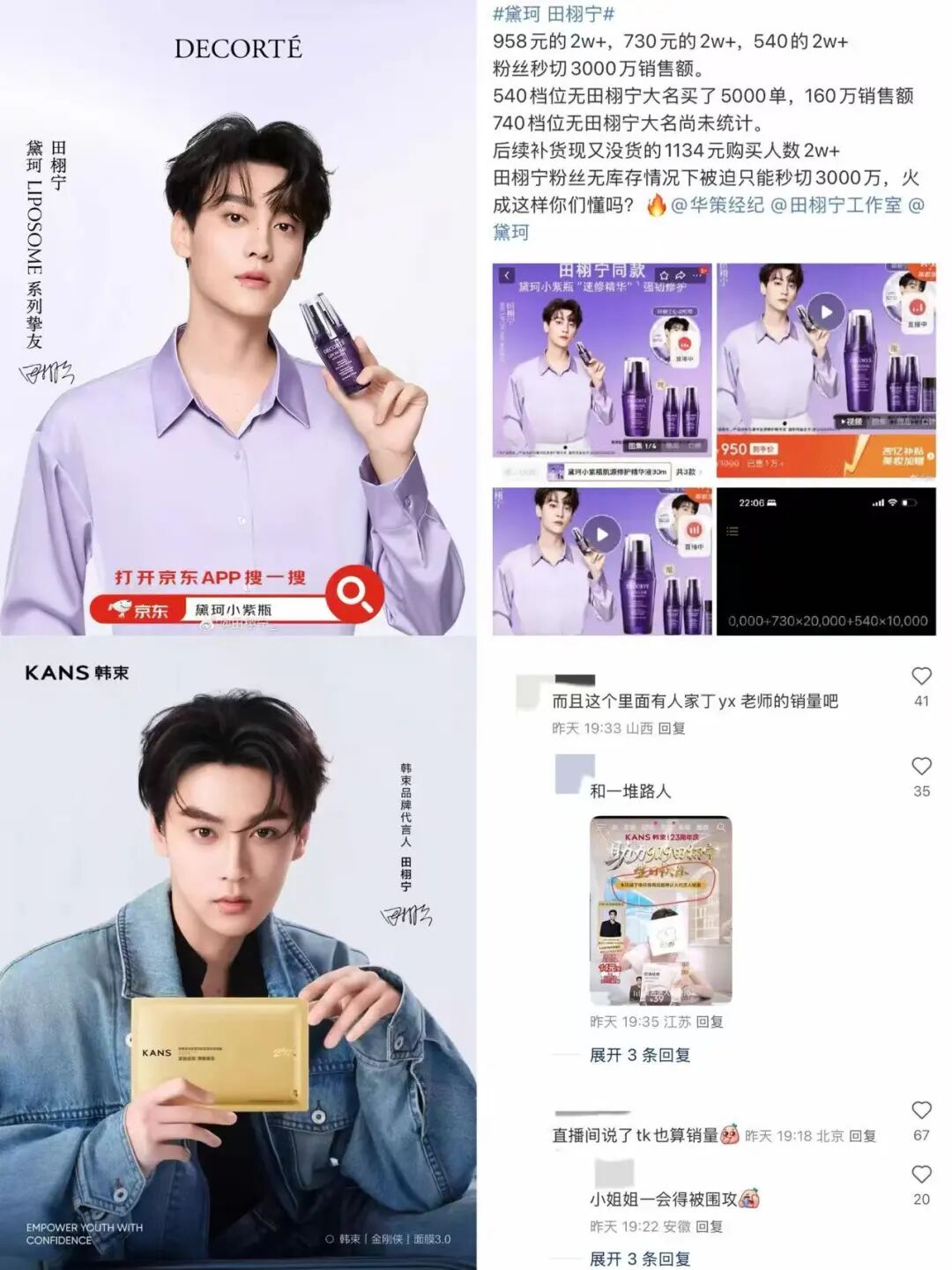
Core Insights - The collaboration between beauty brands and celebrities has surged this year, with over 20% of endorsements in the beauty and skincare category in Q1, indicating a strong market position [1] - Notable examples include Tian Xuning's partnerships with Decorte and Han Shu, which resulted in significant sales spikes, raising questions about the authenticity of reported sales figures [1][5] - The industry is witnessing a shift from influencer marketing to celebrity endorsements due to declining effectiveness of influencer promotions and lower costs for celebrity partnerships [9][14] Group 1 - The effectiveness of beauty endorsers in enhancing brand value is under scrutiny, prompting industry reflection [5] - The trend of brands moving away from influencer marketing to celebrity endorsements is attributed to the diminishing returns of influencer campaigns and the need for stronger brand recognition [9][14] - The current celebrity endorsement strategy is evolving, focusing on integrated marketing that combines storytelling and consumer engagement rather than traditional advertising [14][35] Group 2 - The rise of sports and short-drama stars as new influencers in the beauty sector is notable, with athletes like Sun Yingsha and Wang Chuqin becoming prominent brand ambassadors [16][19] - Brands are increasingly selecting endorsers based on their alignment with brand values and target demographics, leading to a more nuanced approach to celebrity partnerships [22][23] - The integration of live streaming with celebrity endorsements is emerging as a new strategy to enhance brand visibility and consumer engagement [15][36] Group 3 - The industry is facing challenges related to the potential risks of celebrity endorsements, particularly the impact of negative publicity on brand reputation [25][32] - Brands are implementing rigorous vetting processes for selecting endorsers to mitigate risks associated with celebrity scandals [26][29] - The focus on long-term brand alignment with celebrity partners is essential to avoid the pitfalls of short-term marketing strategies [36][37]
开源晨会-20250922
KAIYUAN SECURITIES· 2025-09-22 14:59
Macro Economic Overview - The "14th Five-Year Plan" emphasizes the use of more proactive fiscal policies to support employment and foreign trade, and to improve people's livelihoods [3][4] - Recent policies focus on industrial internet applications and the development of new energy sectors, indicating a shift towards digitalization and innovation [3][4] Fixed Income Market - As of August 2025, the total bond custody amount reached 174.54 trillion yuan, with a net increase of 15,060.06 million yuan, indicating a slight decrease in growth compared to previous months [9][10] - The leverage ratio in the bond market slightly increased to 106.88%, reflecting a cautious optimism in the market [13][14] Pharmaceutical Industry - The pharmaceutical sector is entering a new growth phase driven by innovation and optimization of centralized procurement, with major companies like Heng Rui Pharmaceutical and China Biologic Products showing robust revenue growth [17][18] - The recent adjustments in the national medical insurance directory are expected to benefit innovative drugs, leading to potential rapid growth for companies involved [18][19] Non-Bank Financial Sector - The performance of non-bank financial companies is primarily driven by property and equity investments, with significant contributions from the property insurance sector [21][22] - The net profit growth of listed insurance companies improved in the first half of 2025, largely due to the profitability of property insurance [21][24] Agricultural Sector - The price of white feather chicken increased due to supply disruptions and rising demand, with the average selling price reaching 7.17 yuan/kg in August 2025 [30][31] - The egg market faces pressure from high production capacity, limiting the potential for price increases despite some upward movement in prices [32][33] Machinery Industry - The valuation of global robotics companies is being redefined, with Figure's recent funding round valuing the company at 39 billion USD, indicating a bullish outlook for the robotics sector [37][38] - Key components in robotics are expected to see significant valuation increases, with potential PE ratios reaching 200 times as the industry matures [38][39] Consumer Services Sector - The upcoming National Day holiday is expected to boost travel bookings, with a steady increase in pre-booking trends observed [42][45] - The tea and coffee sector continues to show strong performance, with leading brands expanding their market presence despite some overall industry slowdowns [43][45] Real Estate and Construction - China Overseas Property is experiencing growth in both scale and profitability, with projected net profits increasing from 16.1 billion yuan in 2025 to 19.6 billion yuan by 2027 [47][48] - The company is focusing on high-quality expansion and has seen a significant increase in managed area and new contract signings [49][50] Electronics Industry - The domestic high-power server power supply market is growing, with companies like Oulu Tong positioned as leaders in this space, benefiting from the rise of AI applications [51][52] - The demand for higher power server supplies is expected to increase, with new products in development to meet the needs of advanced AI servers [53]





2025年第37周:美妆行业周度市场观察
艾瑞咨询· 2025-09-21 00:06
Core Viewpoints - The beauty market is experiencing a shift in business logic due to "growth anxiety," with a market size of 600 billion and only a 3.1% increase in retail sales from January to July 2025 [6][4]. Group 1: Industry Environment - Niche imported products are driving sales in offline beauty stores, with brands like 法朗丝 achieving high sales and customer retention through effective product positioning and compliance [3]. - The international beauty industry is under pressure, with only five companies, including L'Oréal and Kao, showing growth in the first half of 2025. Companies are responding with layoffs and brand optimization [4]. Group 2: Offline Beauty Market Dynamics - A significant number of beauty brands are closing stores, with 828 closures reported in July 2025. The rise of online channels and changing consumer preferences are contributing to this trend [5]. - The offline beauty service experience is lacking, leading to a shift towards online shopping. Domestic beauty brands may present new opportunities for offline channels [5]. Group 3: Market Growth and Consumer Trends - Despite growth pressures, the beauty market shows resilience, with Tmall's beauty segment capturing 45.1% market share during the 618 shopping festival [6]. - The youth demographic, particularly the Alpha generation, is increasingly entering the beauty market, with 75% of teenagers using skincare or fragrance products [9]. Group 4: Capital Market Trends - The beauty capital market is experiencing a dichotomy, with over 30 companies pursuing IPOs while nine face delisting risks due to financial misconduct [14]. - Brands like 珀莱雅 are planning to issue H-shares for global expansion, indicating a shift towards high-quality development in the industry [14]. Group 5: New Product Innovations - The hair care market is rapidly growing, driven by Z generation consumers focusing on scalp care and deep repair products [13]. - Brands are innovating with new products like 卡诗's护发精油 and FAN BEAUTY's发膜, emphasizing technology and consumer insights [13].



美妆线上大盘双月下滑,详拆五个“逆增长”品牌案例
FBeauty未来迹· 2025-09-20 09:02
Core Viewpoint - The online beauty market in 2025 is experiencing a downturn, with significant declines in July and August, while some brands are achieving remarkable growth despite the overall market pressure [2][4][6]. Market Performance - The overall online beauty market from January to August 2025 recorded a total transaction value of 411.99 billion yuan, a year-on-year increase of 5.7%, with a transaction volume of 5.653 billion items, up 6.46% [5]. - Monthly performance shows a declining trend, with July and August being the only months with both transaction value and volume decreasing [5][6]. High-Growth Brands - Brands like Han Shu, Bai Que Ling, Helena, ELL, and Canban have shown exceptional growth in August, with Han Shu nearing 1 billion yuan in transaction value, up 51.37% year-on-year, and Bai Que Ling achieving a growth rate of 108.77% [4][11]. - The growth of these brands occurred without major promotional events, indicating innovative strategies that could provide insights for the beauty industry [4][6]. Platform Performance - Douyin has emerged as a key growth engine, with several brands achieving over 50% growth in transaction value on the platform [11][12]. - Brands like Han Shu and Bai Que Ling have successfully utilized a multi-platform strategy, achieving significant growth on platforms like JD and Kuaishou as well [11][12]. Brand Strategies - Han Shu focuses on a matrix of self-broadcasting and product bundling to create a self-sustaining growth engine, with multiple flagship stores catering to different product categories [13][14]. - Bai Que Ling employs a dual strategy of self-broadcasting and influencer marketing, with live streaming accounting for 83% of its sales [16][17]. - Helena capitalizes on high-end gifting opportunities, particularly around promotional events like Qixi Festival, maintaining a premium brand positioning [19][20][21]. Unique Market Entries - ELL, a white-label brand, has successfully navigated the market with a low-price strategy and celebrity endorsements, achieving a transaction value of 2.35 billion yuan in August [25][26]. - Canban stands out in the oral care segment, achieving over 100% growth in both transaction value and volume, despite the overall category facing challenges [27][28][29]. Conclusion - The online beauty market in August reflects a duality of challenges and opportunities, with brands adapting to a shift from price competition to value-driven strategies [32]. - The success of these brands highlights the importance of understanding user needs and enhancing operational efficiency to navigate market fluctuations [32].
国泰海通 · 晨报0917|化妆品
国泰海通证券研究· 2025-09-16 12:02
Core Viewpoint - The beauty industry is experiencing double-digit growth online, driven by promotional events and the rise of domestic brands, suggesting a need for selective investment in companies with adaptable products and channels [2]. Industry Summary - In August, both Tmall and Douyin achieved double-digit growth in beauty sales, with a combined year-on-year increase of 19.0%. Douyin's beauty GMV exceeded 20 billion, growing by 19.56%, while Tmall's GMV rose by 18.37%. The overall GMV growth rate for July and August was 16.1%, indicating a recovery primarily due to Tmall's promotional strategies [2]. - During the Qixi Festival, domestic brands dominated the top sales rankings, with Han Shu leading with over 700 million GMV. The top 20 makeup brands saw an increase of 4 new entrants, including Mao Ge Ping and Carzi Lan, showcasing the competitive strength of domestic brands across various categories [3].
关注高端国货美妆发展潜力
Xiangcai Securities· 2025-09-14 10:59
Investment Rating - The industry investment rating is maintained at "Overweight" [3] Core Views - The retail sector showed a slight increase of 0.85% last week, underperforming the CSI 300 index by 0.53 percentage points, indicating a mixed performance across various retail sub-sectors [4][9] - The current Price-to-Earnings (PE) ratio for the retail sector is 42.81X, reflecting a 0.45 percentage point increase week-on-week, with a one-year range between 24.35X and 43.07X [5][17] - The retail sector's Price-to-Book (PB) ratio stands at 2.06X, with a one-year range from 1.19X to 2.07X [5][19] Industry Dynamics - The Shenzhen Stock Exchange adjusted the list of eligible stocks for the Hong Kong Stock Connect, adding 20 stocks including brands related to retail and light manufacturing, which may enhance liquidity and trading opportunities [6][20][22] - In August, domestic beauty brands showed strong performance on Douyin, with Han Shu leading sales at over 700 million yuan, indicating a growing acceptance and market share for domestic brands [7][23] - The rise of domestic beauty brands is attributed to improved product quality and the growing trend of "Guochao" (national tide), which enhances consumer recognition and acceptance [7][23] Investment Recommendations - The report suggests focusing on recently added Hong Kong stocks in the retail sector and high-end domestic beauty brands, particularly those that are scarce in the market, such as Mao Ge Ping [6][24] - The ongoing domestic policies aimed at boosting consumption are expected to further enhance consumer willingness and capacity, supporting the retail sector's growth [7][24]