
小米

Search documents
寒武纪回应原CTO索赔42.87亿元;泰州队夺得首届苏超冠军;王腾称将离开手机行业;段永平回应向一高校捐赠1万股茅台股票丨邦早报
创业邦· 2025-11-02 01:35
Group 1: New Energy Vehicle Deliveries - Xiaopeng Motors delivered 42,013 vehicles in October, setting a new monthly record and achieving a total of 355,209 deliveries from January to October, a year-on-year increase of 190% [1] - NIO delivered 40,397 vehicles in October, a year-on-year increase of 92.6%, with a total of 241,618 vehicles delivered year-to-date, up 41.9% [1] - Leap Motor delivered 17,342 vehicles in October, marking a year-on-year increase of 301.5% and a month-on-month increase of 13.7% [1] - Li Auto delivered 31,767 vehicles in October, with a cumulative total of 1,462,788 vehicles delivered as of October 31, 2025 [1] - Xiaomi Motors continued to deliver over 40,000 vehicles in October [1] - Zero Run delivered 70,289 vehicles in October, a year-on-year increase of over 84% [1] - Zeekr delivered 61,636 vehicles in October, a year-on-year increase of 9.8% [1] - BAIC New Energy sold 30,542 vehicles in October, with Arcfox sales exceeding 23,000 vehicles, a year-on-year increase of 110% [1] - Lantu delivered 17,218 vehicles in October, with a year-on-year increase of 82% for the January-October period [1] - Avita sold 13,506 vehicles in October [2] - Zhijie Motors surpassed 10,000 vehicle deliveries in October [2] Group 2: Xiaomi Automotive Developments - Xiaomi's vehicle delivery cycle has been shortened again, with the YU7 model expected to be delivered in 35-38 weeks, a reduction of 10 weeks from the original timeline [4][5] - The YU7 Pro is expected to be delivered in 34-37 weeks, shortened by 8 weeks, while the YU7 Max is expected in 32-35 weeks, shortened by 4 weeks [5] Group 3: Global Automotive Market Insights - By September 2025, China's share of the global automotive market is projected to reach 38%, with a total global sales volume of 8.55 million vehicles, a year-on-year increase of 10% [23] - From January to September 2025, global automotive sales reached 70.53 million units, a year-on-year increase of 6%, with China contributing 24.32 million units, up 13% [23] - The U.S. automotive market saw sales of 12.58 million units, an increase of 4%, while the Indian market grew by 2% to 4 million units [23]




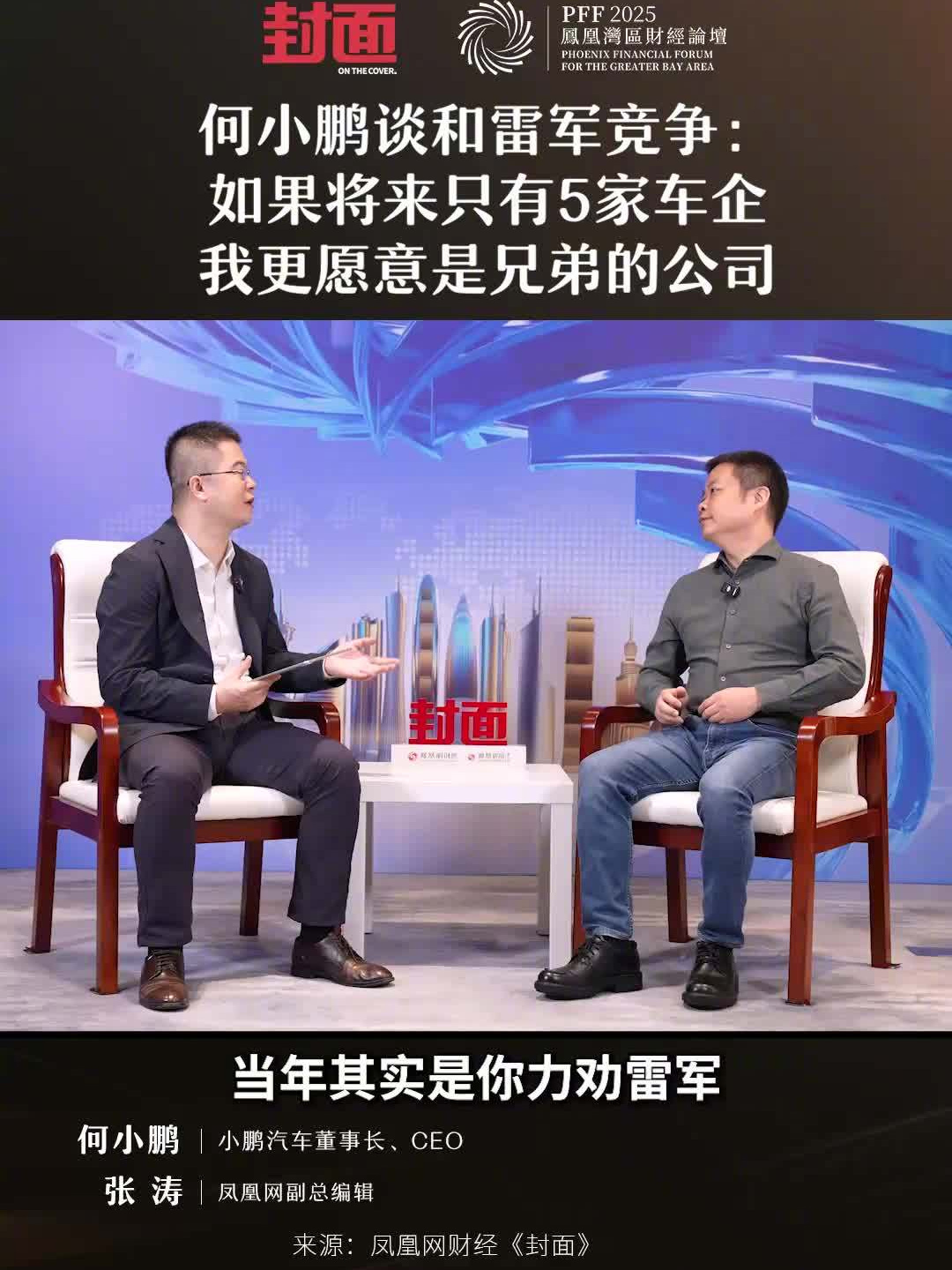
何小鹏谈和雷军竞争:如果将来只有 5 家车企,我更愿意是兄弟的公司
Xin Lang Cai Jing· 2025-11-01 15:33
Group 1 - The CEO of Xpeng Motors, He Xiaopeng, expressed a preference for a market with only five car companies, indicating that competition would be more orderly among "brother companies" [1] - He Xiaopeng anticipates that Xiaomi will eventually enter the automotive industry, believing that it is only a matter of time [1] - In October, Xpeng Motors achieved a record monthly delivery of 42,013 vehicles, marking the second consecutive month of deliveries exceeding 40,000 units [5] Group 2 - Xiaomi's automotive deliveries also surpassed 40,000 units in October, indicating strong performance in the electric vehicle market [5] - Cumulatively, Xpeng Motors delivered 355,209 vehicles from January to October 2025, reflecting a year-on-year growth of 190% [5] - He Xiaopeng previously suggested to Lei Jun that Xiaomi is well-suited for the automotive sector due to its strong internet software and hardware genes, which have a high correlation with the automotive industry [8]
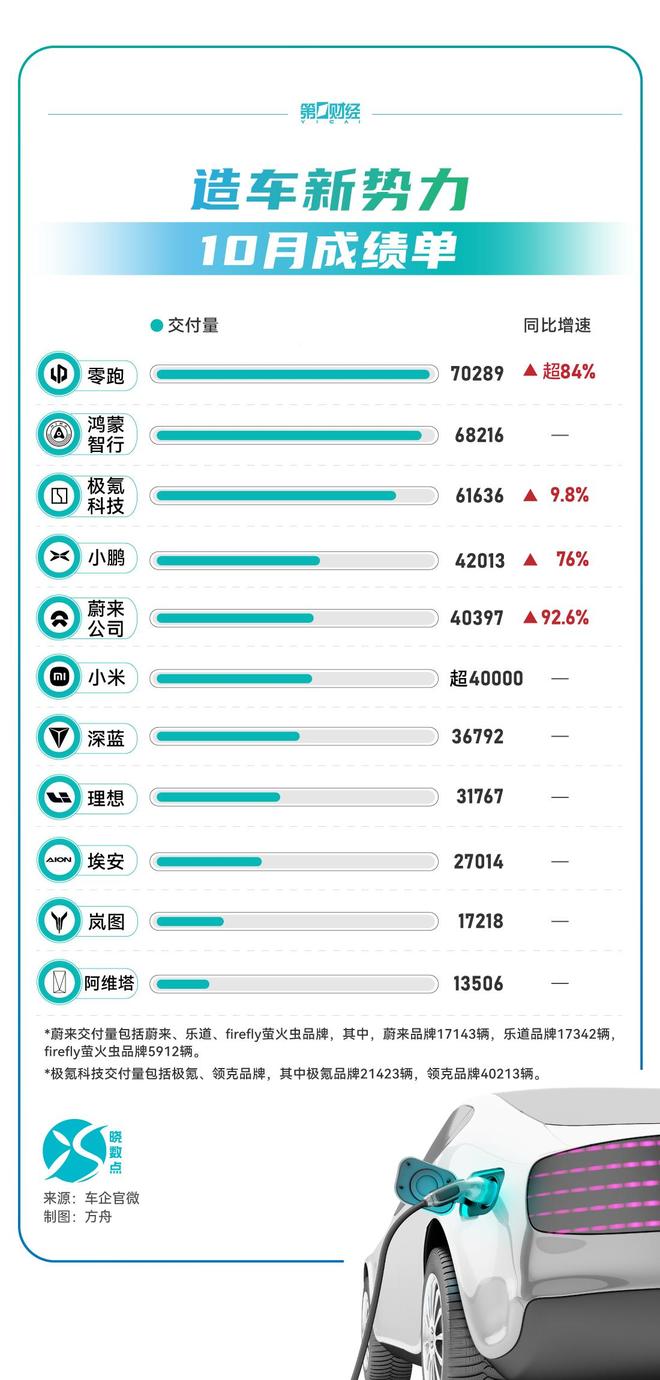
晓数点|造车新势力10月成绩单:零跑汽车破7万,蔚来小鹏创新高
Di Yi Cai Jing Zi Xun· 2025-11-01 13:43
Delivery Performance - The new energy vehicle sector showed significant growth in October, with total deliveries reaching 70,289 units, representing an increase of over 84% year-on-year [1] - Leading the delivery numbers, Li Auto delivered 68,216 units, marking a year-on-year increase of 9.8% [1] - Other notable performers include NIO with 40,397 units delivered, reflecting a substantial increase of 92.6% [1] Brand Breakdown - NIO's delivery figures include 17,143 units from the NIO brand, 17,342 units from the Ladao brand, and 5,912 units from the Firefly brand [2] - The performance of various brands indicates a competitive landscape, with significant contributions from multiple players in the market [1][2]


三个央企新能源品牌,销量加起来不如一个新势力
第一财经· 2025-11-01 12:19
Core Insights - The article highlights the significant differentiation in sales performance among new energy vehicle (NEV) companies during October, with Li Auto facing notable declines while others like Leap Motor and Xiaopeng achieve record deliveries [3][4][5]. Sales Performance - Leap Motor delivered over 70,000 vehicles in October, achieving a year-on-year growth of over 84% with total deliveries reaching 70,289 units [3][5]. - Xiaopeng and NIO both surpassed 40,000 deliveries, marking their historical highs with deliveries of 42,013 and 40,397 units respectively [4][5]. - Li Auto's deliveries fell to 31,767 units, a decrease of 6.43% month-on-month and 38.25% year-on-year, making it the only NEV company with a delivery progress below 50% of its annual target [5][6]. Market Positioning - The new energy vehicle market's first tier now has a monthly sales threshold of 40,000 units, which includes Leap Motor, Hongmeng Zhixing, Xiaopeng, NIO, and Xiaomi, while Li Auto has been excluded from this group [5][6]. - Traditional automakers' NEV brands, such as Zeekr and Deep Blue, also showed strong performance, with Zeekr's monthly sales exceeding 60,000 units for the first time [9][10]. Industry Trends - The article notes that as subsidies for new energy vehicles decline, companies that have not gained competitive advantages in scale will face tougher challenges in the coming year [10]. - Leap Motor's CEO emphasized the long-term nature of the automotive industry, indicating that continuous improvement and leveraging strengths are essential for success [10].



华域汽车(600741):盈利能力同环比改善,收购上汽清陶股权布局固态电池业务
Orient Securities· 2025-11-01 09:13
Investment Rating - The report maintains a "Buy" rating for the company with a target price of 27.69 CNY, based on a comparable company PE average valuation of 13 times for 2025 [3][6]. Core Insights - The company has improved its profitability on a quarter-on-quarter basis and has acquired a 49% stake in SAIC Qingtao, positioning itself in the solid-state battery business [2][9]. - The company expects continued growth in revenue and profitability, driven by the recovery in sales from SAIC Group and an increase in revenue from external customers [9]. - The forecasted EPS for 2025-2027 is 2.13, 2.28, and 2.32 CNY respectively, with slight adjustments made to gross margin and expense ratios [3]. Financial Summary - **Revenue Forecast**: The company anticipates revenues of 168,594 million CNY in 2023, growing to 197,815 million CNY by 2027, reflecting a CAGR of approximately 5.2% [5][10]. - **Net Profit**: The net profit attributable to the parent company is projected to be 7,214 million CNY in 2023, with a slight increase to 7,316 million CNY by 2027 [5][11]. - **Profitability Ratios**: The gross margin is expected to improve from 13.1% in 2023 to 13.3% in 2026 and 2027, while the net margin is projected to decrease slightly from 4.3% in 2023 to 3.7% in 2027 [5][10]. - **Earnings Per Share (EPS)**: EPS is forecasted to be 2.29 CNY in 2023, slightly decreasing to 2.12 CNY in 2024, and then gradually increasing to 2.32 CNY by 2027 [5][11].

挂帅新部门,雷军还要再赌一次
Hua Er Jie Jian Wen· 2025-10-31 11:36
Core Viewpoint - Xiaomi is undergoing a significant organizational restructuring in response to recent safety concerns and market challenges, with a new department focused on the next-generation technology architecture for its electric vehicles [2][3][4]. Group 1: Organizational Changes - Xiaomi has established a new primary department, the Architecture Department, led by founder Lei Jun, to enhance its strategic focus on technology development [2][4]. - The restructuring aims to elevate the importance of architectural considerations in the company's strategy, allowing for independent decision-making on technology direction 3 to 5 years ahead of product development cycles [2][4][7]. Group 2: Market Challenges - The company has faced significant scrutiny following two high-profile accidents involving its vehicles, which have raised public safety concerns and affected consumer perception [3][5][6]. - Following the accidents, the resale value of Xiaomi vehicles has plummeted, with prices dropping from over 10,000 yuan to around 2,000 yuan in the second-hand market [5][6]. Group 3: Strategic Priorities - The establishment of the Architecture Department signals that defining the next-generation technology architecture is now a top strategic priority for Xiaomi [7][9]. - The company must shift its focus from a "cost-performance" philosophy in consumer electronics to prioritizing safety as the most critical aspect in the automotive industry [9].
互联网大厂,正“横扫”一二级市场!
Zheng Quan Shi Bao Wang· 2025-10-31 10:31
Core Insights - Major internet companies are actively conducting research on A-share technology companies, indicating a strategic interest in understanding advancements in robotics, AI, and other cutting-edge technologies [1][2][6] - The trend of investment and research by these giants reflects a shift from consumer internet to hard technology sectors, focusing on companies with proprietary technologies [5][6] Group 1: Research Activities - Internet giants like Meituan, Tencent, Xiaomi, and Alibaba have been frequently involved in research activities with A-share technology companies [2][3] - Tencent's research spans various industries, including industrial robotics, memory interface chips, and high-end medical imaging [2][3] - Xiaomi has shown interest in companies related to robotics and AI, conducting multiple research sessions with specific firms [2][3] Group 2: Investment Trends - Internet companies are not only researching but also increasing their equity investments in A-share companies, particularly in sectors like robotics, AI, and semiconductors [3][5] - As of October 30, 2025, major firms have participated in 82 financing events, with estimated funding exceeding 25 billion [5] - Alibaba has been particularly active, investing in various AI and semiconductor companies this year [5] Group 3: Strategic Implications - The investments by internet giants are aimed at creating synergies between their technological advantages and the manufacturing capabilities of listed companies [4][6] - The trend indicates a broader industry shift towards a technology-driven ecosystem, where internet companies leverage their strengths to support emerging technologies [4][6] - The proactive investment approach is expected to accelerate the development of new technologies and applications, potentially disrupting existing market leaders [6]

港股收评:持续走低!恒科指大跌2.37%,恒指再破二万六,科技金融集体弱势
Ge Long Hui· 2025-10-31 08:16
Market Overview - The Hong Kong stock market indices continued to decline in the afternoon, reflecting a low market sentiment and recording a three-day pullback [1] - The Hang Seng Index fell by 1.43%, closing below the 26,000-point mark, while the Hang Seng China Enterprises Index dropped by 1.91% and the Hang Seng Tech Index decreased by 2.37%, also falling below 6,000 points [1] Sector Performance - Major technology stocks collectively weakened, negatively impacting market sentiment, with Alibaba down by 4%, Tencent falling over 3%, and other companies like Kuaishou, Baidu, JD.com, and Xiaomi declining by more than 2% [1] - Large financial stocks, including banks, insurance, and brokerage firms, mostly experienced declines, with China CRRC dropping over 10%, leading to declines in China Railway and China Railway Construction, while Everbright Securities fell by 6% and China People's Insurance Group decreased by 5.8% [1] - Semiconductor stocks were weak throughout the day, with leading company SMIC down by over 5%, alongside declines in military, automotive, coal, gold, real estate, aviation, photovoltaic, and Apple concept stocks [1] Innovation and Growth Sectors - Multiple catalysts ignited the innovative drug sector, with 3SBio surging over 11%, leading the gains, followed by Innovent Biologics rising nearly 8%, and Fosun Pharma and Ascletis Pharma also showing strong performance [1] - Some sectors such as education, home appliances, and gaming saw partial increases, with online education leader New Oriental rising over 2% [1]
对话深蓝汽车董事长邓承浩:电池做不好安全,就不配做电车
Feng Huang Wang· 2025-10-31 07:10
Core Viewpoint - The chairman of Deep Blue Automotive, Deng Chenghao, emphasizes the importance of battery safety in electric vehicles, stating that if battery safety is compromised, the company should not produce electric cars. He outlines the company's strategic focus on intelligent technology, cost control, and global expansion in a competitive market [1]. Group 1: Technology Route and Brand Positioning - Deep Blue aims for differentiated competition in the sedan market, with a clear sales target of over 10,000 units per month for the L06 model. The L06 will be part of a product lineup that includes the S05 and S07, which are expected to be the largest models in terms of scale [2]. - The core competitive advantage of the L06 is described as "road magnetic suspension, intelligent driving veteran," highlighting the unique magnetic rheological suspension technology and the inclusion of laser radar for urban NCA [2]. - The choice of suspension technology is explained, with magnetic rheological suspension offering superior performance in damping adjustment compared to traditional systems, making it ideal for driving control [2]. Group 2: Safety Bottom Line and Cost Control - Deng Chenghao asserts that the company will not compromise on safety for the sake of profit, emphasizing that if battery safety is not ensured, the company should not produce electric vehicles. Deep Blue has delivered 650,000 vehicles without any incidents of battery fires during charging or parking [4]. - The L06 model is equipped with CATL batteries and designed to meet "PPP-level safety" standards. The company adapts to consumer preferences, shifting from hidden door handles to mechanical ones based on market demand [4]. - Deep Blue's cost control strategy is supported by its affiliation with Changan, allowing for quality and performance maintenance while optimizing costs through platform sharing and transparent cost structures in core systems [5]. Group 3: Globalization Progress - Deep Blue has expanded into over 100 countries, with the S05 being the first globally developed model. Sales in Norway and Egypt demonstrate the brand's growing international presence, with ambitious targets set for future sales [6]. - The company aims to achieve monthly sales of 10,000 units internationally by next year and aspires for half of its sales to come from global markets by 2030 [6]. - Deng Chenghao reiterates the unique positioning of the L06, claiming it has no true competitors, and emphasizes its competitive experience and value proposition against models like Tesla's Model 3 and Xiaomi's SU7 [6].
中国银河证券:理性看家电国补退坡 清洁电器零售市场依然有望保持增长
Zhi Tong Cai Jing· 2025-10-31 07:01
Core Insights - The retail monitoring by AVC indicates a general decline in major appliances since September, with a significant drop in retail for cleaning appliances in October, although there is still substantial growth compared to the same period in 2023 [1][2] - The industry has anticipated these trends, as evidenced by production data showing a cautious attitude with air conditioning production down by -11.5%, -8.4%, and -9.9% for October, November, and December respectively compared to the previous year [1][2] - The demand for appliance upgrades is expected to be the main driver, with short-term impacts from subsidy exhaustion; however, the penetration rate of cleaning appliances continues to rise, suggesting growth potential in the retail market through 2026 [1][2] Market Trends - The consumer electronics market is highly competitive, with Xiaomi upgrading its air conditioning warranty to 10 years, which has helped maintain its retail market share despite negative publicity from its automotive ventures [3] - The smart lawn mower market is gaining attention, with multiple companies entering, leading to intense competition; major players in the vacuum market have also launched similar products [3] - DJI is aggressively pricing its action cameras and drones, likely in response to competition from other brands entering the drone market [3] Company Performance - Ugreen Technology has benefited from a surge in demand for power banks following safety incidents, reporting a revenue of 2.51 billion yuan in Q3 2025, a year-on-year increase of 60.4% [4] Export Market Dynamics - The export market is seeing a shift in production capacity, with a recovery in heat pump exports; the U.S. has announced additional tariffs on Chinese imports, prompting companies to accelerate global production strategies [5] - Data indicates a 22.5% year-on-year increase in heat pump exports from January to August 2025, driven by low comparative bases and upcoming heating seasons in Europe [5] Investment Recommendations - The current market is active, with traditional appliance leaders lacking growth potential; technology-related companies are performing better [6] - Recommended stocks include Stone Technology, Ecovacs, and Ugreen Technology for their growth prospects, alongside undervalued companies like Midea Group and Haier Smart Home that have successfully digitized their offline channels [6]


