蔚来

Search documents
传江汽集团高层密会任正非,智能化转型缺技术,跨界合作是唯一出路?
Sou Hu Cai Jing· 2026-01-07 07:25
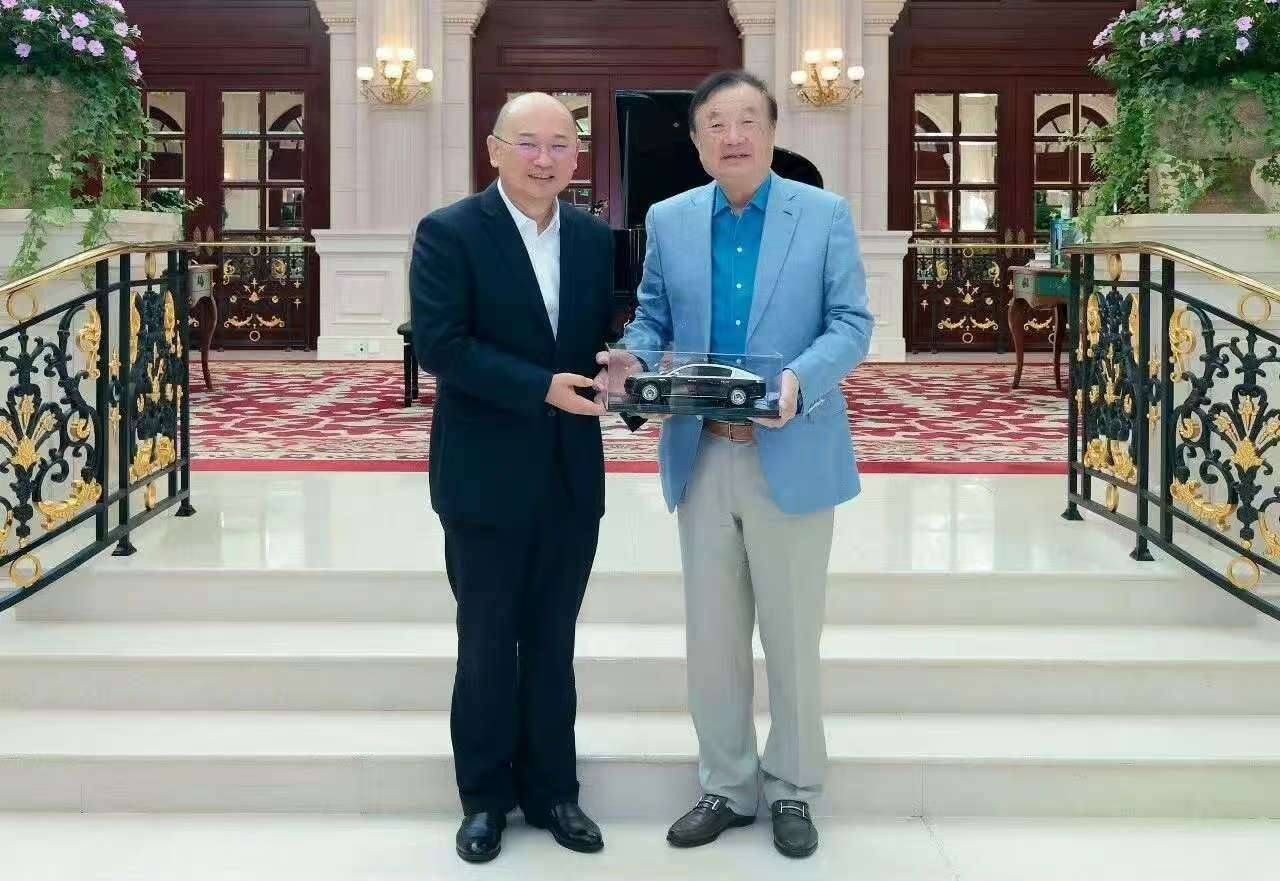
近日,江汽集团控股公司党委书记、董事长项兴初率核心团队远赴深圳,会晤华为创始人任正非等企业掌舵者。这场跨域相逢,不仅是双方合作征程中的重 要里程碑,更成为洞察中国汽车产业智能化变革浪潮的关键窗景。 双方聚焦汽车产业智能化转型的时代浪潮、既有合作项目的推进脉络及未来发展的宏伟蓝图,展开深度擘画,明确将进一步拓宽合作疆域,在汽车智能化、 企业数智化等核心领域续写协同创新的篇章。事实上,江汽与华为的深度携手绝非偶然,既是江汽冲破发展桎梏、驰骋智能化转型赛道的战略抉择,更深刻 映照出当下汽车行业从"孤勇前行"迈向"跨界共生"、从"电动化普及"迈向"智能化深耕"的核心演进趋势。 从合作根基与发展远景来看,江汽与华为已构建起体系化的合作矩阵,此次深化携手将进一步实现优势互补、资源聚合的乘数效应。事实上,双方的合作渊 源并非始于此次会晤:2025年4月,双方便签署全面深化战略合作协议,聚焦新能源汽车平台开发、智能电动部件应用等关键领域;同年6月,合作版图进一 步拓展,明确在智能驾驶、智能座舱、企业数智化转型等维度开展全方位协作,尊界系列车型的成功交付,正是双方协同效能的生动注脚。 此次深圳会晤,则为未来的合作路径勾勒出更清 ...


米黑摇身一变成乙方,雷军怒了
Sou Hu Cai Jing· 2026-01-07 07:14
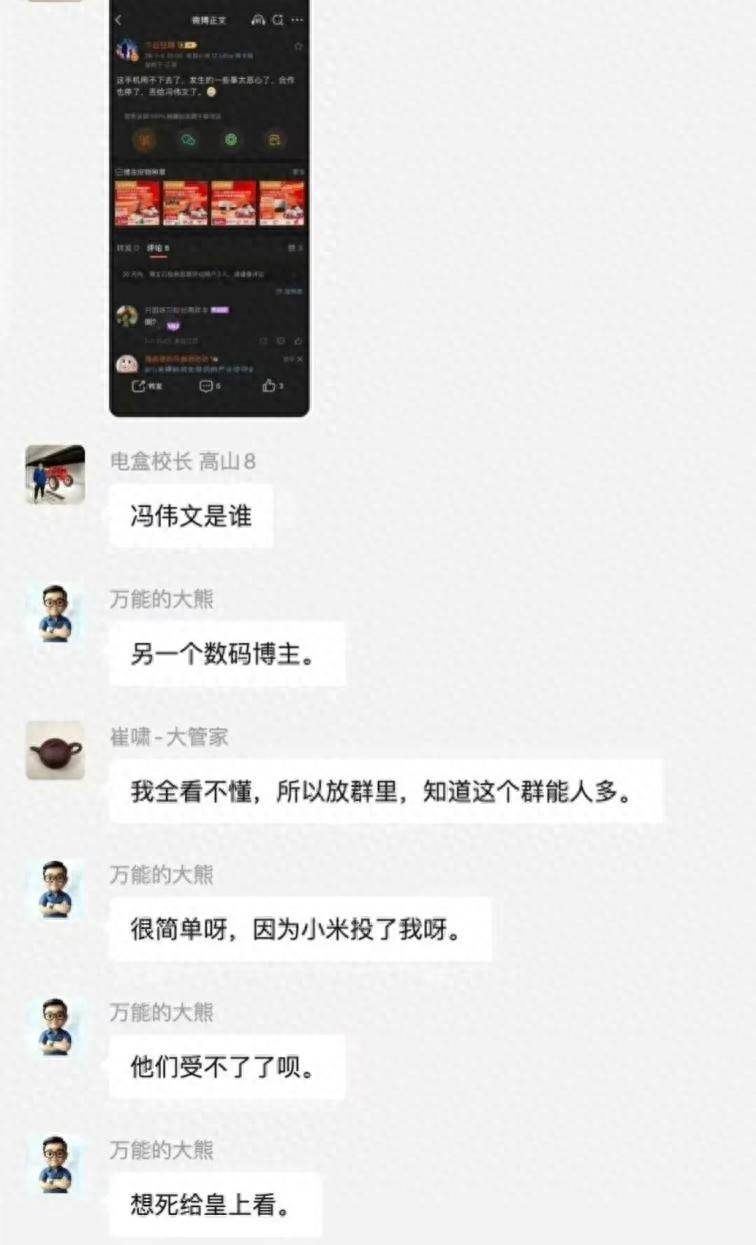
文:谈擎说AI 这几天的走向堪称魔幻——一场毫无征兆的 KOL 合作风波,竟让米粉集体体验了一把"背后中刀"的错愕。 米黑成正规军,米粉控诉 1月3日的拆车直播里,雷军还当众放话,法务部将会重击小米黑粉;结果镜头一转,小米却悄悄跟头号"黑米"KOL商量,把对方写进合作投放名单。 最戏剧的是,这段暗度陈仓的戏码,还是由当事人亲自截图爆料,自己锤自己。 万能的大熊作为头号反米粉一份子,曾经在微博直接表态"小米不会死,死的会是米粉"。 那用词叫做一个犀利,这种针对米粉发表极端言论的博主,自然而然上到了米粉的"追杀名单"。 合作计划一自曝,瞬间点燃舆情,雷军、徐洁云的微博秒变抗议海洋——死忠粉们觉得自己在前线冲锋,总部却暗地给"敌军"送弹药,品牌人设分裂,信任 大厦一朝开裂。 过去,他们逐条反击黑稿,@法务部 求援;如今高管亲手递刀,信仰瞬间塌方,只剩"臣等死战,陛下何故先降"的苍凉。 眼看怒火燎原,雷军这次真生气了:1 月 6 日 22:55,官方通报——涉事员工直接走人,集团 CMO 许斐、公关一把手徐洁云通报批评、扣绩效、年终奖, 一场内部处刑才勉强按下暂停键 小米再次强调"因为米粉,所以小米"的核心原则,直言 ...

小米汽车明年拟推4款新车,包含2款增程|36氪独家
3 6 Ke· 2026-01-07 07:13
Core Insights - Xiaomi plans to launch four new car models in 2026, including the revamped SU7, SU7 Executive version, a five-seat range-extended SUV, and a seven-seat range-extended SUV [1][2] - The seven-seat range-extended SUV, codenamed "Kunlun," aims to compete in the family market with a large battery providing a pure electric range of 400-500 kilometers [2][4] - Xiaomi has achieved significant sales milestones, delivering over 500,000 vehicles within a short time frame, and aims to penetrate the mainstream family market with its new SUV offerings [9][10] Product Strategy - The new range-extended SUVs are designed to address the needs of family users, focusing on space, energy efficiency, and smart features [4][10] - The market for range-extended SUVs is growing rapidly, with over 15 new models expected to launch in China by 2025, indicating strong competition [5][6] - Xiaomi's entry into this segment is seen as a strategic move to diversify its product line and enhance its market presence [10][11] Competitive Landscape - Xiaomi will face established competitors like Li Auto and Aito, which have already built strong brand recognition among family users [11] - The company has previously disrupted the electric vehicle market by breaking Tesla's dominance, indicating its potential to challenge existing players in the family car segment [11] - The introduction of new models marks a shift in Xiaomi's strategy from rapid product launches to a more systematic approach to competition, focusing on comprehensive capabilities across the supply chain and customer service [11]
特斯拉股价单日暴跌超4% 市值一夜蒸发约4300亿元
Xin Lang Cai Jing· 2026-01-07 06:16
【特斯拉股价单日暴跌超4% 市值一夜蒸发约4300亿元 】#特斯拉股价暴跌#当地时间1月6日,美股市场 剧烈震荡。新能源汽车巨头美国特斯拉股价单日暴跌4.14%,报收432.96美元/股,总市值下跌至1.44万 亿美元,市值一夜蒸发662.3亿美元,折合人民币超4346亿元,接近于5个蔚来的总市值规模。消息面 上,据央视新闻,当地时间1月2日,特斯拉公布的数据显示,该公司2025年全球交付汽车163.6万辆, 同比下降约8.6%,连续两年销量下滑。这也是特斯拉有史以来首次在全年电动汽车销量上被中国汽车 制造商比亚迪超越。比亚迪发布的2025年12月产销快报显示,2025年全年比亚迪累计销量460.24万辆, 同比增长7.73%。其中纯电车型全年累计225.67万辆,同比大增27.86%。(红星资本局视频) 转自:今晚报 (来源:今晚报) ...

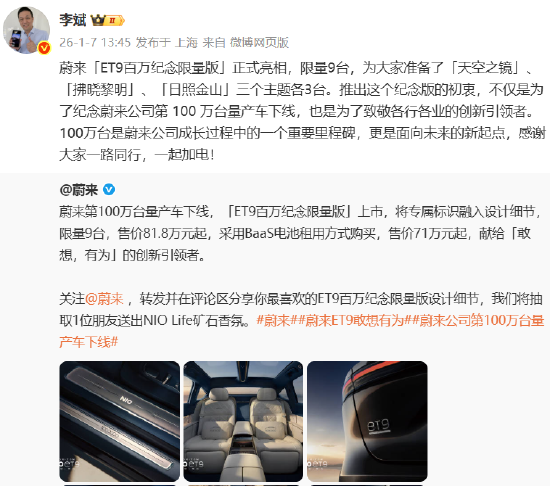
蔚来ET9百万纪念限量版上市:81.8万元起,全球限量9台
Xin Lang Cai Jing· 2026-01-07 06:04
1月7日,蔚来宣布,值此蔚来第100万台量产车下线之际,正式推出"ET9百万纪念限量版",将专属标 识融入设计细节,限量9台,售价81.8万元起,采用BaaS电池租用方式购买,售价71万元起。 蔚来创始人、董事长、CEO李斌表示,ET9百万纪念限量版有三个主题:"天空之镜"、"拂晓黎明"、"日 照金山"。推出纪念版的初衷,不仅是为了纪念蔚来公司第 100 万台量产车下线,也是为了致敬各行各 业的创新引领者。 1月7日,蔚来宣布,值此蔚来第100万台量产车下线之际,正式推出"ET9百万纪念限量版",将专属标 识融入设计细节,限量9台,售价81.8万元起,采用BaaS电池租用方式购买,售价71万元起。 蔚来创始人、董事长、CEO李斌表示,ET9百万纪念限量版有三个主题:"天空之镜"、"拂晓黎明"、"日 照金山"。推出纪念版的初衷,不仅是为了纪念蔚来公司第 100 万台量产车下线,也是为了致敬各行各 业的创新引领者。 责任编辑:李昂 责任编辑:李昂 ...

复盘2025新能源汽车下半场:在喧嚣、焦虑与体验升级中打响淘汰赛
Xin Lang Cai Jing· 2026-01-07 05:57
Core Insights - The 2025 year for the electric vehicle (EV) industry is characterized by aggressive growth, a backlash against internal competition, and uncertainty heading into 2026 [2][17][19] Group 1: Aggressive Growth - The EV industry is projected to sell 12.852 million units in 2025, with a market penetration rate surpassing 50% [3] - BYD leads the market with 4.6024 million units sold, achieving a 7.7% year-on-year growth [6] - New players like Leap Motor and Xiaomi are also showing significant growth, with Leap Motor achieving a 103% year-on-year increase [4][6] Group 2: Backlash Against Internal Competition - The industry has faced issues of malicious competition, with average price reductions of 9.2% leading to a decline in profit margins from 6.2% in 2020 to 4.3% in 2025 [17][18] - Regulatory bodies are advocating for a shift towards innovation and service differentiation rather than price wars [18] - The backlash aims to guide companies towards better product definitions and fair competition practices [18] Group 3: Uncertainty in 2026 - The competition in the EV sector is expected to intensify, with a slowdown in growth rates and increased pressure on product iteration [19][20] - Key factors influencing competition will be autonomous driving capabilities and expansion strategies [20][25] - The industry may face a dilemma regarding price wars as average vehicle prices have decreased from 184,000 yuan in 2024 to 178,000 yuan in 2025 [27]


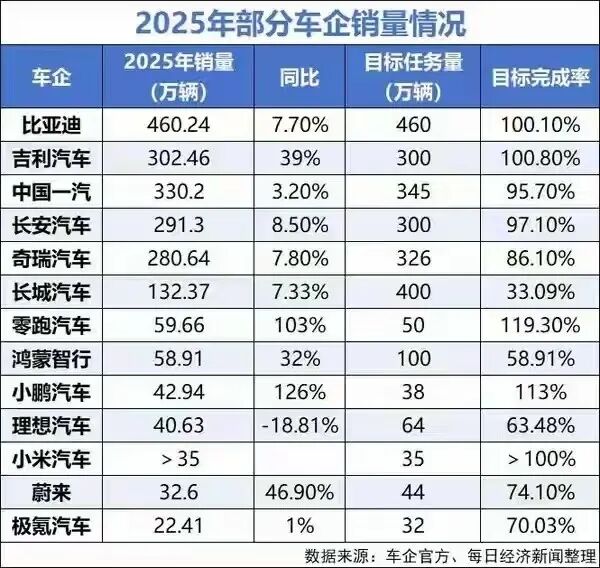
市场最前沿|从车企年报透视中国汽车产业突围密码
Xin Hua Wang· 2026-01-07 05:56
Group 1 - BYD has topped the global sales chart for pure electric vehicles, with a total sales exceeding 4.6 million units in 2025, maintaining its position as the annual sales champion in China [3] - China FAW Group achieved over 3.3 million vehicle sales in 2025, marking a 3.2% year-on-year increase, with its joint venture FAW-Volkswagen leading in sales among joint venture brands [3] - Geely Automobile surpassed 3.02 million units in sales, exceeding its annual target and setting a historical record [3] Group 2 - Leap Motor emerged as the biggest "dark horse" in the new energy vehicle sector, delivering nearly 600,000 units in 2025, representing a 103% year-on-year growth and achieving over 119% of its annual target [4] - NIO reported a record delivery of over 320,000 vehicles in 2025, with a significant increase in delivery volume in the latter half of the year [6] - Multiple automakers indicated that the Chinese new energy vehicle industry is entering a new phase of technological iteration and global development, aiming to lead in both quantity and quality [6] Group 3 - The establishment of new state-owned enterprise China Changan Automobile Group aims to accelerate breakthroughs in new energy, intelligence, and globalization, contributing to a total sales of 2.91 million units in 2025, the highest in nearly nine years [3] - Chery Group's sales exceeded 2.8 million units in 2025, focusing on innovation to enhance product service for global users [3] - Huawei's collaboration with automakers like Seres and BAIC has led to the successful launch of popular models, with a total delivery of nearly 590,000 units in 2025 [4]

蔚来要去下沉市场和BBA掰手腕了
Feng Huang Wang· 2026-01-07 05:47
Core Insights - NIO has reached a significant milestone with the production of its one-millionth vehicle, but it still holds only about 1% of the Chinese automotive market, indicating a long journey ahead in a highly competitive landscape [1] - The company is entering a new phase of growth, focusing on expanding its brand matrix and enhancing operational efficiency while aiming for a 40%-50% annual growth rate without setting specific sales targets for 2026 [4][5] Group 1: Company Strategy and Market Position - NIO's founder, Li Bin, emphasizes the importance of not becoming complacent and acknowledges the competitive nature of the market, predicting that only about ten Chinese EV companies will survive in the long run [1] - The company has segmented its development into three phases: rapid growth (2018-2021), an adjustment period with growth (2022-2025), and a new phase starting in late 2025 characterized by a mature brand matrix and technological advancements [2] - NIO plans to deepen its market penetration by expanding its sales network into 210 cities, aiming to compete more effectively with established brands [4] Group 2: Product Development and Technological Advancements - NIO is set to launch the ES9, a flagship SUV, in the second quarter of 2026, which is expected to leverage the company's technological advantages to deliver significant user value [5] - The company has committed to building at least 1,000 new battery swap stations in 2026, addressing the critical issue of battery life synchronization in electric vehicles [5] - NIO is increasing its investment in computing power to enhance its smart driving capabilities, with plans for large-scale model training in 2026 [5] Group 3: Financial Performance and Profitability - Li Bin expresses confidence in achieving profitability in the fourth quarter, driven by high-margin models like the new ES8 and effective cost management [3] - The company has invested over 65 billion yuan in R&D, focusing on self-developed technologies that create a competitive edge [3] - Despite rising costs due to material price increases, NIO plans to absorb some of the pressure without adjusting vehicle prices, relying on existing profit margins [5]
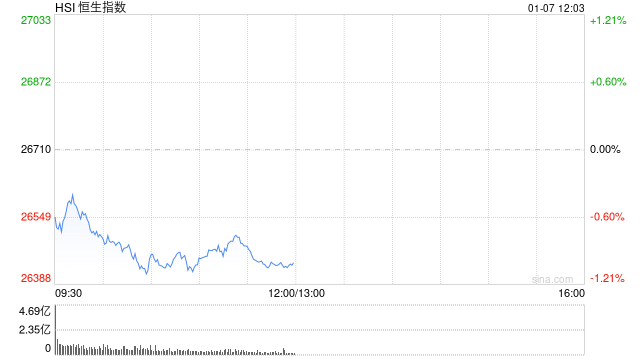
港股午评:恒指跌1.01%、科指跌1.65%,科网股、券商股及银行股集体低迷,有色金属及生物医药股活跃
Jin Rong Jie· 2026-01-07 04:12
Market Overview - The Hong Kong stock market opened lower on January 7, with the Hang Seng Index down 1.01% at 26,439.68 points, the Hang Seng Tech Index down 1.65% at 5,729.41 points, the National Enterprises Index down 1.11% at 9,141.25 points, and the Red Chip Index down 0.64% at 4,114.5 points [1] - Major technology stocks experienced declines, with Alibaba down 4.05%, Tencent down 1.98%, JD.com down 1.47%, Xiaomi down 1.34%, NetEase down 2.18%, Meituan down 2.17%, Kuaishou down 2.78%, and Bilibili down 3.54% [1] - The biopharmaceutical sector continued to rise, with Kangfang Biopharmaceutical up over 6% [1] - The metals sector showed strength, with Luoyang Molybdenum up over 5% [1] - Oil stocks weakened, with PetroChina down over 3% [1] - Automotive stocks faced significant declines, with NIO down over 3% [1] Company News - Yadea Holdings (01585.HK) expects a net profit of no less than RMB 2.9 billion for 2025, up from RMB 1.27 billion in the previous year, driven by increased sales of electric two-wheelers and optimized product structure [2] - Poly Property Group (00119.HK) anticipates a cumulative contract sales amount of approximately RMB 50.2 billion for 2025, a decrease of 7.38% year-on-year [3] - Sunac China (01918.HK) expects a cumulative contract sales amount of approximately RMB 36.84 billion for 2025, down 21.85% year-on-year [4] - Gemdale Corporation (00535.HK) projects a cumulative contract sales total of approximately RMB 10.696 billion for 2025, a decrease of 47.33% year-on-year [5] - Greentown Management Holdings (09979.HK) estimates new project management fees for 2025 to be RMB 9.35 billion, an increase of approximately 0.4% [6] - Yuexiu Property (00123.HK) acquired a land parcel in Shanghai's Pudong New Area for RMB 2.561 billion [7] - Jiufang Zhitu Holdings (09636.HK) completed the acquisition of 100% equity in JF Financial and its core information system [8] - Weimob Group (02013.HK) partnered with Taobao Flash Sale to enhance local retail solutions [8] - Dali Pu Holdings (01921.HK) became a qualified supplier for Saudi Aramco [9] - Xiehe New Energy (00182.HK) successfully completed a secondary listing on the Singapore Stock Exchange [10] - Bokan Vision Cloud-B (02592.HK) submitted a clinical trial application for the new drug CBT-009 [11] - Yingtong Holdings (06883.HK) established a partnership with the Italian high-end fragrance brand CULTI to strengthen its distribution network in China [11] Institutional Insights - Guosen Securities believes that the Hong Kong stock market's recovery has begun, driven by a weaker US dollar and improved domestic liquidity, suggesting a focus on AI and PPI [12] - CITIC Securities anticipates a second round of valuation recovery and performance revival in the Hong Kong market in 2026, recommending attention to technology, healthcare, resource products, essential consumer goods, paper, and aviation sectors [12] - Everbright Securities notes that domestic policy support and a weaker dollar may lead to continued upward movement in the Hong Kong market, highlighting the relative strength of overall profitability [12] - Dongwu Securities indicates that the Hong Kong market is entering a period of upward volatility, emphasizing the importance of dividends and technology growth in the first half of the year [12] - Industrial Securities recommends a bullish stance, predicting a spring rally led by the Hang Seng Tech Index, with a continued bull market expected in 2026 [13]


午评:港股恒指跌1.01% 科指跌1.65% 科网股普跌 石油股走弱 生物医药股延续涨势 阿里巴巴跌超4%
Xin Lang Cai Jing· 2026-01-07 04:04
Market Overview - The Hong Kong stock market indices experienced a decline, with the Hang Seng Index falling by 1.01% to 26,439.68 points, the Hang Seng Tech Index down by 1.65%, and the National Enterprises Index decreasing by 1.11% [1][9]. Technology Sector - Technology stocks faced widespread losses, with Alibaba dropping over 4%, Bilibili down more than 3%, and Kuaishou, NetEase, and Meituan each declining by over 2% [1][9]. Biopharmaceutical Sector - The biopharmaceutical sector continued its upward trend, highlighted by Kangfang Biopharmaceutical's stock rising over 6%. The company announced an important update regarding its PD-1/VEGF bispecific antibody, which has shown statistically significant and clinically meaningful benefits in treating advanced non-squamous non-small cell lung cancer [2][11]. Metals Sector - The metals sector showed strength, with Luoyang Molybdenum rising over 5%. Citigroup raised its short-term copper price target to $14,000 per ton, although it warned that the price increase may be nearing its peak [5][14]. Oil Sector - Oil stocks weakened, with PetroChina falling over 3%. This decline follows an announcement regarding the transfer of 30 to 50 million barrels of oil from the Venezuelan interim government to the U.S., which will be sold at market prices [5][16]. Automotive Sector - The automotive sector saw significant declines, with NIO dropping over 3%. Reports indicate that the Chinese auto market may experience a 7% decline in sales in 2026, marking the first anticipated annual drop since 2020. A price war has begun, involving over 76 models from various manufacturers [6][16].