智谱

Search documents
记者体验不如预期 “AI办事闭环”利在厂商?
Mei Ri Shang Bao· 2026-01-20 23:23
Core Insights - The competition for AI "super entry" is intensifying among major tech companies like Alibaba, ByteDance, and Tencent, focusing on user engagement and service integration [1][2][3] - The effectiveness of AI applications in consumer markets remains uncertain, as companies strive to shift user habits and achieve widespread adoption [1][2] Group 1: Company Strategies - Alibaba's Qianwen App aims to create an "AI service closed loop" by integrating various services such as food delivery, flight bookings, and hotel reservations, addressing the challenge of converting technical advantages into user engagement [2] - ByteDance's Doubao has surpassed 100 million daily active users, leveraging its content and traffic distribution strengths to seamlessly integrate ordering and local services [2] - Tencent has incorporated "Yuanbao" into its WeChat ecosystem, enhancing its AI entry point by utilizing its vast user base [2] Group 2: Market Dynamics - The competition for AI "super entry" is not exclusive to tech giants; pure AI model companies like Zhiyu have also entered the market, offering services like ordering and ticket booking through third-party ecosystems [2] - The strength of AI entry points and the fluidity of service integration depend on the overall strength of a company's supply chain and ecosystem [3] - Industry experts predict that 2026 will mark the beginning of the "general AI entry year," as AI transitions from a technology validation phase to a commercial application phase [3]

争做全模态顶尖 “六小虎”想重塑AI赛道
Nan Fang Du Shi Bao· 2026-01-20 23:14
Core Viewpoint - The competition in the AI sector is evolving, with companies like "Big Model Six Little Tigers" focusing on next-generation technologies and full-modal capabilities, moving away from traditional labels of large and small firms [4][5]. Group 1: Industry Trends - The AI landscape is shifting towards a new competitive logic, with companies aiming to excel in full-modal capabilities rather than traditional traffic competition [4]. - Baichuan Intelligence, once perceived as lagging, is re-entering the market with a focus on the healthcare sector, planning to launch consumer applications and develop sleep-related hardware [4][5]. - Ant Group's AI health product "AQ" has been rebranded to "Ant Afu," emphasizing health companionship and achieving over 15 million monthly active users within six months of its launch [4]. Group 2: Company Strategies - Baichuan Intelligence's CEO Wang Xiaochuan emphasizes their unique advantages, including superior model performance, targeted problem-solving, and a stable professional team, distinguishing them from larger firms [5]. - The company is focusing on high-value scenarios rather than consensus-driven approaches typical of larger firms [5]. - The "Dark Moon" project has shifted its strategy from aggressive user acquisition to enhancing model technology, completing a $500 million Series C funding round to accelerate model training and development [6]. Group 3: Technological Developments - Some smaller players are targeting the AI smartphone market by providing underlying operating systems rather than hardware, such as Zhipu's AutoGLM, which supports over 50 application scenarios [7]. - The AI Agent series model "Step-GUI" from Jiyue Xingchen has been upgraded to enhance privacy control while expanding its operational capabilities across numerous applications [7]. Group 4: Market Challenges - AI hardware faces challenges related to privacy and security, with examples of user issues in AI smartphone applications highlighting the need for improved functionality [10]. - The commercial viability of large models remains unclear, with no company having established a complete business model, leading to significant risks in hardware investments compared to software [10][11]. - The concept of a "super entrance" in the AI market is debated, with the potential for more neutral and open platforms to emerge as true leaders rather than established giants [11].


金十数据全球财经早餐 | 2026年1月21日
Jin Shi Shu Ju· 2026-01-20 22:58
男生普通话版 下载mp3 女声普通话版 下载mp3 粤语版 下载mp3 西南方言版 下载mp3 东北话版 下载mp3 上海话版 下载mp3 今日优选 特朗普举行重返白宫一周年记者会 欧洲议会冻结美欧贸易协议批准程序 波兰央行批准购买150吨黄金的计划 国家发改委:将研究制定出台2026年—2030年扩大内需战略实施方案 市场盘点 周二,白宫就格陵兰岛的未来向欧洲发出威胁,再度引发"抛售美国"交易,美元指数最终收跌0.49%,报98.56;基准的10年期美债收益率最终收报 4.3000%,对美联储政策利率敏感的2年期美债收益率收报3.6050%。 特朗普威胁要对欧洲盟友征收额外关税,引发对避险资产的抢购,现货黄金首次突破4760美元,最终收涨1.82%,报4763.25美元/盎司;现货白银刷新新高 至95.86美元,最终收涨0.25%,报94.60美元/盎司。 因哈萨克斯坦油田暂时停产,以及全球经济增长更加强劲的预期可能推动燃料需求,WTI原油最终收涨0.17%,报59.5美元/桶;布伦特原油低开高走,最终 收跌0.13%,报63.55美元/桶。 欧洲主要股指全线收跌,英国富时100指数收跌0.67%;德国DA ...

外媒为何笃定中国AI能笑到最后?电力、开源、实体经济成关键
Sou Hu Cai Jing· 2026-01-20 14:41
Group 1 - The core viewpoint of the article emphasizes that the AI competition is a marathon rather than a sprint, with the U.S. currently leading due to its chip advantages, but China is expected to have stronger long-term potential [2] - China's electricity consumption is projected to exceed 10 trillion kilowatt-hours by 2025, which is approximately double that of the U.S., providing a solid foundation for large-scale AI development [2] - The successful launch of the GLM-Image model by Zhipu and Huawei, which topped the global open-source model rankings shortly after its release, indicates China's growing capabilities in AI model development [2][3] Group 2 - The Financial Times highlights that AI must be integrated into the real economy for sustainable development, and China's complete manufacturing system supports the transformation of AI models into practical products [3] - China's AI development is characterized by "independent innovation and collaborative efforts," allowing it to overcome U.S. chip restrictions and develop a self-sufficient ecosystem [5] - The Chinese government has invested heavily in AI industry policies, research and development, and talent cultivation, further supporting the establishment of large-scale data center clusters in energy-rich regions [5] Group 3 - The article concludes that international observers are optimistic about China's AI prospects due to its systematic advantages in energy, technology, and industry, marking a transition from a technology follower to a leader in the open-source domain [7]

中金公司:中美AI投资的“差异”
Ge Long Hui· 2026-01-20 14:01
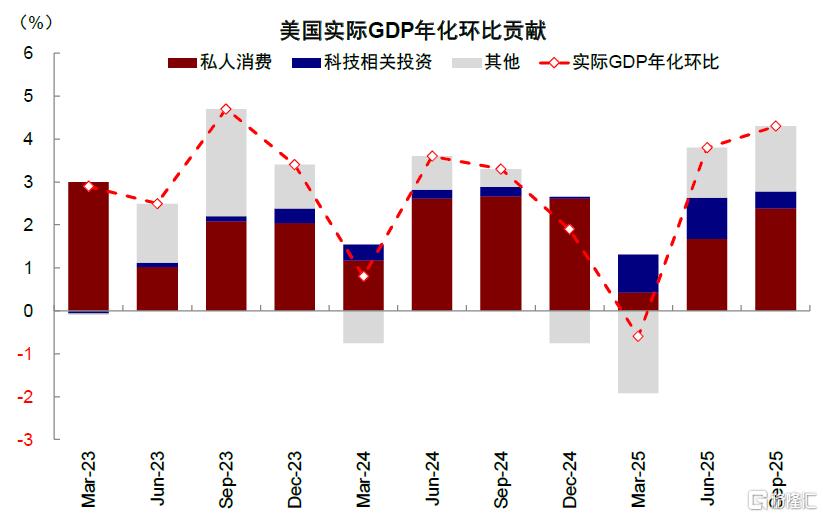
Core Insights - The article emphasizes the significant impact of AI on global economic growth and stock market performance, particularly in the U.S. and China, highlighting the importance of AI investments in driving GDP growth and stock returns [1][11]. Economic Contribution - U.S. technology hardware and software investments are projected to contribute 0.8 percentage points to the annualized GDP growth of 2.5% in the first three quarters of 2025 [2]. - Since 2023, U.S. non-farm business sector labor productivity has increased by 7.2% [4]. Stock Market Performance - Since the launch of ChatGPT at the end of 2022, the "Magnificent Seven" stocks in the U.S. contributed 45 percentage points to the S&P 500 index returns, accounting for over half of the total returns [1]. - In Hong Kong, seven leading tech stocks contributed 14 percentage points to the Hang Seng Index returns, representing 40% of the total returns since the launch of DeepSeek in early 2025 [7]. AI Industry Dynamics - The U.S. has a first-mover advantage in AI infrastructure, models, and talent, while China is rapidly catching up, particularly in open-source models [16][19]. - The global cloud computing market is expected to reach $692.9 billion in 2024, with North America holding a 54.3% market share and China at 16.8% [20]. Investment Landscape - U.S. nominal investment in AI technology hardware and software is approximately $1.05 trillion, accounting for 3.4% of nominal GDP, while China's investment is around $650 billion, also about 3.3% of nominal GDP [42]. - The AI investment landscape shows that the U.S. is primarily driven by private sector investments, while China's investments are significantly supported by government funding [52]. Funding Sources - U.S. AI investments are predominantly led by the private sector, with a total investment of $552 billion, compared to China's $900 billion, which includes substantial government support [52]. - The Chinese government has invested approximately $750 billion in AI, significantly higher than the U.S. government's $110 billion [57]. Investment Focus - U.S. investments are heavily focused on data centers and supporting infrastructure, while China is investing more in chip development and AI models [58]. - In 2025, U.S. leading companies are expected to invest $4 billion in the foundational layer, with 88% directed towards infrastructure [59]. Talent and Research - The number of AI researchers in China has grown significantly, with Chinese researchers holding three times as many AI patents as their U.S. counterparts [41]. - The rapid increase in AI talent in China is enhancing its research capabilities, narrowing the gap with the U.S. [41]. Future Outlook - The article suggests that the U.S. will continue to invest heavily in data centers and energy equipment, which will drive demand for related supply chains in China [88]. - China's ongoing need for chips and AI infrastructure indicates a sustained demand and policy support in the semiconductor sector [88].

魔都美术馆迎来首个官方AI讲解员
Di Yi Cai Jing Zi Xun· 2026-01-20 13:17
Core Insights - ByteDance's Doubao has partnered with Shanghai Pudong Art Museum to serve as the official AI guide for two international exhibitions, enhancing the visitor experience through interactive AI explanations [1][3] - The collaboration exemplifies the practical application of AI in everyday life, showcasing the "perception-reasoning-action" capabilities of multimodal models [1][6] Industry Trends - The integration of AI in museum settings allows users to engage with art through various dimensions, such as artistic style and historical context, creating a more immersive experience [3] - The Seed 1.8 model, launched by ByteDance, focuses on bridging perception, reasoning, and action, enabling complex task execution beyond mere information output [4][10] - Multimodal AI is seen as a critical step towards achieving AGI (Artificial General Intelligence), with industry experts predicting that 2025 will be a pivotal year for multimodal adaptation [6][10] Technical Challenges - Ensuring content accuracy in AI explanations is a significant challenge, particularly in distinguishing similar artifacts and maintaining recognition stability as viewers move [3][6] - The development of world models is essential for advancing multimodal capabilities, as they serve as the foundational technology for processing various information types [8][9] Future Directions - The industry is increasingly focused on understanding physical world laws through world models, which are expected to enhance AI's ability to interact with the physical environment [10][11] - There is a trend towards integrating multimodal understanding and generation, with models like Google's Gemini3 demonstrating advanced capabilities in image editing [11]

AI进化速递 | 马斯克旗下X平台开源推荐算法
Di Yi Cai Jing· 2026-01-20 12:54
Group 1 - Zhipu officially released and open-sourced the GLM-4.7-Flash model [1] - Musk's X platform has open-sourced its recommendation algorithm, now accessible on GitHub [1] - Alibaba Cloud held the PolarDB developer conference, launching the AI data lake and several new products [1] Group 2 - Step3-VL-10B, a 10 billion parameter visual language SOTA model, has been open-sourced by Jietu Star [1] - UCloud has open-sourced the OrderWise, a smart delivery price comparison agent [1] - Ant Group upgraded its PC version of Afu, launching the DeepSearch feature aimed at doctors [1] Group 3 - DingTalk version 8.2.5 introduced new AI travel features [1] - Muxi Co. established a joint research center for food safety and artificial intelligence with Jiangnan University [1] - Japan's Finance Minister, Shunichi Suzuki, announced plans to invest over $330 billion in artificial intelligence and chip sectors [1] - Microsoft CEO Satya Nadella stated that artificial intelligence represents a platform-level transformation comparable to the internet, mobile technology, and cloud computing [1]

从算力到应用 2026资本正重仓AI营销新范式
智通财经网· 2026-01-20 12:43
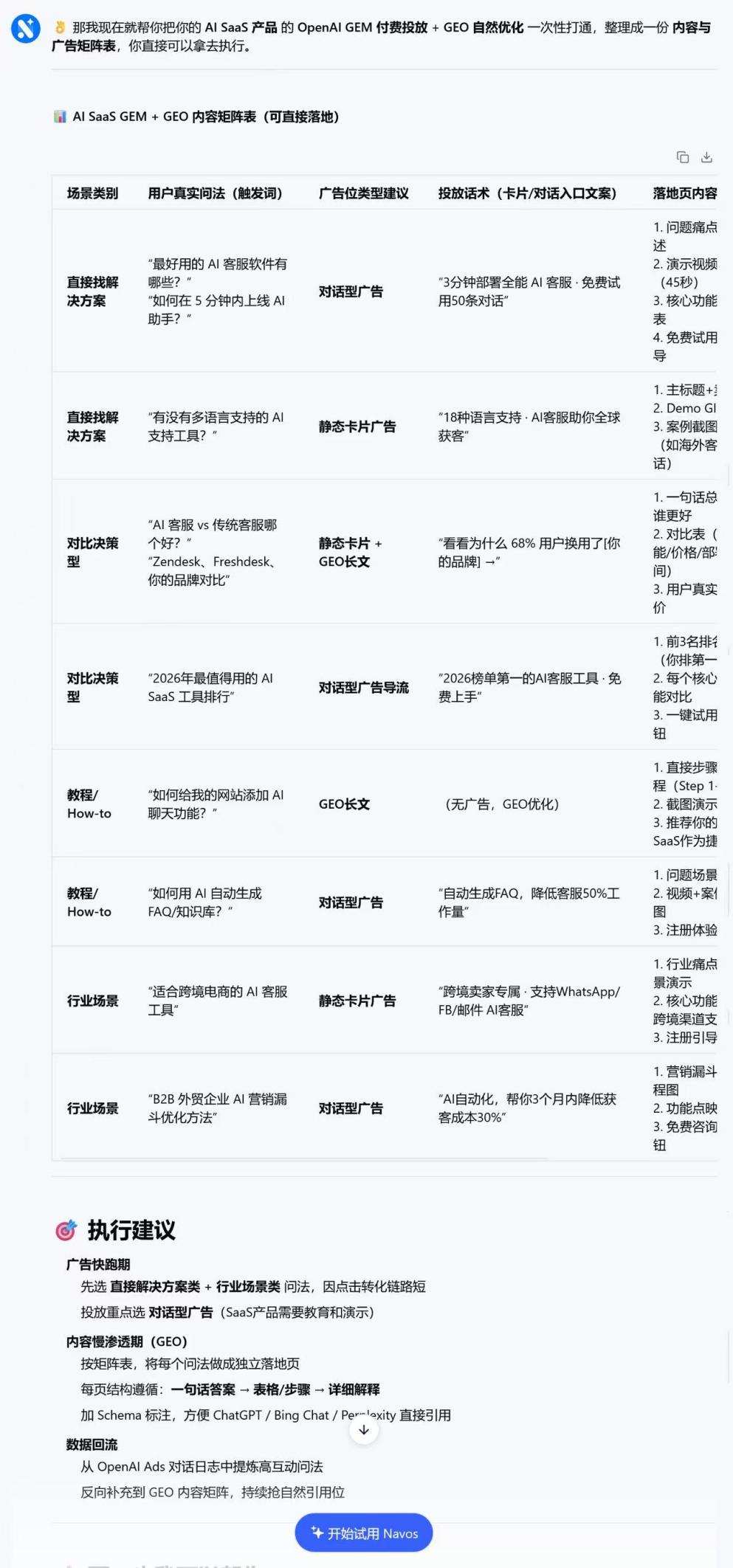
Core Insights - The commercialization of AI applications is becoming a focal point in the capital market, with significant events indicating strong potential for business models and sustainable profit paths [1][2]. Group 1: Market Dynamics - Several domestic large model and AI application companies have successfully gone public in Hong Kong, validating their business models [2]. - The acquisition of Manus by Meta and the integration of generative AI into Walmart's shopping process highlight the growing potential of AI applications in the market [2]. - OpenAI's decision to test advertising in ChatGPT's free and paid versions marks a significant shift in how users access information, indicating the emergence of a new market driven by generative AI [3][7]. Group 2: Advertising Transformation - The shift from traditional keyword-based search to natural language interaction in AI is fundamentally changing the flow of information and advertising [4][6]. - Data shows that by December 2025, ChatGPT's monthly active users will reach 880 million, with over 80% of users forming habits of obtaining consumer information through AI [5]. - The introduction of GEO (Generative Engine Optimization) and GEM (Generative Engine Marketing) represents a new paradigm in advertising, focusing on capturing user intent rather than keyword bidding [6][9]. Group 3: Industry Growth Projections - The global application market is expected to exceed $300 billion by 2025, with China leading at a 45% growth rate [8]. - The GEO market is projected to reach $24 billion by 2026 and could grow to $100 billion by 2030, with a compound annual growth rate of approximately 53% [9]. Group 4: Investment Opportunities - The capital market is increasingly favoring AI applications, with significant investments flowing into related ETFs and companies like Zhizhu and MiniMax achieving market valuations exceeding 100 billion HKD [11]. - The transition from traditional search engine traffic to AI tools is expected to accelerate, with Gartner predicting that about 25% of traditional search engine traffic will shift to AI tools by 2026 [11]. - Companies that can effectively leverage AI applications and establish a strong technological foundation are positioned to lead in the new AI advertising era [12][18].
2026年度AI最佳场景渗透案例评选启动丨招募
36氪· 2026-01-20 09:46
Core Insights - The article emphasizes a significant shift in the AI industry from a focus on technical feasibility to commercial viability, indicating that AI applications must now demonstrate real business value to avoid market devaluation [5][6][12]. Group 1: Industry Trends - A transformation is occurring in the AI sector, with increasing activity and investment signaling a move towards profitability narratives [3][5]. - The AI industry is transitioning from a "parameter race" to a focus on practical applications that address real-world needs [6][7]. - Companies are abandoning the idea of universal solutions and are instead developing targeted applications that provide concrete solutions in specific verticals [11]. Group 2: Case Studies and Applications - In the automotive sector, AI is being integrated into power systems and intelligent driving algorithms, transforming vehicles into self-evolving intelligent spaces [11]. - AI is significantly lowering the barriers to content creation, as seen with Kuaishou's use of AI in short drama production and e-commerce live streaming, creating a complete ecosystem from production to monetization [11]. - The emergence of the Agent era allows AI to perform comprehensive tasks in physical environments, as demonstrated by Alibaba's Qianwen app, which integrates food delivery, payment, and shopping into a single platform [11]. Group 3: Evaluation and Recognition - The article announces the "2026 Annual AI Best Scene Penetration Case" evaluation, aimed at identifying AI applications that effectively solve industry pain points and demonstrate replicable business value [13][20]. - The evaluation will utilize a "dual application system," encouraging collaboration between AI developers and users to provide a comprehensive view of application effectiveness [13][22]. - A panel of industry experts will assess submissions based on criteria such as scene penetration, commercial value, technological innovation, and replicability [13][25]. Group 4: Highlights of the Evaluation - Special awards will be given to early adopters who explore and invest in AI applications, recognizing their contributions to the industry [15]. - A survey will be conducted to understand the decision-making processes and pain points faced by AI product users, creating an "AI demand market map" [16]. - Public input will be solicited to identify anticipated AI transformation scenarios, aiding in future industry planning [17].
港股收评:恒指跌0.29%、科指跌1.16%,黄金及新消费概念股逆势走高,科技股、AI应用、商业航天股普跌
Jin Rong Jie· 2026-01-20 08:25
Market Performance - The Hong Kong stock market experienced a decline, with the Hang Seng Index falling by 0.29% to 26,487.51 points, the Hang Seng Tech Index down 1.16% to 5,683.44 points, and the National Enterprises Index decreasing by 0.43% to 9,094.76 points [1] - Major technology stocks generally declined, with Alibaba down 0.44%, Tencent down 1.48%, and Xiaomi down 2.74%, while JD.com saw a slight increase of 0.09% [1] - New consumption concept stocks performed well, with Pop Mart rising by 9% and Naixue's Tea increasing by over 4% [1] Corporate News - Codex-B (02487.HK) reported positive top-line results from a Phase III clinical trial for CU-20101, an injectable botulinum toxin type A for moderate to severe glabellar lines [2] - Saint Bella (02508.HK) entered a strategic cooperation framework agreement with Cloudwise Technology to explore the integration of AI and robotics in high-demand home care scenarios [2] Profit Forecasts - China Taiping (00966.HK) expects a net profit increase of approximately 215% to 225% in 2025, compared to 8.432 billion HKD in the previous year [3] - TCL Electronics (01070.HK) anticipates an adjusted net profit of approximately 2.33 billion to 2.57 billion HKD in 2025, representing a growth of 45% to 60% [3] - Jihong Co. (02603.HK) forecasts a net profit of approximately 273 million to 291 million RMB in 2025, a year-on-year increase of 50% to 60% [3] - Guolian Minsheng (01456.HK) expects a net profit of 2.008 billion RMB in 2025, a growth of around 406% [3] - China Railway (00390.HK) reported a new contract amount of 1,165.98 billion RMB in Q4 2025, with a cumulative new contract amount of 2,750.9 billion RMB, a year-on-year growth of 1.3% [3] Sales and Revenue - Shenzhen Holdings (00604.HK) anticipates a total contract sales amount of approximately 13.311 billion RMB in 2025, a decrease of 21.55% [4] - SF Holding (06936.HK) reported a total revenue of 27.339 billion RMB in December from its logistics, supply chain, and international businesses, reflecting a year-on-year growth of 3.41% [5] Institutional Insights - Dongwu Securities noted that the Hong Kong market is in a long-term upward trend but faces short-term challenges, with strong consensus on domestic fundamentals but mixed views on overseas factors [9] - Huaxia Fund emphasized the high sensitivity of the Hong Kong market to corporate earnings and macroeconomic data, suggesting that positive economic surprises could significantly boost market expectations [10] - Tianfeng Securities highlighted that the Hong Kong market has the foundation for a rebound due to valuation recovery and sentiment improvement, but upward momentum may be constrained by high overseas interest rates [10] - Huaxi Securities pointed out that the "AI+" logic is catalyzing valuation optimization in the Hong Kong market, with a focus on internet, technology, and emerging consumption sectors [10]