
招商银行

Search documents
国新国证基金总经理谌重和首席投资官毕子男离任 张鹏代任总经理
Xi Niu Cai Jing· 2026-01-18 05:41
| 离任高级管理人员职务 | 首席投资官 | | --- | --- | | 离任高级管理人员姓名 | 毕子男 | | 离任原因 | 工作调整 | | 离任日期 | 2026-01-13 | | 转任本公司其他工作岗位的说明 | 转任其他岗位 | 公告显示,张鹏现任国新国证基金副总经理、督察长,此前曾任银河金汇证券资产管理有限公司合规总监兼首席风险官(副总经理级)、华融基金管理有限 公司督察长。 谌重担任国新国证基金总经理一职不到2年。2024年8月下旬,国新国证基金发布公告称,中邮基金原副总经理谌重出任国新国证基金总经理。 1月14日,国新国证基金发布高管变更公告称,总经理谌重因个人原因离任,暂无转任该公司其他工作岗位的说明;首席投资官毕子男因工作调整离任,转 任其他岗位;张鹏代任总经理。 | 离任高级管理人员职务 | 总经理 | | --- | --- | | 离任高级管理人员姓名 | 谌重 | | 离任原因 | 个人原因 | | 离任日期 | 2026-01-13 | | 转任本公司其他工作岗位的说明 | | 目前毕子男在管基金仅有1只——国新国证融泽6个月定开混合基金,并且曾于2025年6月离任国新国 ...


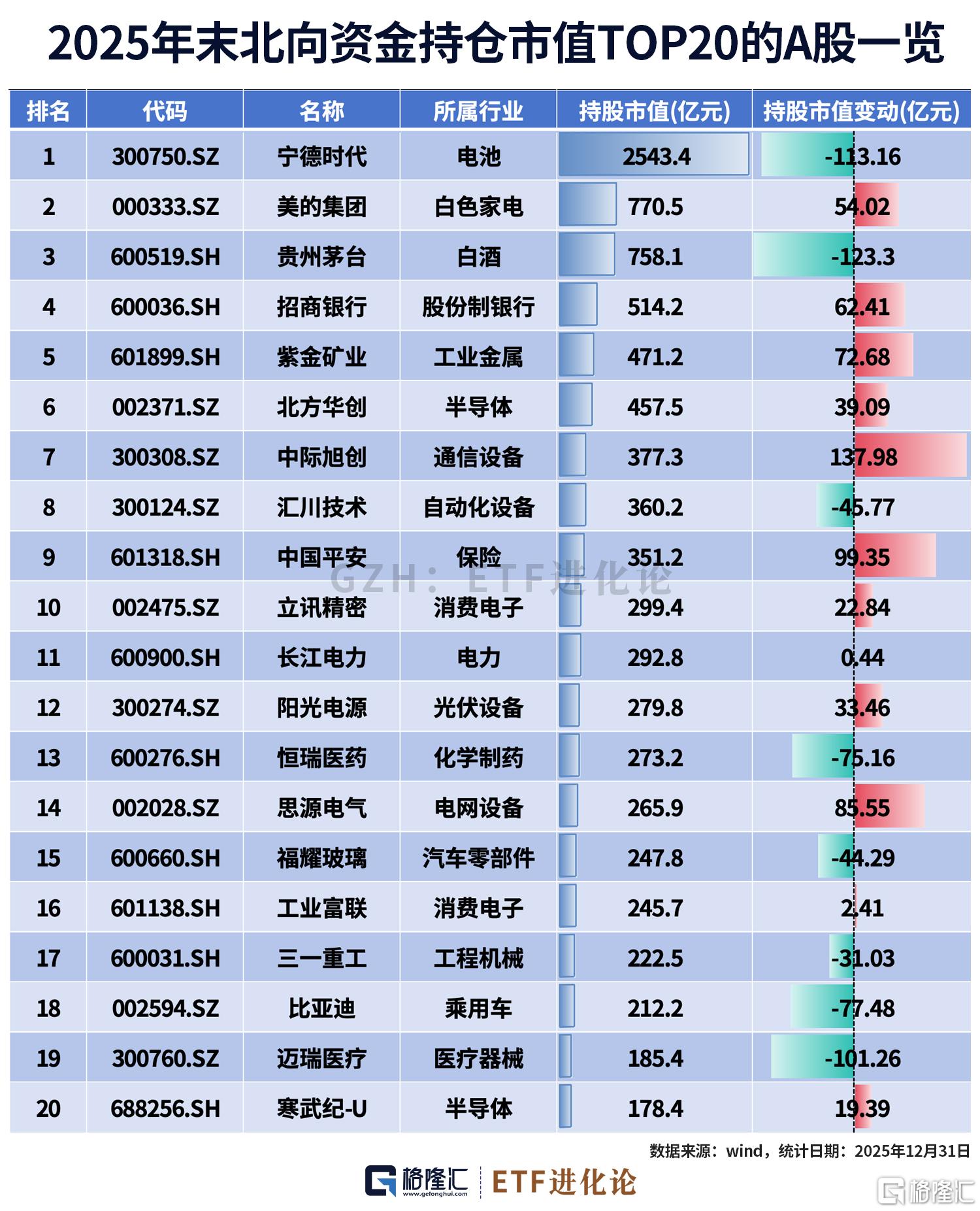
图解北向资金最新持仓股
Ge Long Hui A P P· 2026-01-18 03:02
Core Viewpoint - Northbound capital saw a net inflow of 10.15 billion yuan in Q4 2025, with the market value of A-shares held increasing slightly from 25,852 billion yuan at the end of Q3 to 25,898 billion yuan at the end of Q4 [1]. Group 1: Top Holdings - The top ten stocks held by northbound capital as of the end of 2025 include CATL, Midea Group, Kweichow Moutai, China Merchants Bank, Zijin Mining, Northern Huachuang, Zhongji Xuchuang, Huichuan Technology, Ping An Insurance, and Luxshare Precision [1]. - New additions to the top 20 holdings include Suyuan Electric and Cambricon, while WuXi AppTec and Lattice Semiconductor exited the top 20 [1]. Group 2: Sector Performance - In Q4, northbound capital increased holdings in sectors such as new energy (CATL, DeYuan Co., Sunshine Power), electronics (Luxshare Precision, Northern Huachuang, Zhaoyi Innovation), non-ferrous metals (Aluminum Corporation of China, Jiangxi Copper, Zhongjin Gold), and large financials (China Merchants Bank, Ping An Insurance) [2][3]. - The sectors with the highest increase in holdings were non-ferrous metals, communication, and basic chemicals [7][8]. Group 3: Net Inflows and Outflows - The stocks with the highest net inflows in Q4 included CATL (12.19 billion yuan), Luxshare Precision (6.1 billion yuan), Weichai Power (4.87 billion yuan), China Merchants Bank (4.26 billion yuan), and Ping An Insurance (3.49 billion yuan) [4]. - Conversely, the stocks with the largest net outflows included Kweichow Moutai (-8.45 billion yuan), WuXi AppTec (-5.32 billion yuan), BYD (-4.98 billion yuan), and Mindray Medical (-4.22 billion yuan) [5]. Group 4: Industry Holdings - The leading industry by market value held by northbound capital is electrical equipment, followed by electronics, non-ferrous metals, banking, and machinery [6]. - The industries with the most significant increase in market value held were non-ferrous metals (51.63 billion yuan), communication (19.48 billion yuan), and basic chemicals (8.86 billion yuan) [8].






2025年Q3中国移动互联网流量季度报告
艾瑞咨询· 2026-01-18 00:06
Core Insights - The report indicates a slight growth in mobile internet traffic in Q3 2025, with user behavior shifting towards low-frequency deep usage. Monthly active devices reached 1.452 billion, a 0.83% increase from Q2 2025. Daily usage frequency decreased by 2.9% to 59.8 times, while usage duration increased by 2.3% to 282.9 minutes, indicating deeper user engagement [1][2][6]. User Changes - The proportion of unmarried users increased to 32.7%, up 1.39% year-on-year, with growth driven by the unmarried demographic in mid-to-high tier cities. Users aged 35 and below accounted for 49.1% of the total, with a 4.2% increase in users from second-tier cities and above [2][8]. - User preferences vary significantly by age, with younger users (post-2000s) favoring gaming and entertainment, while those aged 25-30 lean towards parenting and family content [2][16]. Industry Changes - The food delivery sector saw a temporary surge in traffic due to intense competition among major players, but growth momentum has weakened post-surge. The travel sector continues to show strong demand, with a 15% year-on-year increase in usage duration [3][61]. - Artificial intelligence applications are experiencing rapid growth, with monthly active users reaching 470 million and a year-on-year increase of 321% in user scale, reflecting high market demand and acceptance [3][37]. - The gaming service sector is facing overall decline, with intensified competition among existing players, although MOBA and shooting games are experiencing growth [4][76]. APP Changes - In September 2025, the top three apps with over 100 million monthly active users were Railway 12306, Doubao, and Quanmin K Ge, while the top three apps with over 50 million monthly active users included Tencent Yuanbao, Soda Music, and Zhuanzhuan [5][81][82].

发生了什么?欧美股市集体下挫,A50五连阴,下周A股还会下跌?
Sou Hu Cai Jing· 2026-01-17 16:38
Market Overview - On January 14, 2026, the A-share market experienced significant volatility, with the Shanghai Composite Index initially rising close to 4200 points before a sharp decline, ultimately closing down 0.31% at 4126.09 points. The total market turnover exceeded 3.9 trillion yuan, setting a new historical high [1] - The U.S. stock market also faced declines, with the Dow Jones down 83.11 points (0.17%), S&P 500 down 4.46 points (0.06%), and Nasdaq down 14.63 points (0.06%). European markets followed suit, with all major indices declining [3] Policy Changes Impact - A significant factor contributing to the market's volatility was a policy change announced on January 14, which raised the minimum margin requirement for investors from 80% to 100%. This adjustment directly reduced investors' leverage, impacting trading behavior [4] - The A-share margin balance reached 2.67 trillion yuan as of January 13, with a net financing scale approaching 140 billion yuan in just the first seven trading days of 2026 [4] Sector Performance - The A-share market showed a mixed performance with 2747 stocks rising and 2592 falling, indicating intense market competition. AI application sectors led the gains, while energy metals, banking, and insurance sectors faced declines [3] - The CSI 300 index opened 1.2% higher but fell 2.38% by the end of the day, marking the largest single-day drop of 2026. Key stocks like China Merchants Bank and Kweichow Moutai saw declines exceeding 3% [6][7] Market Dynamics - The decline in heavyweight stocks is attributed to three main factors: valuation mismatch with profit expectations, pressure from a wave of share reductions, and a rebalancing of fund structures. The forward P/E ratio of the CSI 300 reached 13.8 times, a premium of 18% over the past five years [7][9] - In the first week of 2026, 39 A-share companies announced significant share reduction plans, with some major shareholders planning to reduce their stakes [9] Technical Analysis - The A50 index maintained its long-term trend line despite the sharp drop, while the Shanghai Composite Index is caught between a mid-term downtrend and a long-term uptrend [10] - The market liquidity situation remains complex, with a structural "rate cut" leading to a perception of abundant liquidity, which has influenced market movements [10] External Influences - The external environment, including U.S. policy changes under Trump, has raised global market concerns, particularly regarding the tech sector, which has seen significant declines [12][14] - The banking sector faces uncertainty due to proposed changes in credit card interest rates, which could impact net interest margins significantly [14]

A股突然降温!融资收紧保证金调整,是打压市场还是保护散户?
Sou Hu Cai Jing· 2026-01-17 10:21
Core Viewpoint - The adjustment of the financing margin ratio from 80% to 100% by the Shanghai, Shenzhen, and Beijing stock exchanges aims to reduce excessive leverage in the A-share market, which has seen record-high trading volumes and margin balances, thereby ensuring market stability and protecting investors' rights [1][15]. Group 1: Policy Changes and Market Reactions - The new financing margin ratio will take effect on January 19, significantly reducing investors' new financing capabilities and directly lowering the overall leverage level by 20% [4][6]. - Following the announcement, the A-share market experienced a sharp decline, with major indices turning negative and significant sell orders observed in heavyweight stocks, such as China Merchants Bank with over 6.5 billion yuan in sell orders [1][4]. - The adjustment is a response to the overheated margin trading environment, with the A-share margin trading volume reaching a record 427.2 billion yuan on January 12 and the margin balance exceeding 2.7 trillion yuan on January 15 [1][12]. Group 2: Impact on Investors and Market Dynamics - The increase in the financing margin ratio raises the entry barrier for retail and aggressive investors, making them more cautious about leveraging their investments [6][17]. - The "new and old separation" rule allows existing financing contracts to continue under the previous 80% margin ratio, providing a buffer period for the market to adjust without forcing existing investors to add margin or face liquidation [6][10]. - The current leverage level in the A-share market is relatively low, with margin balances accounting for only 2.56% of the A-share market's circulating value, indicating that the market is not in a bubble [12][15]. Group 3: Long-term Market Outlook - The adjustment is seen as a moderate normalization of policy rather than a drastic measure to suppress the market, aiming for a sustainable "slow bull" market rather than a speculative "crazy bull" [10][15]. - The regulatory intent is to guide the market from being driven by capital to being driven by performance, fostering a more rational investment environment [14][17]. - Analysts believe that while high-volatility sectors may face profit-taking pressures, blue-chip stocks will be less affected, and the overall market is unlikely to experience systemic risks [12][15].

同步内地市场,高开低走
Ge Long Hui· 2026-01-17 05:13
恒生医疗小幅高开后只需跳水,随后全天维持在低位盘整,截至收盘下跌0.83%。三生制药下跌 1.78%,百济神州下跌1.36%,京东健康下跌1.03%,康方生物、中国生物、药明生物等股均小幅收跌。 同步内地市场,高开低走后恒生指数收跌0.29%。恒生医疗跌幅居前,互联网、大消费、银行、科技等 均小幅收跌。 恒生科技高开低走后一路回撤,盘中所有反弹,但力度有限,截至收盘下跌0.13%,其中小米集团下跌 2.01%,快手下跌1.51%,京东集团下跌1.3%。 内容只是个人观点,仅供参考,不作为投资依据!欢迎关注交流,互相学习、共同探讨! 恒生银行冲高回落后全天震荡下行,截至收盘下跌0.28%。其中重庆银行下跌2.85%,光大银行下跌 2.4%,浙商银行、招商银行、中信银行等股跌幅均在1%上方;大新银行逆势上涨1.89%。 ...

这场政银企对接座谈会,聚焦破解数商融资难题→
Xin Lang Cai Jing· 2026-01-17 03:18
Group 1 - The meeting focused on the theme of "linking data value to a new ecosystem," addressing the challenges of "difficult and expensive financing" faced by data-driven enterprises [1] - The Inner Mongolia Data Center shared typical cases of data product pledge loans, providing innovative models for data asset monetization and addressing practical challenges [1] - Financial institutions such as China Merchants Bank, Industrial Bank, and Guangfa Bank introduced tailored financial products for data technology companies, moving beyond traditional asset-based financing [1] Group 2 - The meeting served as a closed-loop design to effectively connect policy benefits, financial resources, and enterprise needs, enhancing the concept of "data empowering the real economy" [2] - The Inner Mongolia Data Center aims to continuously improve the data element circulation service system and optimize the long-term mechanism for government-bank-enterprise collaboration [2]
中农发种业集团股份有限公司 第七届董事会第五十七次会议决议公告
Zhong Guo Zheng Quan Bao - Zhong Zheng Wang· 2026-01-17 02:05
Group 1 - The seventh meeting of the board of directors of Zhongnongfa Seed Industry Group Co., Ltd. was held on January 16, 2026, via communication methods, with all six directors present and voting, complying with relevant regulations [2] - The board approved the proposal to open a special account for raised funds and authorized the signing of a fund supervision agreement, with a unanimous vote of 6 in favor [2] - The company has received approval from the China Securities Regulatory Commission for the issuance of stocks to specific objects, ensuring compliance with laws and regulations regarding the management and use of raised funds [2]

降温组合拳火速出手 解码四万亿天量
Hua Xia Shi Bao· 2026-01-17 01:13
Core Viewpoint - The recent regulatory measures in the A-share market aim to cool down speculative trading and maintain market stability, guiding the market towards a "slow bull" trend in the medium to long term [1][3][4]. Market Performance - On January 16, the three major A-share indices experienced collective declines, with the Shanghai Composite Index down 0.26%, Shenzhen Component Index down 0.18%, and ChiNext Index down 0.2% [1]. - The trading volume in the market decreased from nearly 4 trillion yuan to over 2 trillion yuan, indicating a significant reduction in trading activity [1]. Regulatory Actions - The financing margin ratio was raised from 80% to 100% for new financing contracts, a move aimed at controlling the heat of financing funds and preventing the accumulation of leverage trading risks [3][4]. - Major stocks, including招商银行 (China Merchants Bank) and 贵州茅台 (Kweichow Moutai), saw significant sell orders, interpreted as a clear intention to cool the market [3]. Investor Sentiment - The market has seen a resurgence of interest from external funds, with the margin financing balance reaching a historical high of 2.7 trillion yuan [3]. - Analysts believe that the current market environment, characterized by a combination of domestic economic recovery and international fund inflows, supports a positive outlook for A-shares [5][6]. Sector Performance - Sectors such as advanced packaging, semiconductors, and electric grid equipment showed strong performance, while sectors like AI materials and cultural media faced declines [1]. - The market is expected to continue its upward trajectory, driven by structural opportunities in sectors like AI computing, semiconductors, and new energy [9].
FOF发行持续回暖 银行渠道强力驱动,资产配置需求释放
2 1 Shi Ji Jing Ji Bao Dao· 2026-01-16 23:49
Core Insights - The FOF (Fund of Funds) market is experiencing a resurgence, with significant fundraising activity observed at the beginning of 2026, indicating strong demand for asset allocation products [1][13] - The total scale of FOF funds reached 2,442.92 billion yuan as of January 14, 2026, marking a steady increase from the end of 2025 and a significant growth compared to 2024 [14][15] - The issuance of new FOF funds is robust, with 23 funds expected to open for subscription in January 2026, reflecting a shift towards more stable investment strategies [3][15] Fundraising Activity - On January 5, 2026, Wanji Fund's FOF raised 2.099 billion yuan in a single day, while GF Fund's FOF raised 3.288 billion yuan in just two days [1][14] - By January 16, 2026, four newly established FOF products had collectively raised over 6 billion yuan, accounting for approximately 30% of the total new fund issuance during the same period [1][15] Market Growth - The FOF market has seen a continuous growth trend, with a 79.03% increase in scale in 2025 and a further 2.48% growth in early 2026 [14][15] - The total number of FOF funds reached 2,241.01 million shares, with a year-on-year growth of approximately 65% in 2025 [15] Product Structure - The FOF market is predominantly composed of mixed-asset FOFs, which account for 91.75% of the total scale, catering to various risk preferences [16] - Major fund managers like E Fund, GF Fund, and others have established a significant presence in the mixed-asset FOF space, with several products exceeding 10 billion yuan in scale [16] Distribution Channels - The resurgence in FOF popularity is closely linked to the support from banking channels, particularly the customized FOF offerings from banks like China Merchants Bank [5][17] - The "TREE Long-term Profit Plan" launched by China Merchants Bank has significantly boosted FOF scale, with over 10 million clients participating by the end of 2024 [5][17] Investment Strategies - FOF products are increasingly adopting passive investment strategies, focusing on index-based investments through ETFs, while also diversifying into multiple asset classes such as gold and REITs [16] - The average return of FOFs in 2025 was nearly 15%, which has positively influenced investor confidence [9][17] Market Dynamics - The current FOF sales surge is partly driven by sales efforts rather than purely organic demand from clients, indicating a potential reliance on marketing strategies [19] - Investors are advised to prioritize diversified FOFs that align with their risk preferences and investment goals, emphasizing the importance of long-term holding for compounding returns [19][20]