
李宁

Search documents
智通港股沽空统计|9月12日
智通财经网· 2025-09-12 00:22
Summary of Key Points Core Viewpoint - The report highlights the short-selling ratios and amounts for various stocks, indicating significant bearish sentiment in the market, particularly for New World Development, Li Ning, and BYD, which have the highest short-selling ratios [1][2]. Short-Selling Ratios - New World Development and Li Ning both have a short-selling ratio of 100.00%, indicating complete bearish positions [2]. - BYD has a short-selling ratio of 91.94%, suggesting strong negative sentiment towards the stock [2]. Short-Selling Amounts - Alibaba leads in short-selling amount with 7.482 billion, followed by China Pacific Insurance at 1.943 billion and Meituan at 1.420 billion [2]. - Tencent Holdings and CSPC Pharmaceutical also feature in the top five for short-selling amounts, with 1.006 billion and 0.887 billion respectively [2]. Deviation Values - China Ping An has the highest deviation value at 45.98%, indicating a significant difference between its current short-selling ratio and its average over the past 30 days [2]. - China Pacific Insurance and Lai Kai Pharmaceutical follow with deviation values of 44.30% and 39.82% respectively, suggesting notable shifts in market sentiment [2].



运动品牌也“痛”了 痛包频频上新引关注
Mei Ri Shang Bao· 2025-09-11 22:15
Group 1 - The "pain culture" consumption trend is gaining momentum, with brands like Converse, LEE, Dickies, and Li Ning increasing their focus on pain bags to attract young consumers [1][2] - Pain bags differ from regular bags primarily due to a transparent compartment designed for displaying merchandise, rooted in Japanese "pain bag culture" where fans showcase their favorite badges [1][2] - The market for pain bags is becoming concentrated, with over ten sports brands, including Adidas and Anta, participating, and prices generally range from 100 to 200 yuan, with some single items selling over a thousand units [1][2] Group 2 - New products are being launched in the pain bag market, such as Converse's white backpack with a large transparent compartment and Skechers' concert-specific pain bag [2] - The influence of "pain culture" is extending beyond bags, with brands exploring DIY options in footwear and clothing, enhancing the emotional connection with consumers [2] - Industry experts note that the Z generation seeks emotional value over mere functionality, suggesting brands should adopt interactive systems and customization options to meet these demands [2]







星巴克中国出售案进入决赛圈
Xin Lang Cai Jing· 2025-09-11 13:41
Core Viewpoint - The bidding process for Starbucks' China business has narrowed down to four private equity firms: Boyu Capital, Carlyle Group, EQT, and Sequoia China, with a valuation of approximately $5 billion based on projected EBITDA of $400 to $500 million for 2025 [3][11]. Group 1: Bidding Participants - Carlyle Group is a notable contender due to its previous investment experience in McDonald's China, where it held a 28% stake and achieved a net gain of approximately $1.2 billion from a $1.8 billion exit [4][5]. - Boyu Capital has shifted its focus towards larger acquisitions, recently participating in significant deals, indicating its growing capacity in the M&A space [5][6]. - EQT, while less known in China, has a strong background in private equity and has successfully executed high-value exits, including a $15.1 billion exit in the first half of the year [6][7]. - Sequoia China has been active in M&A, recently acquiring a majority stake in Marshall Group for €1.1 billion (approximately ¥8.4 billion) and has a significant fundraising capability, which may drive its participation in the Starbucks deal [8][10]. Group 2: Starbucks' Sale Process - Starbucks has been in the spotlight for nearly a year regarding its strategic options in China, initially indicating it was not considering a full sale but rather seeking external funding while retaining significant ownership [10][11]. - The valuation of Starbucks' China business has fluctuated, with estimates ranging from $5 billion to as high as $10 billion, reflecting market perceptions of its growth potential amid competition from local brands [11][12]. - Starbucks has requested non-binding offers from potential investors, signaling a desire to expedite the selection process while maintaining negotiation leverage by retaining core assets and some equity [12][13].

首店经济爆发:上海成全球运动品牌“战略母港”
Guo Ji Jin Rong Bao· 2025-09-11 13:01
Core Insights - Shanghai is leveraging the "first store economy" to drive the global fashion and sports industry upgrade, attracting major brands like Nike, Adidas, and Arc'teryx to establish flagship and concept stores, positioning the city as a strategic hub for future product and consumer model definitions [1][2] Group 1: Market Trends - From January to July this year, Shanghai saw the opening of 554 new first stores, including 11 global and Asian first stores, and 85 national and mainland first stores, with high-energy first stores accounting for 17.3% of the total [1] - The sports apparel sector represented 28% of new flagship stores opened in Shanghai from last year to the first half of this year, indicating significant growth in this category [2] Group 2: Brand Activities - Nike launched the LeBron XXIII signature shoe in Shanghai, highlighting the city as a priority location for new product releases [2] - Adidas opened two flagship stores in May and June, focusing on customization and sustainable practices, aligning with Shanghai's "waste-free city" initiative [2] Group 3: Consumer Behavior - Consumers are increasingly valuing emotional connections, with flagship stores serving as platforms for cultural exchange and creative expression [3] - The presence of international brands and local companies in Shanghai is fostering innovation in design, research, and product development, enhancing the consumer market [3] Group 4: Strategic Importance - The evolution of Shanghai's first store economy reflects a dual approach of urban commercial ecology and global brand strategies, providing brands with access to high-net-worth consumers and mature retail infrastructure [4] - The establishment of sports brand flagship stores contributes not only to tax revenue and employment but also enhances the city's international influence [4]
加拿大鹅没人要了?
创业邦· 2025-09-11 10:12
Core Viewpoint - Canada Goose's controlling shareholder, Bain Capital, has received a privatization offer valued at $1.4 billion, with significant interest from Chinese investors [8][10]. Group 1: Canada Goose's Situation - Bain Capital has held controlling interest in Canada Goose for 12 years and is looking to exit as the fund's term nears its end, having initially invested around $300-400 million [10]. - The brand has seen a significant decline in growth, with revenue growth dropping from 21.5% to 1.1% for the fiscal years 2022-2025, amid increasing competition and a downturn in global consumer spending [10]. - Despite challenges, Canada Goose remains profitable, with Q1 2026 revenue growing by 22.4% to CAD 108 million (approximately RMB 561 million), marking the largest increase in nine quarters [19][22]. Group 2: Potential Buyers - Anta Sports, with a strong cash position of RMB 55.58 billion and a net cash inflow of RMB 10.93 billion for the first half of 2025, is seen as a potential buyer for Canada Goose [12][13]. - Other interested parties include Boyu Capital and Advent International, as well as domestic brands like Bosideng, which recently acquired a stake in another high-end down jacket brand [8][17]. Group 3: Market Dynamics - The Chinese market has become Canada Goose's largest, with sales in the Greater China region surpassing those in the US and Canada, reaching CAD 422 million (approximately RMB 220 million) in FY 2024 [19]. - The overall retail growth in China's apparel sector has slowed, with a mere 3.1% increase in retail sales for clothing, shoes, and textiles in the first half of the year [27]. Group 4: Broader Industry Trends - There is a trend of foreign brands seeking to sell their Chinese operations, with notable examples including Decathlon and Starbucks, as they struggle to adapt to the changing market landscape [26][27]. - Anta's strategy has shifted from aggressive expansion to improving operational quality and efficiency, as evidenced by the increased inventory turnover days to 136 days [15].
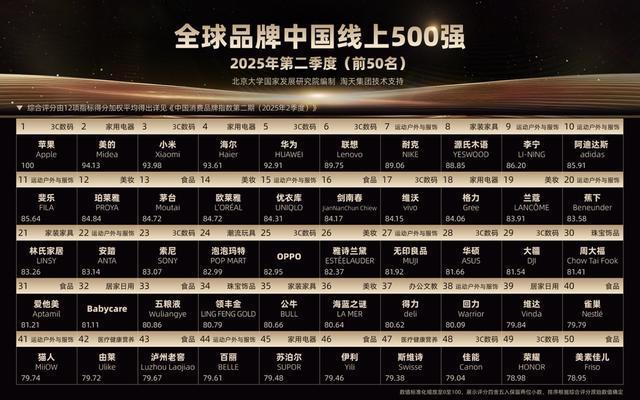
“中国线上消费品牌指数”亮相服贸会,淘宝天猫助力“品质消费”研究
Huan Qiu Wang Zi Xun· 2025-09-11 09:07
Core Insights - The "China Online Consumption Brand Index" (CBI) was prominently featured at the 2025 China International Service Trade Fair, showcasing its significance in measuring online consumer quality [1][3] - The CBI index reflects a shift towards higher quality consumption in China, with the average score increasing from 59.42 in Q1 2023 to 65.21 in Q2 2025, indicating a notable improvement in consumer brand quality [5][6] Group 1: CBI Index Overview - The CBI index is the first of its kind to utilize real consumer data to focus on high-quality development in online consumption, filling a gap in macroeconomic statistics regarding consumption quality [2][3] - The index includes various sub-indices such as the China Online Brand Purchasing Power Index and the Global Brand China Online 500 Strong list, providing insights at both national and regional levels [3] Group 2: Industry Insights - The highest CBI scores are found in the 3C and home appliance sectors, indicating a consumer preference for high-scoring brands in these categories [5] - Emerging sectors like pet products and jewelry are experiencing the fastest growth in CBI scores, reflecting an increasing consumer focus on quality and brand [5] Group 3: Regional Characteristics - New first-tier and second-tier cities exhibit stronger CBI scores, suggesting higher average consumption quality in these areas, while first-tier cities dominate in total purchasing power [5] - Regions with a high proportion of mobile populations show a balanced consumption quality and strong purchasing power [5] Group 4: Consumer Demographics - The middle-income group in China exceeds 400 million, providing a solid foundation for quality consumption growth, despite perceptions of a "white label era" [6] - The research indicates that new brands on the list share characteristics such as strong originality and a focus on product innovation in niche consumption scenarios [5]
平安证券(香港)港股晨报-20250911
Ping An Securities Hongkong· 2025-09-11 03:21
Market Overview - The Hong Kong stock market experienced fluctuations, with the Hang Seng Index closing at 23,831 points, down 145 points or 0.61% [1] - The market saw a net inflow of funds through the Hong Kong Stock Connect, amounting to 484 million HKD, with the Shanghai and Shenzhen Connects contributing 283 million HKD and 201 million HKD respectively [1] - The US stock market showed mixed results, with the Dow Jones falling by 220 points while the Nasdaq and S&P 500 reached new highs [2] Key Companies and Performance - Oracle's stock surged by 36% following a report of a 1,529% increase in multi-cloud database revenue from major clients like Amazon, Google, and Microsoft, driven by AI server demand [2] - Tencent Holdings and Alibaba both showed positive stock performance, with Tencent up 1.0% and Alibaba up 0.6% [15] - Li Ning Company reported a revenue of 14.817 billion HKD for the first half of 2025, reflecting a year-on-year growth of 3.3% [10] Investment Recommendations - The report suggests focusing on sectors such as artificial intelligence, semiconductors, and industrial software, which are seen as new productivity drivers [3] - It is recommended to pay attention to upstream non-ferrous metals benefiting from anticipated interest rate cuts by the Federal Reserve, as well as technology sectors empowered by AI applications [3] - The report highlights the potential of state-owned enterprises with low valuations and high dividends, suggesting they remain attractive investment options [3] Industry Insights - The report emphasizes the growth of the data market in China, with a focus on enhancing data trading institutions and fostering a unified national data market [9] - The renewable energy sector is also highlighted, with China Resources Power reporting an 8.9% increase in electricity sales in August, indicating robust growth in the sector [9][13]
加拿大鹅没人要了?
投中网· 2025-09-11 02:45
Core Viewpoint - The article discusses the challenges faced by foreign brands in China, particularly focusing on Canada Goose's potential privatization and the competitive landscape for sportswear brands like Anta and Bosideng [5][11][24]. Group 1: Canada Goose's Situation - Canada Goose's controlling shareholder, Bain Capital, has received a privatization offer valuing the brand at $1.4 billion, with interest primarily from Chinese investors [7][8]. - Bain Capital has held Canada Goose for 12 years and is looking to exit as the fund's term nears its end, having initially invested around $300-400 million [11]. - Despite a significant drop from its peak valuation of $7.8 billion, Canada Goose remains profitable, with Q1 2026 revenue growing 22.4% year-over-year to CAD 108 million (approximately RMB 561 million) [21]. Group 2: Anta's Position and Strategy - Anta has a strong cash position, with net operating cash inflow of RMB 10.93 billion and total cash and equivalents of RMB 55.58 billion, making the $1.4 billion acquisition feasible [14]. - Anta's growth strategy has shifted from aggressive expansion to improving operational quality and efficiency across its brands, as evidenced by a stable store count and a 1.6x revenue increase over five years [15][16]. - The company has developed a comprehensive brand matrix, including Anta, Anta Kids, and Fila, and is focusing on direct-to-consumer (DTC) integration to enhance its retail model [30][31]. Group 3: Market Dynamics and Trends - The article highlights a broader trend of foreign brands seeking to divest their Chinese operations, with notable examples including Decathlon and Starbucks [24][26]. - The retail growth in China has slowed, with a mere 3.1% increase in retail sales for clothing and textiles in the first half of the year, indicating a challenging market environment [26]. - The competitive landscape is shifting, with domestic brands like Anta gaining market share, as evidenced by Anta's revenue being comparable to that of Nike and Adidas combined in China [25].

智通港股沽空统计|9月11日
智通财经网· 2025-09-11 00:27
Short Selling Ratios - The top three companies with the highest short selling ratios are SenseTime-WR (80020), Anta Sports-R (82020), and Li Ning-R (82331), all at 100.00% [1][2] - Other notable companies with significant short selling ratios include BYD Company-R (81211) at 79.06% and JD Health-R (86618) at 77.31% [2] Short Selling Amounts - Alibaba-SW (09988) leads in short selling amount with 4.715 billion, followed by Tencent Holdings (00700) at 2.280 billion and Baidu Group-SW (09888) at 1.299 billion [3] - Other companies with substantial short selling amounts include Meituan-W (03690) at 1.140 billion and Zijin Mining (02899) at 0.844 billion [3] Deviation Values - The highest deviation values are recorded for SenseTime-WR (80020) at 51.53%, Li Ning-R (82331) at 36.92%, and JS Global Life (01691) at 33.07% [1][3] - Other companies with notable deviation values include Ping An Insurance-R (82318) at 30.67% and China Pacific Insurance (02601) at 26.19% [3]

消费品牌如何提升“年轻力”
Zheng Quan Ri Bao· 2025-09-10 16:20
Core Viewpoint - The upcoming "National Day" holiday indicates a trend of younger consumer groups in the tourism sector, which is also reflected in other consumption industries, presenting both challenges and opportunities for brands to adapt to this demographic shift [1][2]. Group 1: Brand Strategies - Brands need to enhance innovation by continuously improving products based on the preferences of young consumers, as seen with Luzhou Laojiao's focus on low-alcohol products and Moutai's collaboration with Luckin Coffee to launch a popular sauce-flavored latte [1]. - Engaging young consumers in product design and promotion can strengthen brand loyalty, exemplified by Taiping Bird's "Guochao Transformation" campaign on Douyin, where netizens voted on designs for production [1]. - Brands should cultivate a youthful, fashionable, and vibrant image, as demonstrated by Li Ning's sub-brand "China Li Ning" debuting at New York Fashion Week, and Tea Yan Yue Se's creative marketing using elements from "Shan Hai Jing" to appeal to younger audiences [1]. Group 2: Marketing and Interaction - Brands must keep pace with industry trends and consumer demand by innovating marketing strategies and enhancing interaction with young consumers, which is essential for expanding domestic demand and promoting economic growth in China [2].