
易方达

Search documents
公募基金规模暗战正酣
2 1 Shi Ji Jing Ji Bao Dao· 2025-11-04 23:08
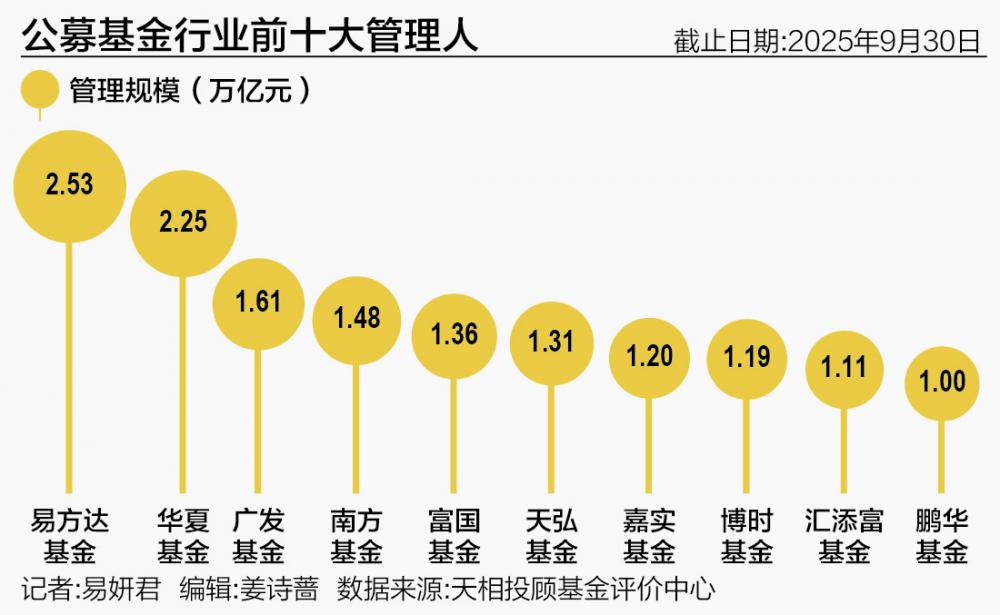
Core Insights - The total net asset value of public funds in China reached a historical high of 36.74 trillion yuan by the end of September 2025, marking a nearly 7% increase from the end of Q2 2025 and a 14.56% increase year-on-year [1][4]. Fund Management Landscape - There are 165 public fund management institutions in China, including 150 fund management companies and 15 asset management institutions with public qualifications [1]. - The top two fund management companies, E Fund and Huaxia, have assets exceeding 2.5 trillion yuan and 2.2 trillion yuan, respectively, while eight other firms have surpassed 1 trillion yuan in assets [1][7]. Fund Type Performance - All major fund types, except bond funds, experienced growth in Q3 2025. The fastest-growing were overseas investment funds, which increased by 33.18%, followed by stock funds with a 25.3% increase [4][5]. - The total net asset value of stock funds reached 5.94 trillion yuan, while mixed funds grew to 3.91 trillion yuan [4]. Bond Fund Trends - Bond funds saw a decline in total net asset value, dropping to 10.62 trillion yuan, a decrease of 1.33% from the end of Q2 2025 [6]. Market Dynamics - The top ten fund managers accounted for 41.31% of the total market size, with their combined assets reaching 15.06 trillion yuan, reflecting a trend of "the strong getting stronger" [7][8]. - The top ten fund managers in terms of equity fund size include E Fund, Huaxia, and others, with E Fund leading at 1.29 trillion yuan [9]. Investor Behavior - There is a significant divergence in the subscription trends of equity funds, with thematic ETFs and cross-border ETFs being particularly popular, achieving net subscriptions exceeding 100 billion units in Q3 2025 [10][11]. - Some actively managed equity funds also attracted substantial net subscriptions, but their levels were lower compared to ETF products [12]. Redemption Trends - Despite the overall market expansion, there is a notable trend of profit-taking among investors, leading to significant redemptions in certain funds, particularly those that had previously experienced long periods of adjustment [14][15]. - For instance, the Huaxia Science and Technology 50 ETF and E Fund Medical ETF saw substantial reductions in their fund sizes during Q3 2025 [16].

唯一降级上市银行!上海银行信披失色,症结在哪?
Sou Hu Cai Jing· 2025-11-04 16:24
Core Viewpoint - Shanghai Bank has been downgraded from A to B in the recent information disclosure evaluation, becoming the only bank to experience such a downgrade, raising concerns about its compliance and transparency in operations [3][6][19]. Group 1: Information Disclosure Evaluation - The Shanghai Stock Exchange's evaluation results for 2024-2025 show that 22 out of 42 A-share listed banks received an A rating, with 5 banks improving their ratings, indicating strong industry performance in information disclosure [2][6]. - Shanghai Bank's downgrade is particularly notable as it directly affects its capital operation efficiency, losing privileges such as "exemption from post-review for temporary reports" and "priority support for refinancing" [6][19]. - The evaluation criteria focus on "normativity, effectiveness, and punishment situations," which are essential indicators of a company's compliance level [5][11]. Group 2: Regulatory Actions and Compliance Issues - The downgrade is linked to two fines imposed by the National Financial Supervision Administration for "overseas investment violations," totaling 800,000 yuan, which were issued prior to the downgrade [3][6][8]. - Shanghai Bank has faced scrutiny due to its involvement in the "E Fund whistleblower incident," where it failed to disclose specific details about its overseas investments and the nature of the violations related to the fines [3][12][17]. - The bank's management team has been criticized for not adequately addressing the compliance issues, leading to a disconnect between the execution and decision-making levels regarding information disclosure [10][11][18]. Group 3: Response and Future Outlook - In response to the downgrade, Shanghai Bank has proactively released nine new regulations aimed at improving information disclosure practices, demonstrating a commitment to rectifying the situation [3][18]. - The bank's management is encouraged to focus on enhancing compliance processes and ensuring that the new regulations are effectively implemented [18][20]. - Despite the downgrade, the bank's core fundamentals remain stable, with solid asset quality and resilient profitability, suggesting that this incident could serve as a catalyst for future improvements [20][22].


基金能当嫁妆了...
表舅是养基大户· 2025-11-04 13:27
Market Overview - The market experienced a significant decline today, with major global indices, including US, Asia-Pacific, and Europe, all showing losses due to the rising US dollar index, which broke above 100 for the first time since August [6][7]. - The A-share market's trading volume fell below 2 trillion yuan again, indicating a decrease in market activity [11]. Dollar Index Impact - The dollar index has been on an upward trend since mid-September, influenced by hawkish signals from the Federal Reserve and rising US Treasury yields, which negatively affect risk assets [7][8]. - The biotech sector, particularly in Hong Kong, has seen substantial declines, with some stocks dropping nearly 20% since their peak [14]. Sector Performance - There is a notable divergence in sector performance, with some sectors like telecommunications, electronics, and non-ferrous metals surpassing their previous highs, while others like oil, coal, and food and beverage remain below their peak levels [16][17]. - Recently, traditionally "lagging" sectors such as oil and coal have shown better performance, contrasting with the persistent underperformance of the food and beverage sector [17]. Financing and Risk - A significant risk has emerged from the selling of stocks by leveraged funds, particularly in the technology sector, where many stocks have experienced substantial declines [20][22]. - The report highlights the dual nature of leveraged funds, acting as a market booster in bullish conditions but posing risks during market downturns [20]. Fund Management Insights - Insights from major asset management teams, such as E Fund's multi-asset team, indicate a shift towards growth-oriented assets like electronics, new energy, and pharmaceuticals, while reducing exposure to traditional sectors [25][26]. - The concept of "mean reversion" is emphasized, suggesting that asset prices tend to return to their long-term averages, which is crucial for investment strategies in convertible bonds [28][29].

广发资管换帅,“广发系” 老将孙晓燕接棒
Huan Qiu Lao Hu Cai Jing· 2025-11-04 11:18
Group 1 - The core point of the article is the leadership change at GF Asset Management, with Qin Li stepping down as chairman and Sun Xiaoyan taking over the role effective October 31, 2025 [1] - Qin Li has extensive experience within the "GF system," having served as chairman of GF Asset Management and general manager of GF Securities since May 2022, along with previous roles at GF Fund and E Fund [1] - Sun Xiaoyan, also a veteran of the "GF system," has been with GF Securities since 1993 and has held various key positions, including manager and vice general manager of the finance department [1][2] Group 2 - GF Asset Management, a wholly-owned subsidiary of GF Securities, was established in January 2014 and is the first broker-dealer asset management company in South China [2] - As of June 30, 2025, GF Asset Management's total asset management plan size was 250.645 billion yuan, a decrease of 1.13% from the end of 2024 [2] - The net asset value of single and special asset management plans increased by 4.56% and 39.49% respectively, while the net asset value of collective asset management plans decreased by 8.85% [2] Group 3 - In August 2023, GF Asset Management withdrew its application for a public offering license and began transferring its public collective products to GF Fund [3] - The transfer of public collective products is a response to the slowdown in public offering license approvals, impacting the asset management scale of broker-dealer firms [3]

科技回调或迎布局机会,科创板50ETF(588080)连续4个交易日获资金净流入
Mei Ri Jing Ji Xin Wen· 2025-11-04 10:23
Group 1 - The technology sector experienced a volatile adjustment today, with the robotics sector leading the decline, and both computing hardware and innovative pharmaceutical and medical device stocks collectively falling [1] - As of the market close, the STAR Market 50 Index dropped by 1.0%, the STAR Growth Index fell by 1.4%, the STAR Composite Index decreased by 1.6%, and the STAR 100 Index declined by 1.9% [1] - According to Wind data, the STAR Market 50 ETF (588080) has seen a net inflow of funds for four consecutive trading days, totaling over 500 million yuan [1] Group 2 - The STAR Market 50 ETF tracks the STAR Market 50 Index, which consists of 50 stocks with large market capitalization and good liquidity, prominently featuring "hard technology" companies, with over 65% in semiconductors and nearly 80% in total across medical devices, software development, and photovoltaic equipment [3] - The STAR 100 ETF focuses on 100 medium-cap stocks with good liquidity, with over 80% in electronics, pharmaceuticals, and electrical equipment, and a significant portion in the electronics and pharmaceuticals sectors [3] - The STAR Composite Index ETF covers all securities in the STAR Market, focusing on core frontier industries such as artificial intelligence, semiconductors, new energy, and innovative pharmaceuticals, encompassing all 17 primary industries in the STAR Market [3]
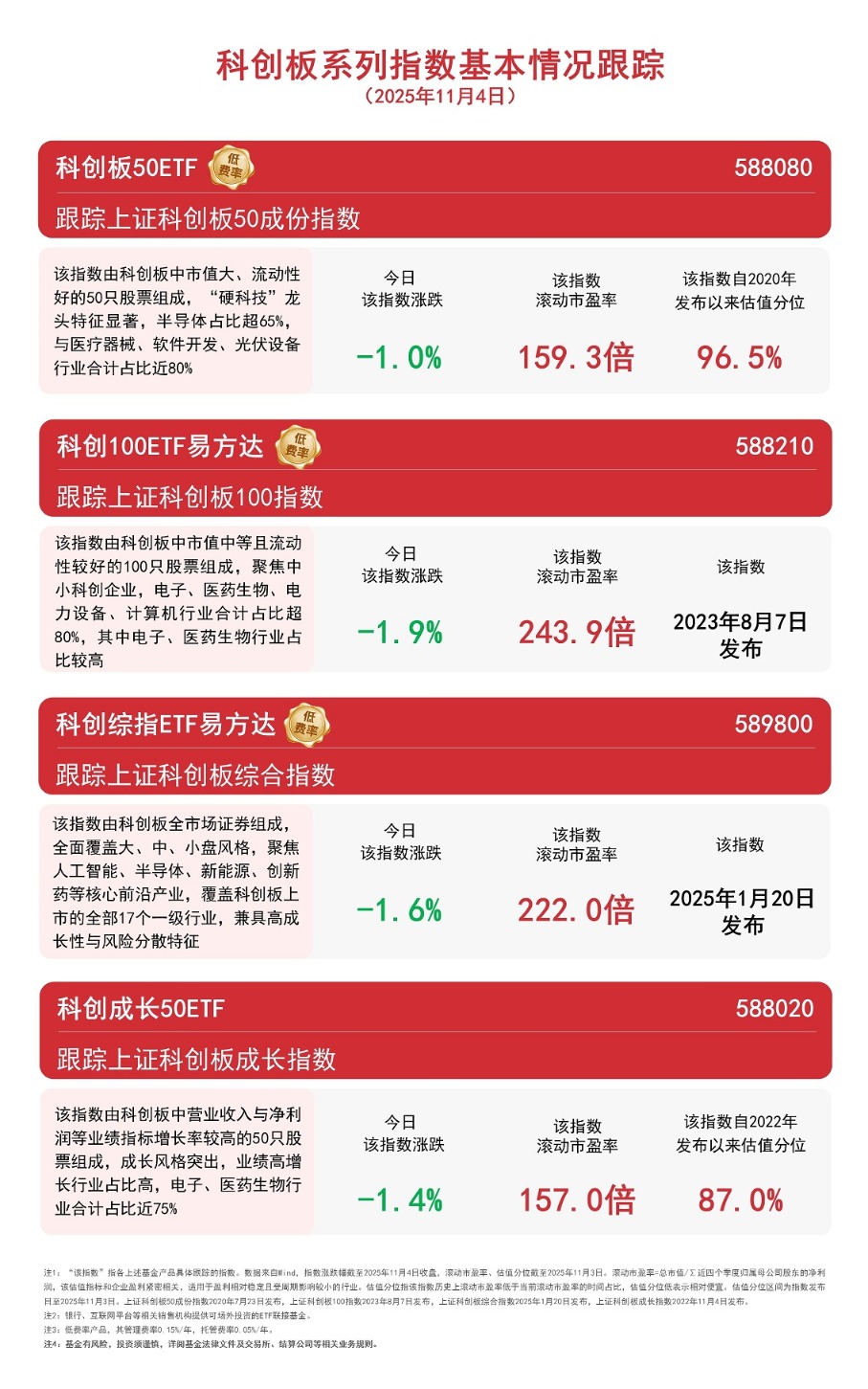
创业板指数下跌2.0%,资金逢低布局意愿明显,创业板ETF(159915)全天净申购约4000万份
Sou Hu Cai Jing· 2025-11-04 09:58
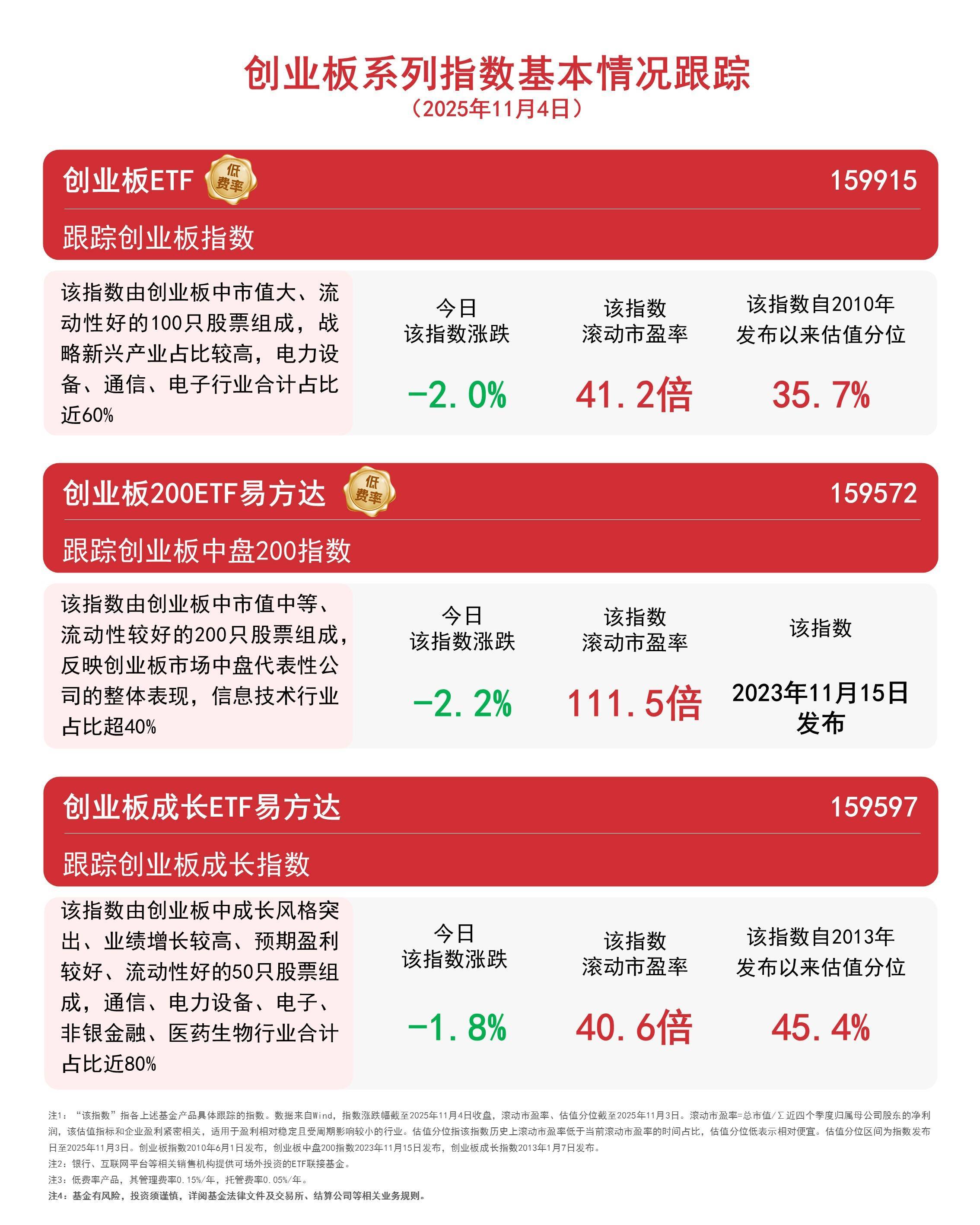
Group 1 - The ChiNext Growth Index fell by 1.8%, the ChiNext Index by 2.0%, and the ChiNext Mid-Cap 200 Index by 2.2% at the close [1] - The ChiNext ETF (159915) saw a net subscription of 39 million units throughout the day, accumulating over 1.2 billion yuan in the previous three trading days [1] - Huajin Securities indicated that factors causing recent adjustments in A-shares may gradually diminish, with market sentiment indicators not fully adjusted but industry rotation largely completed [1] Group 2 - The ChiNext Growth ETF managed by E Fund tracks the ChiNext Growth Index, which consists of 50 stocks characterized by growth style, high performance growth, good profit expectations, and strong liquidity [4] - The information technology sector accounts for over 40% of the overall performance of representative mid-cap companies in the ChiNext market [3] - The combined weight of the telecommunications, power equipment, electronics, non-bank financials, and pharmaceutical sectors in the ChiNext Growth Index is nearly 80% [4]

红利板块延续涨势,红利ETF易方达(515180)、恒生红利低波ETF(159545)等助力布局高股息资产
Sou Hu Cai Jing· 2025-11-04 09:58
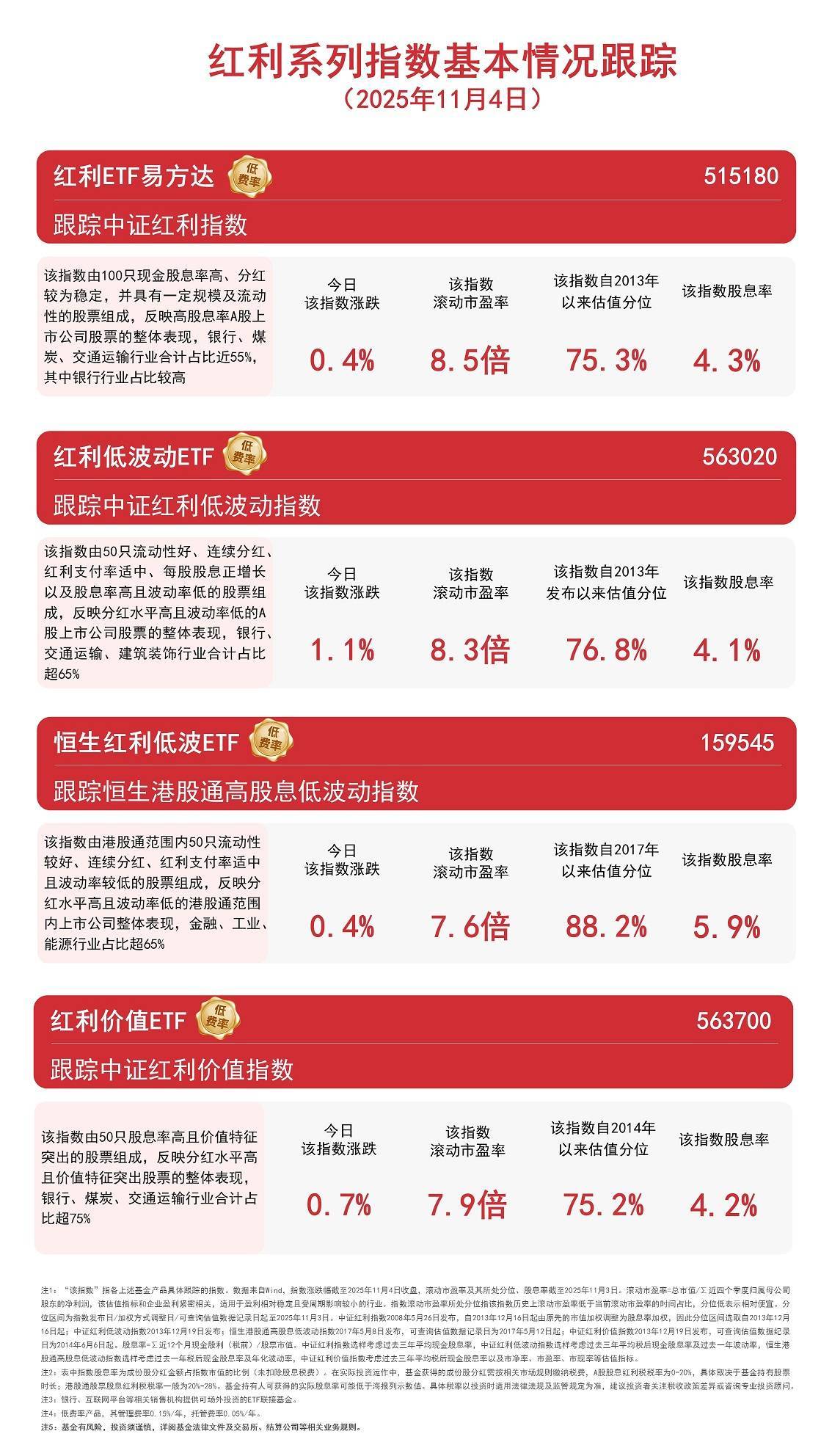
Group 1 - The core viewpoint of the news highlights the continued performance of the dividend sector, with the CSI Dividend Low Volatility Index rising by 1.1% and the CSI Dividend Value Index increasing by 0.7% as of market close [1] - The Hang Seng Dividend Low Volatility Index and the CSI Dividend Index both saw an increase of 0.4%, indicating a strong interest in high-dividend stocks [1] - Long-term analysis from Changjiang Securities suggests that the dividend sector holds greater allocation value during low interest rate periods, with excess returns negatively correlated with government bond yields [1] Group 2 - The ten-year government bond yield has reached its lowest point since 2002, which is expected to open up price space for dividend assets, enhancing their investment value [1] - The index mentioned consists of 50 stocks characterized by high dividend yields and value features, with a rolling price-to-earnings ratio of 7.9 times and a dividend yield of 4.2% [4] - The banking, coal, and transportation sectors collectively account for over 75% of the index, reflecting the concentration of high-dividend stocks in these industries [4]
沪深300指数ETF今日合计成交额91.33亿元,环比增加34.41%
Zheng Quan Shi Bao Wang· 2025-11-04 09:11
Core Viewpoint - The trading volume of the CSI 300 Index ETFs reached 9.133 billion yuan today, an increase of 2.338 billion yuan from the previous trading day, representing a growth rate of 34.41% [1] Trading Volume Summary - The Huatai-PB CSI 300 ETF (510300) had a trading volume of 5.709 billion yuan, up 2.035 billion yuan from the previous day, with a growth rate of 55.37% [1] - The E Fund CSI 300 ETF (510310) recorded a trading volume of 1.458 billion yuan, increasing by 701 million yuan, with a growth rate of 92.52% [1] - The FT Fund CSI 300 ETF (159300) had a trading volume of 88.087 million yuan, up 53.220 million yuan, with a growth rate of 152.64% [1] - The Guolian An CSI 300 ETF (515660) and Minsheng Jianyin CSI 300 ETF (515350) saw significant increases in trading volume, with growth rates of 1117.45% and 434.82% respectively [1] Market Performance Summary - As of market close, the CSI 300 Index (000300) fell by 0.75%, while the average decline for related ETFs was 0.72% [1] - The ETFs with the largest declines included the China Merchants CSI 300 Enhanced Strategy ETF (561990) and the Invesco Great Wall CSI 300 Enhanced Strategy ETF (159238), both down by 1.05% [1]
降息周期下,黄金资产为何值得布局
Sou Hu Cai Jing· 2025-11-04 09:06
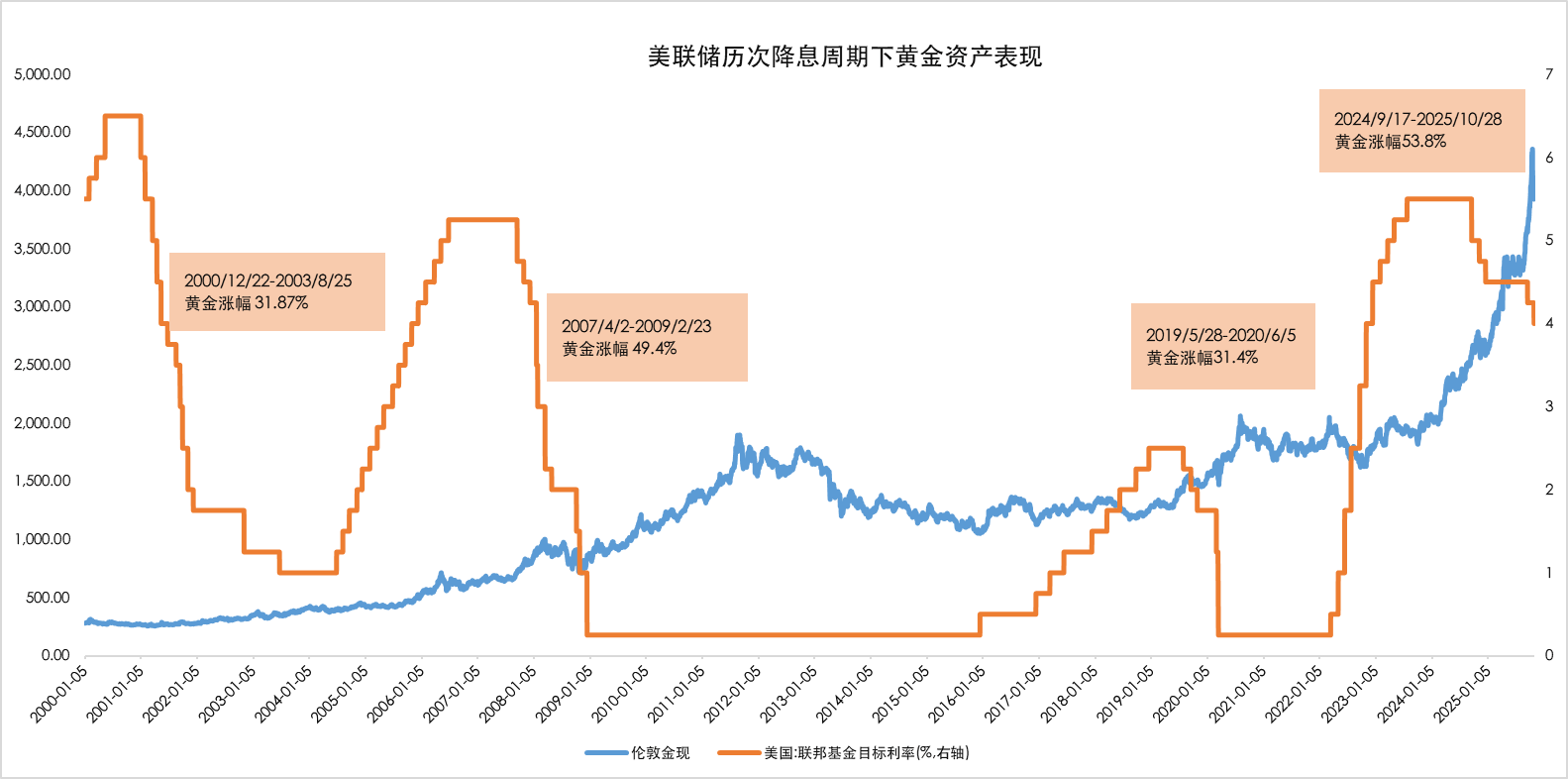
Group 1 - The core viewpoint of the articles highlights a significant rebound in the gold market, with spot gold closing at $4024.46 per ounce on October 30, marking a 2.4% increase, the largest single-day gain since the market correction in October [1] - The strong demand for gold is supported by central bank purchases and investments in gold bars and coins, with global gold demand reaching a record high of 1313 tons in Q3 2025 [1] - The performance of the technology sector in the U.S. stock market is under pressure, particularly due to Meta's net profit decline and increased AI capital expenditure expectations, leading to a significant sell-off in tech stocks [1] Group 2 - Historical data shows that every rate-cutting cycle by the Federal Reserve since 2000 has led to substantial appreciation in gold assets, with gold prices increasing by 53.8% in the current cycle from September 2024 to October 2025 [2] - Gold ETFs have consistently captured market allocation demand during these cycles, with their net value and scale growth closely tied to the strengthening of gold asset attributes in a rate-cutting environment [2] Group 3 - Currently, gold ETFs face a mixed market environment with short-term pressures from expectations of improved international trade relations, which diminish gold's safe-haven appeal, while also experiencing significant support from the recent 25 basis point rate cut by the Federal Reserve [5] - The Federal Reserve's recent rate cut lowers the holding cost of gold and potentially weakens the dollar, providing foundational support for gold prices and gold ETFs [5] - As of the end of October, the probability of a rate cut in December has decreased to 72.8%, indicating market uncertainty regarding future monetary policy [5][7] Group 4 - Investment strategies for gold ETFs should balance short-term volatility with long-term trends, as historical patterns indicate that gold typically rises following the initiation of a rate-cutting cycle [8] - Despite short-term pressures from trade relations, the ongoing rate-cutting cycle and structural support from global central bank gold purchases suggest that the upward momentum in gold prices will continue [8] - Gold's attributes as an inflation hedge and a counter to geopolitical risks, combined with global monetary easing, position it as a "ballast" in asset allocation [8]
华夏布拉德斯科巴西伊博维斯帕ETF配售比例为11.54%
Zheng Quan Shi Bao Wang· 2025-11-04 08:17
Core Insights - On November 4, Huaxia Fund announced the launch of the Huaxia Bradesco Brazil Ibovespa ETF (QDII) on October 31, which exceeded its fundraising cap of 300 million yuan on the first day of subscription [1] - The allocation ratio on the first day was 11.53867900%, rounded to 11.54%, indicating a strong demand for the ETF [1] - It is estimated that approximately 2.6 billion yuan was subscribed for the ETF on October 31 [1] - This ETF is one of the first two Brazilian ETFs launched, alongside the E Fund Itaú Brazil Ibovespa ETF, which also reached its fundraising cap on the same day [1]