陕西煤业

Search documents
产量创24年5月以来新低,再次强调“反转,不是反弹”
GOLDEN SUN SECURITIES· 2025-08-17 07:42
Investment Rating - Maintain "Buy" rating for the coal mining industry [5] Core Viewpoints - The coal production in July 2025 reached a new low since May 2001, indicating a "reversal, not a rebound" in the market [1] - The report emphasizes that while coal production is expected to grow in 2025, the growth rate is projected to narrow to approximately 1.4% [1] - The report highlights the importance of government policies in stabilizing coal supply and prices, suggesting that recent measures could lead to a price bottoming out [4][33] Production Summary - In July 2025, the industrial raw coal production was 380 million tons, a year-on-year decrease of 3.8%, with a daily average production of 12.29 million tons [1][11] - For the first seven months of 2025, the total industrial raw coal production was 2.78 billion tons, showing a year-on-year increase of 3.8% [1][11] - The forecast for total thermal coal production in 2025 is around 3.88 billion tons, with a growth rate of 1.4% [1][11] Import Summary - In July 2025, coal imports were 35.609 million tons, a decrease of 22.9% compared to the same month last year [1][14] - For the first seven months of 2025, total coal imports were 257.305 million tons, reflecting a year-on-year decline of 13.0% [1][14] - The expected total thermal coal import level for 2025 is projected to be around 38 million tons, down 6.4% year-on-year [1][14] Demand Summary - In July 2025, the industrial power generation reached 926.7 billion kWh, a year-on-year increase of 3.1% [2][17] - The growth rate of industrial thermal power generation was 4.3%, accelerating by 3.2 percentage points compared to June [2][17] - Solar power generation saw a significant increase of 28.7% year-on-year, with a notable acceleration in growth [2][17] Investment Recommendations - The report suggests focusing on major coal enterprises such as China Shenhua and China Coal Energy, as well as companies with strong performance elasticity like Lu'an Mining and Jinneng Holding [4][33] - The report also highlights the potential of companies undergoing asset restructuring, such as Anyuan Coal Industry, and those with promising future growth like Huayang Co. and Gansu Energy [4][33]



印尼主产省公路禁止运煤卡车或将导致1000万吨年产能下降
GOLDEN SUN SECURITIES· 2025-08-17 07:03
Investment Rating - The industry investment rating is "Increase" [3] Core Viewpoints - The ban on coal truck transportation on public roads in South Sumatra, Indonesia, starting January 2026, is expected to lead to a reduction of 10 million tons in annual coal production capacity [2] - South Sumatra is a major coal-producing province in Indonesia, contributing 13.6% of the country's total coal output in 2024 [2] - The report recommends focusing on key coal companies such as China Coal Energy and China Shenhua, while also suggesting attention to companies like Qinfa and Shaanxi Coal and Chemical Industry [2] Summary by Sections Coal Mining - The ban on coal truck transportation in South Sumatra may impact annual coal production by 10 million tons [2] - The coal prices at various ports are as follows: Newcastle port coal (6000K) at $112.1/ton, IPE South Africa Richards Bay coal at $90.15/ton, and Europe ARA port coal at $108.5/ton [2][32] Price Trends - Brent crude oil futures settled at $65.85/barrel, down $0.74 (-1.11%) from the previous week [1] - WTI crude oil futures settled at $62.8/barrel, down $1.08 (-1.69%) from the previous week [1] - Northeast Asia LNG spot price is $10.858/million BTU, down $0.537 (-4.71%) from the previous week [1] Investment Recommendations - Key recommended stocks include China Coal Energy (Buy), China Shenhua (Buy), and Qinfa (Buy) [5] - Other notable companies include Shaanxi Coal, Datong Coal, and Yanzhou Coal Mining, which are expected to perform well [5]
煤炭行业周报(8月第3周):煤矿库存同比首次下降,基本面持续好转-20250817
ZHESHANG SECURITIES· 2025-08-17 03:12
Investment Rating - The industry rating is "Positive" [1] Core Viewpoints - Coal inventory has decreased year-on-year for the first time, indicating a continuous improvement in the fundamentals of the coal industry [1] - The coal sector has underperformed compared to the CSI 300 index, with a decline of 0.77% as of August 15, 2025, while the CSI 300 index rose by 2.37% [2] - Key monitored enterprises reported an average daily coal sales volume of 7.15 million tons, a week-on-week increase of 1.9% and a year-on-year increase of 5.3% [2] - The total coal inventory of key monitored enterprises was 26.18 million tons as of August 14, 2025, a week-on-week decrease of 5.9% and a year-on-year decrease of 3.1% [2] - The supply-demand balance in the coal market is improving, with significant price increases for thermal coal and potential marginal improvements in the coking coal sector due to environmental factors [6] Summary by Sections Thermal Coal Industry Chain - As of August 15, 2025, the price index for thermal coal (Q5500K) in the Bohai Rim was 670 CNY/ton, a week-on-week increase of 0.3% [3] - The average daily sales volume of thermal coal increased by 0.6% week-on-week [2] Coking Coal Industry Chain - The main coking coal price at Jingtang Port was 1,630 CNY/ton, unchanged week-on-week [4] - The inventory of coking coal at Jingtang Port decreased by 5.4% week-on-week [4] Coal Chemical Industry Chain - The price of methanol in East China was 2,354.55 CNY/ton, a week-on-week decrease of 38.86 CNY/ton [5] - The price of urea in Henan was 1,700 CNY/ton, a week-on-week decrease of 50 CNY/ton [5] Investment Recommendations - The report suggests focusing on high-dividend thermal coal companies and coking coal companies undergoing turnaround [6] - Key companies to watch include China Shenhua, Shaanxi Coal and Chemical Industry, and Yanzhou Coal Mining Company for thermal coal; and Huabei Mining, Shanxi Coking Coal, and Lu'an Environmental Energy for coking coal [6]


煤炭开采行业动态研究:7月煤炭基本面超预期改善
Guohai Securities· 2025-08-16 15:21
Investment Rating - The report maintains a "Recommended" rating for the coal mining industry [1] Core Viewpoints - The coal mining industry has seen an unexpected improvement in fundamentals as of July 2025, with significant changes in production and demand dynamics [2][7] - The report highlights a notable decline in coal production and imports in July, alongside a significant increase in thermal power demand due to high temperatures [11][30] - The overall supply of coal has contracted, while demand from key sectors such as electricity generation has shown signs of recovery [12][50] Summary by Sections Recent Trends - The coal mining sector's performance over the last month shows a 6.8% increase over one month, a 3.5% increase over three months, but a 5.2% decrease over twelve months [4] Supply Dynamics - In July 2025, the production of raw coal decreased by 3.8% year-on-year, with a daily average production of 12.29 million tons, reflecting a month-on-month reduction of 1.746 million tons per day [19][21] - The report notes that coal imports in July 2025 were 35.609 million tons, down 23% year-on-year, indicating a tightening supply [9][29] Demand Dynamics - The demand for thermal power increased significantly in July, with a year-on-year growth of 4.3%, marking a 3.2 percentage point increase from June [11][30] - The report estimates that the four major industries (electricity, steel, chemicals, and construction materials) contributed to a 3.8% year-on-year increase in coal consumption in July [50] Inventory Management - By the end of July, coal inventories at production enterprises decreased by 168,000 tons to 4.096 million tons, indicating effective inventory management [51][52] Investment Recommendations - The report suggests focusing on stable companies such as China Shenhua, Shaanxi Coal, and China Coal Energy, as well as companies with greater elasticity in thermal coal like Yanzhou Coal and Jinneng Holding [12][14]


信用债跟随利率调整3-5年二永债上行幅度较大
Xinda Securities· 2025-08-16 14:55
1. Report Industry Investment Rating No information about the industry investment rating is provided in the report. 2. Core View of the Report - Credit bonds adjusted following interest rates, with medium - to long - term high - grade bonds having a larger upward amplitude. Credit spreads mostly declined, with medium - to long - end low - grade varieties having a larger compression amplitude [2][5]. - Urban investment bond spreads had limited changes, with spreads of external rating AAA and AA+ platforms generally up 1BP compared to last week, and AA - rated platforms remaining flat [2][9]. - Industrial bond spreads slightly declined overall, and the spreads of mixed - ownership real estate bonds significantly decreased. Central and state - owned enterprise real estate bond spreads remained flat, while mixed - ownership real estate bond spreads dropped 15BP and private real estate bond spreads rose 7BP [2][17]. - Perpetual and secondary capital (Two - Yong) bonds performed weakly with rising spreads, and the yields of 3 - 5 - year high - grade varieties significantly increased [2][29]. - The excess spreads of industrial perpetual bonds increased, while those of urban investment perpetual bonds narrowed [2][31]. 3. Summary by Relevant Catalog 3.1 Credit Bonds Adjusted Following Interest Rates, with Medium - to Long - Term High - Grade Bonds Having a Larger Upward Amplitude - Affected by the rising equity market and policies such as discount interest and state - owned enterprise purchases, interest - rate bonds weakened significantly this week. The yields of 1Y, 3Y, 5Y, 7Y, and 10Y China Development Bank bonds increased by 3BP, 4BP, 8BP, 7BP, and 8BP respectively [5]. - Credit bond yields also increased, with medium - to long - term high - grade varieties having a larger upward amplitude. For example, the yield of 1Y AAA - rated credit bonds increased by 2BP, and the yields of other grades increased by 3BP [5]. - Credit spreads mostly declined, with medium - to long - end low - grade varieties having a larger compression amplitude. Rating spreads and term spreads showed differentiation [5]. 3.2 Urban Investment Bond Spreads Had Narrow Fluctuations - The spreads of external rating AAA and AA+ urban investment platforms generally increased by 1BP compared to last week, and AA - rated platforms remained flat. Most platform spreads changed within 1BP [9]. - By administrative level, the credit spreads of provincial and municipal platforms generally remained flat, while the credit spreads of district - county platforms increased by 1BP [14]. 3.3 Industrial Bond Spreads Slightly Declined, and the Spreads of Mixed - Ownership Real Estate Bonds Significantly Decreased - Industrial bond spreads slightly declined overall. Central and state - owned enterprise real estate bond spreads remained flat, mixed - ownership real estate bond spreads dropped 15BP due to events such as state - owned enterprise purchases, and private real estate bond spreads rose 7BP [17]. - The spreads of AAA and AA+ coal bonds decreased by 1BP respectively, and the spreads of AA - rated coal bonds remained flat. The spreads of AAA - rated steel bonds remained flat, and the spreads of AA+ - rated steel bonds decreased by 1BP. The spreads of all grades of chemical bonds decreased by 1BP [17]. 3.4 Two - Yong Bonds Performed Weakly with Rising Spreads, and the Yields of 3 - 5 - Year High - Grade Varieties Significantly Increased - This week, Two - Yong bonds performed weakly with rising spreads, and overall they performed worse than ordinary credit bond varieties. The yields of 3 - 5 - year high - grade varieties significantly increased [29]. - For 1Y bonds, the yields of all grades of secondary capital bonds increased by 2 - 3BP, and the spreads compressed by 0 - 1BP; the yields of all grades of perpetual bonds increased by 4BP, and the spreads increased by 1BP [29]. 3.5 The Excess Spreads of Industrial Perpetual Bonds Increased, and the Excess Spreads of Urban Investment Perpetual Bonds Narrowed - This week, the excess spreads of industrial AAA - rated 3Y perpetual bonds increased by 2.76BP to 10.17BP, at the 15.70% quantile since 2015. The excess spreads of industrial AAA - rated 5Y perpetual bonds increased by 0.01BP to 11.83BP, at the 23.40% quantile since 2015 [31]. - The excess spreads of urban investment AAA 3Y perpetual bonds decreased by 1.82BP to 3.34BP, at the 0.29% quantile; the excess spreads of urban investment AAA 5Y perpetual bonds decreased by 3.40BP to 7.51BP, at the 3.67% quantile [31]. 3.6 Credit Spread Database Compilation Instructions - The overall market credit spreads, commercial bank Two - Yong spreads, and urban investment/industrial perpetual bond credit spreads are calculated based on ChinaBond medium - and short - term bill and ChinaBond perpetual bond data. The historical quantiles are since the beginning of 2015 [38]. - The credit spreads of industrial and urban investment individual bonds are calculated by subtracting the yield to maturity of the same - term China Development Bank bonds (calculated by linear interpolation) from the ChinaBond valuation (exercise) of individual bonds, and then the industry or regional urban investment credit spreads are obtained by the arithmetic average method [38].
煤炭周报:供给收缩显现,港口库存再度下滑,煤价弹性充足-20250816
Minsheng Securities· 2025-08-16 12:48
Investment Rating - The report maintains a cautious recommendation for Lu'an Huanneng and a recommendation for Jin Control Coal Industry, Huayang Co., Shanxi Coal International, China Shenhua, Zhongmei Energy, Shaanxi Coal Industry, and Zhongguang Nuclear Mining [3][4][10]. Core Viewpoints - Supply contraction is evident, with port inventories declining again and coal prices showing sufficient elasticity. Since April, domestic production and imports from Xinjiang have significantly reduced, with a year-on-year decline of 3.8% in national raw coal production in July. The National Energy Administration has initiated production inspections in key provinces, leading to self-reduction in some overproducing mines. A comprehensive reduction in overproducing mines is expected by late August, further tightening supply. As a result, port inventories have significantly decreased compared to the same period last year, and power plant inventories have also declined. Demand has been recovering since June, with total electricity generation increasing by 3.1% year-on-year in July [1][7][8]. - Coal prices have rebounded from 615 CNY/ton to 700 CNY/ton since early July, with expectations of continued upward momentum, potentially reaching levels above 800 CNY/ton and possibly breaking through 1000 CNY/ton if production cuts are effective. The report suggests focusing on companies with high spot price elasticity, particularly those in Shanxi province, which has minimized the impact of the current production limits [1][7][8]. - Strong support from essential demand indicates that coking coal prices still have room for upward movement. Despite some fluctuations in coking coal prices, supply-side reductions are anticipated, and demand may see a temporary decline due to limited production expectations in Shandong and Hebei. However, strong supply contraction is also expected, suggesting potential for price increases [2][9][10]. Summary by Sections Supply and Demand Dynamics - The report highlights a significant reduction in coal supply, with national raw coal production experiencing its first year-on-year decline in 2025, down 3.8% in July. The National Energy Administration's inspections are expected to lead to further production cuts, tightening supply conditions [1][7][35]. - Demand for coal has shown signs of recovery, with total electricity generation increasing by 3.1% year-on-year in July, and coal consumption in the chemical industry also rising by 13.6% year-on-year [1][9][35]. Price Trends - Coal prices have rebounded significantly, with expectations of continued increases due to improved supply-demand dynamics. The report anticipates that coal prices could reach levels above 800 CNY/ton and potentially exceed 1000 CNY/ton if production cuts are effectively implemented [1][7][8]. Company Recommendations - The report recommends focusing on companies with high spot price elasticity, such as Lu'an Huanneng, and those with stable performance and growth potential, including Jin Control Coal Industry and Huayang Co. Additionally, it suggests monitoring industry leaders like China Shenhua and Zhongmei Energy for their robust performance [2][3][10].

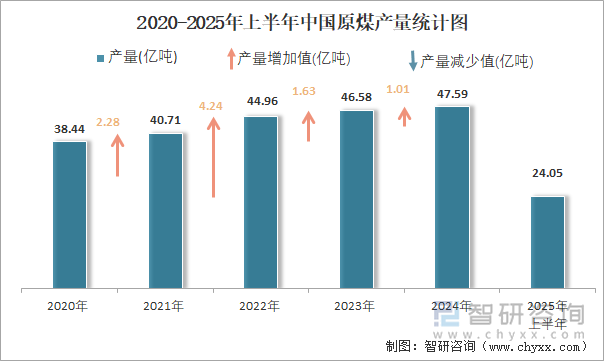
2025年上半年中国原煤产量为24亿吨 累计增长5.4%
Chan Ye Xin Xi Wang· 2025-08-16 03:43
Group 1 - The core viewpoint of the article highlights the growth in China's coal production, with a projected output of 420 million tons by June 2025, reflecting a year-on-year increase of 3% [1] - In the first half of 2025, China's cumulative coal production reached 2.4 billion tons, marking a cumulative growth of 5.4% [1] - The report by Zhiyan Consulting provides an analysis of the supply and demand dynamics in the coal mining industry in China from 2025 to 2031, indicating potential market operation capabilities [1] Group 2 - Listed companies in the coal sector include China Shenhua (601088), Zhongmei Energy (601898), Shanxi Coking Coal (000983), and others, indicating a diverse market landscape [1] - Zhiyan Consulting is recognized as a leading industry consulting firm in China, specializing in in-depth industry research reports and tailored services [2] - Data sources for the report include the National Bureau of Statistics and Zhiyan Consulting, ensuring credibility and accuracy in the presented figures [3]


陕西煤业股价微跌0.19% 陕煤入渝量突破亿吨大关
Jin Rong Jie· 2025-08-15 13:47
Group 1 - The core point of the article highlights the recent performance of Shaanxi Coal Industry, which reported a stock price of 21.57 yuan on August 15, experiencing a slight decline of 0.04 yuan or 0.19% from the previous trading day [1] - The trading volume on that day was 336,400 hands, with a total transaction amount reaching 727 million yuan [1] - Shaanxi Coal Industry is a significant coal production enterprise in Shaanxi Province, primarily engaged in coal mining, washing, processing, and sales [1] Group 2 - The company has made progress in its energy strategic cooperation with Chongqing, having shipped 9.64 million tons of coal to Chongqing from January to July this year, with 7.91 million tons being thermal coal, accounting for 46% of the total thermal coal imports to Chongqing [1] - As of now, the cumulative total of thermal coal shipped to Chongqing by Shaanxi Coal Industry has exceeded 10 million tons [1] - On August 15, the net inflow of main funds into Shaanxi Coal Industry was 12.89 million yuan, while the net outflow over the past five days was 72.46 million yuan [1]
煤炭行业:国内和澳洲动力煤价上涨,三大港口煤炭库存下降明显
Dongxing Securities· 2025-08-15 08:18
Investment Rating - The industry investment rating is "Positive" for the coal sector, indicating an expectation of performance that exceeds the market benchmark by more than 5% over the next 6 months [5]. Core Insights - Domestic and Australian thermal coal prices have increased month-on-month, while South African and European thermal coal offshore prices have decreased. As of August 8, the price of Shanxi premium mixed thermal coal at Qinhuangdao is 678.00 CNY/ton, up 60 CNY/ton, a rise of 9.71% [1][18]. - The monthly production of key state-owned coal mines in Shaanxi, Shanxi, and Inner Mongolia showed a decline in Shaanxi both year-on-year and month-on-month, while Shanxi and Inner Mongolia saw year-on-year declines but month-on-month increases [2][22]. - Coal inventories at the three major ports have significantly decreased month-on-month, while the average daily coal consumption of the six major power generation groups has increased [2][35]. - Domestic and international shipping costs have risen month-on-month, with domestic shipping from Qinhuangdao to Shanghai at 30.10 CNY/ton, reflecting a 9.06% increase [3][46]. Summary by Sections 1. Thermal Coal 1.1 Price - The price of thermal coal has increased month-on-month, with Shanxi premium mixed thermal coal at 678.00 CNY/ton, up 60 CNY/ton, a rise of 9.71% as of August 8 [9][12]. - Prices in Inner Mongolia and Shanxi have also risen, with Inner Mongolia's Q5500 coal at 550.00 CNY/ton, up 74 CNY/ton (15.5%) and Shanxi's Q5500 coal at 598.00 CNY/ton, up 83 CNY/ton (16.12%) [9][18]. 1.2 Production - The monthly production of raw coal in June was 42,107.40 million tons, a year-on-year increase of 1,569.20 million tons (3.87%) [19]. - In June, the production from key state-owned coal mines showed a decline in Shaanxi, while Shanxi and Inner Mongolia experienced increases month-on-month [22]. 1.3 Imports - The monthly import volume of coal and lignite in July reached 35.6093 million tons, a month-on-month increase of 2.5693 million tons (7.78%), but a year-on-year decrease of 10.6007 million tons (22.94%) [24]. 1.4 Inventory - As of August 8, coal inventories at the three major ports totaled 11.959 million tons, a month-on-month decrease of 1.186 million tons (9.02%) [28][30]. - The average available days of coal inventory for the six major power generation groups decreased to 14.70 days, down 1.10 days (6.96%) month-on-month [34]. 1.5 Downstream Demand - The average daily coal consumption of the six major power generation groups increased to 934,500 tons, a month-on-month rise of 32,900 tons (3.65%) [35][39]. - National electricity generation in June increased by 3.61% year-on-year to 796.29 billion kWh, with thermal power generation rising by 1.42% [35][44]. 1.6 Shipping Costs - Domestic shipping costs have risen, with the Qinhuangdao to Shanghai route at 30.10 CNY/ton, a 9.06% increase month-on-month [3][46]. - International shipping costs also increased, with the Newcastle to China coal shipping rate at 15.80 USD/ton, up 2.30 USD/ton (17.04%) [3][46].
国海研究 | 美国降息周期中的“第四种”交易模式/宠物系列专题—晨听海之声0815
Xin Lang Cai Jing· 2025-08-15 03:59
Group 1: U.S. Interest Rate Cycle and Trading Strategies - The report identifies three traditional trading modes during U.S. interest rate cycles: easing trading, recession trading, and recovery trading, with specific examples from past cycles [2] - A new "fourth" trading mode, termed stagflation trading, is introduced, characterized by mild economic cooling combined with insufficient policy support [2][3] - The report forecasts continued optimism for U.S. equities, particularly in sectors benefiting from fiscal and tariff negotiations, such as TMT, energy, materials, and industrials [3] Group 2: Domestic Pet Industry Insights - The domestic pet market is identified as a growing consumer market with a low industry concentration, with a market size of 300.2 billion yuan in 2024, reflecting a 7.5% year-on-year growth [4] - The penetration rate of pet ownership in China is only 21%, compared to 40% in Japan and 60% in the U.S., indicating significant growth potential [4] - The report highlights that leading brands are gaining market share, with online GMV growth rates for top brands significantly outpacing platform growth [5] Group 3: Coal Mining Safety Regulations - The new 2025 Coal Mine Safety Regulations, effective from February 1, 2026, represent the most comprehensive revision to date, with 56 new articles and 353 substantive modifications [6][7] - Key changes include enhanced requirements for the prevention of gas outbursts and increased operational costs due to stricter construction requirements for gas-prone mines [8] - The regulations may constrain production capacity in certain mines while potentially improving resource continuity by allowing deeper mining operations [8] Group 4: Coal Industry Investment Outlook - The coal mining sector is viewed as a stable investment opportunity, with high dividend yields and strong cash flow characteristics, particularly among leading coal enterprises [9] - The report suggests maintaining a "recommended" rating for the coal mining industry, focusing on companies with robust asset quality and cash flow [9] - Specific investment targets include China Shenhua, Shaanxi Coal, and other firms with significant operational resilience [9]