中国中铁

Search documents
申万宏源助力中铁信托先锋13号应收账款资产支持专项计划成功发行
申万宏源证券上海北京西路营业部· 2025-07-28 01:44
免责声明 发行人 中铁信托有限责任公司 是经中国银行保险监督管理委员会批准,以金融信 托为主营业务的非银行金融机构,公司业务范围涵盖资金信托、动产信托、 不动产信 托 、 有价证券信托 、投资基金、证券承销、 投资银行业务 等 ,拥有 40 年持续经营 的历史。公司注册资本 50 亿元,建立以成都总部为核心,北上深汉渝为支点,"立足 四川、面向全国"的现代金融服务网络,获准建立有信托行业第三家、四川省内金融机 构第一家博士后创新实践基地,与西南财大联合建立中国信托研究中心。 此次资产证券化产品的成功发行为未来双方进一步深化合作奠定了坚实的基础, 对申万宏源持续资产证券化业务市场具有重要意义 。未来,申万宏源将继续为广大实 体企业提供深湛优良的综合金融服务,把落实国家战略与企业使命深度结合,为助力实 体经济高质量发展贡献金融央企力量。 7 月 22 日 ,由申万宏源担任 销售机构 的 中铁信托先锋 13 号应收账款资产支 持专项计划 项目成功发行 。 本期 资产证券化产品 优先 A 级 , 发行规模 9.09 亿 元,期限 2.75 年 ,票面利率 2.09 % , 债项评级 AAA ,无外部增信。优先 B 级 ...


城改持续推进叠加重大项目开工建设,下半年基建投资有望提速
Guotou Securities· 2025-07-27 13:32
Investment Rating - The report maintains an investment rating of "Outperform the Market-A" [4] Core Viewpoints - The ongoing urban renewal and the commencement of major projects are expected to accelerate infrastructure investment in the second half of the year [1][20] - The central government has emphasized the importance of urban village renovations and has set ambitious targets for the renovation of old urban residential areas, with 58,000 new projects planned for 2024 and 25,000 for the first half of 2025 [1][17] - The report suggests focusing on low-valuation state-owned enterprises in the infrastructure sector, as their fundamentals and operational metrics are expected to improve due to ongoing reforms and market conditions [9][11] Summary by Sections Industry Dynamics - The State-owned Assets Supervision and Administration Commission (SASAC) has called for state-owned enterprises to actively participate in urban development and infrastructure projects, emphasizing the need for safety and reliability in infrastructure [1][16] - The National Development and Reform Commission (NDRC) has allocated 735 billion yuan for central budget investments, focusing on modern infrastructure and urbanization projects [2][18] - Infrastructure investment growth rates for the first half of 2023 were reported at 4.60% for narrow definitions and 8.90% for broader definitions, with expectations for acceleration in the latter half of the year [9][20] Market Performance - The construction industry saw a weekly increase of 5.62%, outperforming major indices such as the Shenzhen Composite Index and the Shanghai Composite Index [21] - The municipal engineering sector experienced the highest growth within the construction industry, with a weekly increase of 14.33% [21] Company Announcements - Major contracts were awarded, including China Power Construction winning contracts worth approximately 57.52 billion yuan for a pumped storage power station [32] - China State Construction reported new contracts totaling 2.5 trillion yuan for the first half of 2025, reflecting a year-on-year increase of 0.9% [32] Valuation - As of July 25, the construction and decoration industry had a price-to-earnings (P/E) ratio of 11.65 and a price-to-book (P/B) ratio of 0.85, indicating a slight increase from the previous week [24] - The report highlights that the construction industry ranks 27th in P/E valuation among major sectors, suggesting potential for valuation improvement [24][25] Key Focus Stocks - The report recommends focusing on low-valuation state-owned enterprises such as China State Construction, China Railway, and China Communications Construction, which are expected to benefit from improved operational metrics and market conditions [11][12][28]






后续还有哪些重大项目可以期待?
GOLDEN SUN SECURITIES· 2025-07-27 08:10
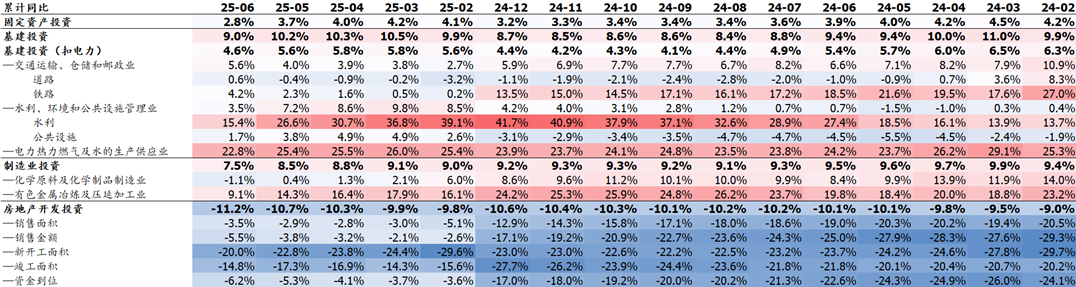
Investment Rating - The report maintains a "Buy" rating for the construction and decoration industry, indicating a positive outlook for major projects and regional development strategies [4][10]. Core Insights - The initiation of the Yaxia Hydropower Station signals a clear trend of central government leveraging, with expectations for further major projects and regional development strategies to stabilize overall infrastructure investment and total demand [1][9]. - The report highlights that infrastructure and manufacturing investments are experiencing a high-level continuous decline, with real estate investment, sales, and funding showing significant drops, indicating a core issue of insufficient demand [1][14]. - It is anticipated that fiscal policies will continue to strengthen in the second half of the year, improving the funding situation for infrastructure and accelerating the implementation of physical workloads [1][14]. Summary by Sections Major Projects and Regional Development Strategies - Significant transportation projects are expected, including the China-Kyrgyzstan-Uzbekistan Railway and the New Tibet Railway, with total investments of approximately $8 billion and 960 billion yuan respectively [2][21]. - The report outlines several large canal projects, such as the Pinglu Canal, with a total investment of about 72 billion yuan, which is expected to enhance logistics efficiency and stimulate economic growth [3][26]. - The Xinjiang regional strategy is highlighted, with over 800 billion yuan in coal chemical projects planned, driven by the region's abundant coal resources [7][10]. Key Recommendations - The report recommends major construction enterprises that will benefit from large-scale transportation and water conservancy projects, including China Energy Engineering, China State Construction, and China Railway Construction [10][11]. - It also emphasizes companies involved in coal chemical development in Xinjiang, such as China Chemical Engineering and Donghua Technology, as key beneficiaries of the regional strategy [10][11]. - Companies like Sichuan Road and Bridge are recommended due to their involvement in the construction of the national strategic hinterland [10][11].
国盛证券:后续还有哪些重大项目可以期待?
智通财经网· 2025-07-27 06:07
Core Viewpoint - The launch of the Yaxia Hydropower Station indicates a clear trend of central government leverage, with expectations for a series of major projects and regional development strategies to stabilize overall infrastructure investment and total demand [1][2] Infrastructure Investment and Major Projects - The central government is expected to introduce significant projects and regional strategies to maintain infrastructure investment and total demand, especially in light of declining economic indicators such as fixed asset investment and real estate sales [2][6] - Key upcoming projects include major transportation initiatives like the China-Kyrgyzstan-Uzbekistan Railway and the New Tibet Railway, with substantial investments planned [6][10] Beneficiaries of Infrastructure Projects - Recommended beneficiaries include leading state-owned construction enterprises such as China Energy Engineering, China State Construction, and China Railway Construction, which are expected to benefit from large-scale infrastructure projects [1][7] - Specific companies highlighted for their roles in construction and materials include China Communications Construction, China Railway Group, and regional players like Qing Song Jian Hua in Xinjiang [1][10] Canal Projects and Economic Impact - The development of major canal projects is anticipated to enhance logistics efficiency and stimulate economic growth, with significant investments planned for projects like the Pinglu Canal and the Zhejiang-Jiangxi-Guangdong Canal [11][14] - The estimated total investment for these canal projects is approximately 620.4 billion, which is expected to provide strong support for investment in 2023 [11][14] Xinjiang Regional Strategy and Coal Chemical Industry - The Xinjiang region is expected to receive increased support from the central government, with significant investments in coal chemical projects projected to exceed 800 billion by 2025 [16][19] - Key players in this sector include China Chemical Engineering and local construction firms, which are well-positioned to capitalize on the anticipated growth in coal chemical investments [16][19] Strategic Hinterland Development - Sichuan has been identified as a strategic hinterland for national development, with policies expected to support infrastructure and investment growth in the region [21][24] - Companies involved in transportation infrastructure, such as Sichuan Road and Bridge, are likely to benefit from these strategic initiatives [21][24]
“标点”“空行”瑕疵致投标被否决 中冶建工、中建七局、北京城建错失10亿元项目?
Mei Ri Jing Ji Xin Wen· 2025-07-27 05:18
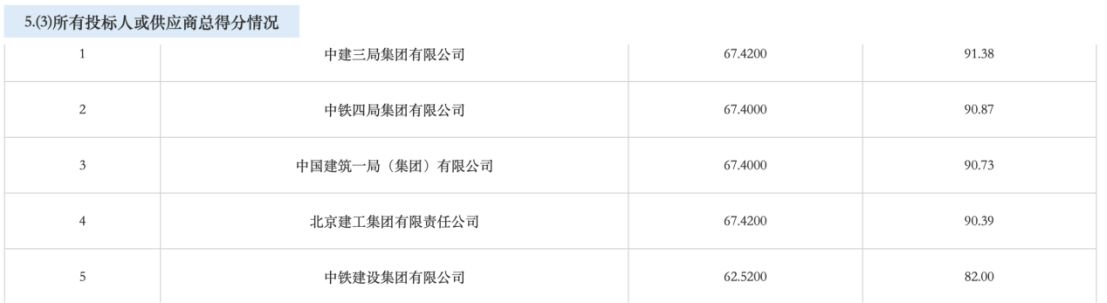
Group 1 - The core point of the article is the announcement of the candidates for the construction contract of the second group of the first phase of the Xiong'an Campus of Beijing Jiaotong University, with China State Construction Engineering Corporation (CSCEC) and China Railway Fourth Group among the selected bidders [1][11] - The bid prices for the selected candidates are approximately 1.044 billion yuan for CSCEC, 1.044 billion yuan for China Railway Fourth Group, and 1.044 billion yuan for China State Construction First Group [1] - The evaluation scores indicate that CSCEC ranked first with a total score of 91.38, followed by China Railway Fourth Group and China State Construction First Group with scores of 90.87 and 90.73 respectively [2] Group 2 - Several bidders were disqualified due to non-compliance with the technical bid requirements, including China Metallurgical Group Corporation and China State Construction Engineering Seventh Bureau, which failed to meet the formatting standards outlined in the bidding documents [4][5] - The disqualification reasons included the presence of English punctuation and empty lines in the technical documents, which did not adhere to the "dark marking" requirements that ensure the anonymity of bidders during evaluation [4][7] - The article highlights the importance of adhering to formatting requirements in bid submissions, as failure to comply can lead to disqualification, emphasizing that these requirements are often treated as substantive criteria in practice [8][9]

反内卷行情持续升温,把握建筑板块投资机遇
Tianfeng Securities· 2025-07-27 04:43
Investment Rating - The industry rating is maintained as "Outperform" [5] Core Viewpoints - The construction sector has seen a significant increase of 7.1% this week, outperforming the Shanghai and Shenzhen 300 index by 5.9 percentage points, driven by infrastructure projects and the rise in specialized engineering and civil explosives sectors [1][29] - The report emphasizes the ongoing trend of "anti-involution" in the industry, suggesting investment opportunities in construction blue chips and steel structure sectors, particularly in the central and western regions of China [1][2][36] Summary by Sections Investment Logic - Four angles to capture investment opportunities in the construction sector: 1. **Price Elasticity**: Companies involved in resource development or trade, such as Northern International and China Railway, are recommended due to expected price increases in resources [2][15] 2. **Supply-Demand Optimization**: Focus on construction blue chips as the anti-involution movement may alleviate price pressures in the industry, with recommendations for quality local state-owned enterprises like Sichuan Road and Bridge [2][17] 3. **Transformation and Upgrading**: Companies with stronger technological attributes are expected to benefit from structural high prosperity in technology-driven infrastructure demands, with recommendations for Tunnel Corporation and China State Construction International [2][21] 4. **Downstream Profit Improvement**: If anti-involution policies improve profitability in steel and cement industries, there will be a rebound in capital expenditure needs, recommending companies like China National Materials and China Steel International [2][23] Market Performance - The report notes a slight decline in the operating rates of petroleum asphalt and cement shipment rates, with the cement shipment rate at 43.07%, down by 2.8 percentage points [3][26] - Central state-owned enterprises showed a positive trend in order data for Q2, with notable growth in orders for companies like China Railway and China Nuclear Engineering [3][26] Key Recommendations - The report suggests focusing on high-growth local state-owned enterprises in regions with strong infrastructure investment, such as Sichuan, Zhejiang, and Anhui, as well as major central state-owned enterprises like China Communications Construction and China Railway [36][37] - Emphasis is placed on the potential of nuclear power and emerging business directions within the construction sector, highlighting the high prosperity of nuclear power investments [38]


海外经验和国内溢价:ETF扩容能稳定提升信用债流动性吗
GUOTAI HAITONG SECURITIES· 2025-07-25 09:37
1. Report Industry Investment Rating No relevant content provided. 2. Core Viewpoints of the Report - The increase in the scale of the US ETF market has a temporary impact on the turnover rate, and the liquidity premium of domestic bond ETF component bonds is already relatively high [1]. - The expansion of ETFs is difficult to bring about a continuous improvement in the liquidity of component bonds. The liquidity premium of some component bonds is already at a high level, and the valuation difference between the exchange and the inter - bank market may lead to a narrowing of the spread [2][5][6]. - It is recommended to pay attention to the impact of market sentiment changes on liquidity [6]. 3. Summary According to the Directory 3.1 US Bond ETF Market Scale and Liquidity Comparison - The scale of the US bond ETF market increased significantly from 2023 - 2024 and declined significantly in 2025. In 2023, the scale was $554.482 billion, rising to $1152.808 billion in 2024 with a growth rate of 107.9%. As of June 2025, it was only $441.57 billion [2][11]. - During the periods when the scale of the US bond ETFs increased, the turnover rate of US credit bond ETFs increased significantly in 2022. However, in the long - term, there is no obvious positive correlation between the increase in the scale of US bond ETFs and the change in the turnover rate [2][12]. 3.2 Current Changes in Domestic ETF Liquidity and Component Bond Liquidity - Under the expansion of ETFs, the number of component bond transactions has increased significantly. Taking the Shanghai Stock Exchange AAA Benchmark Market - making Credit Bond Index as an example, the proportion of component bonds in the top three component entities has been continuously rising since 2025, reaching 91.7% since July [21]. - The valuation difference between the exchange and the inter - bank market for medium - long - term and medium - high implicit rating component bonds is more obvious. The spread between Shanghai market - making component bonds and inter - bank comparable bonds is currently between - 1BP and 13BP. The spread difference between central enterprises and local industrial state - owned enterprises is more obvious, while that of urban investment and transportation - related entities is relatively small [21]. - The exchange - inter - bank excess spread of science and technology innovation bond component bonds has widened since July [22]. 3.3 Component Bond Liquidity Pricing: Reasonable Liquidity Premium and Potential Risks - The reasonable pricing anchor for liquidity premium is within 10BP. Since 2024, under the expectation of debt resolution, the spread between high - grade urban investment bonds and secondary capital bonds is centered at 0, and the spread fluctuation range is basically within 10BP. The same is true for the spread between high - grade securities firm bonds and secondary capital bonds [35]. - The risk points of the valuation difference between the exchange and the inter - bank market: the spread of some benchmark market - making bonds and science and technology innovation bonds between the exchange and the inter - bank market has exceeded 10BP, and the spread of some component bonds with high institutional buying enthusiasm has exceeded 15BP [35]. - Three views on liquidity premium and risk points: ETF expansion is difficult to bring continuous improvement in component bond liquidity; the liquidity premium of some component bonds is already at a high level; after the valuation difference between the exchange and the inter - bank market, the exchange corporate bonds become more offensive, while inter - bank bonds are more defensive, and the spread may narrow with the increase in supply [36].
调仓风向标|中泰资管姜诚:重仓股整体“瘦身”,组合防守性上升
Sou Hu Cai Jing· 2025-07-25 09:02
Core Viewpoint - The report highlights the investment strategies and portfolio adjustments of Jiang Cheng, a prominent fund manager at Zhongtai Asset Management, during the second quarter of 2025, emphasizing a defensive approach amidst market volatility [3][20]. Group 1: Fund Performance and Adjustments - Jiang Cheng's overall strategy for the second quarter was to "moderately enhance defensiveness," leading to a reduction in stock holdings across most funds, while selectively increasing positions in certain stocks [6][8]. - By the end of the second quarter, Jiang Cheng managed a total of 7 funds with an aggregate size of 12.606 billion yuan, a decrease of 559 million yuan from the previous quarter [8]. - The stock allocation across Jiang Cheng's funds showed slight reductions, with the largest fund, Zhongtai Xingyuan, experiencing significant net redemptions despite positive returns [8][14]. Group 2: Portfolio Composition and Stock Adjustments - Jiang Cheng maintained a stable portfolio composition, with no new stock additions in major funds, while reducing holdings in several high-performing stocks, particularly in the banking sector, where reductions approached 20% [9][10]. - Specific reductions included 16.72 million shares of Industrial and Commercial Bank of China and 2.67 million shares of China Merchants Bank, indicating a clear profit-taking strategy [9][12]. - The overall concentration of holdings in the major funds slightly decreased, but the decline was less than 0.4% [14]. Group 3: Sector Focus and Market Outlook - The report noted strong performances in sectors such as defense, consumer goods, and media entertainment, but Jiang Cheng opted for a conservative approach, focusing on long-term value rather than short-term gains [6][20]. - Jiang Cheng expressed a cautious optimism regarding the macroeconomic outlook while emphasizing the need for prudence at the individual stock level, aiming for a balanced portfolio that prioritizes stability over high returns [20].





申万宏源助力中铁信托先锋13号应收账款资产支持专项计划成功发行
申万宏源证券上海北京西路营业部· 2025-07-25 02:41
Group 1 - The core viewpoint of the article highlights the successful issuance of the asset-backed securities by China Railway Trust, which lays a solid foundation for future cooperation between the parties involved [2][4]. - The asset-backed securities include three classes: - Class A with a scale of 909 million yuan, a term of 2.75 years, a coupon rate of 2.09%, and a AAA rating [2]. - Class B with a scale of 794 million yuan, a term of 0.92+1+1 years, a coupon rate of 1.85%, and a AAA rating, supported by China Railway No. 5 Engineering Group [2]. - Class C with a scale of 990 million yuan, a term of 1+1+1 years, a coupon rate of 1.77%, and a AAA rating, supported by China Railway [2]. Group 2 - China Railway Trust Co., Ltd. is a non-bank financial institution approved by the China Banking and Insurance Regulatory Commission, with a registered capital of 5 billion yuan and a 40-year operational history [3]. - The company has established a modern financial service network centered in Chengdu, with a focus on national outreach, and has created a post-doctoral innovation practice base in collaboration with Southwest University of Finance and Economics [3]. - The successful issuance of the asset-backed securities is significant for Shenwan Hongyuan's ongoing asset securitization business and its commitment to providing comprehensive financial services to real economy enterprises [5].
平安证券(香港)港股晨报-20250725
Ping An Securities Hongkong· 2025-07-25 01:54
Market Overview - The Hong Kong stock market showed mixed performance, with the Hang Seng Index closing at 23,831 points, down 145 points or 0.61%, while the Hang Seng Technology Index fell 0.05% to 5,743 points [1][5] - The market turnover decreased to 82.799 billion HKD, with net inflows of 484 million HKD recorded in the Hong Kong Stock Connect [1][5] - The US stock market experienced varied movements, with the S&P 500 Index rising 4 points to 6,363 points, while the Dow Jones Industrial Average fell 316 points or 0.7% to 44,693 points due to declines in IBM and Tesla stocks [2] Sector Performance - In the Hong Kong market, the local real estate, software, and 5G concept sectors saw significant declines, while gold stocks performed well [1][5] - The materials sector remained strong, with lithium companies Ganfeng Lithium and Tianqi Lithium both rising over 10%, and China Hongqiao increasing by over 6% [1][5] - The semiconductor industry attracted active capital, with companies like SenseTime and Huahong Semiconductor rising approximately 7% and nearly 3%, respectively [1][5] Investment Recommendations - The report suggests a continued focus on sectors with growth potential, including artificial intelligence, robotics, semiconductors, and industrial software [3] - It highlights the innovation-driven pharmaceutical sector and consumer-oriented traditional Chinese medicine and healthcare sectors as areas of interest [3] - The report also points to undervalued sectors such as coal, oil and gas, and telecommunications, which are expected to benefit from low-risk interest rates in mainland China [3] Company Highlights - BYD's vehicle registrations in Europe surged by 91% year-to-date, with a market share of 5.1%, second only to Mercedes [9] - The report emphasizes the potential of companies like Xpeng Motors and BYD, which are expected to benefit from the growing demand for electric vehicles [9] - The pharmaceutical sector is also highlighted, with companies like Fosun Pharma expected to benefit from recent policy changes in drug procurement [10]