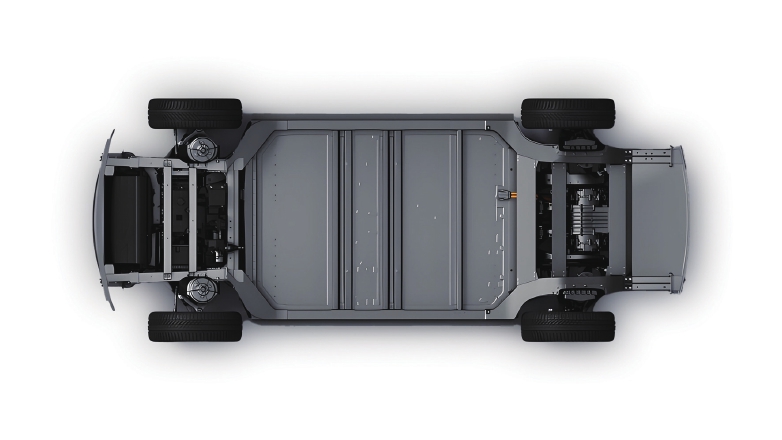
比亚迪

Search documents
2025年中国汽车产量为3477.8万辆 累计增长9.8%
Chan Ye Xin Xi Wang· 2026-01-28 03:42
上市企业:比亚迪(002594),长城汽车(601633),上汽集团(600104),广汽集团(601238),一汽解放 (000800),东风汽车(600006),赛力斯(601127) 相关报告:智研咨询发布的《2026-2032年中国汽车行业市场深度评估及投资机会预测报告》 数据来源:国家统计局,智研咨询整理 知前沿,问智研。智研咨询是中国一流产业咨询机构,十数年持续深耕产业研究领域,提供深度产业研 究报告、商业计划书、可行性研究报告及定制服务等一站式产业咨询服务。专业的角度、品质化的服 务、敏锐的市场洞察力,专注于提供完善的产业解决方案,为您的投资决策赋能。 根据国家统计局数据显示:2025年12月中国汽车产量为341万辆,同比下降2.8%;2025年中国汽车累计 产量为3477.8万辆,累计增长9.8%。 2020-2025年中国汽车产量统计图 ...


BYD could expand India operations as demand begins to outstrip supply
MINT· 2026-01-28 03:14
Core Viewpoint - BYD Co. is exploring options to expand its presence in India, including local assembly to meet the increasing demand for its electric vehicles, amidst regulatory challenges and a competitive market landscape [1][4]. Group 1: Expansion Plans - The company is considering local assembly of semi-assembled parts in India, which would be more cost-effective and easier to obtain regulatory approvals compared to a full assembly plant [2]. - BYD is working on obtaining local safety and regulatory certifications for additional models to navigate import quotas [1]. Group 2: Market Demand and Sales Performance - Strong demand for BYD vehicles in India has led to a reassessment of strategies to increase car availability, with dealers reportedly holding hundreds of bookings [3]. - BYD's sales in India surged approximately 88% last year, reaching around 5,500 cars, despite facing import duties of up to 110% on fully built models [6]. Group 3: Competitive Landscape - The Atto 3, priced at 2.5 million rupees ($27,255), competes in the premium segment of India's mass-market EVs, undercutting Tesla's pricing [8]. - The Sealion 7, which sold 2,200 units last year, is priced between 4.9 million to 5.5 million rupees, also positioned below Tesla's Model Y [8]. Group 4: Regulatory Challenges - BYD has approached Indian regulators to address concerns regarding import limits that could hinder growth, contrasting with Tesla's ongoing struggles against similar tariff barriers [9]. - The company is facing regulatory hurdles in one of the fastest-growing auto markets, reflecting a strategic shift to strengthen its position in India despite previous pushbacks from the Indian government [4]. Group 5: Strategic Importance - Diversifying beyond China has become crucial for BYD as domestic growth slows due to reduced EV subsidies and increasing competition [5]. - The company aims to boost deliveries to markets outside China by nearly 25% this year [5].


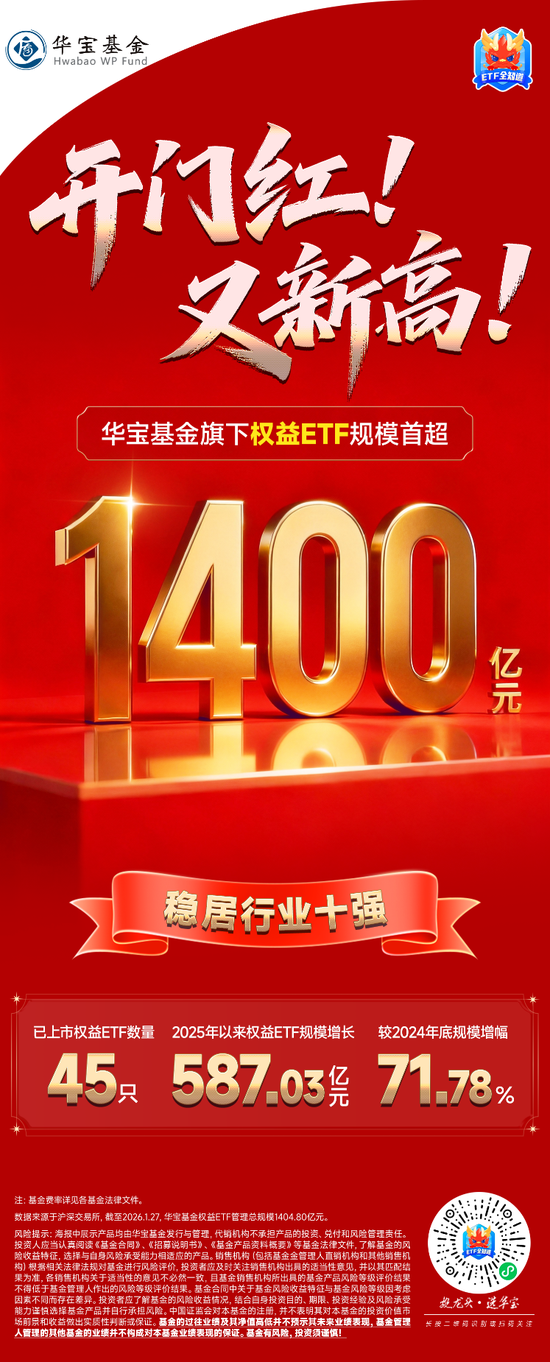
开门红!又新高!华宝基金旗下权益ETF规模升超1400亿元
Xin Lang Cai Jing· 2026-01-28 03:10
Core Viewpoint - The Hong Kong stock market is expected to perform strongly in 2026, with various Hong Kong Stock Connect ETFs becoming key instruments for investors to engage in this bullish trend. Analysts predict a long-term bull market driven by technology as the main theme [1][28]. Group 1: Market Performance and Trends - The Hong Kong stock market had disappointing performance in Q4 2025, which may set the stage for a better performance in 2026. A potential influx of 10% of A-shares' funds into Hong Kong could double its trading activity [28]. - As of January 27, 2026, the trading volume of Hong Kong stocks was less than 300 billion HKD, while A-shares reached 30 trillion HKD, indicating a significant disparity in market activity [28]. - The Hong Kong Stock Exchange achieved a record IPO financing total of 274.6 billion HKD in 2025, ranking first globally, with domestic tech companies being the main contributors [48]. Group 2: ETF Growth and Features - Huabao Fund's equity ETF management scale surpassed 140 billion HKD, reaching 140.48 billion HKD as of January 27, 2026, marking a 71.78% increase from the end of 2024 [1][30]. - The Hong Kong Stock Connect ETFs support T+0 trading, enhancing investment efficiency and liquidity, with a diverse range of industry themes and unique products [33][47]. - Notable ETFs include the Hong Kong Information Technology ETF (159131), which focuses on the chip industry and is the first to track the CSI Hong Kong Stock Connect Information Technology Index [33][39]. Group 3: Sector-Specific ETFs - The Hong Kong Internet ETF (513770) has a significant focus on leading internet companies and had a fund size of 14.5 billion HKD as of January 27, 2026, with an average daily trading volume exceeding 600 million HKD [33][39]. - The Hong Kong Automotive ETF (520780) targets scarce leading automotive companies, while the Hong Kong Medical ETF (159137) covers four major medical sectors, including CXO and biopharmaceuticals [33][40]. - The Hong Kong Dividend Low Volatility ETF (159220) has shown strong performance since 2021, outperforming the CSI 300 Index, highlighting its defensive and growth potential in volatile markets [41][43]. Group 4: Investment Strategies and Future Outlook - The focus on technology and high dividend strategies is forming a robust product line for Huabao Fund, with a comprehensive "high dividend ETF family" across A-shares and Hong Kong stocks [41][46]. - The influx of southbound funds into the Hong Kong market reached a record net inflow of 1.404 trillion HKD in 2025, with continued interest into 2026, indicating a growing demand for Hong Kong investments [49]. - The market is expected to see more high-quality Chinese tech companies listed, providing effective tools for investors to capture beta returns through various Hong Kong ETFs [49].
丰田全方位战略:保留内燃机的觉悟
日经中文网· 2026-01-28 02:53
Core Viewpoint - Toyota is committed to maintaining the total number of internal combustion engines until 2030, despite the shift towards electric vehicles (EVs) [2][8]. Group 1: Internal Combustion Engine Strategy - Toyota's President Akio Toyoda emphasized the importance of internal combustion engines, stating that they still have a role to play in the automotive industry [6][8]. - The company held a "combustion engine pledge conference" in June 2025, where it announced plans to develop various high-power engines [8]. - The upcoming "GR GT" supercar, set to launch around 2027, will feature a 4-liter V8 engine, marking a shift as it is developed independently by Toyota rather than in collaboration with Yamaha [4][6]. Group 2: Hybrid Vehicle Investment - Toyota plans to invest up to $10 billion in the U.S. over the next five years to increase production of hybrid vehicles and their components [8][10]. - The hybrid vehicle "Prius" will now incorporate larger engines, reflecting a strategic response to stringent environmental regulations [4][6]. - In the U.S., hybrid vehicles accounted for approximately 13% of new car sales from July to September 2025, leading Toyota to increase local production of core components [10]. Group 3: Electric Vehicle Development in China - Toyota is shifting its strategy in China, focusing on developing models specifically for the Chinese market rather than global models [12][14]. - The company plans to launch the EV sedan "bZ7" in spring 2026, following the successful introduction of the electric SUV "bZ3X" [14]. - Toyota's sales in China have been declining, with projections of 1.77 million units sold in 2024, indicating a need for a more localized approach [11][14]. Group 4: Research and Development Costs - Toyota's R&D expenses for the fiscal year 2024 are projected to be 1.3 trillion yen, which may lead to challenges in keeping pace with emerging competitors like BYD and Tesla [16]. - The company is also collaborating with NTT on AI and communication infrastructure to enhance safety and with Waymo for advancements in autonomous driving [16].

未知机构:T链调研储能业务2026展望装机量预期MegapackMegablock技术迭代产能布局与市场拓展Michael调研纪要20260128-20260128
未知机构· 2026-01-28 02:35
Summary of Conference Call Records Company and Industry Involved - **Companies Mentioned**: Tesla (TSLA.US), CATL (300750.SZ), BYD (002594.SZ), Sungrow (300274.SZ), HIBOR (688411.SH), EVE Energy (300014.SZ), Zhongxin Innovation (3931.HK), Guoxuan High-Tech (002074.SZ), Xinwanda (300207.SZ) - **Industry**: Energy Storage and Clean Energy Key Points and Arguments Tesla's Progress in Energy Storage - Tesla's energy storage business is expected to see a **50% year-on-year increase in shipment volume by 2025**. The installation target for 2026 is based on existing and new orders [1][1] - Despite subsidy reductions in some regions, regulatory changes are accelerating customer purchases. High-energy-consuming projects like AI computing centers are expected to contribute **20% to 30% of demand growth** [1][2] Demand Drivers for Energy Storage Equipment - AI computing centers are a significant driver for energy storage demand, contributing **20% to 30%** to the overall demand. Large industrial enterprises are also increasing interest in energy storage systems due to equipment upgrades and energy cost savings [2][2] - National energy projects, particularly in North America, are transitioning from traditional grids to microgrid solutions, further driving demand for energy storage products [2][2] Global Clean Energy and Green Power Trends - The clean energy and green power sectors are rapidly developing, driven by AI computing centers, grid modernization, and the green transition in traditional industries. North America and Europe are expected to create stable demand through large-scale national projects [3][3] - Emerging economies in the Middle East, South America, and Southeast Asia are also becoming significant sources of demand due to manufacturing shifts [3][3] Regional Market Performance for Tesla's Energy Storage Products - By 2025, **80%-85% of Tesla's global energy storage shipments** will come from large Megapack systems in the commercial sector. North America and Europe are the primary markets, with North America leading [4][4] - Tesla is expanding its presence in emerging markets like the Middle East, South America, and Southeast Asia, where increased electricity demand is expected [4][4] Production Capacity Plans for 2026 - Tesla plans to expand its production capacity to support a shipment target of **55-60 GWh** in 2026, with the Shanghai factory expected to contribute significantly [5][5] - The new third-generation Megapack 3XL will enhance technical capabilities, but the current sales will primarily rely on the second-generation 2XL until the new product launches [5][5] Technological Upgrades in Megapack Products - The Megapack 3 will feature a **5 MWh capacity**, improved thermal management, and enhanced modular design to meet high power demands from industrial users [6][6] - Safety measures include a new thermal management controller that can respond quickly to potential thermal runaway situations, significantly reducing disaster risks [6][6] Cost Reduction and Competitive Strategy - Tesla has reduced component costs from over **3 RMB per kWh to approximately 1.9 RMB** through local sourcing, aiming for **70%-80% localization** in 2026 [16][16] - The company leverages a software-hardware integration strategy to enhance customer value and maintain competitiveness in mature markets [16][16] Market Expansion Strategies for 2026 - Tesla will focus on North America and Europe while exploring emerging markets like Southeast Asia, particularly Singapore, for data center projects [18][18] - In China, Tesla plans to collaborate with municipal units for service delivery and expand its presence in key regions like the Yangtze River Delta [18][18] Impact of Energy Storage Growth on Battery Prices - The growth of the energy storage sector is not expected to significantly impact battery prices due to the different production standards and existing capacity in the market [19][19] Transition to Active Profit Models in Energy Storage - Tesla is transitioning energy storage systems from passive supply models to active profit-generating assets, exploring investment options for customers and integrating software services to enhance hardware value [20][20] Challenges for Battery Manufacturers Transitioning to Energy Storage - Battery manufacturers face technical barriers in transitioning to energy storage system integration, including thermal management, energy management systems, and power conversion systems [21][21] Conclusion - Tesla's strategic focus on expanding its energy storage capabilities, enhancing technology, and entering new markets positions it well for future growth in the clean energy sector. The company's efforts to reduce costs and improve product safety and efficiency will be critical in maintaining its competitive edge in a rapidly evolving industry.

沪指震荡上涨,“Meta概念股”暴涨,金银板块大面积涨停,恒指涨超1%创近五年新高,科网股反弹
Hua Er Jie Jian Wen· 2026-01-28 02:30
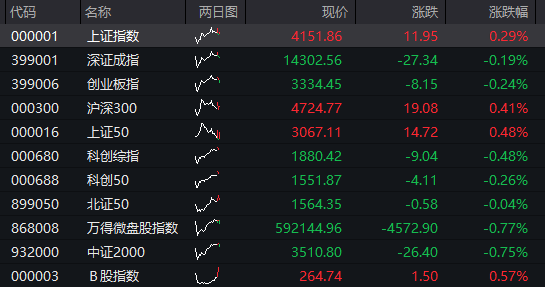
Group 1 - Corning, a veteran glass manufacturer, secured a significant contract with Meta, which is expected to boost the CPO and storage chip sectors in the A-share market [1][14] - The A-share market saw a mixed performance with the Shanghai Composite Index slightly up by 0.29%, while the Shenzhen Component and ChiNext indices experienced declines of 0.19% and 0.24% respectively [1][2] - The precious metals sector in the A-share market continued to surge, with gold stocks like Zhaojin Mining and Sichuan Gold hitting the daily limit [6][7] Group 2 - The Hang Seng Index in Hong Kong rose over 1%, reaching its highest level since 2021, with technology and semiconductor stocks showing strong rebounds [1][11][17] - The bond market showed fluctuations, with the 30-year treasury futures contract increasing by 0.07% [3][4] - Domestic commodity futures displayed mixed results, with gold and asphalt prices rising significantly, while lithium carbonate and other commodities saw declines [4][5]


“新三样”出口增长逾90% 长沙外贸“含新量”持续飙升
Chang Sha Wan Bao· 2026-01-28 02:03
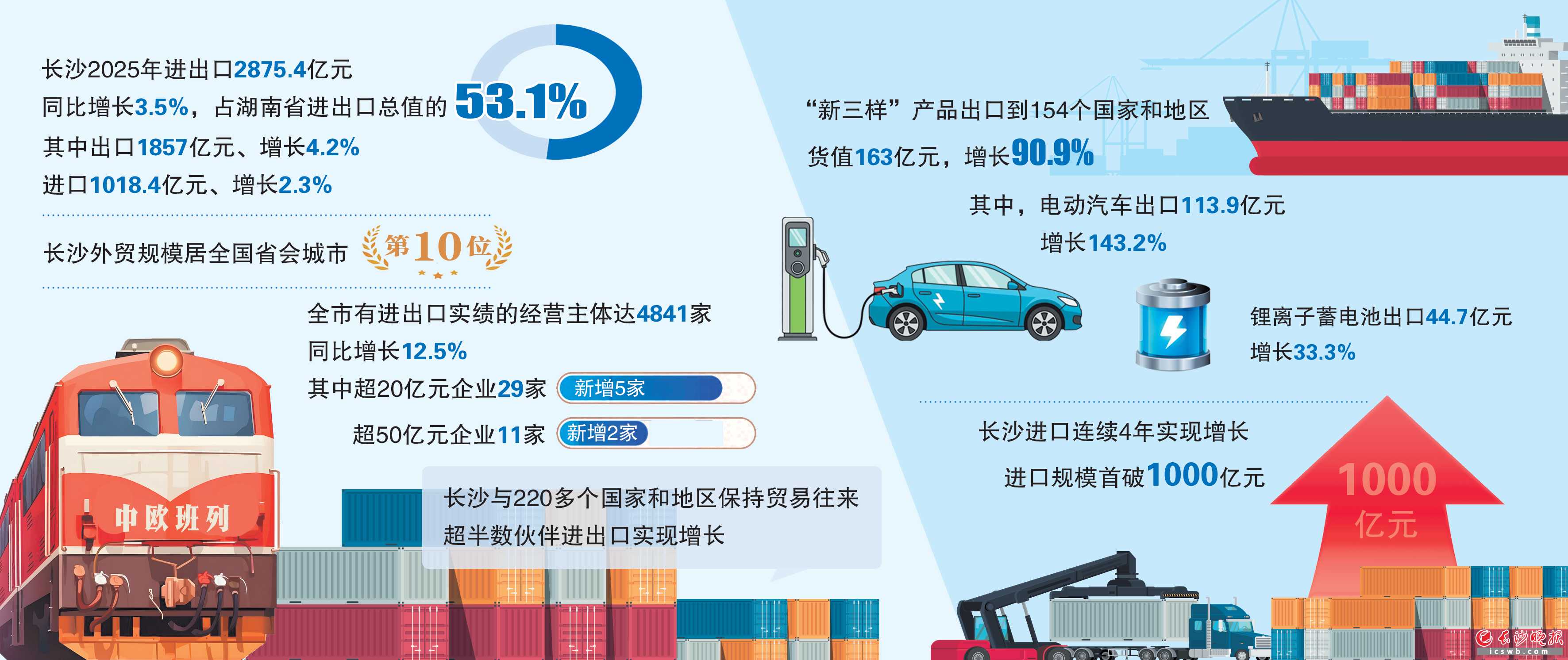
Core Insights - In 2025, Changsha's foreign trade demonstrated resilience amidst international uncertainties, achieving a total import and export value of 287.54 billion yuan, a year-on-year increase of 3.5% [2] - Changsha ranked 10th among provincial capital cities in terms of foreign trade scale, solidifying its position as a leader in Hunan's foreign trade [3] Trade Performance - The city contributed nearly 10 billion yuan to the province's foreign trade growth, increasing its share to 53.1%, up by 3.8 percentage points from the previous year [3] - The number of enterprises engaged in import and export activities reached 4,841, a 12.5% increase year-on-year, with significant contributions from private, state-owned, and foreign-invested enterprises [6] Trade Structure and Growth - Changsha maintained trade relations with over 220 countries and regions, with more than half of its trading partners experiencing growth [7] - Exports to Africa saw a historic high, with significant increases in trade with ASEAN, Latin America, and the Middle East [7] Product and Trade Model Upgrades - Changsha's exports of "new three items" (electric vehicles, lithium-ion batteries, and photovoltaic products) surged, with total export value reaching 16.3 billion yuan, a 90.9% increase [8] - Electric vehicle exports led the growth, surpassing 10 billion yuan for the first time, with a year-on-year increase of 143.2% [8] Domestic Demand and Import Growth - Changsha's imports exceeded 100 billion yuan for the first time, with notable growth in integrated circuits, rubber, machine tools, and specialty agricultural products [11] Policy and Infrastructure Support - The Huanghua Comprehensive Bonded Zone achieved national and central region "Double A" status, enhancing its competitive position [12] - Innovative customs supervision and logistics measures, including the operation of 1,037 China-Europe freight trains, have effectively reduced costs and improved efficiency for enterprises [12]
汽车早餐 | 春节假期免收7座及以下小型客车通行费;比亚迪与埃克森美孚签署战略合作备忘录;欧盟公布印欧贸易协议
Zhong Guo Qi Che Bao Wang· 2026-01-28 01:32
Domestic News - The Ministry of Transport has implemented a policy to waive toll fees for small passenger vehicles (7 seats or fewer) during the Spring Festival holiday [2] - The Ministry's notice emphasizes the need to enhance charging infrastructure for electric vehicles, proposing tailored strategies for busy service areas to reduce long wait times for charging [2] Industry Insights - In 2025, profits for large-scale high-tech manufacturing industries are expected to grow by 13.3% year-on-year, surpassing the overall industrial profit growth of 12.7% [3] - The smart electronics sector is driving significant profit increases, with profits in the smart consumer device manufacturing sector rising by 48%, and specific industries like smart drones and smart vehicle equipment seeing profits increase by 102% and 88.8%, respectively [3] - The automotive industry is projected to generate profits of 461 billion yuan in 2025, reflecting a modest year-on-year increase of 0.6% [4] - The automotive sector's revenue is expected to reach 1,117.96 billion yuan, with production figures at 34.78 million vehicles, marking a 10% increase year-on-year [4] International News - The EU has announced a trade agreement with India, granting EU service providers preferential access in key sectors such as finance and maritime services, while gradually reducing automotive tariffs to 10% with an annual quota of 250,000 vehicles [5] - Stellantis Group reported that despite a sluggish market, it expects to sell over 2.42 million new vehicles in Europe in 2025, achieving a market share of 16% [6] - The company leads the hybrid vehicle market with a 15% share and holds a 28.6% share in the commercial vehicle sector [6] - The European new car registration is projected to grow by 2.4% in 2025, reaching 13.3 million units, with electric vehicle registrations surging by 30% [7] - In Vietnam, the automotive market is expected to grow by 22% in 2025, although major players like Hyundai and Kia are experiencing declining sales for the third consecutive year [8] - South Africa's electric vehicle sales are projected to decline by 17% in 2025, accounting for only 0.17% of total new car sales, despite overall new car sales reaching a decade-high of 596,818 units [9] Corporate News - BYD has signed a long-term strategic cooperation memorandum with ExxonMobil, focusing on innovation in new energy hybrid technology and collaborative product development [10] - Li Auto plans to close a small number of underperforming stores as part of normal operational adjustments, clarifying that rumors of closing 100 stores are unfounded [11] - Didi plans to enhance the experience of its ride-hailing services in 2026, focusing on improving driver service levels and optimizing vehicle offerings [12] - DeepWay has completed a Pre-IPO financing round of 1.177 billion yuan, marking the largest single financing in the autonomous driving new energy heavy truck sector [13] - XPeng Motors anticipates "very strong" growth this year, with overseas sales growth potentially outpacing domestic sales [14]



2026年中国新能源汽车融资租赁行业政策、产业链、市场规模、重点企业及趋势研判:新能源汽车产销持续高速增长,带动融资租赁市场规模跃升至千亿元[图]
Chan Ye Xin Xi Wang· 2026-01-28 01:25
Core Insights - The rapid growth of the new energy vehicle (NEV) financing leasing market is driven by policy support and technological advancements, making it a crucial financial solution to lower ownership barriers and mitigate technology iteration risks [1][6][7]. Group 1: Market Overview - The NEV financing leasing market in China is projected to grow from 449 million yuan in 2015 to 112.72 billion yuan in 2024, with a compound annual growth rate (CAGR) of 84.78% [1][7]. - By 2025, the market size is expected to reach approximately 165.58 billion yuan, indicating robust growth potential [1][7]. Group 2: Policy Support - The Chinese government has extended the NEV purchase tax exemption policy until 2025 and is exploring innovative models like battery-vehicle separation [1][4][7]. - Local governments are also providing targeted financing leasing subsidies to stimulate procurement and consumption [1][4][7]. Group 3: Technological Advancements - Continuous improvements in NEV technology and performance are enhancing user experience and increasing market acceptance, particularly among the younger generation [1][7]. - The Z generation shows a strong preference for environmentally friendly, intelligent, and connected NEVs, promoting the "rent-to-buy" consumption model [1][7]. Group 4: Industry Structure - The NEV financing leasing industry comprises various players, including traditional automotive finance companies, specialized leasing firms, and financial institutions [6][8]. - Major companies in the sector include SAIC General Motors Automotive Finance Co., Ltd., Volkswagen Financial Services (China) Co., Ltd., and Mercedes-Benz Automotive Finance Co., Ltd. [2][8][10]. Group 5: Industry Trends - Digital transformation in the NEV financing leasing sector is expected to evolve towards intelligent risk control and asset management based on big data [11]. - The integration of NEV financing leasing with green finance will create unique competitive advantages, allowing for lower-cost funding through green bonds and innovative financial products linked to carbon reduction [12]. - International expansion will focus on local operations and global asset circulation, particularly in emerging markets with rising electric vehicle penetration [13].


头部份额走低 商用车驱动增长 ——2025动力电池格局异动
Zhong Guo Qi Che Bao Wang· 2026-01-28 01:24
中国汽车动力电池产业创新联盟的数据显示,去年我国动力电池销售1200.9GWh,同比增长51.8%,远超 新能源汽车29%的增速。记者调查发现,新能源商用车及换电市场快速发展,引领动力电池行业增长;新能源 乘用车单车电量未因此增长,反而略有下降。此外,两家头部企业份额有所下降。 乘用车平均单车电量下降 2025年,我国动力电池国内累计装车量769.7GWh,同比增长40.4%;其中三元电池装车量为144.1GWh,占总 装车量的18.7%,同比增长3.7%;磷酸铁锂电池累计装车量625.3GWh,占总装车量的81.2%,同比增长 52.9%。 动力电池增长速度远超新能源汽车,是平均单车电量增长了吗?中国汽车动力电池产业创新联盟副秘书长尹艳 萍告诉记者,这两组数据给人的感觉是每辆车的平均电量提高了,但从细分车型可以看出,动力电池销量、装 车量增长的主要原因是电动卡车销量大幅增长,以及换电模式快速增长,一辆电动卡车的电池电量远超乘用 车,一个换电站的电池配套量更是远超一辆电动卡车。另外,2025年,大量的专用车,如环卫车、洒水车等改 成纯电动车型,它们的电量也较高。 "从乘用车数据来看,平均电量没有上升,反而略有 ...