石药集团

Search documents
石药集团(01093):2025年上半年业绩承压,看好公司创新兑现长期价值
Tianfeng Securities· 2025-09-28 12:57
Investment Rating - The report maintains a "Buy" rating for the company [6][8]. Core Viewpoints - The company experienced a revenue decline of 18.5% year-on-year, with total revenue of 13.273 billion yuan and a net profit decrease of 15.6% to 2.548 billion yuan, primarily due to the impact of centralized procurement [1]. - The sales of traditional pharmaceutical products faced significant pressure, with a 24.4% decline in revenue to 10.248 billion yuan, and a 32.3% drop in product sales when excluding licensing income [2]. - The company is expected to enter a new growth phase with multiple innovative drugs set to be launched between 2025 and 2027, including SYS6010, KN026, and others [2]. - Licensing income has become a strong revenue and profit source, with a notable 120 million USD upfront payment for SYH2086 expected to contribute to future earnings [2]. - The company has initiated overseas clinical trials for SYS6010, which has received multiple regulatory recognitions, including Fast Track Designation from the FDA [3]. - The HER2 bispecific antibody KN026 has had its new drug application accepted by the Chinese National Medical Products Administration, showing promising clinical trial results [4]. Summary by Sections Financial Performance - For the first half of 2025, the company reported revenues of 13.273 billion yuan and a net profit of 2.548 billion yuan, reflecting a year-on-year decrease of 18.5% and 15.6%, respectively [1]. Traditional Pharmaceutical Business - The traditional pharmaceutical business generated 10.248 billion yuan in revenue, down 24.4% year-on-year, with a 32.3% decline in product sales when excluding licensing income [2]. Innovative Drug Pipeline - The company plans to submit multiple innovative drugs for approval from 2025 to 2027, including SYS6010 and KN026, which are expected to drive future revenue growth [2][4]. Licensing Income - Licensing income has significantly increased, with the company securing 6 business development deals and expecting continued contributions from these agreements [2]. Clinical Trials and Regulatory Approvals - SYS6010 has received Fast Track Designation from the FDA and Breakthrough Therapy Designation from NMPA, indicating strong regulatory support for its clinical development [3]. - The KN026 application is based on positive results from a pivotal clinical trial, demonstrating improved efficacy and safety compared to existing treatments [4]. Profit Forecast - The company is projected to achieve revenues of 28.398 billion yuan, 30.145 billion yuan, and 32.242 billion yuan, with net profits of 5.521 billion yuan, 5.940 billion yuan, and 6.457 billion yuan from 2025 to 2027 [6].
丹麦巨头巨变,国产药千亿商机来了
投中网· 2025-09-28 09:16
Core Viewpoint - The global weight loss drug market is undergoing significant restructuring, with Novo Nordisk's layoffs and strategic shifts indicating the end of its dominance and the rise of competition from other pharmaceutical companies, particularly in China [4][10][14]. Group 1: Novo Nordisk's Strategic Changes - Novo Nordisk plans to cut approximately 9,000 jobs globally, with around 5,000 in Denmark, as part of a resource reallocation strategy focusing on diabetes and obesity treatments [4][7]. - The company’s revenue from semaglutide exceeded $16 billion in the first half of the year, with annual sales expected to approach $40 billion, indicating a lucrative market despite internal challenges [7][8]. - Marketing missteps have led to market chaos in China, where semaglutide was initially marketed without a comprehensive strategy, resulting in misuse and regulatory scrutiny [8][9]. Group 2: Market Dynamics and Competition - The GLP-1 drug market is projected to exceed $70 billion, with significant growth anticipated in the Chinese market, where the obesity rate is rising [7][15]. - By 2030, the Chinese weight loss drug market is expected to reach nearly $25 billion, driven by increasing obesity rates and healthcare spending [15][16]. - Domestic players are entering the market, with over 20 semaglutide generics in clinical trials, indicating a shift towards a more competitive landscape [15][16]. Group 3: Challenges and Opportunities - The competitive landscape is characterized by the need for speed, patience, and differentiation among players, as the market becomes increasingly crowded [5][20]. - Novo Nordisk's challenges highlight the importance of effective marketing and understanding consumer needs, as well as the risks associated with drug development and safety [19][20]. - The potential for GLP-1 drugs extends beyond weight loss to other therapeutic areas, with a projected global market size of over $150 billion by 2031 [21][22].



中金:主动外资流出A股及海外中资股扩大 被动外资低配中国程度微降
智通财经网· 2025-09-28 07:14
Core Viewpoint - Active foreign capital continues to flow out of A-shares, increasing to $0.7 billion compared to $0.3 billion last week, while outflows from overseas Chinese stocks also expanded to $2.4 billion from $0.75 billion last week [1][2] Group 1: Foreign Capital Flows - Passive foreign capital continues to flow into overseas Chinese stocks, with inflows of $20.7 billion compared to $30.7 billion last week, and into A-shares at $10.5 billion versus $10 billion last week [1][2] - As of August, the proportion of active foreign capital allocated to China increased from 6.4% in July to 6.7%, while the proportion of passive funds rose to 8% [2] - The under-allocation degree decreased from 1.45 percentage points in July to 1.35 percentage points, but remains lower than 1.31 percentage points in June, indicating slow accumulation by active funds [2] Group 2: Market Trends and Predictions - Southbound capital accelerated inflows, with $439.6 billion HKD this week compared to $368.5 billion HKD last week, averaging $87.9 billion HKD daily versus $73.7 billion HKD last week [2] - The most net increased holdings were in Alibaba and Meituan, while reductions were seen in Huahong, CSPC Pharmaceutical, and China Telecom [2] - The overall market is expected to experience high-level fluctuations, primarily driven by strong structural expectations, but will inevitably face volatility due to rotation [2] - Factors contributing to market fluctuations include: 1) Accelerating domestic fundamentals weakening, 2) Potential turning point in macro liquidity, 3) Improvement in overseas liquidity but expectations have already been priced in, 4) Extreme sentiment and technical indicators, 5) Active micro liquidity [2] Group 3: Market Dynamics - Recent market volatility was influenced by both internal and external catalysts, with significant structural differentiation observed [3] - The US GDP revision and strong durable goods orders have driven the dollar and US long-term bond yields higher, aligning with previous expectations that a rate cut does not equate to a decline in bond yields and the dollar [3] - Recommendations suggest focusing on "short-term time loss but long-term space gain" strategies, similar to previous trends in the internet sector and current banking/dividend stocks [3] - Current intersections of economic conditions, event catalysts, and market crowding include: 1) Strong expectations for AI-related hardware and applications, 2) Ongoing attention to US-China relations, 3) Supply disruptions in copper mines and AI advancements, 4) Trade frictions affecting certain industries [3]


港股投资周报:恒生科技领涨,港股精选组合年内上涨72.29%-20250927
Guoxin Securities· 2025-09-27 08:58
Quantitative Models and Construction Methods - **Model Name**: Guosen JinGong Hong Kong Stock Selection Portfolio **Model Construction Idea**: The model is based on a dual-layer selection process that combines fundamental and technical analysis of stocks recommended by analysts. The goal is to identify stocks with both fundamental support and technical resonance, which are expected to outperform[14][15] **Model Construction Process**: 1. Construct an analyst-recommended stock pool based on the following events: - Analysts upgrading earnings forecasts - Analysts initiating coverage - Analyst report titles indicating unexpected events 2. Perform dual-layer screening on the stock pool: - **Fundamental analysis**: Evaluate the fundamental support of the stocks - **Technical analysis**: Assess the technical resonance of the stocks 3. Select stocks that meet both fundamental and technical criteria to form the Hong Kong Stock Selection Portfolio 4. Backtesting period: 2010-01-01 to 2025-06-30, considering full position and transaction costs **Model Evaluation**: The model demonstrates strong performance with significant annualized returns and excess returns over the Hang Seng Index[15] - **Model Name**: Stable New High Stock Screening **Model Construction Idea**: The model leverages momentum and trend-following strategies, which have been shown to be effective in the Hong Kong stock market. Stocks that reach new highs are considered market leaders and are expected to deliver higher future returns[20] **Model Construction Process**: 1. Define the 250-day new high distance as: $ 250 \text{ day new high distance} = 1 - \frac{\text{Close}_{t}}{\text{ts\_max}(\text{Close}, 250)} $ - $\text{Close}_{t}$: Latest closing price - $\text{ts\_max}(\text{Close}, 250)$: Maximum closing price over the past 250 trading days - If the latest closing price reaches a new high, the 250-day new high distance is 0; if it falls from the new high, the distance is positive, indicating the degree of decline 2. Screen stocks that have reached a 250-day new high in the past 20 trading days based on the following criteria: - Analyst attention: At least 5 buy or overweight ratings in the past 6 months - Relative stock strength: Top 20% in terms of 250-day price change within the sample pool - Price stability: Evaluate using two indicators: - Price path smoothness: Stock price displacement ratio - New high persistence: Time-series average of the 250-day new high distance over the past 120 days - Trend continuation: Time-series average of the 250-day new high distance over the past 5 days 3. Select the top 50 stocks based on the above criteria, ensuring at least 50 stocks are included[22][23] Model Backtesting Results - **Guosen JinGong Hong Kong Stock Selection Portfolio**: - Annualized return: 19.11% - Excess return over Hang Seng Index: 18.48% - Maximum drawdown: 23.73% - Information ratio (IR): 1.22 - Tracking error: 14.55% - Return-to-drawdown ratio: 0.78[19] - **Stable New High Stock Screening**: - The model identified 14 stocks in the pharmaceutical sector, 11 in the cyclical sector, 8 in technology, 6 in consumer, and 4 in manufacturing as stable new high stocks for the week[22][23] Quantitative Factors and Construction Methods - **Factor Name**: 250-Day New High Distance **Factor Construction Idea**: This factor measures the distance of the latest closing price from the 250-day high, capturing the momentum and trend-following characteristics of stocks[22] **Factor Construction Process**: - Formula: $ 250 \text{ day new high distance} = 1 - \frac{\text{Close}_{t}}{\text{ts\_max}(\text{Close}, 250)} $ - $\text{Close}_{t}$: Latest closing price - $\text{ts\_max}(\text{Close}, 250)$: Maximum closing price over the past 250 trading days - Interpretation: A value of 0 indicates the stock is at its 250-day high, while a positive value indicates the percentage drop from the high[22] Factor Backtesting Results - **250-Day New High Distance Factor**: - The factor was used to identify stable new high stocks, with the pharmaceutical sector having the highest number of selected stocks (14), followed by cyclical (11), technology (8), consumer (6), and manufacturing (4)[22][23]
丹麦巨头大裁员,掀开国产药千亿商机
Hu Xiu· 2025-09-27 02:12
Core Viewpoint - The recent layoffs at Novo Nordisk, which will affect approximately 9,000 positions globally, signal a significant shift in the weight-loss drug market, moving from a dominant position to a more competitive landscape where multiple players are emerging [1][3][19]. Group 1: Company Actions and Strategy - Novo Nordisk's layoffs are part of a broader strategy to reallocate resources towards diabetes and obesity treatment, indicating a transformation within the company [1][7]. - The company aims to save 8 billion Danish Kroner annually by 2026 through these layoffs, but the primary goal is to refocus on competitive areas rather than just cost-cutting [7][3]. - The layoffs come as Novo Nordisk faces increased competition from other pharmaceutical companies like Pfizer and Eli Lilly, which are investing heavily in next-generation weight-loss drugs [1][6]. Group 2: Market Dynamics and Competition - The GLP-1 drug market is projected to exceed $70 billion, with expectations of reaching a $100 billion market soon, driven by rising obesity rates and demand for effective treatments [3][11]. - In China, the obesity rate among adults is reported at 34.3%, with predictions that the number of overweight and obese individuals could exceed 500 million by 2030, leading to significant healthcare expenditures [11][12]. - The competitive landscape is shifting, with multiple Chinese companies entering the market, as the patent for semaglutide will expire in 2026, allowing for generic versions to emerge [12][13]. Group 3: Challenges and Risks - Novo Nordisk has faced marketing missteps, particularly in China, where it failed to effectively manage the off-label use of its diabetes drug for weight loss, leading to market chaos [4][5]. - The company has also struggled with supply issues in the U.S., losing exclusive supply rights for semaglutide due to underestimating market demand [6][5]. - The development pipeline for Novo Nordisk has been under scrutiny, with recent failures in new drug candidates raising concerns about its future competitiveness [6][15]. Group 4: Future Outlook - The GLP-1 market is entering a new phase, with expectations of diverse product offerings and increased competition, particularly from domestic players in China [11][12]. - The industry's growth potential is significant, with forecasts suggesting that the global market could surpass $150 billion by 2031 [18]. - Companies must navigate challenges related to safety, marketing, and strategic positioning to succeed in this evolving landscape [18][17].
康宁杰瑞制药-B(9966.HK):自研项目迈向收获期 多起授权合作验证公司平台价值
Ge Long Hui· 2025-09-26 16:41
Core Viewpoint - The company is leveraging technological innovation as a driving force for its drug development, with key products in advanced clinical stages and expected market submissions in the near future [1][2]. Group 1: Product Development and Clinical Trials - The company has two main products, KN026 (HER2 bispecific antibody) and JSKN003 (HER2 bispecific antibody ADC), both in Phase 3 clinical trials, with KN026 expected to submit for market approval for 2L+ HER2-positive gastric cancer in 2025 [1]. - KN026 is involved in three Phase 3 clinical trials, including a combination study with chemotherapy for 2L+ HER2-positive gastric cancer, which has met the primary endpoint for progression-free survival (PFS) [1]. - JSKN003 is also in three Phase 3 clinical trials targeting HER2-positive breast cancer and platinum-resistant recurrent epithelial ovarian cancer [1]. Group 2: Financial Performance and Collaborations - In 2024, the company achieved significant licensing revenue from multiple collaborations, including a $700.8 million deal for KN035 and a $308 million deal for JSKN003, leading to a total revenue of 640 million yuan, a year-on-year increase of 192.6% [2]. - The company turned a profit of 166 million yuan in 2024, marking its first profitable year, while maintaining a stable R&D expenditure of 404 million yuan [2]. - Cash reserves at the end of 2024 stood at 1.571 billion yuan, providing a solid financial foundation for ongoing clinical development [2]. Group 3: Future Outlook and Strategic Focus - The company is focusing on the development of JSKN016 (TROP2/HER3 ADC), which is currently in Phase 2 clinical trials, aiming to enhance efficacy through dual-targeting mechanisms [2]. - The clinical strategy for JSKN016 includes targeting unmet needs in triple-negative breast cancer (TNBC) and EGFR-TKI resistant non-small cell lung cancer (NSCLC) [2]. - Revenue projections for 2025-2027 are estimated at 458 million, 490 million, and 398 million yuan respectively, with a recommendation for investment based on the promising pipeline [3].
天风医药细分领域分析与展望:创新药、制药行业及个股2025半年度回顾与展望
Tianfeng Securities· 2025-09-26 07:13
Industry Rating - The report maintains an "Outperform" rating for the pharmaceutical and biotechnology industry [1] Core Insights - The innovative drug sector is experiencing a positive trend with significant revenue growth and a reduction in losses, indicating a potential for sector-wide profitability [2][6] - The overall revenue for the innovative drug sector in H1 2025 reached 30.649 billion yuan, a year-on-year increase of 9.77%, while the net loss attributable to shareholders was 2.096 billion yuan, showing a substantial reduction in losses [6] - The sector's gross margin remains high at 84.43%, with a slight decrease compared to the previous year, but showing signs of recovery in Q2 2025 [3][6] Summary by Sections Innovative Drug Sector - The innovative drug sector's revenue for H1 2025 was 30.649 billion yuan, with a growth rate of 9.77% year-on-year. Q2 2025 revenue was 16.387 billion yuan, reflecting a 33.24% increase [5][6] - The sector's gross margin for H1 2025 was 84.43%, slightly down from the previous year, but Q2 2025 saw an increase to 84.73% [3][6] - The number of License-out transactions with upfront payments exceeding 10 million USD reached a new high, indicating that overseas rights have become a crucial funding source for Chinese companies [4][7] Financial Performance - The innovative drug sector's net loss for H1 2025 was 2.096 billion yuan, with a significant reduction in losses of 127.58% year-on-year. The adjusted net loss was 2.880 billion yuan, reflecting a 151.25% reduction in losses [5][6] - The sector's operating cash flow was positive at 210 million yuan, indicating improved financial health [5] Traditional Pharmaceutical Sector - The traditional pharmaceutical sector, comprising 136 listed companies, reported total revenue of 254.895 billion yuan in H1 2025, a decrease of 1.64% year-on-year. The net profit attributable to shareholders was 32.099 billion yuan, down 4.83% [26][32] - The gross margin for the traditional pharmaceutical sector was 51.05% in H1 2025, showing a slight increase compared to the previous year [27][32] - The sector is adapting to policy changes, with increased industry concentration and some leading companies achieving growth through transformation and international expansion [32]



申万宏源:小核酸药物进入快速发展阶段 国内企业加速抢占蓝海
智通财经网· 2025-09-26 06:58
Core Viewpoint - The global small nucleic acid drug market is experiencing significant growth, with a projected increase from $4.6 billion in 2023 to $46.7 billion by 2033, driven by technological advancements and increased clinical approvals [1][2]. Market Growth - The global small nucleic acid drug market size grew from $2.7 billion in 2019 to $4.6 billion in 2023, reflecting a compound annual growth rate (CAGR) of 14.3% [2]. - The market is expected to accelerate growth starting in 2023, with a projected CAGR of 26.1% until it reaches $46.7 billion by 2033 [1][2]. Technological Advancements - Small nucleic acid drugs are becoming more mature, offering significant advantages over traditional small molecule and antibody drugs, including shorter development cycles, a wider range of targets, lasting effects, and higher success rates [1][3]. - These drugs act directly on the mRNA level, targeting "undruggable" targets that traditional drugs cannot reach, providing new treatment options for many difficult-to-treat diseases [1]. Shift in Focus - The trend is shifting from rare diseases to chronic and common diseases, with small nucleic acid drugs expanding into areas such as hyperlipidemia, hepatitis B, and hypertension [2][3]. - Currently, there are 22 approved small nucleic acid drugs globally, primarily focused on rare diseases, but recent data indicates a move towards more prevalent conditions [2]. Domestic Market Dynamics - Domestic innovative pharmaceutical companies are accelerating their entry into the small nucleic acid drug market, focusing on chronic diseases rather than following the traditional model of starting with rare diseases [3]. - Key therapeutic areas for domestic companies include cardiovascular diseases, hepatitis B, and cancer [3]. Investment Opportunities - Companies with proprietary technology platforms and advantageous pipelines are recommended for investment, including Reebio, Sanofi, Bowang Pharmaceutical, Yuyuan Pharmaceutical, CSPC Pharmaceutical, Tsinghua Tongfang, and Hengrui Medicine [4]. - Notable overseas companies include Alnylam, Ionis, and Arrowhead [4].

开源证券:小核酸药物有望成为减重赛道新风口 联用GLP-1或多重满足临床需求
Zhi Tong Cai Jing· 2025-09-26 06:39
Core Viewpoint - The report from Open Source Securities indicates that small RNA drugs targeting weight loss are focusing on two main targets: INHBE and ALK7, with Arrowhead and Wave making the fastest progress in this area [1][2]. Group 1: Market Potential - The small RNA drug sector is expected to break into the billion-dollar weight loss market, with a focus on INHBE and ALK7 as key targets [1]. - INHBE is expressed in liver cells and plays a role in fat metabolism by encoding and secreting Activin E, which interacts with ALK7 [1]. Group 2: Company Progress - Arrowhead and Wave are leading in the development of INHBE siRNA molecules, with phase 1 trial data expected within the next six months [2]. - Alnylam, while slightly behind, has a comprehensive approach covering INHBE, ALK7, and GeneD for muscle targeting [2]. Group 3: Clinical Insights - Preclinical data shows that Arrowhead's ALK7 siRNA combined with Tirzepatide can enhance weight loss effects and provide longer-lasting efficacy, allowing for less frequent dosing [3]. - Genetic studies suggest that individuals with loss of function in INHBE or ALK7 exhibit healthier metabolic profiles, indicating that targeting these pathways may reduce visceral fat rather than just overall weight [3]. Group 4: Investment Recommendations - Short-term focus is recommended on Arrowhead and Wave's data readouts, particularly regarding safety, pharmacokinetics, dosing intervals, biomarker knockdown levels, early efficacy, and metabolic changes [4]. - Recommended stocks include Yuyuan Pharmaceutical (688658.SH), Sunshine Novo Nordisk (688621.SH), Rejuve Biotech (688068.SH), and Shiyao Group (01093), with beneficiaries including Frontier Biotech-U (688221.SH) and Hengrui Medicine (600276) (01276) [4].



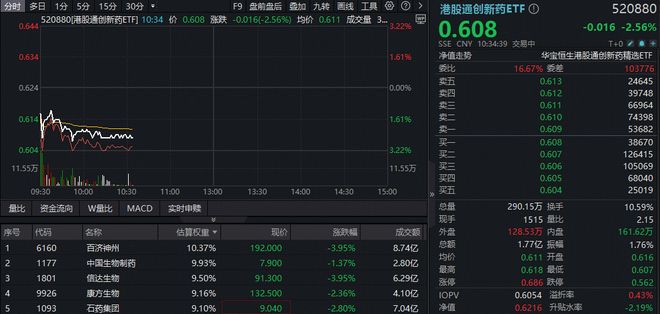
特朗普再挥关税大棒,港股通创新药遭错杀?520880跌2.5%溢价飙升
Xin Lang Cai Jing· 2025-09-26 03:02
Group 1 - The Hong Kong pharmaceutical market experienced a significant decline, with the Hong Kong Stock Connect Innovative Drug ETF (520880) opening down over 2.5% on September 26, 2023, as 35 out of 37 constituent stocks fell, including major players like BeiGene and Innovent Biologics, which dropped over 3% [1][2] - The recent announcement by U.S. President Trump regarding a new round of high tariffs on various imported products, including a 100% tariff on pharmaceutical products, has negatively impacted pharmaceutical stocks in Japan, South Korea, and Australia [3] - Analysts suggest that the impact of the U.S. tariffs on Chinese innovative drug companies is relatively limited, as these companies primarily rely on domestic demand and do not directly export to the U.S. market [4] Group 2 - The Hong Kong Stock Connect Innovative Drug ETF (520880) has seen a surge in net subscriptions, with over 6.4 billion CNY in net inflows across 16 out of the last 20 trading days, indicating strong investor interest despite market volatility [5][6] - The ETF focuses exclusively on innovative drug research and development companies, excluding contract research organizations (CROs), which positions it as a pure play on the innovative drug sector [6][7] - The index tracked by the ETF has shown a year-to-date increase of 119.75% before the recent adjustments, outperforming other innovative drug indices, and is expected to demonstrate stronger performance as the innovative drug market evolves [7][8]