
保利发展

Search documents
地产央企精兵简将:区域公司消亡与规模信仰瓦解
2 1 Shi Ji Jing Ji Bao Dao· 2026-02-12 11:18
即将春节,房地产行业的组织架构调整如期而至。 今年1月底,中海集团董事长颜建国宣布,撤销中海地产沿用多年的华东、华南、北部、中西部4大区域 公司,中海地产正式告别"总部-区域-城市"的三级管控模式,未来将进入"总部-城市"的扁平管理时代, 华润置地也在近期宣布再度精简地区公司,从28个压缩至18个。在此次组织架构调整后,华润置地也形 成了"哑铃型"的组织,即"专总部"、"强一线"的模式。事实上,在这两家央企之前,招商蛇口已经先行 一步裁撤所有区域公司,至此,头部央企的极致扁平化组织已经宣告全面成型。 面对新的竞争环境,地产央企也在顺应市场做出改变。此次变动的逻辑是,房地产市场具备布局价值的 城市缩减,过往"摊大饼"式的发展逻辑已经不适应当下,房企采取总部"一盘棋"的投资决策,能够提高 运营和决策的效率。 随着房企纷纷深耕高能级城市,"规模为王"的时代也基本宣告终结。房企也在采取更灵活、敏捷、扁平 的组织,在深耕城市进行规模以外的比拼,例如商业布局,或者其他增量业务。 "扁平"的敏捷组织 在房地产行业的发展史上,区域公司曾经是规模扩张的利器。在行业高速发展之时,房企通常采取总 部-区域-城市的三级管控模式。在这 ...
首批商业不动产REITs,蓄势待发!
Jin Rong Shi Bao· 2026-02-12 10:54
Group 1 - The first batch of commercial real estate REITs is gaining momentum, with 12 products submitted for approval since the end of January, and 10 of them accepted by the exchange, with a fundraising scale expected to reach 37.7 billion yuan [1] - The project initiators include state-owned enterprises, local state-owned enterprises, private enterprises, and foreign companies, with all projects located in core areas of first- and second-tier cities [1][3] - The underlying assets of the projects show a "retail-led, diversified supplement" pattern, including 4 retail projects, 3 mixed-use commercial projects, 2 hotels, and 1 office [1] Group 2 - The first batch of accepted projects is characterized by mature operations, good historical performance, and stable cash flow, with some assets currently fully leased [3] - Notable projects include those from Poly Developments in the Guangdong-Hong Kong-Macao Greater Bay Area, and various state-owned enterprises in Shanghai with diverse asset types located in key urban areas [3] - Private enterprises like Vipshop and Sanda have extensive commercial property management experience, with their underlying assets being outlet projects in major cities [3] Group 3 - The launch of commercial real estate REITs is seen as a new opportunity for the real estate industry, which is transitioning from a high-leverage, high-turnover model to a more sustainable operational model [5][6] - REITs provide a significant funding channel for developers, encouraging a shift from "developers" to "asset managers and service providers," enhancing operational management capabilities [6] - The first batch of projects includes four with clear renovation plans aimed at improving space utilization and optimizing asset combinations [6] Group 4 - Commercial real estate REITs will provide a crucial "pricing anchor" for the market, addressing the lack of a transparent price discovery mechanism in the commercial real estate sector [6][7] - The introduction of REITs is expected to enhance price transparency and valuation science in the commercial real estate market, aiding in the identification and allocation of quality assets [7] Group 5 - The current low-interest-rate environment is favorable for the launch of commercial real estate REITs, as there is a strong demand for stable, long-term income-generating assets [8] - The predicted cash distribution rate for the first batch of 10 projects ranges from 3.79% to 5.21%, with an average of 4.75% [9] - The recent rational price adjustments in high-quality commercial properties provide a foundation for acquiring or integrating assets at reasonable costs, benefiting long-term returns for investors [9] Group 6 - Compliance remains a fundamental requirement for commercial real estate REITs, with complex structures and extensive regulatory procedures involved [10][11] - The regulatory process aims to balance the significance of compliance issues with the need for market development, ensuring a constructive approach to project advancement [11] - There is a growing expectation that more quality commercial real estate will connect with capital markets through REITs, broadening financing channels for the real economy [11][12]

房地产行业:商业不动产REITs密集申报,盘活存量商业资产
金融街证券· 2026-02-12 09:22
Investment Rating - The report maintains an "Outperform" rating for the commercial real estate REITs sector [3] Core Insights - The first batch of 10 commercial real estate REITs has been submitted for approval, with an expected financing of 37.7 billion yuan, aimed at revitalizing existing commercial assets [4][6] - The underlying assets of these REITs are primarily located in key urban areas, including first-tier cities like Shanghai and Guangzhou, and second-tier cities like Hefei and Xi'an, showcasing strong location advantages [4][6] - The underlying assets are diversified, mainly consisting of retail and mixed-use properties, which enhances risk resilience and revenue stability [4][6] - The projects exhibit mature operations with high occupancy rates, generally above 90%, and expected net cash flow distribution rates between 4.5% and 6% for 2026-2027 [4][6] Summary by Sections REITs Submission and Financing - As of February 8, 2026, the first batch of 10 commercial real estate REITs has been submitted, with a total expected financing of 37.7 billion yuan [4][6] - The assets are located in prime areas, such as Shanghai's Qiantan and Guangzhou's Zhujiang New Town, indicating strong market demand [4][6] Asset Diversification and Risk Management - The underlying assets include shopping centers, office buildings, and hotels, with a mixed-use approach to mitigate risks associated with single asset types [4][6] - Multiple projects utilize a combination of office and commercial spaces to enhance operational synergy and reduce risks [4][6] Operational Performance - The projects have demonstrated strong cash flow performance, with occupancy rates typically exceeding 90%, and some projects, like the Dingbao Building, achieving a 100% occupancy rate by 2025 [4][6] - The expected net cash flow distribution rates for the submitted REITs are projected to be between 4.5% and 6% for the years 2026 and 2027, reflecting solid financial health [4][6]
甲级写字楼与零售市场概况
Cushman & Wakefield· 2026-02-12 08:12
Investment Rating - The report does not explicitly state an investment rating for the industry Core Insights - The macroeconomic environment in Chengdu shows a GDP of 4,148.9 billion CNY, with a third industry growth rate of 6.0% and a retail sales growth rate of 6.5% [4][6][8] - The average disposable income for urban residents in Chengdu is 44,507 CNY [10] - The real estate development investment growth rate in Chengdu is -0.2%, indicating a challenging market [14] - The office market in Chengdu has a total stock of 3,473,265 square meters, with an average rent of 84.00 CNY per square meter per month, and a vacancy rate of 31.8% [19][35] - The retail market has a total stock of 8,498,923 square meters, with an average rent of 585.00 CNY per square meter per month, and a vacancy rate of 8.68% [40][54] Summary by Sections Macroeconomic Overview - Chengdu's GDP is 4,148.9 billion CNY, with a third industry growth rate of 6.0% and retail sales growth of 6.5% [4][6][8] - The average disposable income for urban residents is 44,507 CNY [10] Real Estate Market - Real estate development investment growth rate in Chengdu is -0.2% [14] - Major land transactions in 2025 include residential land in various districts, with prices ranging from 16,500 to 21,500 CNY per square meter [17] Office Market Overview - The office market has a total stock of 3,473,265 square meters, with an average rent of 84.00 CNY per square meter per month and a vacancy rate of 31.8% [19][35] - The market has not recorded any new supply in the last quarter, and the net absorption has turned negative for the first time [35] - The financial district is expected to see significant new projects entering the market, which may create pressure on supply and demand balance [35] Retail Market Overview - The retail market has a total stock of 8,498,923 square meters, with an average rent of 585.00 CNY per square meter per month and a vacancy rate of 8.68% [40][54] - The market is expected to see a slowdown in new supply due to some projects being stalled [54] - International brands are expanding their presence in Chengdu, indicating strong consumer potential [54]
未来3年,楼市最值得关注的地方
Ge Long Hui A P P· 2026-02-12 06:22
Core Viewpoint - The recent announcement of five residential land plots in Shenzhen's Guangming District is expected to significantly impact the housing market, providing a boost in new residential supply and enhancing the quality of new housing developments [1][5][14]. Group 1: Land Supply and Market Impact - Guangming District will auction five prime residential land plots in 2026, marking the largest release of core residential land in five years [1][3]. - The new plots are strategically located near key amenities such as schools, parks, and transportation hubs, which are expected to attract buyers [3][5]. - The introduction of these plots is anticipated to lead to the supply of approximately 5,000 to 6,000 new residential units in the market [14]. Group 2: Market Trends and Housing Quality - The new residential developments are expected to align with Shenzhen's current trend towards higher quality housing, adhering to new national standards and improved community designs [9][13]. - The competition among new housing projects is likely to enhance the overall quality of residential offerings in the market, benefiting consumers [13][19]. - The market has seen a shift towards newer properties, with 45.8% of transactions in Guangming involving homes aged 0-5 years, indicating a preference for newer developments [15][19]. Group 3: Price Dynamics and Historical Context - Historical data shows a decline in transaction prices for similar properties, with significant price drops observed from 2020 to 2023 for various housing projects in the area [20][21]. - The competitive nature of the Guangming market, characterized by a high proportion of new and nearly new homes, suggests that the influx of new land may increase pressure on existing property prices [19][30]. - The market is expected to undergo structural adjustments as new developments are introduced, posing challenges for both new and existing properties [30].


中银晨会聚焦-20260212-20260212
Bank of China Securities· 2026-02-12 01:01
Group 1: Macro Insights - January CPI growth rate year-on-year was lower than expected, while PPI growth rate was slightly higher than expected, influenced by the Spring Festival timing and base period rotation [4][5] - The average impact of the base period rotation on CPI and PPI year-on-year indices is estimated to be approximately 0.06 and 0.08 percentage points, respectively, which is relatively small [4][5] - CPI in January increased by 0.2% month-on-month and year-on-year, with core CPI rising by 0.8%, indicating a mixed inflationary environment influenced by seasonal factors and external inputs [5] Group 2: Real Estate Sector - The traditional residential development sector is contracting, while commercial real estate is entering a policy-driven growth phase, with a focus on creating new consumption scenarios to meet diverse consumer needs [12][13] - The shift from traditional commercial spaces to new consumption scenarios emphasizes emotional engagement and immersive experiences, moving beyond mere transactional spaces [14][20] - The rise of non-standard commercial projects, characterized by innovative space and operational models, is gaining traction, particularly in major cities like Shanghai and Beijing [16][17] Group 3: Chemical Industry - The dye industry is experiencing price increases due to rising costs of intermediate products, with significant price hikes observed in January, benefiting integrated companies with stable market shares [24][25] - The concentration of supply in the dye industry is improving due to stringent safety and environmental regulations, which may lead to a more favorable market environment for leading companies [26][27] Group 4: Electronics Sector - The demand for AI computing materials is expected to rise significantly as cloud service providers increase capital expenditures, leading to a supply-demand mismatch in the electronic fabric market [29][30] - Traditional electronic fabric production is transitioning to low-dielectric materials, with price increases anticipated across both traditional and low-dielectric electronic fabrics due to supply constraints [32][33]
债市看多的逻辑
2026-02-11 15:40
Summary of Conference Call Notes Industry Overview - The focus of the conference call is on the bond market in China, with a long-term bullish outlook on the bond market despite short-term fluctuations [1][15]. Key Points and Arguments 1. **Long-term Bullish Outlook**: The company maintains a long-term bullish view on the bond market, with expectations of upward trends despite potential short-term volatility, particularly after the Spring Festival [1][10]. 2. **High Real Interest Rates**: China's real interest rates, measured by the 10-year government bond yield relative to CPI, remain high at approximately 1.1168, which is conducive to economic growth and necessitates a low-interest environment [2][4]. 3. **International Comparisons**: Historical data from developed economies shows that exiting low-interest environments takes considerable time, suggesting that China may also require a prolonged period to stabilize its interest rates [3][4]. 4. **Government Debt Levels**: The increasing scale of government debt, projected to rise to over 70 trillion for central government bonds and 80 trillion for local government bonds by 2026, indicates significant fiscal pressure that necessitates a low-interest environment [4][5]. 5. **Banking Sector Stability**: The banking sector's net interest margin has been declining, from approximately 2.1% in 2020 to 1.42% in 2025, which impacts profitability and necessitates a stable interest rate environment to maintain financial stability [6][7]. 6. **Insurance Sector Growth**: The insurance sector has seen rapid growth, with new premium income reaching 212.6 billion in January 2026, a 27.6% increase year-on-year, indicating strong demand for bonds from non-bank financial institutions [8][9]. 7. **Bond Market Demand**: There is a significant demand for bonds from various sectors, including insurance, as large amounts of fixed deposits are maturing and being converted into insurance products and other financial instruments [9][10]. 8. **Interest Rate Projections**: The 10-year government bond yield is expected to remain within the range of 1.7% to 1.9%, with a potential decline to 1.6% if interest rates are cut further [10][11]. 9. **Investment Strategies**: The company recommends focusing on high liquidity government bonds and credit bonds, with an emphasis on safety and yield, particularly in the context of expected low interest rates and potential market volatility [22][23]. Additional Important Content - **Fiscal and Monetary Policy Coordination**: The need for coordinated fiscal and monetary policies to support domestic demand is emphasized, with a focus on maintaining liquidity and reducing financing costs [15][16]. - **Asset Management Products**: The total assets of asset management products have reached 120 trillion, reflecting a growing trend in the financial market that requires careful monitoring [17][18]. - **Regional Investment Insights**: Specific regions such as Beijing and Guangxi are highlighted for their stable investment opportunities, with a focus on local government bonds and enterprises that are financially sound [26][29]. This summary encapsulates the key insights and strategic outlook presented during the conference call, focusing on the bond market dynamics, fiscal pressures, and investment strategies in the context of China's economic landscape.
首批商业不动产REITs产品获受理 拓宽实体经济融资渠道
Zheng Quan Ri Bao Wang· 2026-02-11 14:04
Core Viewpoint - The launch of commercial real estate investment trusts (REITs) in China represents a significant new option for investors, enhancing asset allocation opportunities and promoting the efficient utilization of existing assets [1][6]. Group 1: Market Development - The China Securities Regulatory Commission (CSRC) announced the pilot program for commercial real estate REITs on December 31, 2025, marking a critical step in expanding the public REITs market [1]. - The first batch of commercial real estate REITs has been accepted for registration, indicating a move towards a more comprehensive asset class in public REITs [1]. - The market has shifted from anticipation to active interest in commercial real estate REITs, suggesting a growing acceptance and recognition of their potential [1]. Group 2: Asset Utilization - China has accumulated a substantial amount of quality commercial real estate, which holds significant value potential that can be unlocked through REITs [2]. - Commercial real estate REITs can transform stable cash flow-generating real estate assets into standardized, tradable financial shares, facilitating the reinvestment of funds into innovation and industrial upgrades [2][3]. Group 3: Industry Transformation - The introduction of commercial real estate REITs provides a new opportunity for the real estate sector to transition from a development-focused model to one centered on asset management and services [4]. - REITs will serve as a crucial pricing anchor for the commercial real estate market, enhancing price transparency and providing a benchmark for non-listed commercial assets [4]. Group 4: Financial Environment - The current low-interest-rate environment has altered the underlying logic of asset allocation, making commercial real estate REITs an attractive option for institutional investors seeking stable, long-term returns [5]. - REITs offer a transparent and efficient exit channel for companies holding quality commercial properties, facilitating a shift from heavy asset ownership to professional management [5]. Group 5: Regulatory Framework - The development of commercial real estate REITs is grounded in principles of marketization and rule of law, emphasizing compliance and the need for a balanced approach to innovation and regulation [7]. - The regulatory framework aims to ensure that the launch of REITs contributes to a multi-tiered capital market system, enhancing financing channels for the real economy [7].
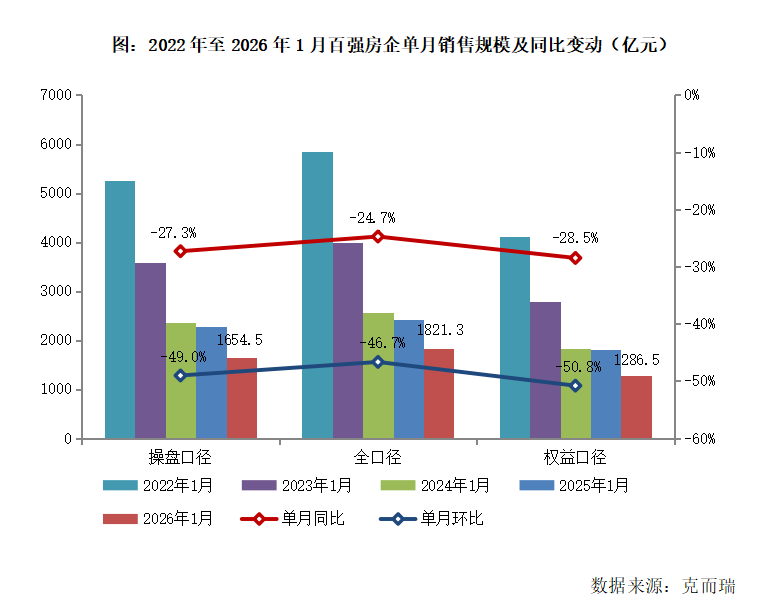
克而瑞地产研究:1月新房市场整体进入淡季 百强房企单月业绩1654.5亿元
智通财经网· 2026-02-11 13:19
Core Viewpoint - The real estate market in China is experiencing a seasonal slowdown in January 2026, but there are signs of recovery in the second-hand housing market in key cities, which may stabilize market expectations and lead to a potential "small spring" after the Spring Festival, especially with supportive policies in place [1][12]. Group 1: Sales Performance - The top 100 real estate companies achieved a total sales amount of 165.45 billion yuan in January 2026 [2][8]. - 32 companies among the top 100 reported year-on-year sales growth, with 10 companies experiencing growth rates exceeding 100% [8][10]. - Notably, companies like Junyi Holdings and Bangtai Group saw significant increases in sales, with Junyi Holdings reporting a staggering growth of 757.4% [10]. Group 2: Market Dynamics - The new housing market showed weak performance with a transaction area of approximately 8.1 million square meters, while the second-hand housing market saw a 16% month-on-month increase and a 33% year-on-year increase in transaction area [12]. - The central government has introduced various supportive policies focusing on urban renewal, financing optimization, and tax incentives to stimulate the real estate market [12][13]. Group 3: New Entrants and Rankings - In January 2026, seven new companies entered the top 100 list, with CITIC City Opening making a notable entry into the top 30 [5][6]. - The sales performance of new entrants indicates that some small and medium-sized private enterprises are managing to maintain stable operations and achieve growth despite market challenges [5][8].



沪市债券新语 | 扩品增类启新程 商业REITs激活资管新生态
Xin Lang Cai Jing· 2026-02-11 12:33
Core Viewpoint - The launch of commercial real estate investment trusts (REITs) in China represents a significant new option for investors, enhancing the asset allocation landscape and promoting the efficient utilization of existing social assets [2][4]. Group 1: Introduction of Commercial Real Estate REITs - The China Securities Regulatory Commission (CSRC) announced the pilot program for commercial real estate REITs on December 31, 2025, marking a key step in expanding public REITs to encompass a wider range of underlying assets [2]. - The first batch of commercial real estate REITs projects was disclosed by the CSRC and exchanges at the end of January 2026, indicating a growing market interest and the transition of public REITs into a more diversified phase [2][3]. Group 2: Value Creation and Market Opportunities - China has accumulated a substantial amount of quality commercial real estate, which holds significant value potential, especially as the economy shifts towards efficiency and innovation [3]. - The first batch of commercial real estate REITs projects has shown stable cash flows and strong historical performance, particularly from state-owned enterprises in key urban areas [3][4]. Group 3: Industry Transformation and Financial Innovation - The introduction of commercial real estate REITs is seen as a pivotal opportunity for the real estate industry to transition from a high-leverage development model to a more sustainable asset management approach [5]. - REITs provide a crucial "pricing anchor" for the commercial real estate market, enhancing price transparency and enabling better asset valuation through public market mechanisms [5][6]. Group 4: Demand and Supply Dynamics - The ongoing low-interest-rate environment has shifted the asset allocation logic, creating favorable conditions for the adoption of commercial real estate REITs, which can meet the demand for stable, long-term income assets [6][7]. - The market has seen a rational adjustment in valuations for quality commercial properties, providing a foundation for REITs to acquire or consolidate assets at reasonable costs [7][8]. Group 5: Regulatory Framework and Compliance - The development of commercial real estate REITs is guided by a commitment to market-oriented and legal principles, ensuring compliance while fostering innovation [9][10]. - Regulatory bodies emphasize the importance of balancing compliance with market needs, allowing for a constructive approach to project approvals and asset management [10]. Group 6: Future Outlook - The launch of commercial real estate REITs is expected to enhance the multi-tiered capital market system in China, facilitating better financing channels for the real economy and contributing to high-quality economic development [11].
