
国睿科技

Search documents
长不大的“五毛基”
Shang Hai Zheng Quan Bao· 2025-12-01 19:23
Core Insights - The article discusses the performance of public funds in a structurally rising market, highlighting the contrast between successful funds and those struggling, referred to as "five-dime funds" [1] - It emphasizes the importance of fundamental analysis, diversification, and effective risk management for fund managers to navigate market cycles successfully [1] Fund Performance Overview - Active equity funds have shown strong performance this year, with the mixed equity fund index rising over 28%. However, many funds have missed opportunities, with 84 active equity funds having a net value below 0.6 yuan as of November 28, and 20 of those below 0.5 yuan [2] - A specific example is the Dongfang Alpha Zhaoyang Mixed Fund, which has a net value of 0.4193 yuan and has lost over 17% this year, primarily due to a concentrated bet on the military industry sector [2] Notable Fund Management Issues - The Huiquan Zhenxin Zhiyuan Mixed Fund, managed by well-known investor Liang Yongqiang, has only returned 5.75% this year and has lost over 50% since inception. The fund has seen multiple changes in management, with significant losses during these transitions [3] Successful Turnarounds - Some previously underperforming funds have successfully recovered, such as Hengyue Advantage Selected Mixed Fund and Huatai Bairui Quality Selected Mixed Fund, which have seen their net values rise above 1 yuan as of November 28 [4] - The Hui Tianfu Hong Kong Advantage Selected Mixed Fund, which switched its holdings to the innovative drug sector, has seen a recovery with over 140% returns this year, reaching a net value of 1.6454 yuan [5] Strategic Adjustments - The Hengyue Advantage Selected Mixed Fund has achieved over 136% returns this year, primarily due to a strategic shift towards storage concept stocks and AI-related investments [6][7] - Fund managers are increasingly focusing on risk management and portfolio diversification to avoid heavy losses during market fluctuations [8] Investor Behavior and Market Dynamics - Despite some funds recovering, many investors have chosen to redeem their shares after net value increases, indicating a lack of confidence in long-term holding [8] - High volatility in fund net values can lead to frequent trading by investors, which diminishes overall returns and creates a cycle of higher risk with lower rewards [9]
第七届金麒麟军工行业最佳分析师第一名广发证券孟祥杰最新行研观点:十五五行业景气扩展三大方向(投资图谱)
Xin Lang Zheng Quan· 2025-12-01 07:01
Group 1 - The 14th Five-Year Plan emphasizes high-quality development in the defense and military sectors, focusing on the construction of unmanned intelligent combat forces and enhancing military system operational efficiency [1] - The plan aims to achieve the centenary goal of building a strong military by accelerating the development of advanced combat capabilities and modernizing military governance [1] - Key areas of focus include improving national security capabilities in emerging fields such as cyber, data, artificial intelligence, and space [1] Group 2 - The demand for AI, commercial aerospace, and large aircraft is expected to rise, with Nvidia's CEO announcing $500 billion in orders for upcoming chip series [2] - Malaysia Airlines is evaluating the C919 aircraft from COMAC as a potential addition to its fleet, indicating growing interest in new aircraft models [2] - Domestic companies are successfully producing GaN power amplifier chips for mobile devices, with over 1 million units delivered, highlighting advancements in consumer electronics [2] Group 3 - Investment opportunities are identified in companies benefiting from domestic demand and overseas expansion, including AVIC Shenyang Aircraft, AVIC Xi'an Aircraft, and others [3] - The military AI-driven information technology upgrade presents opportunities across the entire supply chain, with companies like Ruichuang Micro-Nano and AVIC Optoelectronics highlighted [3] - The civil aviation sector's capacity expansion and opportunities in large aircraft and controllable nuclear fusion are noted, with a focus on companies like Aero Engine Corporation and China Power [3]

军工周报:国家航天局设立商业航天司,关注商业航天投资机会-20251130
NORTHEAST SECURITIES· 2025-11-30 12:12
Investment Rating - The report maintains an "Outperform" rating for the defense and military industry [5] Core Insights - The establishment of the Commercial Space Administration by the National Space Administration signifies a dedicated regulatory body for the commercial space industry, which is expected to drive high-quality development and benefit the entire industry chain [2][37] - The low-altitude economy is entering a phase of accelerated commercialization, with significant policy support and new product development, indicating a promising growth trajectory [3][36] - The defense and military sector is projected to experience sustained growth due to the execution of backlog orders from the 14th Five-Year Plan and the introduction of new orders under the 15th Five-Year Plan [3][38] Summary by Sections Market Review - The defense and military index rose by 2.85% last week, ranking 14th among 31 primary industries [1][13] - The current PE (TTM) for the defense and military sector is 77.60 times, with aerospace equipment at 305.61 times and military electronics at 106.55 times [1][22] Key Recommendations - Recommended companies include: 1. Downstream manufacturers: AVIC Chengfei, Hongdu Aviation, AVIC Shenyang, AVIC Xifei 2. New military technologies: Lianchuang Optoelectronics, Guangqi Technology, Zhongjian Technology 3. Underwater equipment: Yaxing Anchor Chain, Zhongke Haixun, Changying Tong 4. Missile industry chain: Feili Hua, Guoke Military Industry, Zhongbing Hongjian 5. Military titanium materials: Western Superconducting 6. Electronic components: Hongyuan Electronics, Aerospace Electric [4][40][41][42][43][44][45][46] Industry Dynamics - The National Space Administration's action plan for commercial space development aims for a significant expansion of the industry by 2027, enhancing innovation and resource utilization [2][37] - The low-altitude economy is being bolstered by new regulations and infrastructure developments, with a focus on safety and efficiency in low-altitude flight activities [3][34][36]


军贸行业深度研究报告:军费增长释放需求,格局重塑催生机遇
Western Securities· 2025-11-27 11:11
Investment Rating - The industry rating is "Overweight" and has been maintained from the previous rating [8] Core Insights - The military trade industry is experiencing rapid growth due to increasing military expenditures and evolving supply-demand dynamics driven by geopolitical conflicts [5][11] - The demand for military products is shifting, with aircraft being the primary focus, an increase in missile demand, and a promising outlook for unmanned equipment [6][11] - China is strategically expanding its military trade, focusing on systematic output and seizing overseas opportunities [6][11] Summary by Sections Military Expenditure Growth - Global military spending has increased for ten consecutive years, with a projected rise to $27,180 billion in 2024, reflecting a 9.36% increase from 2023 [20][24] - The military burden, defined as military spending as a percentage of global GDP, is expected to rise to 2.46% in 2024 [20] - The U.S. leads in military spending, projected at $997.31 billion in 2024, while China ranks second with $313.66 billion [24] Military Trade Demand - The Asia-Pacific region has the highest import volume, while Europe shows the fastest growth in military imports [25][29] - Ukraine has emerged as the largest arms importer due to the ongoing conflict, with imports increasing nearly 100-fold from 2015-2019 levels [37][41] - India remains the second-largest arms importer, although its reliance on Russian arms is decreasing [48] Military Trade Supply - The U.S. maintains a dominant position in the global arms market, with its exports accounting for 46.69% of the total military trade volume in 2024 [60] - The top five arms exporting countries from 2020-2024 are the U.S., France, Russia, China, and Germany, with the U.S. significantly increasing its market share [54][60] - Russia's arms exports have declined sharply due to geopolitical tensions and sanctions, dropping to 4.63% of global exports in 2024 [68] Key Companies in the Industry - The top 100 defense companies generated $632 billion in revenue in 2023, with U.S. firms accounting for a significant portion [72] - Lockheed Martin is highlighted as a leading defense contractor, with a projected revenue of $71.04 billion in 2024, primarily from U.S. government contracts [77][80]
纳睿雷达3.7亿元收购芯片公司 强化雷达核心部件自研能力
Xin Lang Cai Jing· 2025-11-27 10:53
Core Viewpoint - Guangdong Narui Radar Technology Co., Ltd. plans to acquire 100% equity of Tianjin Sigma Microelectronics Technology Co., Ltd. for a transaction price of 370 million yuan, aiming to enhance radar-specific chip design capabilities and establish a self-controlled chip technology system [1][2] Transaction Background - Narui Radar currently relies on purchasing general-purpose chips for phased array radar, with chip costs accounting for 23%-29% of the total machine cost. As the next-generation digital phased array radar technology evolves, the chip cost proportion is expected to rise to 30%-50% [2] - The target company possesses mature technology reserves in optoelectronic sensors and MCU chips, with its ADC/DAC intellectual property matrix aligning with radar chip demands [2] Synergy Effects - Post-acquisition, self-developed chips are expected to enhance product competitiveness in terms of cost and performance. For instance, the price of MCU chips is projected to drop over 50% from 15 yuan to 3 yuan per unit [3] - Key performance parameters of the next-generation radar using self-developed chips are anticipated to improve significantly, including a 46.5% increase in peak power and an 8.6% reduction in system noise figure [3] R&D Progress - The target company has delivered MCU chip samples for testing, with plans for small batch verification within six months. Projects for ADC and DAC chips are underway, with a total investment of 140 million yuan planned for radar-specific chip R&D [4] - The core team of the target company has over 20 years of chip design experience, facilitating a feasible collaboration with Narui Radar's technical team [4] Valuation and Integration - The transaction price of 370 million yuan is significantly lower than the historical valuation of 1.05 billion yuan, reflecting changes in the semiconductor investment environment [5] - Management shareholders will lock in 78% of their shares for 36 months, with performance commitments set for 2025-2027 [5] Industry Benchmarking - The acquisition positions Narui Radar to transition from purchasing general-purpose chips to custom chip design, addressing gaps in radar-specific chip capabilities and laying the groundwork for expansion into new areas such as 5G communication and satellite radar [6] Independent Financial Advisor Opinion - CITIC Securities believes the transaction will help the listed company reduce core component procurement costs and acquire key technologies, with the transaction price deemed fair [7]

重庆加入!多省市真金白银支持低空经济
Xin Lang Cai Jing· 2025-11-27 08:19
转自:智通财经 《科创板日报》11月27日讯(编辑 宋子乔)日前,重庆发布推动低空经济高质量发展的相关措施,真 金白银支持低空经济的发展,实施期限到2027年12月31日。 支持低空装备企业开展"订单式"研发制造,按项目投资总额的20%支持,最高300万元。 对符合条件的低空领域现代生产性服务业项目,按照单个项目原则上不超过项目投资总额的 10%,一次性给予最高不超过500万元的支持,最高不超过2000万元。 重庆提出的补贴方向涉及低空示范场景、低空产业创新发展、低空保障体系,补贴对象包括通用航空、 无人机整机及零部件制造、低空飞行运营及保障等相关企业: (1)低空物流、城市空中交通航线为主的低空示范场景补贴 小型无人机航线:常态化运营1年以上、年执行≥1000架次(往返为1架次,下同),一次性 补贴5万元;中大型无人机航线:常态化运营1年以上、年执行≥500架次,一次性补贴15万 元。单个企业年度支持总额不超过100万元。 对开通通用航空短途运输或eVTOL商业运行航线的企业,按规定给予支持,市、区县各承 担50%。 (2)试飞测试基地建设、低空装备制造为主的低空产业创新发展补贴 对于投资额超过500万元的 ...


地方政府与城投企业债务风险研究报告:南京市
Lian He Zi Xin· 2025-11-26 11:26
Report Industry Investment Rating No relevant content provided. Core Views of the Report - Nanjing, an important central city in eastern China, has obvious regional advantages, convenient transportation, a high - level of urbanization, a reasonable industrial structure, and clear industrial planning. In 2024, its economic aggregate and general public budget revenue ranked second in Jiangsu Province. The general public budget revenue has good quality and strong fiscal self - sufficiency, while government - funded revenue decreased year - on - year. The government debt burden is at a medium level among prefecture - level cities in Jiangsu [4]. - Among Nanjing's districts, Jiangning District has the strongest overall economic strength, and core areas such as Jianye and Xuanwu Districts have prominent per - capita GDP levels. There are differences in fiscal strength among districts. Affected by the real - estate market adjustment, the government - funded revenues of Jiangning, Lishui, and Liuhe Districts are under significant pressure. Most areas have a relatively heavy overall debt burden [4]. - Nanjing has a large number of existing bond - issuing urban investment enterprises, with the main body ratings being AA and AA+. In 2024, the net financing of urban investment bonds turned from net inflow to net outflow. In the first three quarters of 2025, the net financing continued to show a large - scale net outflow. The debt scale of bond - issuing urban investment enterprises continued to grow, and some district - level platforms have heavy debt burdens and weak short - term solvency indicators [4]. Summary by Relevant Catalogs I. Nanjing's Economic and Fiscal Strength (1) Regional Characteristics and Economic Development in Nanjing - Regional advantages and transportation: Nanjing is the capital of Jiangsu Province, with obvious regional advantages and a well - developed transportation network including railways, highways, waterways, and aviation. In 2024, it opened new international train lines, and its subway, airport, and port all had good development [5][7]. - Urbanization level: By the end of 2024, Nanjing's permanent population was 9.577 million, ranking second in Jiangsu, with an urbanization rate of 87.3%, higher than the provincial average [6]. - Economic aggregate: In 2024, Nanjing's GDP was 1.850081 trillion yuan, ranking second in Jiangsu, with a growth rate of 4.5%. In the first half of 2025, it was 917.918 billion yuan, with a year - on - year growth of 5.3% [8]. - Industrial structure: Nanjing has a reasonable industrial structure and a clear "2 + 6+6" industrial plan. In 2024, investment in advanced manufacturing and related product output increased [9]. - Policies and support: Since 2024, Nanjing has introduced various economic guidance policies and received support from the superior government in terms of fiscal transfer payments [12]. (2) Nanjing's Fiscal Strength and Debt Situation - Fiscal revenue: In 2024, Nanjing's general public budget revenue ranked second in Jiangsu, with good quality and strong fiscal self - sufficiency. Government - funded revenue decreased year - on - year, and superior subsidies contributed to the comprehensive fiscal resources [14]. - Debt burden: By the end of 2024, Nanjing's local government debt ratio and debt - to - GDP ratio ranked eighth among prefecture - level cities in Jiangsu, at a medium level [16]. II. Economic and Fiscal Conditions of Nanjing's Districts (Counties, Cities) (1) Economic Strength of Nanjing's Districts - Regional planning: Nanjing will build a spatial structure of "rural areas in the north and south, a metropolis in the middle, development along the Yangtze River, and urban - rural integration" [18]. - Industrial development: Each district forms characteristic industrial clusters based on its own resource endowments, such as integrated circuits and biomedicine in Jiangbei New Area, and advanced manufacturing in Jiangning District [21]. - Economic development: In 2024, there were significant differences in the economic aggregates of Nanjing's districts. The economic growth rates of 11 districts were relatively balanced, and there were large differences in per - capita GDP levels [22]. (2) Fiscal Strength and Debt Situation of Each District - Fiscal revenue: In 2024, there were differences in fiscal strength among districts. Most areas had stable general public budget revenues. Tax revenues accounted for a high proportion, and the government - funded revenues of Jiangning, Lishui, and Liuhe Districts were under pressure. The comprehensive fiscal resources of Jiangning and Jiangbei New Areas were in the first echelon [28][34]. - Debt situation: Except for Jianye District, the government debt balances of other districts increased. Most areas had a relatively heavy overall debt burden, with Jiangning District having the largest debt scale and Gaochun District having the heaviest debt burden [36]. - Debt management: Nanjing and its districts have strengthened debt monitoring and management, and each district has formulated differentiated debt management plans [39][41]. III. Debt - Repayment Ability of Nanjing's Urban Investment Enterprises (1) Overview of Urban Investment Enterprises - As of September 30, 2025, there were 67 urban investment enterprises with existing bonds in Nanjing. The main body ratings were mainly AA and AA+. Since 2024, the ratings of 2 urban investment enterprises have been upgraded [44][45]. (2) Bond - Issuing Situation of Urban Investment Enterprises - In 2024, the bond - issuing scale of Nanjing's urban investment enterprises increased slightly year - on - year, and the net financing of urban investment bonds turned from net inflow to net outflow. In the first three quarters of 2025, the net financing continued to show a large - scale net outflow [46]. (3) Analysis of Debt - Repayment Ability - As of the end of 2024, the debt scale of Nanjing's bond - issuing urban investment enterprises continued to grow, concentrated in the city - level, Jiangning, and Jiangbei New Areas. Some district - level platforms had heavy debt burdens and weak short - term solvency indicators. In 2024 and the first half of 2025, the financing efforts of urban investment enterprises increased [51][59]. (4) Support and Guarantee Ability of Fiscal Revenue for the Debt of Bond - Issuing Urban Investment Enterprises - The ratio of "total debt of bond - issuing urban investment enterprises + local government debt" to "comprehensive fiscal resources" in Nanjing's districts ranges from 1321.72% to 127.20%, showing serious differentiation [61].
【投资视角】启示2025:中国量子精密测量行业投融资及兼并重组分析(附投融资汇总、产业基金和兼并重组等)
Qian Zhan Wang· 2025-11-26 08:20
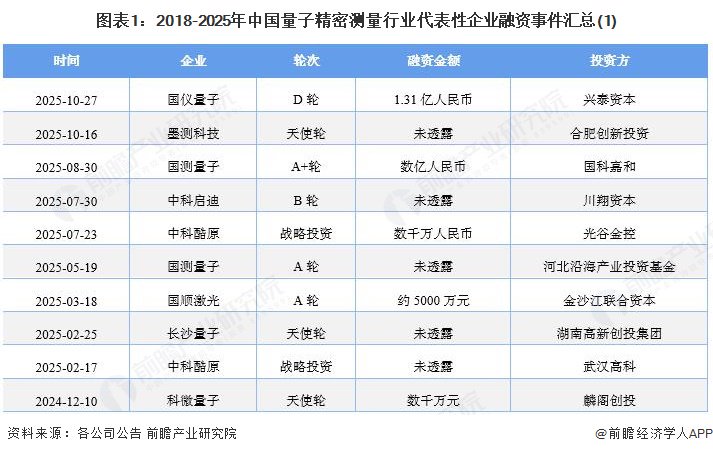
Core Insights - The quantum precision measurement industry in China is experiencing concentrated investment activities, particularly in the quantum sensor sector, with significant funding events reported from 2018 to 2025 [1][2][3] Investment and Financing Overview - Investment in the quantum precision measurement industry is primarily focused on the quantum sensor field, with the highest single financing amount reported at 131 million yuan (approximately 1.31 billion yuan) for Guoyi Quantum's D round [1][2] - From 2017 to 2024, the financing trend shows a few large amounts dominating the market, with a total financing amount of 0.38 billion USD in 2024, slightly down from 2023 [2][3] - The number of financing events in 2024 reached 4, with an average single financing amount of 9.5 million USD, indicating a strategic focus and sustained investment in the sector [3] Financing Rounds - The majority of financing rounds in the quantum precision measurement industry are concentrated in the angel and A rounds, primarily occurring before companies go public [4][7] Geographic Distribution - The majority of financing enterprises are located in Anhui Province, which accounts for 41% of the total. Hefei, Anhui, has developed a comprehensive industrial ecosystem covering quantum computing, communication, and precision measurement [8] - The industrial cluster in Hefei, known as "Quantum Avenue," includes over 90 upstream and downstream enterprises, with leading companies like Guandun Quantum and Guoyi Quantum [8] Investor Profile - The primary investors in the quantum precision measurement industry are investment firms, with notable participants including Guofeng Investment Fund, Chinese Academy of Sciences Capital, and IDG Capital [11] Industry Funds - There are currently few industry funds closely related to the quantum precision measurement sector, with notable funds including the Hefei Co-Creation Venture Capital Fund, which focuses on integrated circuits and quantum industries [14][16] Mergers and Acquisitions - Mergers and acquisitions in the quantum precision measurement industry are limited, primarily consisting of horizontal mergers aimed at enhancing business capabilities [17][18]




国睿科技跌2.01%,成交额2.62亿元,主力资金净流出2511.52万元
Xin Lang Zheng Quan· 2025-11-25 05:20
Core Insights - Guorui Technology's stock price decreased by 2.01% on November 25, trading at 27.32 CNY per share with a market capitalization of 33.928 billion CNY [1] - The company has seen a year-to-date stock price increase of 38.17%, but a decline of 6.95% over the past 20 days [1] Financial Performance - For the period from January to September 2025, Guorui Technology reported a revenue of 2.118 billion CNY, representing a year-on-year growth of 6.68% [2] - The net profit attributable to shareholders for the same period was 373 million CNY, showing a slight increase of 1.15% year-on-year [2] Shareholder Information - As of September 30, 2025, the number of shareholders decreased by 10.35% to 32,900, while the average number of circulating shares per person increased by 11.54% to 37,704 shares [2] - The company has distributed a total of 1.173 billion CNY in dividends since its A-share listing, with 540 million CNY distributed over the last three years [3] Institutional Holdings - As of September 30, 2025, major shareholders include Huaxia Military Safety Mixed A, which increased its holdings by 7.814 million shares, and other funds like Fortune China Securities Military Leader ETF and Southern Military Reform Flexible Allocation Mixed A, which also increased their stakes [3]
亚太局势不确定性加剧,我国装备建设或将提速,关注新质战斗力
Orient Securities· 2025-11-24 05:55
Investment Rating - The report maintains a "Positive" investment rating for the defense and military industry [5] Core Viewpoints - The uncertainty in the Asia-Pacific situation is increasing, which may accelerate the equipment construction in China, focusing on new combat capabilities [2][12] - China's high-end aviation equipment showcased at the Dubai Airshow is expected to further expand the military trade market [12][15] - The Fujian aircraft carrier has conducted its first live training at sea, indicating a significant advancement in operational capabilities and technology [12][18] - The report emphasizes the importance of domestic demand for new combat capabilities and military trade as key growth areas [19] Summary by Sections Investment Suggestions and Targets - The report highlights various investment targets across different segments, including: - Engine and fuel chain: Companies like Xi'an Aero Engine (600893), Western Superconducting (688122), and others [19][20] - New quality and domains: Companies such as Aerospace Electronics (600879), Haige Communication (002465), and others [19][20] - Military electronics: Companies like Aerospace Electric (002025), Zhonghang Optical (002179), and others [19][20] - Military trade and main equipment: Companies such as AVIC Shenyang Aircraft (600760), AVIC Chengfei (302132), and others [19][20] Industry News and Market Performance - The report notes that the defense and military industry index has outperformed the broader market, with a decline of only -1.72% compared to the Shanghai Composite Index's -3.90% [22][25] - The report provides a detailed analysis of weekly market performance, indicating that the defense and military sector remains resilient amid broader market declines [22][25] Key Events and Developments - The report outlines significant recent events, including: - The U.S. government approved a new round of arms sales to Japan, which may heighten regional tensions and prompt China to expedite its military equipment development [12][9] - The successful live training of the Fujian aircraft carrier, showcasing advanced operational capabilities [12][18] - The participation of Chinese high-end military equipment in international exhibitions, enhancing China's presence in the global military trade market [12][15]


