长安汽车

Search documents
德赛西威20251225
2025-12-26 02:12
Summary of Desay SV's Conference Call Company Overview - **Company**: Desay SV - **Industry**: Automotive Technology and Smart Driving Solutions Key Points and Arguments Financial Performance and Projections - Desay SV expects a stable long-term gross margin around 20%, benefiting from increased penetration of traditional joint venture brands in smart driving and premium revenue from overseas operations [2][3] - The company’s contract manufacturing business currently accounts for 10% to 15% of total revenue, with expectations that this proportion will not significantly increase in the long term due to rising contributions from traditional brands' smart driving systems [3] Market Dynamics and Product Development - The cockpit sector has potential for increased per-vehicle value, driven by the demand for higher performance chips as L3 autonomous driving progresses [2][6] - Desay SV anticipates new customers in the smart driving sector primarily from traditional brands and sub-brands that did not launch this year, with a shift towards higher-margin projects expected [7] - The company is collaborating closely with domestic autonomous driving chip manufacturers, maintaining the ability to transition from OV platforms to others [9] Overseas Market Strategy - As of Q3, overseas revenue accounted for 7.5%, with expectations of remaining below 10% for the year. The goal is to increase this to 20% by 2030, starting with mass production of integrated cockpit solutions in Q4 next year [8] Supply Chain and Cost Management - Desay SV has a strong supply chain management capability, particularly in procurement and logistics, providing a significant cost advantage over competitors [11] - The company is addressing rising material costs, especially memory prices, by negotiating cost-sharing with clients and ensuring stable supply for automakers [4] Product Innovation and Competitive Edge - The company’s autonomous vehicles adhere to automotive-grade standards and are fully self-developed, which enhances reliability and quality, allowing Desay SV to capture market share without engaging in price wars [10] - The introduction of L3 autonomous driving standards is expected to significantly enhance vehicle value and increase the demand for high-performance chips [6][12] Customer Structure and Market Trends - The customer base is becoming more diversified, with revenue from any single customer now below 20%. The company expects stable demand from core clients despite competitive pressures [13] - Future market demand is anticipated to be influenced by tax incentives and trade-in policies, with core customers maintaining a strong demand for autonomous configurations [15][16] Research and Development - A decrease in R&D expenses in Q3 is viewed as a temporary phenomenon, with plans to maintain a stable R&D investment ratio to support ongoing innovation [15] Additional Important Insights - Desay SV is exploring opportunities in the instant retail market and potential collaborations in the Robotaxi sector, which is expected to yield higher margins compared to traditional passenger vehicles [12] - The company is positioned to benefit from the growing Robotaxi market, which has a significantly higher value than traditional vehicles, contributing to improved gross margins [12]
政策开闸、车企抢跑,自动驾驶商业化“爬坡”进行时
Xin Hua Cai Jing· 2025-12-26 01:39
Group 1 - GAC Group's Haobo A800 has officially started L3 conditional autonomous driving highway testing, with a maximum speed of 120 km/h, approved by relevant authorities in Guangzhou [1] - The rapid advancement of L3 conditional autonomous driving indicates that the era of autonomous driving is accelerating [1] - The Ministry of Industry and Information Technology has officially announced the first batch of L3 autonomous driving models approved for testing in designated areas in Beijing and Chongqing [2] Group 2 - The essence of L3 level is the "phased transfer of driving responsibility," where the system becomes the actual driver in limited scenarios, while human drivers become standby operators [2] - The first batch of L3 models marks a significant milestone in allowing autonomous vehicles to enter the market in product form and explore commercialization [2] - Various brands, including XPeng and Li Auto, have accelerated their L3 autonomous driving approvals, with XPeng obtaining a testing license in Guangzhou and Li Auto in Beijing [2][3] Group 3 - XPeng's second-generation VLA platform, capable of L4 level, is expected to achieve mass production by Q1 2026 [3] - The first L3 autonomous driving special license plate was issued in Chongqing, and Beijing also issued its first batch of L3 highway autonomous vehicle license plates [3] - Companies like Baidu Apollo and Pony.ai are conducting regular operations of Robotaxi in specific areas, with some platforms achieving over a thousand daily orders [3] Group 4 - The global Robotaxi market is forming a "China-US dual-pole leadership" with rapid growth in the Middle East [5] - Tesla and Waymo are leading the industry in the US, while Chinese companies like Pony.ai and WeRide are expanding their operations domestically [5] - Chinese companies are accelerating their technology output and fleet deployment in regions like the Middle East and Southeast Asia [5][6] Group 5 - The Middle East is becoming a key market for Chinese companies due to high customer prices and strong policy support for autonomous driving [6] - The economic model of Robotaxi is at a critical turning point, with expectations of significant improvements in profitability by 2030 [6] - In the US and UAE, the profitability potential of Robotaxi is more significant, with projected gross margins of 53% and 44% respectively by 2030 [6] Group 6 - Despite the acceleration of commercialization, L3 autonomous driving is currently limited to specific pilot units and scenarios, with challenges remaining [7] - The commercial viability of L3 autonomous driving is questioned, as current regulations and market acceptance are still developing [8] - Some experts suggest that many manufacturers may skip L3 production and move directly to L4 level vehicles [8]


长安汽车总裁赵非:技术务实锚定产业稳态 生态聚力激活资本估值
Zhong Guo Zheng Quan Bao· 2025-12-26 00:21
Core Insights - Zhao Fei's career reflects Changan Automobile's transformation from a traditional manufacturer to a technology company, leading the firm through the challenges of profitability in the new energy vehicle (NEV) sector [1] - Changan's NEV sales have exceeded 100,000 units for three consecutive months, with an annual target of one million units, showcasing the company's commitment to technological advancement and market adaptation [1][2] Group 1: Strategic Management and Organizational Restructuring - Zhao Fei's appointment is part of a systematic organizational restructuring during a critical strategic transition for Changan, with a complete personnel reshuffle across the group and its main brands [2] - The company aims for a stable progression in the NEV market, predicting a 7:3 ratio of NEVs to fuel vehicles in China within two to three years, while globally, fuel vehicles will still account for 70% by 2030 [2] - Changan emphasizes a rational approach to technology, focusing on steady growth rather than aggressive competition, with a commitment to internal capabilities [2] Group 2: Industry Challenges and Responses - Changan welcomes government efforts to address industry over-competition, having reduced supplier payment cycles to 53 days to build trust within the supply chain [3] - The company is committed to avoiding a "no profit" cycle in the industry, advocating for responsible pricing practices [3] - Changan invests 6% of its sales revenue in R&D annually, underscoring the importance of innovation in its transition to a technology-driven enterprise [3] Group 3: Technological Advancements and Safety - The company has achieved significant milestones in L3-level autonomous driving technology, becoming one of the first in China to utilize specialized licenses for such vehicles [3][4] - Zhao Fei identifies data as the critical factor for advancing from L3 to L4 autonomous driving capabilities, emphasizing the need for extensive data to enhance system performance [4] Group 4: Brand Strategy and Market Positioning - Changan's three NEV brands—Avita, Deep Blue, and Changan Origin—are strategically positioned to target different market segments, supported by a centralized management structure [5] - Avita has established a foothold in the high-end market, while Deep Blue has attracted younger consumers with innovative technology [5] Group 5: Capital Operations and Global Strategy - Capital operations are crucial for enhancing the competitiveness of Changan's sub-brands, with a focus on building capabilities rather than immediate profitability [6] - Changan aims for overseas sales to exceed 600,000 units by 2025, with a comprehensive strategy for global market penetration [6] - The company maintains a proactive stance on supply chain risks, particularly regarding battery and chip prices, and is recognized for its advancements in domestic chip applications [6] Group 6: Market Valuation and Operational Quality - Zhao Fei emphasizes that market valuation is a gradual process based on operational quality rather than speculative practices [7] - Changan's focus on practical R&D over marketing has helped it avoid pitfalls in the NEV transition, building a robust foundation of technological and brand strength [7] - The company's transformation is characterized by a systematic approach to value reconstruction, with a clear path for enhancing efficiency and expanding globally [7]

L3级产品上路,激活产业六种可能
2 1 Shi Ji Jing Ji Bao Dao· 2025-12-25 22:52
L3上路激活的第二个发展可能,是汽车产业由此进入"第二曲线"。过去以来凭借新能源电动化第一曲 线,中国汽车产业实现赶超,确立了这个领域汽车科技与产业供应链的全球先导地位。如今自动驾驶、 数字座舱、数字地盘等智能化发展大潮来临,中国汽车产业又面临着第二次发展机遇,如果及时主动实 施智能发展战略,不仅有希望再一次矗立潮头,而且有希望进入汽车产业发展的第二曲线。此次L3上 路,实质是为"第二曲线"正式按下了启动键。此举也标志着产业竞争重点从电动化时代的"三电"系统, 转向"三电+智能"的双引擎发展新格局。中国汽车产业进入以科技深度赋能为特征的新阶段。 第三个可能是推动消费增长与智能应用场景创新。相关部门近期印发的《关于增强消费品供需适配性进 一步促进消费的实施方案》明确提出,到2027年要将智能网联汽车产业打造成三个万亿级消费领域之 一。L3级自动驾驶正是撬动这一万亿市场的技术支点。L3不仅创造新的驾乘体验,也有利于激活和创 造新的消费需求,使汽车从单纯的出行工具,演进为连接各种生活与服务场景的移动智能空间。 激活的第四种发展可能是,自动驾驶对汽车、智能科技产业链产生带动作用。L3级自动驾驶是高度复 杂的技术集成系 ...
长安汽车总裁赵非: 技术务实锚定产业稳态 生态聚力激活资本估值
Zhong Guo Zheng Quan Bao· 2025-12-25 21:11
Core Insights - Zhao Fei's appointment as president of Changan Automobile symbolizes the company's transition from a traditional manufacturer to a technology-driven enterprise, focusing on navigating the profitability challenges in the electric vehicle (EV) sector [1] - Changan's strategy emphasizes leveraging ecological advantages and capital power, aiming for a more intelligent approach to operations [1] Group 1: Strategic Direction - Changan has undergone a comprehensive organizational restructuring, with a focus on stabilizing and advancing its operations in the EV market [2] - The company anticipates that the market share of EVs to fuel vehicles in China will reach 70:30 within the next two to three years, while globally, fuel vehicles will still account for 70% by 2030 [2] - Zhao Fei acknowledges the recent sales achievements of over 100,000 units for three consecutive months, attributing this to the company's commitment to mastering technology since its third entrepreneurial phase in 2017 [2] Group 2: Industry Challenges and Responses - Changan welcomes government efforts to address industry competition issues, having reduced supplier payment cycles to 53 days to build trust within the supply chain [3] - The company is committed to maintaining a research and development (R&D) investment of 6% of sales revenue, emphasizing the importance of innovation in transitioning to a technology company [3] - Changan's collaboration with Huawei is framed as a dual approach, balancing respect for partnerships with a commitment to technological independence and safety [3] Group 3: Technological Advancements - The company has recently achieved a significant milestone by becoming one of the first in China to utilize L3-level autonomous driving technology, focusing on safety through extensive testing and data collection [3][4] - Zhao Fei identifies data as the critical factor for advancing from L3 to L4 autonomous driving capabilities, highlighting the importance of a robust global R&D network [4] Group 4: Brand and Capital Strategy - Changan's three EV brands—Avita, Deep Blue, and Changan Origin—are strategically positioned to target different market segments, supported by a centralized management structure to minimize internal competition [5] - Capital operations are viewed as essential for enhancing the competitiveness of sub-brands, with Deep Blue achieving 700,000 cumulative deliveries and a strong likelihood of profitability in the coming year [6] - The company aims to expand its global presence, targeting 600,000 overseas sales by 2025, while acknowledging the need for improved efficiency and effectiveness in international markets [6] Group 5: Market Positioning and Future Outlook - Zhao Fei emphasizes that market valuation is a gradual process based on operational quality rather than speculation, aligning with Changan's focus on practical engineering and R&D [7] - The company is building a competitive edge through a combination of technological barriers, brand differentiation, and global production capabilities, marking a significant shift from scale competition to value competition in the automotive industry [7]
技术务实锚定产业稳态 生态聚力激活资本估值
Zhong Guo Zheng Quan Bao· 2025-12-25 21:11
Core Insights - Zhao Fei's appointment as president of Changan Automobile symbolizes the company's transformation from a traditional manufacturer to a technology-driven enterprise, particularly in the context of navigating the profitability challenges in the new energy vehicle (NEV) sector [1][2] - Changan's NEV sales have exceeded 100,000 units for three consecutive months, with a target of reaching one million units annually, reflecting a commitment to steady growth rather than aggressive competition [2][3] Group 1: Strategic Direction - The company aims to leverage its ecological advantages and utilize capital effectively, moving beyond traditional hard work to smarter operations [1][3] - Zhao Fei emphasizes a balanced approach to market trends, predicting a 7:3 ratio of NEVs to fuel vehicles in China within two to three years, while globally, fuel vehicles will still account for 70% by 2030 [2][3] - Changan has undergone a comprehensive organizational restructuring to support its strategic transformation, with a focus on R&D, responsibility, and data integrity [1][3] Group 2: R&D and Innovation - Changan invests 6% of its sales revenue in R&D, underscoring the importance of technological advancement in its transition to a tech company [3][4] - The company has achieved a significant milestone by becoming one of the first in China to utilize L3-level autonomous driving technology, highlighting its commitment to safety and innovation [3][4] - Zhao Fei believes that the transition from L3 to L4 technology will hinge on data accumulation, which Changan is well-positioned to achieve through its global R&D network [4] Group 3: Market Positioning and Capital Strategy - Changan's three NEV brands—Avita, Deep Blue, and Changan Origin—are strategically positioned to capture different market segments, supported by a centralized management structure to minimize internal competition [4][5] - The company views capital operations as essential for enhancing the competitiveness of its sub-brands, with Deep Blue expected to achieve profitability next year [5][6] - Changan is proactive in managing supply chain risks, particularly regarding battery and chip prices, and is recognized as a leader in the application of domestic chips [5][6] Group 4: Global Expansion and Valuation - Changan aims to achieve overseas sales of 600,000 units by 2025, with plans to enhance efficiency and effectiveness in its global operations [5][6] - The company is focused on building a strong valuation through quality operations rather than speculative market activities, aligning with its engineering and entrepreneurial culture [6] - The transformation of Changan is characterized by a systematic approach to value reconstruction, moving from scale competition to value competition in the automotive industry [6]
航天智造:持续关注商业航天产业发展动态,努力寻求市场机会
Zheng Quan Shi Bao Wang· 2025-12-25 13:33
Core Viewpoint - Aerospace Intelligent Manufacturing (航天智造) is experiencing growth in its automotive parts business, driven by the overall increase in the automotive industry, particularly in the electric vehicle sector, while also exploring opportunities in the commercial aerospace sector [1][2][3] Group 1: Financial Performance - For the first three quarters of 2025, the company achieved operating revenue of 6.707 billion yuan, a year-on-year increase of 22.01%, and a net profit attributable to shareholders of 651 million yuan, up 21.43% year-on-year [1] - The automotive parts business saw a sales revenue increase of 25% year-on-year, supported by a 13.7% increase in passenger car sales and a 34.9% increase in new energy vehicle sales [1] Group 2: Business Segments - In the automotive parts sector, the company has established strong partnerships with major domestic automakers such as Geely, Changan, and BYD, as well as emerging players like Huawei's HarmonyOS [1][2] - The oil and gas equipment segment maintained stable sales revenue compared to the previous year, focusing on advanced technologies in shale gas and high-temperature, high-pressure perforation systems [1] - The high-performance functional materials segment experienced a decline in performance due to the full electronicization of train tickets, but the company is accelerating market transformation to promote pressure testing membranes as a leading product [1] Group 3: Strategic Focus - The company is closely monitoring developments in the domestic commercial aerospace sector and has not yet participated in related projects, but aims to leverage its core advantages to seek market opportunities in this emerging industry [2] - The company is also paying attention to the development plans of major clients in flying cars and robotics, indicating potential future involvement in these sectors based on industry developments [3]

招商银行AIC首战即大招:豪掷5亿重仓深蓝汽车
Xin Lang Cai Jing· 2025-12-25 12:40
Group 1 - The core point of the article is that the well-known domestic electric vehicle brand, Deep Blue Automotive, backed by Changan Automobile, has successfully completed a capital increase plan, raising a total of 6.122 billion yuan [1][9] - The capital increase involved three investors: Changan Automobile, Chongqing Yufu Group, and China Merchants Bank Investment Financial Asset Investment Company (招银AIC), with Changan contributing 3.122 billion yuan, Chongqing Yufu Group 2.5 billion yuan, and 招银AIC 500 million yuan [1][9] - After the capital increase, Changan Automobile remains the largest shareholder with a stake of nearly 51%, while Chongqing Yufu Group holds approximately 12.09% and 招银AIC enters as a new shareholder with about 2.42% [1][9] Group 2 - Deep Blue Automotive, formerly known as Chongqing Changan New Energy Technology Co., was renamed in April 2023 and operates as an independent electric vehicle brand under Changan Automobile [2][10] - The company reported revenues of nearly 28 billion yuan for the first eight months of 2025, with a total profit loss of 979 million yuan and a net profit loss of approximately 1.005 billion yuan [3][11] - Financial data shows that Deep Blue Automotive has been consistently losing money since its establishment, with total assets of 257 billion yuan and total liabilities of 301.93 billion yuan, resulting in a net asset deficit of nearly 45 billion yuan [3][11] Group 3 - In 2024, Deep Blue Automotive achieved revenues of 37.225 billion yuan, with a net profit loss of about 1.57 billion yuan, while in 2023, revenues were 26.926 billion yuan with a net profit loss of approximately 3.107 billion yuan [4][12] - The company has seen a steady increase in revenue from 15.678 billion yuan in 2022 to 37.225 billion yuan in 2024, although it continues to face significant losses [4][13] - Deep Blue Automotive's product lineup includes various models such as the entry-level S05, mid-size SUV S07, flagship SUV S09, and several sedan models targeting young consumers [7][14] Group 4 - 招银AIC, established in late November 2023, is a new player in the market with a focus on market-oriented debt-to-equity swaps and shareholder investment pilot projects, with a registered capital of 15 billion yuan [8][15] - The investment by 招银AIC in Deep Blue Automotive marks its first significant move since its establishment, indicating a strategic entry into the electric vehicle sector [8][15] - The competitive landscape for Deep Blue Automotive is intensifying, as evidenced by a decline in sales in November despite a year-on-year growth of 45.7% in the first ten months of the year [7][14]


顶着首个L3牌照光环,深蓝汽车增资,渝富招银投资新进,长安汽车把S05、G318车型专利技术评估10.43亿元来入股
Xin Lang Cai Jing· 2025-12-25 12:40
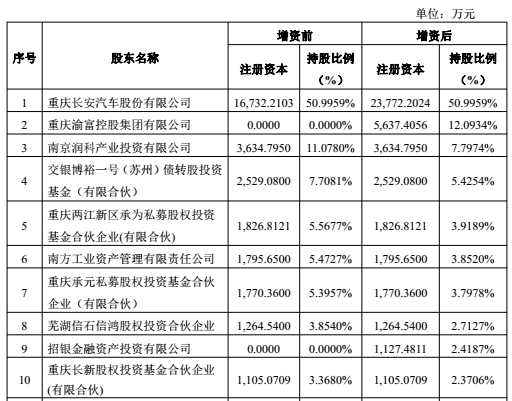
Core Viewpoint - Deep Blue Automotive has completed a capital increase, attracting two external investors, despite holding the first L3 autonomous driving license in China, indicating cautious market sentiment towards investment in the electric vehicle sector [2][11][12]. Group 1: Capital Increase Details - The capital increase involves three parties: Changan Automobile, Chongqing Yufu Holding Group, and China Merchants Bank Financial Asset Investment Co., with contributions of 3.122 billion, 2.5 billion, and 500 million respectively [2][25]. - After the capital increase, Changan Automobile retains a controlling stake of 50.9959%, while the stakes of other original shareholders are diluted to the range of 5%-8% [2][25]. - The total registered capital of Deep Blue Automotive increased from approximately 32.81 billion to 46.62 billion [26]. Group 2: Investment Context - Chongqing Yufu Holding Group, as a local state-owned platform, is likely focused on industrial synergy, while China Merchants Bank's investment may provide financial support, indicating a non-purely financial investment role [10][33]. - The cautious entry of only two investors reflects the intensified competition in the electric vehicle market, alongside subsidy reductions and price wars [11][35]. Group 3: Valuation and Financial Implications - Deep Blue Automotive's valuation is set at 14.55 billion, with the capital increase providing over 5 billion in cash reserves to support ongoing technology investments [14][40]. - The funding is expected to be directed towards the research and development of intelligent driving technology and capacity expansion, crucial for commercializing L3-level vehicles [18][41]. - Changan Automobile's investment strategy includes both cash and technology patents valued at 1.043 billion, ensuring continued R&D progress without burdening the parent company's financials [4][42]. Group 4: Market Position and Future Outlook - The successful acquisition of the L3 license and partnerships with Huawei and CATL provide Deep Blue Automotive with a competitive edge, but long-term success will depend on the speed of technology implementation and market acceptance [10][43]. - The electric vehicle sector's competitive landscape is becoming increasingly challenging, necessitating rapid production scaling for Deep Blue Automotive to keep pace with rivals like Tesla and BYD [18][41][44].
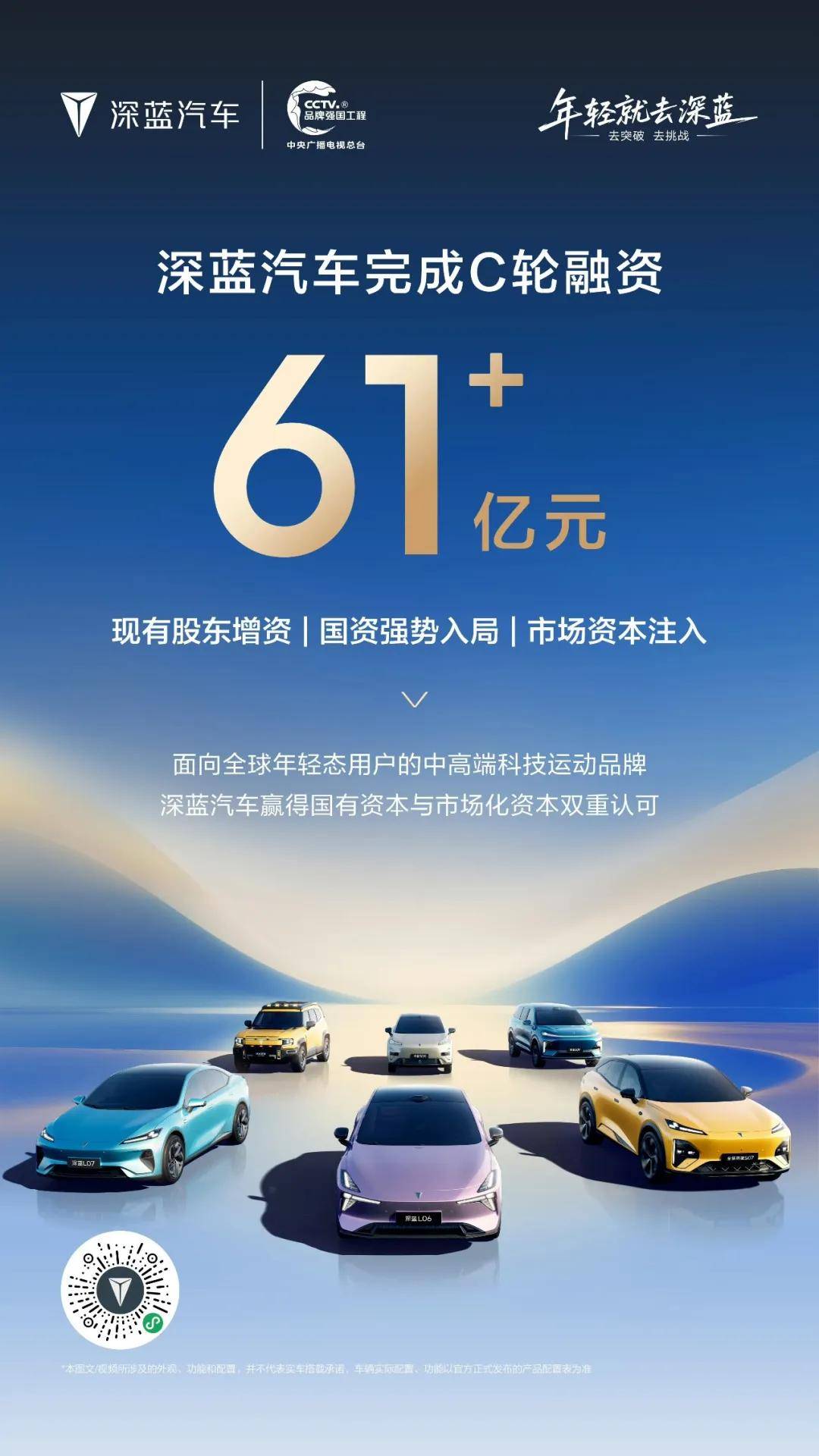
25年车圈最后一笔融资到位,深蓝汽新年开启新征程
Sou Hu Cai Jing· 2025-12-25 12:34
Core Viewpoint - Deep Blue Automotive has successfully completed a significant financing round of 6.122 billion yuan, marking it as the last major financing in the automotive sector for 2025, which is expected to catalyze a leap in brand, product, technology, and marketing dimensions in 2026 [1] Financing Details - The financing round included contributions from Chongqing Yufu Holding Group Co., Ltd. (2.5 billion yuan), Chongqing Changan Automobile Co., Ltd. (3.122 billion yuan), and Zhuhai Financial Asset Investment Co., Ltd. (500 million yuan), totaling 6.122 billion yuan [5] Shareholding Structure - Post-financing, Chongqing Changan Automobile Co., Ltd. remains the largest shareholder with a 50.9959% stake, while Chongqing Yufu Holding Group Co., Ltd. holds 12.0937% and Zhuhai Financial Asset Investment Co., Ltd. holds 2.4187%, indicating strong confidence from new investors [7] Strategic Advantages - Deep Blue Automotive benefits from its unique state-owned enterprise brand value, which enhances investor confidence and provides a solid foundation for financing [7] - As a mid-to-high-end brand under Changan Automobile, Deep Blue aligns with national strategies for technological self-reliance and automotive strength, with financing aimed at core technology advancements in smart and electric vehicles [7] Market Performance - By December 18, 2025, Deep Blue Automotive achieved cumulative deliveries of 700,000 vehicles and has established a presence in nearly 100 countries, with significant sales of its models, including over 300,000 units of the Deep Blue S07 and consistent monthly sales of over 10,000 units for the Deep Blue S05 [7][8] Technological Innovation - The financing will primarily support innovations in smart and electric vehicle technologies, including advancements in L3-level autonomous driving, laser radar algorithms, and the development of a complete technology ecosystem from chips to systems [12][15] - Deep Blue has been a leader in product development, exemplified by its collaboration with Jingxi Group on a magnetorheological suspension system, making the L06 the first Chinese brand model to adopt this technology [14] Future Growth Potential - The company's international success, particularly in Europe and Southeast Asia, is viewed as a key growth driver, enhancing its global brand strength and providing a clear path for future financing [8] - The upcoming changes in the automotive industry, particularly in smart driving and battery technology, are expected to widen the gap between manufacturers, with Deep Blue poised to leverage its technological advancements to gain a competitive edge [15][16] Conclusion - The successful financing not only strengthens Deep Blue's capabilities but also serves as a strategic boost against competitors, positioning the company for a new phase of high-quality development in 2026, with a target of achieving one million vehicle sales [16]