
吉利汽车

Search documents
港股开年上市潮涌中资券商主导市场
Zhong Guo Zheng Quan Bao· 2026-01-13 20:46
● 本报记者 谭丁豪 2026年伊始,港股市场的IPO进程已在忙碌地进行。 港股一级市场迎来"开门红",开年不久便有多家企业顺利完成IPO,涵盖半导体、软件服务等多个赛 道,部分企业募资表现亮眼。回望2025年,港股一级市场热度空前,不仅在全球主要交易所中脱颖而 出,而且IPO与再融资市场均展现出强劲活力。 与此同时,中资券商在港股投行市场占据主导地位,凭借扎实的业务能力展现出强劲竞争力,港股投行 业务也成为多家券商母公司业绩增长的重要支撑。 当前,港股市场仍有大批企业排队等待IPO,多家机构表示,得益于港交所持续优化相关上市规则,以 及各类资金的持续流入,2026年港股新股市场有望延续良好势头,市场发展前景值得期待。 11家公司完成上市 今年以来,截至1月13日,港股市场已有11家公司完成IPO上市,主板10家,创业板1家,募资总额达 331亿港元。上市公司分别为壁仞科技、MINIMAX-WP、豪威集团、兆易创新、智谱、天数智芯、瑞博 生物、精锋医疗-B、金浔资源、红星冷链、BBSB INTL。 从行业分类来看,上述11家上市公司中,4家为半导体行业,2家为软件服务行业,其余分别所属医药生 物、医疗设备与服 ...



“价格承诺”方案落地!中欧电动汽车反补贴案达成积极成果 专家:能极大提升进口商积极性 把利润留给中国车企
Mei Ri Jing Ji Xin Wen· 2026-01-13 13:47
Core Viewpoint - The EU has made significant progress in negotiations with China regarding anti-subsidy tariffs on electric vehicles, replacing high tariffs with a "price commitment" mechanism to facilitate exports of Chinese electric vehicles to the EU [1][3][4]. Group 1: Negotiation Outcomes - The "price commitment" mechanism is a result of mutual discussions between the EU and China, aimed at managing trade frictions and maintaining a rules-based international trade order [3][4]. - The Chinese automotive industry sees the adoption of the "price commitment" as a major positive outcome, signaling enhanced cooperation between China and the EU in the automotive sector [3][4]. Group 2: Impact on Export Pricing - Previously proposed high anti-subsidy taxes could have reached nearly 45%, significantly impacting the cost structure and pricing of Chinese electric vehicles in the EU market [4]. - The EU's decision to implement a "price commitment" mechanism is intended to allow Chinese exporters to raise vehicle prices, thereby mitigating potential impacts on the local automotive market [4][6]. Group 3: Guidelines for Price Commitment - The EU has published guidelines for submitting price commitments, which will be evaluated based on non-discrimination and fairness principles, in accordance with WTO rules [5][6]. - The guidelines outline two potential methods for determining the minimum import price (MIP), ensuring that prices do not fall below those of comparable non-subsidized electric vehicles produced in the EU [6][10]. Group 4: Market Dynamics and Growth Potential - The agreement is expected to stabilize market access for Chinese electric vehicles in the EU, with projections indicating an annual growth rate of approximately 20% for Chinese electric vehicles in the EU market [9][10]. - The "price commitment" mechanism is anticipated to encourage Chinese automakers to shift from a low-cost strategy to a focus on high-end products and local production in Europe [9][10]. Group 5: Industry Reactions - Various industry associations have expressed support for the resolution of the EU's anti-subsidy case, highlighting the importance of dialogue in maintaining stable economic and trade relations between China and the EU [11][12]. - The consensus reached is viewed as a significant step towards fostering cooperation and stability in the automotive supply chain between the two regions [11][12].


约3000名沃尔沃电车车主被警告:不要充满电
第一财经· 2026-01-13 12:36
Core Viewpoint - Volvo has initiated a global recall of its EX30 electric vehicles due to potential overheating risks associated with high-voltage batteries, affecting over 3,300 units across multiple markets [3][4][5]. Group 1: Recall Details - The Australian Federal Department of Transport announced a recall of 2,815 Volvo EX30 vehicles produced in 2024 due to manufacturing issues that may lead to battery overheating [3]. - In the U.S., Volvo submitted a recall report to the National Highway Traffic Safety Administration (NHTSA) for 40 units of the 2025 EX30, citing defects in the high-voltage battery that could cause internal short circuits and overheating [3]. - The NHTSA report indicates that the battery cells in question are supplied by Shandong Geely Xinhua Power Battery Co., Ltd., which is part of the Geely Holding Group [5]. Group 2: Market Impact - The recall has also been reported in Canada, with 85 units affected, and in South Africa, where 372 units of various EX30 models are being recalled [4]. - In the UK, 10,440 EX30 vehicles are potentially impacted by the battery issue, although no official recall notice has been issued yet [5]. - Volvo's EX30 is a key model in its transition to full electrification, with 151,830 pure electric vehicles sold in 2025, representing a 13% year-over-year decline and accounting for approximately 21% of total sales [6].
为什么都在期待百度拆分上市?
3 6 Ke· 2026-01-13 12:26
Core Viewpoint - Baidu's subsidiary Kunlun Chip has submitted an A1 listing application to the Hong Kong Stock Exchange, signaling a potential shift in strategy towards valuing its core assets through spin-offs [1][2]. Group 1: Spin-off Significance - The spin-off of Kunlun Chip is not just a subsidiary listing but a signal of Baidu's intent to unlock value amid a challenging environment for Chinese internet giants regarding asset separation [2]. - The market has historically undervalued Baidu, perceiving it primarily as a traditional search advertising company, despite its significant investments in AI and technology [3][4]. - Kunlun Chip, as a leading AI chip manufacturer, has been undervalued within Baidu, which limits its growth potential and financing capabilities [5][6]. Group 2: Market Dynamics and Identity - The chip industry operates on a principle of neutrality, which has hindered Kunlun Chip's growth while it remained a part of Baidu [7]. - By becoming an independent entity, Kunlun Chip can attract a broader customer base and tap into a larger total addressable market (TAM) [7]. - The financial burden of funding chip development through Baidu's advertising revenue is no longer sustainable, making the spin-off a strategic move to optimize cash flow [8]. Group 3: Future Speculations on Autonomous Driving - The potential for Baidu to spin off its autonomous driving business, particularly the Apollo project, is being speculated as the next logical step following Kunlun Chip's separation [9][10]. - The autonomous driving sector is at a critical juncture, with the need for significant investment to scale operations, which could negatively impact Baidu's financial performance if retained within the company [10][11]. - A proposed spin-off could involve creating a new company focused solely on autonomous driving, allowing for better valuation and attracting strategic investors [11][12]. Group 4: Strategic Implications - The spin-off of Kunlun Chip may serve as a precursor to further separations within Baidu, allowing each business unit to thrive independently [14][15]. - The historical context of successful spin-offs in the tech industry suggests that separating high-growth potential businesses can lead to enhanced valuations and operational efficiencies [13][14]. - Baidu's actions indicate a shift from maintaining a large conglomerate to enabling individual units with unique growth trajectories to compete effectively in their respective markets [15].

崔东树:2025年全国乘用车批发增速9% 新能源乘用车批发增速25%
智通财经网· 2026-01-13 11:42
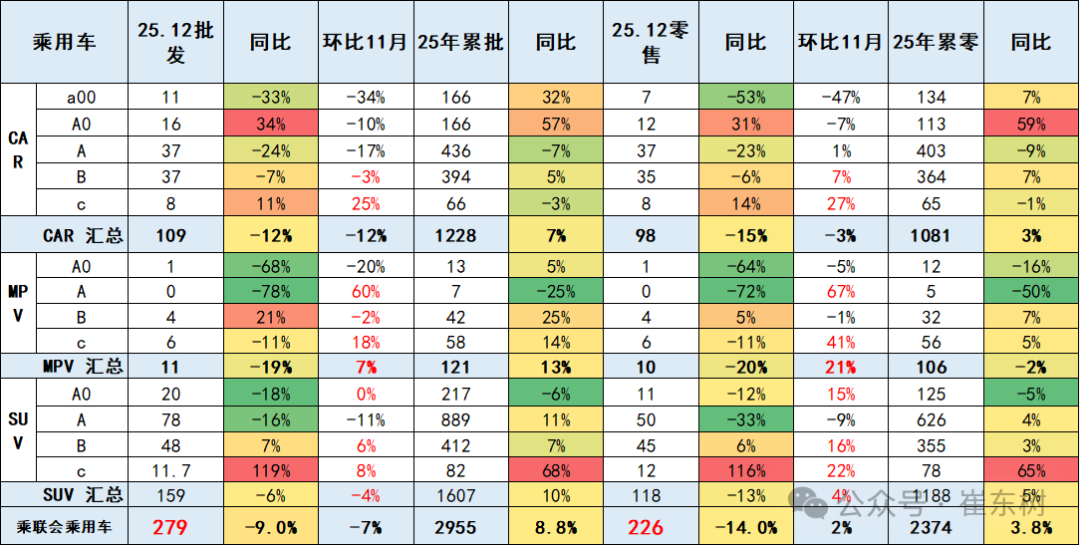
Core Insights - The wholesale growth rate for passenger cars in China is projected to be 9% in 2025, while the growth rate for new energy passenger cars is expected to reach 25%, aligning with the growth expectations set for the "14th Five-Year Plan" [1] - The end of the tax exemption policy for new energy vehicle purchases has led to a significant market shift, with many provinces experiencing a depletion of funds for trade-in subsidies, resulting in a mixed market performance [1] Passenger Car Market Overview - In December 2025, the retail sales of passenger cars decreased by 14%, which is significantly lower than the 9% decline in wholesale sales [2] - The A00 class cars saw a wholesale decline of 33% year-on-year and a 34% month-on-month drop in December 2025, with retail sales down 53% year-on-year [5] - The A0 class cars experienced a 34% increase in wholesale sales year-on-year, but a 10% decrease month-on-month in December 2025, with retail sales up 31% year-on-year [7] - A0 class SUVs had a wholesale decline of 18% year-on-year in December 2025, while retail sales decreased by 12% year-on-year [9] A-Class Passenger Car Trends - A-class sedans saw a wholesale decline of 24% year-on-year in December 2025, with retail sales down 23% year-on-year [11] - A-class SUVs experienced a 16% year-on-year decline in wholesale sales in December 2025, with retail sales down 33% year-on-year [13] B-Class Passenger Car Trends - B-class sedans had a wholesale decline of 7% year-on-year in December 2025, with retail sales down 6% year-on-year [15] - B-class SUVs saw a 7% increase in wholesale sales year-on-year in December 2025, with retail sales up 6% year-on-year [17] - B-class MPVs experienced a 21% increase in wholesale sales year-on-year in December 2025, with retail sales up 5% year-on-year [19]
约3000名沃尔沃电车车主被警告:不要充满电
Di Yi Cai Jing Zi Xun· 2026-01-13 11:33
Group 1 - Volvo has initiated a recall plan for the EX30 model due to potential overheating risks associated with the high-voltage battery, affecting over 3,300 vehicles across multiple markets [1][2] - The recall includes 2,815 units in Australia, 40 units in the United States, 85 units in Canada, and 372 units in South Africa, with additional concerns raised for 10,440 units in the UK [2] - The battery cells in question are supplied by Shandong Geely Xinhua Power Battery Co., Ltd., which has faced previous legal issues regarding battery quality defects [2] Group 2 - Volvo has stated that the battery issue does not affect all EX30 models and has not resulted in serious injuries, emphasizing a proactive approach to safety [3] - The EX30 is a key model for Volvo's transition to full electrification, with 2025 sales figures showing a decline of 13% in pure electric vehicle sales, totaling 151,830 units, which represents about 21% of total sales [3]
【智能化】吉利控股战略增持亿咖通4560万美元
Xin Lang Cai Jing· 2026-01-13 11:33
Core Insights - Yika Technology announced a strategic investment of $45.6 million from Geely Holding Group, with shares priced at $1.67 each and a six-month lock-up period [2][5] - This investment follows a $150 million convertible bond agreement with ATW Partners in November 2024, marking another round of external financing within two months [2][5] - The funding is based on the long-term partnership and rapid business growth of Yika Technology, with Q3 2025 revenue reaching $219.9 million, an 11% year-over-year increase, and gross profit of $47.6 million, up 39% [2][5] Business Performance - The growth is primarily driven by the large-scale application of Yika's intelligent computing platforms in Geely's vehicle models [2][5] - Yika's technology products have a penetration rate of 77% within Geely's related brands [2][5] - The Antora® 1000 AI enhanced computing platform is utilized in the Geely Galaxy A7, while the Parker® platform supports the high-end AI cockpit of the Galaxy M9 [2][5] Market Expansion - Yika Technology is expanding into international markets, having announced in November 2024 that it will provide intelligent cockpit solutions for multiple models sold by the Volkswagen Group in Latin America, including Antora® hardware and the Cloud Mountain cross-domain software platform [2][5] - As of September 2025, nearly 10 million vehicles equipped with Yika's technology are operational across Europe, Asia, Australia, and Latin America [3][6] - The recent investment from Geely further strengthens the collaboration in the field of intelligence and provides funding support for Yika's ongoing R&D and global delivery capabilities [3][6]


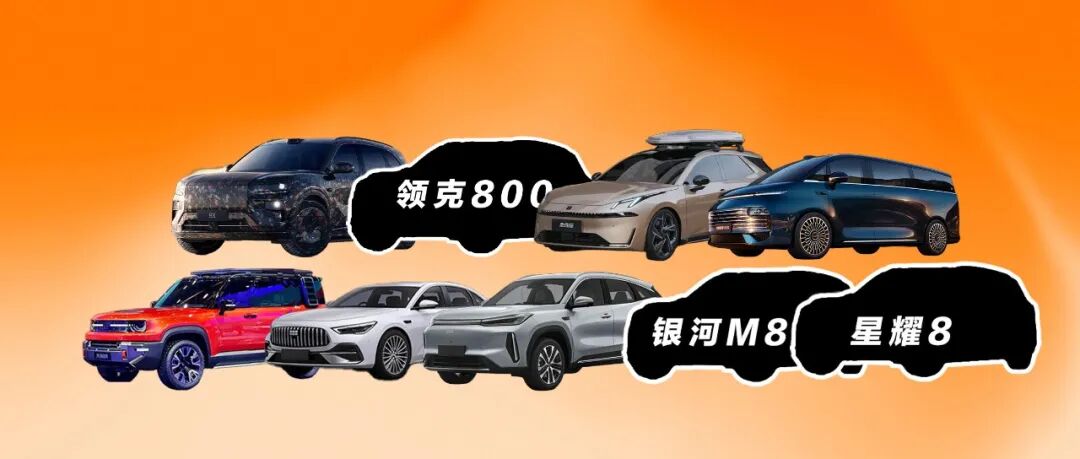
吉利2026新车盘点,极氪8X、领克800、银河M8等重量级车型将上市
Xin Lang Cai Jing· 2026-01-13 11:33
吉利新车规划 编辑:梅梅 2026年车市竞争加剧,吉利以新能源为主线推进产品布局,本期视频聚焦其旗下重点新车规划,我们一起来看看今年吉利将会为消费者带来哪些惊喜。 首先,极氪品牌推出高性能旗舰SUV 8X,基于浩瀚-S超级电混架构打造,定位介于7X与9X之间,定价30-40万区间,直接对标理想问界车型,计划3月底 上市,值得期待。 领克方面,将首次涉足越野领域,推出中大型智能越野SUV,依托SPA evo电混架构强化通过性,配备Super AI数字底盘与激光雷达辅助驾驶系统,给到 消费更多样化的硬派选择。此外领克还将带来领克07 EM-P旅行版,优化装载能力以满足细分需求。 至于吉利主品牌方面,吉利银河将带来银河V900、银河战舰等多款新车,其中银河M8与星舰8两款大五座SUV最值得关注,或将于今年北京车展正式亮 相。 2026年车市竞争加剧,吉利以新能源为主线推进产品布局,本期视频聚焦其旗下重点新车规划,我们一起来看看今年吉利将会为消费者带来哪些惊喜。 首先,极氪品牌推出高性能旗舰SUV 8X,基于浩瀚-S超级电混架构打造,定位介于7X与9X之间,定价30-40万区间,直接对标理想问界车型,计划3月底 上市 ...
新能源汽车2026前瞻,“量变”到“质变”的分水岭
3 6 Ke· 2026-01-13 11:31
Core Insights - The Chinese electric vehicle (EV) industry is set to become mainstream by 2025, with retail penetration rates expected to exceed 60% by year-end, marking a significant shift from being an alternative option to a market leader [2][4] - Domestic brands like BYD and Geely are solidifying their positions, while new entrants are facing intense competition and differentiation [2][6] - The focus for 2026 will shift from market share expansion to value redefinition within the industry [3] Market Penetration - In the first eleven months of 2025, the production and sales of new energy vehicles (NEVs) in China saw a year-on-year increase of over 30%, with NEV sales accounting for 47.5% of total vehicle sales [4] - December is projected to see NEV retail sales reach 1.38 million units, with penetration rates likely to surpass 60% for the first time [4] - Domestic brands dominate the market, with a retail penetration rate of 79.6% for NEVs in November, far outpacing mainstream joint venture brands at 6.8% [4] Company Strategies and Challenges - BYD aims to expand its "smart driving equality" initiative, while facing challenges in balancing scale expansion with profit and quality [5] - Geely's strategy is showing results with a 60.5% NEV penetration rate, but it needs to build a "second growth curve" for overseas market presence [5] - Chery leads in overseas markets but must accelerate its domestic NEV transformation and smart technology integration [5] - New forces like Leap Motor are experiencing rapid growth, while Li Auto faces challenges due to product controversies and performance declines [6] Technological Advancements and Globalization - The "universal smart driving" concept is becoming a reality, with BYD's advanced driving assistance systems becoming more affordable [8] - The global expansion of Chinese EVs is evolving from simple product exports to establishing local manufacturing and supply chains in markets like Thailand [9] - The industry is witnessing a shift towards integrating technology and manufacturing, with companies like Chery and Seres successfully navigating the capital markets [10] Industry Restructuring and Future Directions - The industry is transitioning from a financing and expansion model to one focused on technology depth, profitability, and ecological value [10] - State-owned capital is evolving from a supportive role to an active industry integrator, aiming to stabilize the market and promote long-term R&D [11] - The automotive value chain is shifting towards a focus on electronic architecture, software, and services, with tech giants redefining the automotive experience [11] Challenges and Future Outlook - Structural challenges in the supply chain are emerging, with cost pressures affecting relationships with suppliers, particularly smaller firms [12] - Marketing practices that mislead consumers could damage long-term brand trust, highlighting the need for integrity in communications [12] - The industry must build resilient supply chains, drive technological innovation, and transition to localized ecosystems to sustain growth [13][14] - The competition is entering a new phase where success will depend on defining next-generation technology standards and achieving sustainable business models [15]



2025智能网联新能源汽车十大年度事件 | 精进2025——汽车行业10个十大年度盘点(七)
Jing Ji Guan Cha Wang· 2026-01-13 10:48
Core Insights - The automotive industry in China has made significant progress in 2025, driven by a series of proactive policies that have boosted consumption and improved the competitive environment [2] - The "2025 Progress Report" by Automotive Vertical Media highlights ten key annual reviews in the automotive sector, marking the sixth consecutive year of such reporting [2] Group 1: Key Events in Smart Connected New Energy Vehicles - The issuance of the first L3 special license plate in China marks the beginning of commercialized L3-level autonomous driving, with the first vehicle, Deep Blue SL03, officially licensed for road use [4][5] - The world's first flying car production line has been established in Guangzhou, with the first "land aircraft" successfully produced, indicating a significant step towards commercial production in the low-altitude economy [7][8] - Solid-state battery production is accelerating, with multiple companies announcing timelines for mass production, including CATL and Toyota, which are expected to enhance battery performance and safety [8][9] Group 2: AI Integration and Industry Transformation - Generative AI and large model technologies have been deeply integrated into the automotive industry, enhancing manufacturing efficiency and product competitiveness across the entire supply chain [10][12] - The adoption of AI technologies is reshaping the automotive industry's research and development logic, manufacturing models, and service ecosystems, driving the sector towards a higher quality of intelligent transformation [12] Group 3: Global Market Expansion and Competitiveness - Chinese automotive solutions have gained global recognition, with partnerships established with major international brands like BMW and collaborations with various multinational automakers, indicating a shift towards "China solutions" in the global market [13][14] - BYD has become the world's largest manufacturer of pure electric vehicles, surpassing Tesla in sales, reflecting the competitive strength of Chinese brands in the global electric vehicle market [19][20] Group 4: Safety Standards and Regulations - The introduction of new mandatory national standards for electric vehicle batteries emphasizes safety, requiring batteries to not catch fire or explode under thermal runaway conditions, effective from July 2026 [17][18] - The implementation of dynamic monitoring safety standards for new energy vehicles marks a transition to proactive safety management, enhancing consumer protection and industry accountability [21][22] Group 5: Charging Technology Advancements - The competition in ultra-fast charging technology has reached the "megawatt" level, with several companies launching solutions that enable rapid charging capabilities, significantly improving user experience in electric vehicles [15][16] - The advancements in charging technology are expected to reshape the competitive landscape of the electric vehicle market, facilitating broader adoption and integration of electric vehicles into everyday use [16] Group 6: IPO Trends in Autonomous Driving - The surge of IPOs among autonomous driving companies signifies a shift from capital cultivation to market validation, with major players like Pony.ai and Hesai Technology entering the public market [23][24] - The rise of end-to-end autonomous driving solutions is expected to accelerate the mass production of high-level autonomous vehicles, enhancing the industry's growth trajectory [24]

