东风股份

Search documents
47岁冯长军,升任东风汽车总经理
中国基金报· 2025-10-11 08:42
Core Viewpoint - Dongfeng Motor Group has appointed Feng Changjun as the new Chairman, General Manager, and Deputy Secretary of the Party Committee, who will lead the Hong Kong listing of Lantu Motors, marking a significant step in the company's strategic direction towards new energy vehicles [2][3]. Group 1: Leadership Changes - Feng Changjun, born in May 1978, has a strong background in finance and management, having served in various key positions within state-owned enterprises and the automotive industry [3]. - His previous role as Chief Accountant at Dongfeng Motor involved governance, financial management, capital operations, and risk control, contributing to the successful listing of Lantu Motors [3]. Group 2: Lantu Motors and Market Position - Lantu Motors has submitted its application for a listing on the Hong Kong Stock Exchange, aiming to innovate and explore new avenues in the transition to new energy vehicles [5]. - As a high-end smart new energy vehicle brand under Dongfeng, Lantu Motors has achieved significant milestones, including the production of 200,000 vehicles and ranking among the top three in sales growth for high-end new energy brands in China from 2022 to 2024 [5]. Group 3: Company Overview - Dongfeng Motor is a major state-owned enterprise focused on automotive manufacturing, sales, services, and technology research and development, with a history dating back to 1969 [5]. - The company has produced and sold over 62 million vehicles and contributed approximately 700 billion yuan in taxes over its 56 years of operation [5]. - As of the end of 2024, Dongfeng Motor's total assets are projected to reach 470.386 billion yuan, employing around 117,000 people [5].


东风与华为合作新品牌,全网征集中文名及LOGO
Guan Cha Zhe Wang· 2025-10-11 07:43
Core Viewpoint - Dongfeng and Huawei are collaborating on the DH project, aiming to enhance smart mobility and create a new family car experience through technology and quality [4][9]. Group 1: Project Overview - The DH project is a joint initiative between Dongfeng and Huawei, focusing on providing a new way of smart travel for consumers [4]. - Dongfeng is soliciting suggestions for the Chinese name and logo of the DH project, with submissions due by October 28 [1]. Group 2: Sales and Market Performance - Since the 14th Five-Year Plan, Dongfeng has launched several automotive brands, primarily focusing on electric vehicles, including high-end brand Lantu and mainstream brands like Dongfeng Fengshen, Dongfeng Yipai, and Dongfeng Nano [5]. - In 2024, Dongfeng Passenger Vehicle Company is projected to sell 213,400 vehicles, marking an 82.4% year-on-year increase, with 104,800 units sold in the first half of the year, a 23% increase [5]. Group 3: Strategic Developments - To improve efficiency and reduce internal competition among brands, Dongfeng integrated its three main brands into Dongfeng Yipai Automotive Technology Company [5]. - Dongfeng Yipai announced a strategic plan called "Future Wings," focusing on technology, products, branding, and overseas expansion to accelerate growth [5]. Group 4: Product Development - By 2028, Dongfeng Yipai plans to expand its product lineup to 20 models, with a focus on mainstream technology and intelligent premium series, developed in collaboration with Huawei [6]. - New technologies such as the Qiankun Intelligent Driving ADS 4 and Harmony Cabin 5 will be integrated into products resulting from the Dongfeng and Huawei partnership [6]. Group 5: Strategic Partnerships - Dongfeng has significantly increased investments in electric and intelligent vehicle sectors, with Huawei acting as a catalyst for this progress [9]. - Following the success of Lantu, Dongfeng aims to replicate this model with Dongfeng Yipai and other brands, enhancing overall brand value [9]. - Recent discussions between Dongfeng's chairman and Huawei's leadership focused on strengthening strategic trust and deepening cooperation [11].
9月传统车企销量排名生变:上汽重拾冠军 比亚迪第二 奇瑞反超吉利
Hua Xia Shi Bao· 2025-10-11 05:57
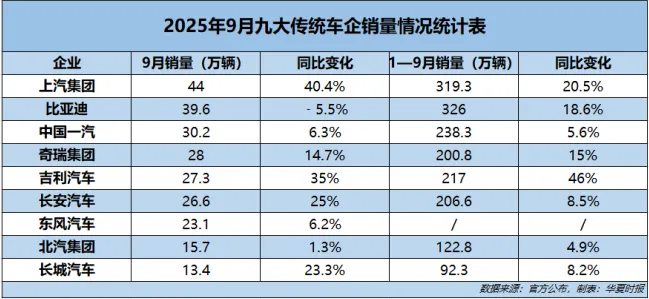
Core Insights - Traditional automakers have shown strong performance in September, with all but BYD reporting sales growth, driven by advancements in new energy vehicles and overseas markets [1][3] - SAIC Motor regained the top position in sales, followed by BYD, with Chery surpassing Geely to claim the fourth spot [1][3] Sales Performance Summary - **SAIC Motor**: Achieved sales of 440,000 units in September, a year-on-year increase of 40.4%, marking a total of 3.193 million units sold in the first nine months, up 20.5% [2][3][4] - **BYD**: Sold 396,000 units in September, down 5.5% year-on-year, with a total of 3.26 million units for the year, up 18.6% [2][4] - **China FAW**: Reported sales of 302,000 units in September, a 6.3% increase, totaling 2.383 million units year-to-date, up 5.6% [2][7] - **Chery**: Sold 280,000 units in September, a 14.7% increase, with year-to-date sales reaching 2.008 million units, up 14.5% [2][7][10] - **Geely**: Recorded sales of 273,000 units in September, a 35% increase, with cumulative sales of 2.17 million units, up 46% [2][8][9] - **Changan**: Achieved sales of 266,000 units in September, a 25% increase, with year-to-date sales of 2.066 million units, up 8.5% [2][11] - **Dongfeng**: Reported sales of 231,000 units in September, a 6.2% increase, with cumulative sales figures not disclosed [2][11] - **BAIC Group**: Sold 157,000 units in September, a 1.3% increase, with year-to-date sales of 1.228 million units, up 4.9% [2][12] - **Great Wall Motors**: Achieved sales of 134,000 units in September, a 23.3% increase, with cumulative sales of 923,000 units, up 8.2% [2][12] Market Dynamics - SAIC Motor's growth is attributed to strong performance in both domestic and export markets, with a notable increase in self-owned brand sales [5][6] - BYD's decline in sales is primarily due to a drop in plug-in hybrid vehicle sales, despite growth in pure electric and other vehicle categories [4][10] - China FAW's growth is supported by strong performance in its self-owned brands, particularly in the new energy segment [7] - Chery's rise in sales is driven by significant growth in its new energy vehicle sales and exports [10] - Geely's strong performance in the new energy vehicle segment, which reached a record high, has contributed to its overall sales growth [8][9] - Changan and Great Wall Motors have shown robust growth in both domestic and overseas markets, particularly in the new energy vehicle segment [11][12]



奋勇争先,决战决胜“十四五”|喜看大江三叠浪
Ren Min Ri Bao· 2025-10-11 05:48
Core Points - The development of the Yangtze River Economic Belt is crucial for China's long-term interests, aiming to become a leader in ecological priority and high-quality economic growth [1][3][4] - The region's GDP is projected to exceed 63 trillion yuan in 2024, with a growth rate of 5.4% [1] - In the first eight months of this year, the foreign trade import and export value of the 11 provinces and cities along the Yangtze River reached 13.7 trillion yuan, a historical high, accounting for 46.3% of the national total [1] Environmental Protection and Restoration - Significant achievements have been made in ecological environment protection and restoration along the Yangtze River, with a focus on "big protection" and not "big development" [1][4][9] - The illegal sand mining activities have been addressed, with 39 illegal sand terminals and 84 sand fields shut down in Hunan [4] - The ecological integrity index of the Yangtze River has improved, with the main stream maintaining a Class II water quality for five consecutive years [9] Industrial Transformation - The transformation and upgrading of industries are essential for achieving both ecological sustainability and economic growth [6][8] - The Jiujiang Petrochemical Industry Park is undergoing a significant transformation with a total investment of 10.6 billion yuan, expected to increase annual revenue by 60 billion yuan [8] - Over 30 chemical companies in Jiujiang have transitioned to green development, with a 13.3% year-on-year increase in profits from the petrochemical industry chain [9] Innovation and Technological Advancement - Innovation is emphasized as a driving force for development, with a focus on transforming research and talent advantages into development advantages [10][11] - The automotive industry in the Yangtze River Economic Belt is becoming the largest automotive industry cluster in China, with significant advancements in electric and intelligent connected vehicles [12] - Quantum technology applications are being developed in Hefei, with over 30 quantum technology companies contributing to a complete ecosystem from research to industrialization [12] Regional Coordination and Integration - The Yangtze River Economic Belt is seeing enhanced regional coordination and integration, with collaborative efforts among provinces to address environmental and economic challenges [15][19] - The establishment of a "capacity pool" mechanism in Zhejiang has facilitated the rapid development of river-sea intermodal transport, significantly improving logistics efficiency [17] - The integration of the Yangtze River Economic Belt with the Belt and Road Initiative is enhancing trade connectivity and market access [18]
企业培训| 未可知 x 上汽集团: 除了自动驾驶,AI还能对汽车做什么?
未可知人工智能研究院· 2025-10-11 03:02
Core Viewpoint - AI has become an essential component for the survival of automotive enterprises, transitioning from an optional technology to a core competitive advantage for the next decade [6][7]. Design Phase - AI enhances the efficiency of "creative realization" by tenfold, significantly reducing the automotive design cycle from weeks to hours through systems like AiCube [12][13]. - Custom design processes have been revolutionized by NVIDIA RTX AI workstations, compressing development timelines from six months to six weeks while improving efficiency and quality [15][16]. - Future automotive design will increasingly rely on "human-machine collaboration" as AI capabilities are integrated into modeling tools [18]. Manufacturing Phase - AI is transforming automotive manufacturing from mass production to flexible intelligent manufacturing, enhancing resilience [19]. - The Li-Mos system at Li Auto's manufacturing base has improved production efficiency by 20% and reduced operational costs by 25% through real-time AI monitoring [21]. - AI-driven flexible production lines have decreased model switching time from four hours to 27 minutes, allowing for the simultaneous production of multiple vehicle models [23]. Product Value Reconstruction - The automotive industry is evolving from "wheeled sofas" to "mobile intelligent terminals," with AI as the driving force behind this transformation [24]. - Tesla's Full Self-Driving (FSD) system exemplifies AI's role in enabling complex decision-making capabilities in autonomous driving [25][27]. - Huawei's investment in AI has led to advancements in human-vehicle interaction, shifting competition from hardware specifications to AI-driven user experiences [29]. Sales and After-Sales Service - AI is transforming marketing from one-way communication to interactive engagement, as demonstrated by Dongfeng's AI co-creation launch event that attracted 280,000 participants [38][40]. - The digital upgrade of the vehicle pickup process by Autox3 enhances transparency and efficiency, creating a win-win situation for vehicle owners, service centers, and parts suppliers [42]. Implementation Insights - Four key actions for AI transformation in automotive enterprises include building a closed-loop technology system, restructuring traditional business processes around AI, establishing high-quality data governance, and cultivating cross-disciplinary talent [43]. - The integration of AI into the automotive industry is a long-term ecological reconstruction rather than a one-time technological upgrade [45].
奋勇争先,决战决胜“十四五”|喜看大江三叠浪
Ren Min Ri Bao· 2025-10-11 00:54
Core Viewpoint - The development of the Yangtze River Economic Belt is crucial for China's long-term interests, focusing on ecological protection, high-quality economic growth, and enhancing domestic and international circulation [1][2]. Group 1: Ecological Protection and Restoration - Significant achievements have been made in ecological protection and restoration along the Yangtze River, with a focus on "coordinated protection and not large-scale development" [1][2]. - The GDP of the Yangtze River Economic Belt is projected to exceed 63 trillion yuan, with a growth rate of 5.4% in 2024 [1]. - In the first eight months of this year, the foreign trade import and export value of the 11 provinces and cities along the Yangtze River reached 13.7 trillion yuan, a historical high, with a year-on-year growth of 6% [1]. Group 2: Industrial Transformation and Upgrading - The transformation and upgrading of industries are essential for achieving both ecological sustainability and economic growth [7]. - The total investment in the 150 million tons/year aromatics and refining project in Jiujiang is 10.6 billion yuan, expected to increase annual revenue by 60 billion yuan [7]. - Jiujiang's petrochemical industry has seen a year-on-year profit increase of 13.3% [7]. Group 3: Innovation and Technological Development - The Yangtze River Economic Belt is becoming a hub for the automotive industry, with significant advancements in electric and intelligent connected vehicles [9][10]. - Over 40 enterprises and universities in Hubei have formed a joint innovation body for automotive-grade chips, leading to the development of the first domestic high-performance microcontroller chip [9]. - The quantum technology sector in Hefei has seen the establishment of over 30 leading enterprises, with more than 2,000 related patents [11]. Group 4: Regional Coordination and Integration - The Yangtze River Economic Belt emphasizes regional collaboration, with various provinces and cities working together to enhance ecological protection and economic development [15][18]. - The establishment of a "five-in-one" governance model in Yueyang has improved environmental management by integrating multiple departments [15]. - The new shipping channel project at the Three Gorges is expected to enhance the comprehensive functions of water conservancy, shipping, and ecology along the Yangtze River [18].
保护为先、创新引领、协同联动,长江经济带迈向高质量发展 喜看大江三叠浪(奋勇争先,决战决胜“十四五”)
Ren Min Ri Bao· 2025-10-11 00:38
Core Viewpoint - The development of the Yangtze River Economic Belt is crucial for China's long-term interests, focusing on ecological protection, high-quality economic growth, and enhancing domestic and international circulation [1][3]. Economic Development - The GDP of the Yangtze River Economic Belt is projected to exceed 63 trillion yuan in 2024, with a growth rate of 5.4% [1]. - In the first eight months of this year, the foreign trade import and export value of the 11 provinces and cities along the Yangtze River reached 13.7 trillion yuan, a historical high, with a year-on-year growth of 6%, accounting for 46.3% of the national total [1]. Ecological Protection - Significant achievements have been made in ecological environment protection and restoration along the Yangtze River, with a focus on "grasping major protection and not engaging in major development" [4][8]. - The ecological integrity index of the Yangtze River has improved, with the main stream maintaining a Class II water quality for five consecutive years [8]. Industrial Transformation - The transformation and upgrading of industries are emphasized, with projects like the 150 million tons/year aromatics and refining modification project in Jiujiang expected to increase annual revenue by 60 billion yuan [7]. - Over 30 chemical companies in Jiujiang have transitioned to green development, with the city's petrochemical industry chain profit increasing by 13.3% year-on-year [8]. Innovation and Technology - The Yangtze River Economic Belt is becoming China's largest automotive industry cluster, with significant advancements in electric and intelligent connected vehicles [11]. - The establishment of a quantum technology ecosystem in Hefei, with over 30 leading quantum technology companies, highlights the region's focus on innovation [12]. Regional Collaboration - The integration of transportation networks and the establishment of a "capacity pool" mechanism in Zhejiang have enhanced the efficiency of logistics and trade along the Yangtze River [17]. - Collaborative efforts among provinces, such as the G60 Science and Technology Innovation Corridor, are promoting resource sharing and technological innovation [19].
喜看大江三叠浪(奋勇争先,决战决胜“十四五”)
Ren Min Ri Bao· 2025-10-10 22:10
Core Insights - The development of the Yangtze River Economic Belt is crucial for China's long-term interests, focusing on ecological priority and high-quality economic growth [1][3][4] - The region's GDP is projected to exceed 63 trillion yuan in 2024, with a growth rate of 5.4% [1] - The foreign trade value of the 11 provinces and cities along the Yangtze River reached 13.7 trillion yuan in the first eight months of this year, marking a historical high and a 6% year-on-year increase [1] Environmental Protection and Restoration - Significant achievements have been made in ecological protection and restoration along the Yangtze River, with a focus on "big protection" and avoiding "big development" [1][4][8] - The illegal sand mining activities have been addressed, with 39 illegal sand terminals and 84 sand fields shut down in Hunan [4] - The ecological integrity index of the Yangtze River has improved, with the main river maintaining a Class II water quality for five consecutive years [8] Industrial Transformation and Innovation - The chemical industry along the Yangtze River is undergoing transformation towards greener practices, with over 30 chemical companies in Jiujiang promoting green development [8][7] - Jiujiang Petrochemical's investment in a 150 million tons/year aromatics and refining project is expected to generate an additional 60 billion yuan in revenue annually [7] - The automotive industry in the Yangtze River Economic Belt is becoming a major hub for electric and intelligent connected vehicles, with significant growth in exports of new energy vehicles [10][11] Regional Collaboration and Connectivity - The Yangtze River Economic Belt is enhancing regional collaboration, with initiatives like the "G60 Science and Technology Innovation Corridor" promoting resource sharing and cooperative innovation [19] - The establishment of a "transport capacity pool" mechanism in Zhejiang has improved logistics efficiency, facilitating the rapid movement of goods along the river [17] - The integration of the Yangtze River Economic Belt with the Belt and Road Initiative is strengthening international trade connections [18]
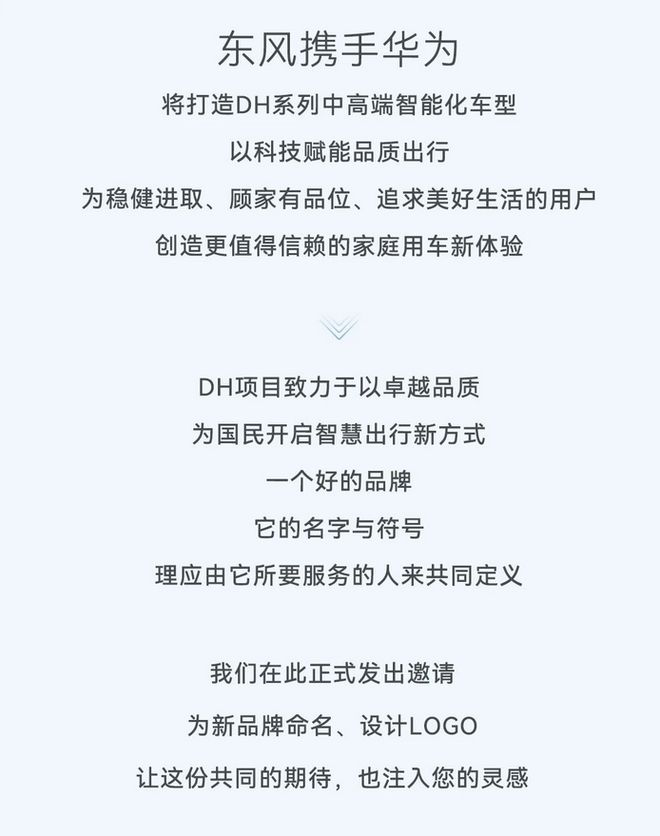
东风华为联手打造DH项目 奕派科技智能精品系列首款车型预计明年上市
Zhong Guo Jing Ying Bao· 2025-10-10 15:44
Core Insights - Dongfeng Motor and its subsidiary Yipai Technology announced a call for new brand names and logo designs for the DH project, which aims to create high-end intelligent vehicles in collaboration with Huawei [1][3] Group 1: Project Overview - The DH project is focused on providing a new intelligent travel experience with exceptional quality, indicating the launch of a new high-end smart car brand by Dongfeng Motor [1] - The project will utilize a new product definition process and incorporate top-tier product development, quality management, and marketing channel operations to enhance user experience [3][5] Group 2: Collaboration with Huawei - Dongfeng Motor's collaboration with Huawei includes joint efforts in product definition, intelligent technology, and marketing, aiming to explore new market-oriented operational paths for state-owned enterprises [4] - The first model under the DH project is planned to be a high-end intelligent full-size SUV, set to launch in 2026, with Huawei's technological expertise supporting the project [5] Group 3: Brand Development - The brand name for the DH project must consist of two Chinese characters, reflecting the concept of intelligent travel, and the logo design should embody technology, quality, and warmth [3] - Yipai Technology is deeply involved in the collaboration, focusing on a full-chain synergy from product development to market services, enhancing the potential for innovation [4]
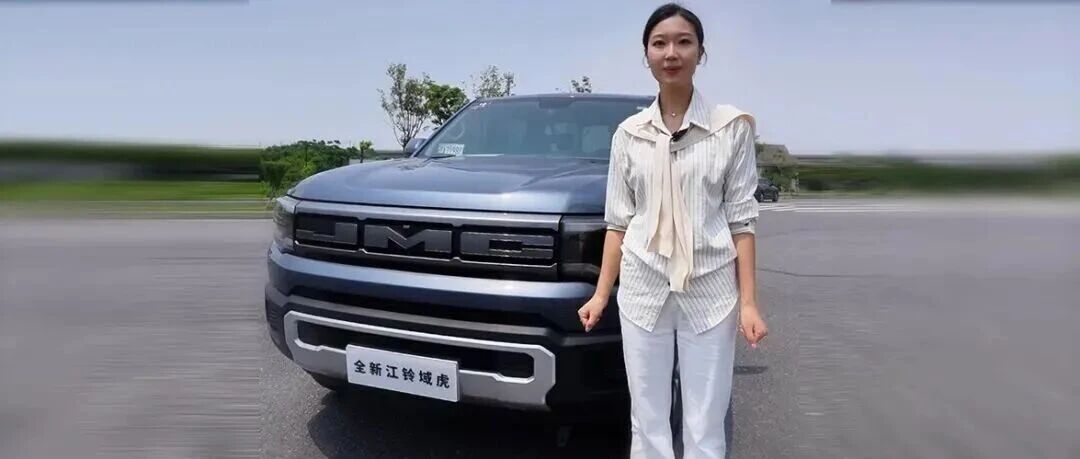
【视频评测】全新江铃域虎抢先试驾!经典外观、质感内饰、强劲动力面面俱到 | 头条
第一商用车网· 2025-10-10 14:00
Group 1 - The heavy truck industry saw significant sales in September, with a total of 105,000 units sold, marking a notable increase in demand [1] - Heavy truck sales for companies like Shandong Heavy Industry exceeded 27,000 units, while Jiefang's sales doubled, indicating strong market performance [1] - Dongfeng, Foton, and XCMG also experienced sales growth, with some companies reporting sales increases of over 100% [1] Group 2 - Changan plans to exceed 300,000 units in sales over the next five years, focusing on reconstructing user value with its "Double Star" strategy [1] - Two new products were globally launched at the 2025 Belgium Bus Exhibition, showcasing CRRC Electric's innovations in the electric vehicle sector [1] - A major order exceeding 3,000 units was reported in the heavy truck industry, highlighting significant business opportunities for manufacturers [1]