宁波银行

Search documents
资本优化提速 多家银行赎回优先股
Zheng Quan Ri Bao· 2025-10-22 16:44
Core Viewpoint - The recent trend of banks redeeming preferred shares is a strategic response to operational pressures and aims to optimize capital efficiency, reshaping the underlying logic of capital management in the banking industry [1][3]. Group 1: Redemption Plans - Major banks, including state-owned and joint-stock banks, have initiated significant preferred share redemption plans, with some banks redeeming amounts reaching billions [1][2]. - Shanghai Bank plans to fully redeem 200 million preferred shares worth 20 billion yuan by December 2025, while Hangzhou Bank and Ningbo Bank plan to redeem 10 billion yuan each [2]. Group 2: Drivers of Redemption - The core drivers for the concentrated redemption of preferred shares are cost optimization and the need for capital structure adjustment [3]. - High dividend rates of previously issued preferred shares (5% to 6.5%) have become a financial burden in the current low-interest environment, prompting banks to replace them with lower-cost instruments [3][5]. Group 3: Capital Structure Transformation - The increasing redemption of high-yield preferred shares and restrictions on new issuances are leading banks to shift towards issuing lower-cost capital instruments such as perpetual bonds and subordinated debt [4]. - The market acceptance of these lower-cost capital tools is rising, providing banks with favorable conditions for capital replacement [4][6]. Group 4: Long-term Implications - The concentrated redemption of preferred shares is expected to diversify capital tools, with banks likely to favor flexible instruments like perpetual bonds and explore innovative options like convertible capital bonds [5]. - The capital management philosophy is shifting from "scale expansion" to "quality first," focusing on capital efficiency and optimizing risk-weighted assets [5][6]. - Regulatory upgrades may lead to improved capital tool rules, encouraging proactive capital management in the banking sector [5].
大摩闭门会-金融、新能源、航空、汽车行业更新
2025-10-22 14:56
Summary of Key Points from Conference Call Industry Overview - **Wind Power and Nuclear Power**: The adjustment of value-added tax subsidies for wind power operators is significant, with a profit impact of approximately 10% starting from November 2025. The internal rate of return (IRR) for onshore wind projects is expected to decline by 0.5-0.6 percentage points, while nuclear power projects will see annual profit reductions of 20-50 million yuan per unit starting from 2031 [1][4]. - **Inbound Tourism**: The inbound tourism market is rapidly growing, projected to account for 18% of national tourism revenue by 2030 and 25% by 2034, driven by business, leisure, and talent immigration. The hotel industry is expected to contribute the most to revenue, with online travel agencies (OTAs) showing significant profit margin advantages [1][5][6]. - **Aviation Industry**: The aviation sector is benefiting from a shortage of flight capacity, with ticket prices turning positive year-on-year. The delivery of aircraft is slow, and engine maintenance is limiting capacity. Domestic flight schedules are experiencing negative growth, but passenger load factors are increasing [1][7][8]. - **Cement Industry**: Chinese cement companies are accelerating overseas expansion, targeting Southeast Asia, Central Asia, and Africa. The competition is intensifying in Southeast Asia, while Central Asia, particularly Tajikistan, remains profitable due to high demand. The potential for growth in Africa is significant [1][9]. Core Insights and Arguments - **Wind Power**: The cancellation of the 50% VAT subsidy for onshore wind projects will significantly impact profitability, with major operators like Longyuan and Goldwind facing substantial profit reductions [3][4]. - **Inbound Tourism Growth**: The growth in inbound tourism is expected to benefit various sectors, particularly hotels and OTAs, with recommendations for stocks like Ctrip and China National Aviation [1][5][6]. - **Aviation Sector Outlook**: The aviation industry is expected to continue its recovery, with increasing load factors and positive ticket pricing trends. Recommendations include H-shares of China National Aviation and Eastern Airlines [1][7][8]. - **Cement Companies' Overseas Strategy**: Companies like Huaxin Cement are leading in overseas expansion, with significant profit contributions from international operations. Huaxin is favored due to its strong growth prospects and risk management capabilities [1][9]. Additional Important Information - **Banking Sector Opportunities**: The banking sector is expected to see opportunities in Q4 2025 and Q1 2026, with stable interest margins and signs of income rebound. High-dividend banks like ICBC and CCB are recommended [10][11][13]. - **Insurance Industry Performance**: The insurance sector has shown strong performance in Q3 2025, with significant profit growth for major players like China Life and New China Life. The outlook for the insurance industry remains positive [14][15][16]. - **Automotive Industry Restructuring**: The automotive sector is undergoing significant restructuring, with mergers like Dongfeng and Changan, and strong sales growth for brands like MG. The outlook for electric vehicles is also positive [17][18][19]. - **State-Owned Enterprises**: Companies like BAIC are exploring transformation paths amid industry pressures, with potential for upward valuation through reforms [20].
专访张健华:建议适时调整数字人民币功能定位
3 6 Ke· 2025-10-22 12:05
Core Viewpoint - The report suggests that the functional positioning of the digital RMB should be adjusted to enhance its application and competitiveness against non-bank payment wallets like Alipay and WeChat Pay [1][2]. Summary by Sections Current Status and Challenges - As of July 2024, the digital RMB app has opened 180 million personal wallets, with a total transaction amount of 7.3 trillion yuan across 26 regions [1]. - The current M0 positioning limits the digital RMB's functionality, as it cannot earn interest and is subject to a 100% reserve requirement, reducing the incentive for individuals and businesses to use it [2][3]. Recommendations for Adjustment - Zhang Jianhua recommends transitioning the digital RMB from M0 to M1 and M2, allowing it to earn interest and enabling the development of financial products [2][7]. - Four key adjustments are proposed: 1. Explore a partial reserve requirement system, potentially aligning with the current 5%-7.5% statutory deposit reserve ratio [8]. 2. Allow commercial banks to pay interest on balances held in digital RMB wallets, incentivizing users to hold digital RMB [8]. 3. Enable commercial banks to use digital RMB as a liability for loans and investments, facilitating its monetary derivation function [8]. 4. Shift the digital RMB from a retail to a wholesale central bank digital currency, expanding its application in interbank transactions [8]. Future Applications and Infrastructure - The digital RMB is expected to evolve into a fully functional currency, capable of performing all five key monetary functions [10][11]. - A robust infrastructure for clearing and settlement is necessary to support the digital RMB's operations, requiring upgrades to the current statistical systems [11]. - The digital RMB's application is anticipated to expand significantly, particularly in B2B scenarios, such as supply chain management and trade financing [15][16]. Cross-Border Payment Advantages - The digital RMB offers advantages in cross-border payments, such as simultaneous information and funds transfer, reducing costs and increasing efficiency [17][18]. - Two primary models for cross-border payments are identified: the mbridge platform for multilateral cooperation and a bilateral model through local branches of Chinese banks [19]. - The cross-border use of digital RMB is expected to promote the internationalization of the yuan, creating a mutually beneficial relationship [20].

二级资本债赎回分化加剧 中小银行资本补充难题待解 有央行分行拟推行\"不赎回\"24小时上报机制
Mei Ri Jing Ji Xin Wen· 2025-10-22 10:46
Core Viewpoint - The secondary capital bond market for commercial banks is experiencing a rare divergence, with large banks redeeming old bonds while some small and medium-sized banks are opting not to redeem, highlighting the differing capital adequacy pressures faced by these institutions [1][2][3]. Group 1: Large Banks' Actions - Major banks like Bank of China and China Construction Bank have fully redeemed hundreds of billions in secondary capital bonds, optimizing their capital structure through "old debt for new" strategies [1][2]. - As of September 2025, the 10-year government bond yield remains around 1.8%, while the interest rates on bonds issued in 2020 range from 4% to 4.73%, prompting banks to redeem high-interest old bonds to lower their funding costs [2][3]. Group 2: Small and Medium-Sized Banks' Decisions - In contrast, smaller banks such as Fuxin Bank and Nanchang Rural Commercial Bank have chosen not to exercise their redemption rights, indicating a reluctance to lose existing bonds with relatively high interest rates [3][4]. - The decision not to redeem is largely due to these banks' capital adequacy ratios nearing regulatory limits, with Nanchang Rural Commercial Bank's capital adequacy ratio reported at 10.34% as of the end of 2024 [4]. Group 3: Regulatory Response - Regulatory bodies are responding to the non-redemption trend by requiring banks to report any decision not to redeem secondary capital bonds within 24 hours, indicating a recognition of the potential risks associated with these decisions [5]. - This regulatory move aims to mitigate information asymmetry and prevent localized risks from spreading, as non-redemption could raise concerns about a bank's operational health and increase future financing costs [5][6]. Group 4: Future Strategies for Small Banks - To address capital replenishment challenges, small banks are encouraged to diversify their capital sources, including the use of perpetual bonds and other methods to enhance core capital [6]. - Improving equity structures and attracting strategic investors or local government funds are also seen as effective ways to strengthen capital bases for small banks [6].
二级资本债赎回分化加剧 中小银行资本补充难题待解 有央行分行拟推行“不赎回”24小时上报机制
Mei Ri Jing Ji Xin Wen· 2025-10-22 08:53
Core Viewpoint - The secondary capital bond market for commercial banks is experiencing a rare divergence, with large banks redeeming old bonds while some small and medium-sized banks choose not to redeem, highlighting the varying capital adequacy levels and operational conditions among banks [1][2][3]. Group 1: Large Banks' Actions - Major banks like Bank of China and China Construction Bank have announced full redemptions of their secondary capital bonds, optimizing their capital structure by replacing old debt with new [2][3]. - As of September 2025, the 10-year government bond yield remains around 1.8%, while the interest rates on bonds issued in 2020 are significantly higher, ranging from 4% to 4.73%, prompting banks to redeem high-interest old bonds to reduce financing costs [2][3]. Group 2: Small and Medium-Sized Banks' Decisions - In contrast, several small and medium-sized banks, such as Fuxin Bank and Nanchang Rural Commercial Bank, have opted not to exercise their redemption rights, indicating potential capital adequacy issues [3][4]. - These banks face pressure as their capital adequacy ratios approach regulatory limits, with Nanchang Rural Commercial Bank reporting a capital adequacy ratio of 10.34% as of the end of 2024, nearing the regulatory threshold [4]. Group 3: Regulatory Response - Regulatory bodies are responding to the trend of non-redemption by requiring banks to report any decision not to redeem secondary capital bonds within 24 hours, indicating a recognition of the potential risks associated with these decisions [5]. - This regulatory move aims to mitigate information asymmetry and prevent localized risks from spreading, as non-redemption could raise market concerns about a bank's operational health [5]. Group 4: Future Strategies for Small Banks - Small and medium-sized banks are encouraged to diversify their capital replenishment strategies, including the use of perpetual bonds and other methods to strengthen their capital base [6]. - Improving equity structures and attracting strategic investors or local government funds are also suggested as effective ways to bolster capital [6]. - The ongoing divergence in the secondary capital bond market reflects deeper structural changes in the banking industry, with a pressing need for small banks to enhance their growth capabilities and develop unique business models to survive [6].
农业银行走出14连阳,10月超90亿资金冲进银行ETF,华宝银行ETF、银行ETF易方达和银行ETF天弘“吸金”居前
Sou Hu Cai Jing· 2025-10-22 08:30
Core Insights - The A-share market is witnessing a rise in bank stocks, with notable increases in shares of banks such as Zhejiang Commercial Bank and Agricultural Bank, which has reached a historical high with a year-to-date increase of nearly 56% [1][5] - Hong Kong bank stocks are also on an upward trend, with Agricultural Bank achieving a 10-day consecutive rise and other banks like China Merchants Bank and Industrial and Commercial Bank of China showing gains [1] - Bank ETFs are experiencing positive performance, with various funds recording increases in value, indicating strong investor interest in the banking sector [1][3] Market Performance - A-share bank index has decreased by 4% since early July, underperforming the CSI 300 index by 19.3 percentage points, while the H-share bank index has slightly increased by 2.2%, lagging behind the Hang Seng index by 5.2 percentage points [5] - The average price-to-book (PB) ratio for A-share banks is 0.71, placing it in the 42.4% percentile over the past three months and 77.7% over the past year, while H-share banks have a PB ratio of 0.5, in the 46% and 73.6% percentiles respectively [5] Investment Trends - There is a growing preference for bank stocks due to their low valuations and high dividend yields, as investors seek safety and stable returns amid rising market risk aversion [5] - Since October 21, a total of 93.14 billion yuan has flowed into 10 bank-themed ETFs, with significant inflows into funds managed by Huabao and E Fund [6][8] - Morgan Stanley anticipates a favorable investment opportunity for domestic bank stocks in the fourth quarter and early next year, supported by upcoming dividend distributions and stable interest rates [10]


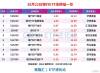
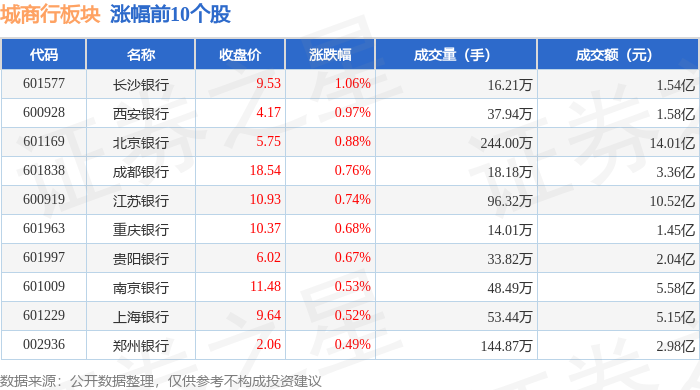
城商行板块10月22日涨0.48%,长沙银行领涨,主力资金净流出2.69亿元
Zheng Xing Xing Ye Ri Bao· 2025-10-22 08:20
Market Performance - The city commercial bank sector increased by 0.48% on October 22, with Changsha Bank leading the gains [1] - The Shanghai Composite Index closed at 3913.76, down 0.07%, while the Shenzhen Component Index closed at 12996.61, down 0.62% [1] Individual Stock Performance - Changsha Bank closed at 9.53, up 1.06% with a trading volume of 162,100 shares and a transaction value of 154 million [1] - Other notable performers include: - Xi'an Bank: closed at 4.17, up 0.97% [1] - Beijing Bank: closed at 5.75, up 0.88% [1] - Chengdu Bank: closed at 18.54, up 0.76% [1] - Jiangsu Bank: closed at 10.93, up 0.74% [1] Capital Flow Analysis - The city commercial bank sector experienced a net outflow of 269 million from institutional investors, while retail investors saw a net inflow of 165 million [2] - The overall capital flow indicates a mixed sentiment among different investor types [2] Detailed Capital Flow for Selected Banks - Shanghai Bank had a net outflow of 34.67 million from institutional investors, with a retail net inflow of 41.06 million [3] - Qilu Bank saw a net inflow of 22.48 million from institutional investors, while retail investors had a net inflow of 9.09 million [3] - Changsha Bank recorded a net inflow of 2.31 million from institutional investors and a net inflow of 1.55 million from retail investors [3]



股债分化格局下:两款“固收+权益”产品三季度涨超10%
2 1 Shi Ji Jing Ji Bao Dao· 2025-10-22 07:52
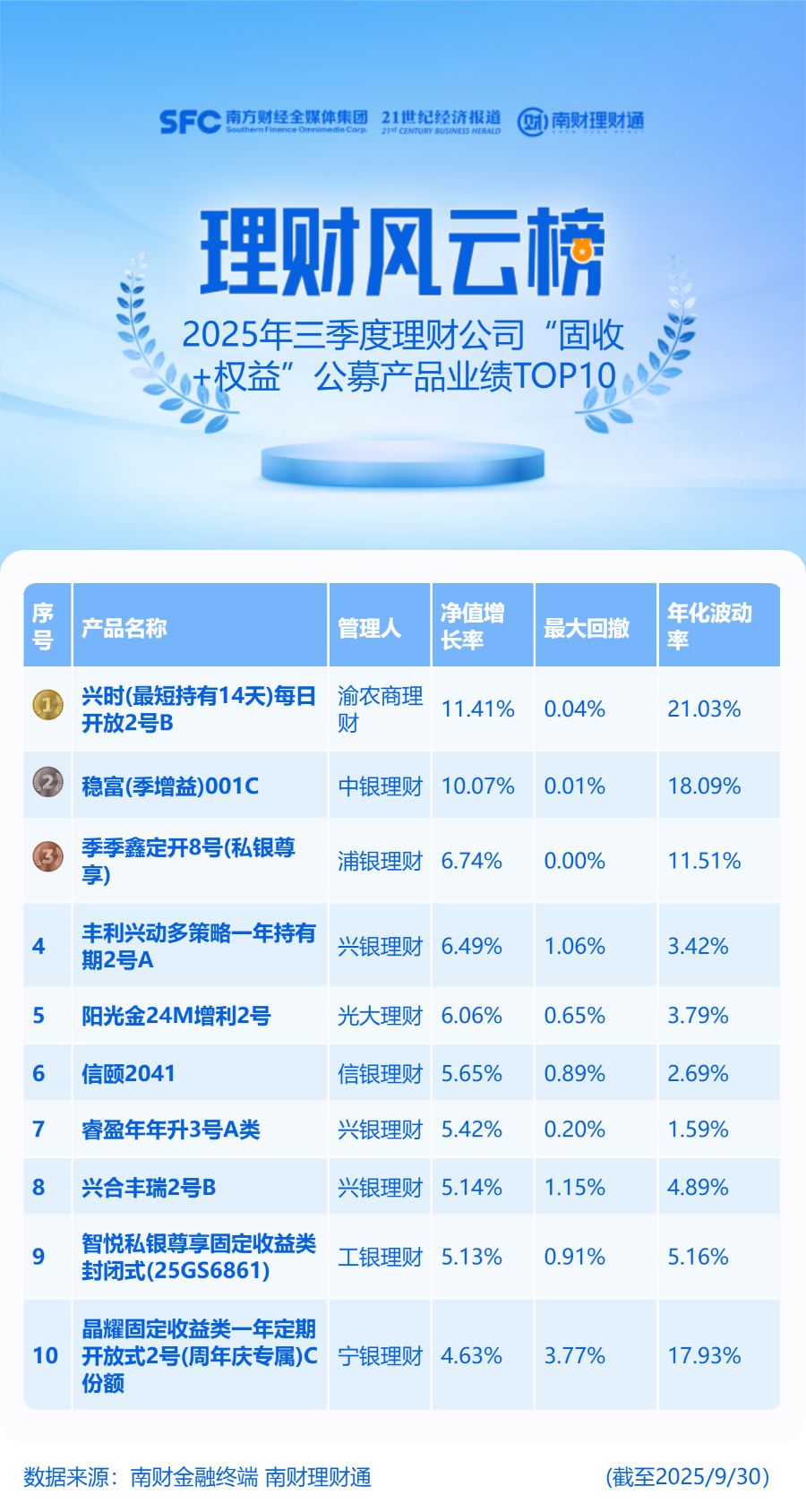
Overall Performance - In Q3 2025, the capital market exhibited significant differentiation due to the "stock-bond seesaw" effect, with the equity market performing strongly while the bond market faced overall pressure [5] - The A-share market experienced a notable upward trend, with the CSI 300 index rising by 17.90% and the Wind All A index increasing by 19.46%, while the ChiNext index surged over 50%, highlighting a growth style dominated by sectors such as artificial intelligence and technology [5][6] Product Analysis - The "fixed income + equity" products generally had conservative equity positions, with many products holding less than 2% in equities, resulting in limited impact from the stock market's rise [6] - The top 10 products listed primarily came from eight wealth management companies, with the top two products achieving net value growth rates exceeding 10% and exhibiting low maximum drawdowns [6][7] - The top-ranked product, "Xing Shi (Minimum Holding 14 Days) Daily Open 2B" from Yunnan Rural Commercial Bank Wealth Management, was positioned to allocate 0-20% in equity assets but held no equity assets as of Q2 2025, with over 51.33% of its assets in cash and bank deposits [6][7] - The second-ranked product, "Stable Wealth (Quarterly Increment) 001C" from Bank of China Wealth Management, had a bond asset ratio of 71.22% as of June 2025, with a significant portion of its holdings in financial bonds, corporate bonds, and private placement bonds [7] - Looking ahead to Q4, the market sentiment remains relatively optimistic towards the equity market, while the bond market may present short-term trading opportunities after the Q3 correction, although further declines in yields are expected to be limited [7]
金价创12年最大单日跌幅,白银跌幅一度超8%
3 6 Ke· 2025-10-22 07:30
Core Viewpoint - Recent declines in gold and silver prices are attributed to the easing of market risk aversion and profit-taking by investors, despite a long-term bullish outlook for precious metals [1][8]. Group 1: Market Reaction - On October 21, gold prices fell over 6% to $4086 per ounce, marking the largest single-day drop in 12 years, while silver prices dropped over 8% to below $48 per ounce, the largest decline since 2021 [1]. - Domestic futures markets also saw significant declines, with Shanghai gold and silver contracts dropping 4.64% and 4.86%, respectively [1]. - Analysts suggest that the recent price corrections have absorbed many profit-taking positions, indicating a potential for future price stability [1][8]. Group 2: Risk Factors Easing - Three major risk factors that previously supported gold prices have shown signs of easing: 1. Optimistic developments in U.S.-China trade relations, with President Trump expressing intentions to visit China and engage in trade discussions [3]. 2. Hopes for an end to the U.S. government shutdown, as Democratic leaders are negotiating to resolve the situation [4]. 3. A relative easing of geopolitical risks, particularly regarding the Ukraine conflict, with leaders expressing support for negotiations to achieve a ceasefire [5][6]. Group 3: Long-term Outlook - Despite the recent price corrections, analysts maintain that the long-term bull market for precious metals is far from over, driven by factors such as the weakening of the dollar's dominance and ongoing geopolitical tensions [2][8]. - Investment in gold remains attractive, with analysts suggesting that current market conditions present suitable buying opportunities for long-term investors [8]. - The historical context of the 1970s gold bull market is referenced, indicating similarities in current market dynamics, including concerns over dollar liquidity and the independence of the Federal Reserve [8]. Group 4: Additional Insights - Following the rapid increase in gold prices, copper is expected to experience a rebound due to its strategic importance in global energy transitions and technological advancements [9].
农业银行14连阳,再创历史新高,年内累涨近56%
Ge Long Hui A P P· 2025-10-22 02:29
Core Insights - The A-share market has seen a rise in bank stocks, with notable increases in shares of several banks, including Agricultural Bank of China, which has achieved a 14-day consecutive rise and a year-to-date increase of nearly 56% [1][3] Group 1: Bank Stock Performance - Zhejiang Commercial Bank, Wuxi Bank, CITIC Bank, Xi'an Bank, Jiangyin Bank, Sunong Bank, Agricultural Bank of China, Ningbo Bank, and Nanjing Bank all experienced gains exceeding 1% [1][3] - Agricultural Bank of China has reached a historical high with a year-to-date increase of 55.96%, marking a significant performance in the banking sector [1][3] Group 2: Market Data - Zhejiang Commercial Bank: 1.32% increase, total market value of 84.6 billion [3] - Wuxi Bank: 1.30% increase, total market value of 13.7 billion [3] - CITIC Bank: 1.29% increase, total market value of 436.8 billion [3] - Agricultural Bank of China: 1.14% increase, total market value of 27,894 billion [3]