
海螺水泥

Search documents
中证中国内地企业全球原材料综合指数报3281.67点,前十大权重包含北方稀土等
Jin Rong Jie· 2025-05-27 08:19
Group 1 - The core index, the CN Materials Composite Index, reported at 3281.67 points, with a 2.51% increase over the past month, 1.68% over the past three months, and a 6.63% year-to-date increase [1] - The index is designed to reflect the overall performance of different industry securities from Chinese mainland enterprises, classified according to the China Securities Index industry classification standards [1] - The top ten holdings of the CN Materials Composite Index include Zijin Mining (6.39%), Wanhua Chemical (2.21%), and others, indicating a concentration in specific companies [1] Group 2 - The market distribution of the CN Materials Composite Index shows that the Shanghai Stock Exchange accounts for 49.23%, Shenzhen Stock Exchange for 42.38%, and Hong Kong Stock Exchange for 7.82% [2] - In terms of industry composition, non-ferrous metals represent 41.47%, chemicals 37.94%, and other sectors such as non-metallic materials and steel also contribute to the index [2] Group 3 - The index samples are adjusted biannually, with adjustments occurring on the next trading day after the second Friday of June and December, and can also be adjusted under special circumstances [3] - Adjustments to the index samples occur when there are changes in industry classification due to special events or when companies are delisted [3]





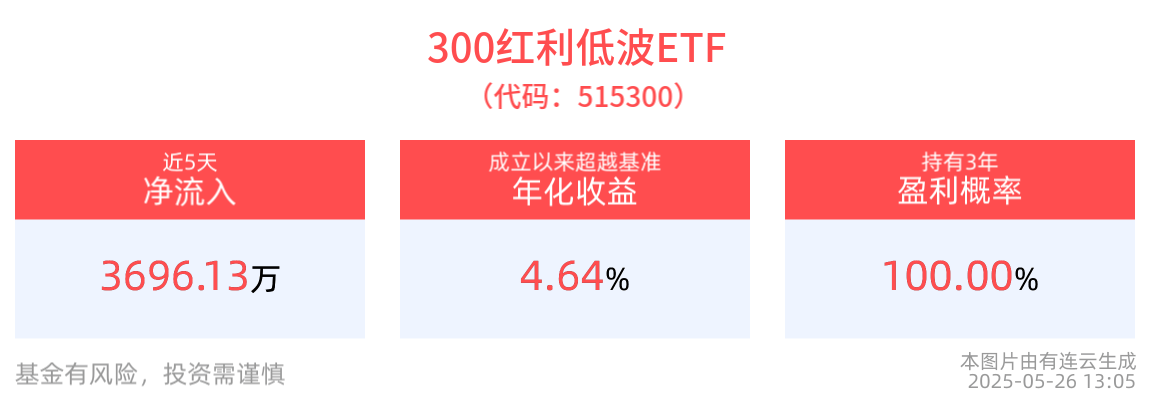
高股息资产投资价值有望延续,300红利低波ETF(515300)最新资金净流入超3000万元
Sou Hu Cai Jing· 2025-05-26 05:33
Group 1 - The CSI 300 Dividend Low Volatility Index decreased by 0.52% as of May 26, 2025, with mixed performance among constituent stocks [1] - Minsheng Bank led the gains with an increase of 0.72%, followed by Ninghu Expressway at 0.63% and China Unicom at 0.56%, while Shanghai Bank, Conch Cement, and Huayu Automotive experienced declines [1] - The CSI 300 Dividend Low Volatility ETF (515300) underwent a rebalancing adjustment [1] Group 2 - The CSI 300 Dividend Low Volatility ETF recorded a trading volume of 54.8688 million yuan during the session, with an average daily trading volume of 110 million yuan over the past week [3] - The latest scale of the CSI 300 Dividend Low Volatility ETF reached 5.643 billion yuan, with a net inflow of 30.3007 million yuan recently [3] - Over the past five trading days, there were three days of net inflows totaling 36.9613 million yuan [3] Group 3 - As of April 30, 2025, the top ten weighted stocks in the CSI 300 Dividend Low Volatility Index accounted for 37.43% of the index, including China Shenhua, Gree Electric, and Daqin Railway [3] - Dongfang Wealth Strategy suggests that the relative return probability of dividends remains high, with a potential marginal increase in stable dividend style profitability from Q2 to Q3 [3] - The micro liquidity environment is expected to limit the valuation elasticity of high sensitivity styles, supporting the relative return probability of stable dividend styles in the near future [3] Group 4 - According to estimates from Founder Securities, long-term holding of dividend assets shows a higher success rate compared to broad indices like the CSI 300, aligning with the long-term performance assessment direction of the "Action Plan for Promoting the High-Quality Development of Public Funds" [4] - Institutions indicate that dividend assets are a valuable investment direction for long-term investors, especially in the context of ongoing policy encouragement for long-term capital market entry [4] - Investors without stock accounts can access investment opportunities through the corresponding CSI 300 Dividend Low Volatility ETF linked fund (007606) [4]

行业观察丨碳约束下的水泥业变局:落后产能加速淘汰,绿色转型成新赛道
Zhong Guo Huan Jing Bao· 2025-05-26 02:45
Core Viewpoint - The inclusion of the cement industry in the national carbon emissions trading market signifies a profound transformation in cost, technology, and competitive landscape, presenting both challenges and opportunities for industry transformation [1] Group 1: Industry Challenges - The Chinese cement industry is experiencing its most severe downturn in nearly a decade, with a projected reduction of 550 million tons in national cement production by 2024 compared to 2021, leading to pressure on the market capitalization of listed companies [1] - The decline in real estate investment and infrastructure growth has resulted in a "cliff-like" drop in cement demand, exacerbated by overcapacity and intense competition among companies [2] - The industry faces challenges such as reduced mutual trust among enterprises and chaotic competition, making effective collaboration difficult and intensifying market confusion [2] Group 2: Opportunities from Carbon Market Inclusion - The implementation of the carbon emissions trading market is expected to drive the cement industry from a high-carbon path to a low-carbon competitive landscape, accelerating innovation and application of low-carbon technologies [3] - The carbon market will encourage companies to adopt advanced production processes, improve energy efficiency, and reduce carbon emissions, enhancing their market competitiveness and promoting a positive green brand image [3][4] - Companies can generate new revenue streams by selling surplus carbon allowances, attracting investments from green funds and financial institutions, thereby broadening financing channels and reducing costs [4] Group 3: Long-term Implications - The carbon market will necessitate increased investments in energy-saving renovations, low-carbon technologies, and materials to lower carbon emission intensity, which is essential for reducing costs associated with purchasing shortfall allowances [5] - The initial phase of the carbon market implementation (2024-2026) provides a transition period for the cement industry, allowing it to adapt without losing price advantages compared to non-participating companies [6] - Despite current market demand decline, the cement industry is expected to remain a crucial raw material in the construction sector due to the large economic scale of the country [6]
总投资2.58亿,柬埔寨实居省海螺水泥厂正式投产
Ren Min Ri Bao Hai Wai Ban· 2025-05-26 01:59
Group 1 - The Cambodian Prime Minister announced the official launch of the "Conch Cement Plant" in Preah Sihanouk Province, which has a total investment of $258 million and is a joint venture between China's Anhui Conch Group and Cambodia's Xu Group [2] - The cement plant has an annual designed capacity of 2.2 million tons and is expected to create over 1,000 direct or indirect jobs [2] - The Cambodian government will extend the special tax policy for domestic cement for an additional five years to enhance the competitiveness of local products and promote industry development [2] Group 2 - Cambodia currently has six operational cement plants with a total annual capacity of approximately 11 million tons, transitioning from self-sufficiency in cement to becoming an exporter [3] - The Cambodian Development Council (CDC) approved 231 investment projects from January to April 2025, with a total investment of $3.36 billion, expected to create around 124,000 jobs nationwide [3]

海螺水泥(00914) - 关连交易:接受工程项目设计与技术服务、矿山基建项目工程设计与施工服务和S...
2025-05-23 10:38
香港交易及結算所有限公司及香港聯合交易所有限公司對本公告的內容概不負責,對其準確性或完 整性亦不發表任何聲明,並明確表示,概不對因本公告全部或任何部份內容而產生或因倚賴該等內 容而引致的任何損失承擔任何責任。 礦山基建項目工程設計與施工服務 二零二五年二月七日,本公司附屬公司廣英礦業(作為發包人)與海螺設計院及銅冠 礦建(作為承包人)簽署《礦山基建項目工程總承包合同》,根據該合同,海螺設計 院及銅冠礦建同意為廣英礦業的水泥用石灰岩礦基建項目提供工程設計及施工服務, 合同價格約為人民幣 3,710 萬元。 安徽海螺水泥股份有限公司 SCR 脱硝技改服務 ANHUI CONCH CEMENT COMPANY LIMITED 二零二四年十一月十一日,本公司(為其自身及代表其相關附屬公司)與海螺設計院 簽署《SCR 脱硝技改服務合同》,根據該合同,海螺設計院同意為本公司若干附屬公 司之三條熟料生產線之 SCR 脫硝技術改造項目提供工程設計、技術標定、設備供貨及 調試服務,合同價格為人民幣 1,755 萬元。 (在中華人民共和國註冊成立之股份有限公司) (股份代號:00914) 關連交易:接受工程項目設計與技術服務、礦 ...
海螺水泥(600585) - 關連交易:接受工程項目設計與技術服務、礦山基建項目工程設計與施工服務和SCR脫硝技改服務
2025-05-23 10:16
香港交易及結算所有限公司及香港聯合交易所有限公司對本公告的內容概不負責,對其準確性或完 整性亦不發表任何聲明,並明確表示,概不對因本公告全部或任何部份內容而產生或因倚賴該等內 容而引致的任何損失承擔任何責任。 安徽海螺水泥股份有限公司 ANHUI CONCH CEMENT COMPANY LIMITED (在中華人民共和國註冊成立之股份有限公司) (股份代號:00914) 關連交易:接受工程項目設計與技術服務、礦山基建項目工程設計與施工 服務和 SCR 脫硝技改服務 工程項目設計與技術服務 二零二五年五月二十三日,本公司(為其自身及代表其相關附屬公司)與海螺設計院 簽署《工程項目設計與技術服務合同》,根據該合同,海螺設計院將為本公司若干附 屬公司的骨料、機制砂、商砼、熟料線、粉磨站、礦粉中轉項目、輥壓機技改項目及 綜合類項目、本公司大型專項改造項目、工程諮詢服務等項目提供工程設計及/或技術 改造服務,合同價格為不超過人民幣 12,188 萬元。 礦山基建項目工程設計與施工服務 二零二五年二月七日,本公司附屬公司廣英礦業(作為發包人)與海螺設計院及銅冠 礦建(作為承包人)簽署《礦山基建項目工程總承包合同》,根據 ...
建筑材料行业双周报(2025年第9期):城市更新有望加速,关注地方建工和消费建材配置机会
Guoxin Securities· 2025-05-22 02:05
Investment Rating - The report maintains an "Outperform" rating for the construction materials sector, indicating expected performance above the market index [2][4]. Core Insights - Urban renewal is anticipated to accelerate, with a focus on local construction and consumer building materials, driven by government policies aimed at enhancing existing building utilization and improving urban infrastructure [3][4]. - The construction materials sector is expected to benefit from increased orders related to urban renewal projects, particularly in waterproof materials, coatings, and piping [3][4]. Summary by Sections Cement - The national average cement price decreased by 1.1% last week, with regional price changes ranging from a drop of 10-30 CNY/ton in North, East, and Central South China, while prices in Liaoning and Henan increased by 20 CNY/ton. Demand showed a slight increase week-on-week but remains 6-7% lower year-on-year [3][22]. Glass - The float glass market continued to show weakness, with an average price of 1306.73 CNY/ton, down 0.82% from the previous week. Demand remains weak, and supply is stable with a production capacity utilization rate of 80.08% [3][35]. Fiberglass - The price of non-alkali fiberglass remained stable, with mainstream prices for 2400tex ranging from 3500-3800 CNY/ton, averaging 3735.25 CNY/ton, a year-on-year decrease of 3.3% [3][46]. Investment Recommendations - The report suggests focusing on resilient consumer building material leaders, particularly those benefiting from second-hand housing and renovation demand, recommending companies such as Sanke Tree, Beixin Building Materials, and others [4]. - For the cement and fiberglass sectors, companies like Anhui Conch Cement and China Jushi are highlighted for their potential recovery in performance [4].
国信证券晨会纪要-20250522
Guoxin Securities· 2025-05-22 02:00
Macro and Strategy - April fiscal data shows tax revenue returning to positive growth at 1.9% YoY, while general expenditure growth accelerated to 12.9% YoY [8][9] - Key tax categories showed mixed results, with personal income tax growing significantly at 9% YoY, while corporate income tax declined to 4% YoY [8][9] Textile and Apparel Industry - Textile manufacturing continues to benefit from inventory optimization and order rebound, with revenue growth of 13.7% YoY in 2024, while apparel and home textiles saw a slowdown to 1.0% YoY [9][10] - In Q1 2025, textile manufacturing growth slowed to 8.2% YoY, while apparel and home textiles faced a 5.1% decline in revenue [9][10] - Major companies in manufacturing, such as Huayi and Shenzhou, reported strong orders and better profitability, while sports brands showed resilience compared to casual wear [9][10] Pharmaceutical Industry - Q1 2025 saw overall revenue growth slow for overseas pharmaceutical companies, with Eli Lilly and Novo Nordisk showing significant growth driven by GLP-1 drugs [15][16] - The U.S. drug pricing reform and macroeconomic uncertainties are impacting revenue forecasts for major pharmaceutical firms [15][16] Computer Industry - Major domestic companies like Alibaba and Tencent are significantly increasing capital expenditures, with Alibaba planning to invest over 380 billion RMB in cloud and AI infrastructure over the next three years [17][18] - There is a growing demand for computing power rental services, with several companies announcing related orders [17][18] Automotive Industry - April 2025 saw a total vehicle production and sales of 2.619 million and 2.590 million units respectively, with a year-on-year increase of 8.9% and 9.8% [19][20] - New energy vehicles accounted for 47.3% of total new vehicle sales, with production and sales growth of 43.8% and 44.2% YoY [19][20] - The market is witnessing a shift towards autonomous driving technologies, with Robotaxi commercial deployment accelerating [20][21] Building Materials Industry - The recent government policy is expected to accelerate urban renewal projects, benefiting local construction and decorative renovation companies [22][23] - Cement prices have seen a slight decline, while demand remains weak, indicating a cautious market outlook [23][24] Smart IoT Industry - The company focuses on IoT solutions and is expanding into AI infrastructure, with significant revenue contributions from its various business segments [26][27] - The global AI server market is projected to grow rapidly, driven by increasing demand for AI training and inference [28] Travel Industry - The company reported a 16.2% increase in revenue for Q1 2025, with strong growth in domestic hotel bookings and international travel [29][30] - The international platform is experiencing rapid growth, benefiting from favorable policies and increased travel demand [30][31] Gaming and E-commerce Industry - The company achieved a 30% revenue growth in Q1 2025, driven by strong performance in e-commerce and digital financial services [33][34] - The gaming segment also saw significant growth, with a notable increase in user engagement and revenue from popular titles [36][37]
建材行业2024年报及2025年一季报综述:由单边下行走向结构分化,赛道及龙头α开始显现
Hua Yuan Zheng Quan· 2025-05-22 01:19
建筑材料 行业专题报告 hyzqdatemark 2025 年 05 月 22 日 戴铭余 SAC:S1350524060003 daimingyu@huayuanstock.com 王彬鹏 SAC:S1350524090001 wangbinpeng@huayuanstock.com 郦悦轩 SAC:S1350524080001 liyuexuan@huayuanstock.com 朱芸 SAC:S1350524070001 zhuyun@huayuanstock.com 证券研究报告 唐志玮 tangzhiwei@huayuanstock.com 板块表现: 由单边下行走向结构分化,赛道及龙头α开始显现 投资评级: 看好(维持) ——建材行业 2024 年报及 2025 年一季报综述 投资要点: 风险提示:经济恢复不及预期,化债力度不及预期,房地产政策不及预期 请务必仔细阅读正文之后的评级说明和重要声明 | 1. 综述:行业压力仍存,结构性拐点逐步显现…………………………………………………………………………………… 5 | | --- | | 2. 消费建材:行业逐步探底,结构分化开始显现. | | 3. ...
从产品“出海”到技术输出升级中国水泥行业引国外同行“取经”
Zheng Quan Shi Bao· 2025-05-21 17:51
Core Viewpoint - The Chinese cement industry has significantly enhanced its international presence and technological capabilities, leading to increased foreign interest and collaboration opportunities in advanced cement production technologies [1][2][3]. Group 1: International Engagement - In mid-May, nearly 300 foreign business representatives from 49 countries visited Hefei, China, to explore cement manufacturing technologies and equipment procurement [1]. - Chinese enterprises hold a 40% full ownership and 60% joint venture stake in overseas cement projects, contributing to local infrastructure development [1][2]. - The number of foreign guests at the recent cement technology conference increased by 66% compared to the previous event, indicating growing international interest [1]. Group 2: Technological Advancements - Over the past 20 years, the Chinese cement industry has surpassed European companies in global influence, with China National Materials Group (Sinoma) operating 351 production lines across 91 countries [2]. - The cement manufacturing sector reached a peak of 2,323 patent applications in 2020, with a stable trend in patent authorizations expected to yield 1,966 patents in 2024 [2]. - Key characteristics of the Chinese cement industry include large-scale equipment, intelligent production processes, and green manufacturing practices [2]. Group 3: Green and Intelligent Manufacturing - The Chinese Cement Equipment Group's roller press series has sold over 2,400 units globally, showcasing the company's strength in providing customized system solutions [3]. - Foreign guests expressed interest in collaborating with Chinese cement companies, particularly in green technologies and intelligent manufacturing capabilities [3]. - A strategic partnership was recently established between a South African cement group and Sinoma to reduce carbon emissions by 20% in future projects [3]. Group 4: Market Dynamics - Among 21 publicly listed cement companies that reported Q1 2025 earnings, 14 showed growth in net profit, although this is attributed to policy implementation rather than high-quality development [5]. - The Chinese cement industry must focus on both domestic and international markets to sustain healthy growth, emphasizing the need for effective capacity replacement policies and international cooperation [5]. - Chinese cement companies are increasingly engaging in global resource allocation and integration, transitioning from product export to technology output, with leading firms like Sinoma and Anhui Conch at the forefront [5][6].
