奔驰

Search documents
英伟达Q1净利188亿美元,盘后涨超5%;美联储纪要强调通胀,美股跳水;德国三大车企被曝直接与美谈判;比亚迪辟谣“经销商爆雷”丨每经早参
Mei Ri Jing Ji Xin Wen· 2025-05-28 22:13
Market Performance - US stock market indices closed lower, with the Dow Jones down 0.58%, Nasdaq down 0.51%, and S&P 500 down 0.56% [4] - International oil prices strengthened, with WTI crude oil rising 1.59% to $61.86 per barrel and Brent crude oil increasing 1.18% to $64.32 per barrel [5] - European stock indices also fell, with Germany's DAX down 0.78%, France's CAC40 down 0.49%, and the UK's FTSE 100 down 0.59% [6] Federal Reserve Meeting Minutes - The Federal Reserve decided to maintain the federal funds rate target range at 4.25%-4.5% during the FOMC meeting on May 6-7 [4] - The committee noted increased uncertainty in the economic outlook, with rising risks of unemployment and inflation [4] Corporate Developments - Huawei transferred the "Shangjie" trademark to SAIC Motor, marking a deepening collaboration in the smart electric vehicle market [15] - BYD responded to rumors regarding financial issues of a dealer group, clarifying that the information was untrue and that they are providing support to the dealer [16] - Tencent released and open-sourced a voice digital human model, enhancing video content creation capabilities [17] Investment and Economic Policies - The Chinese Ministry of Finance announced plans to issue 68 billion RMB in government bonds in Hong Kong [8] - The Chinese government has achieved full visa exemption coverage for Gulf Cooperation Council countries [7] - The Ministry of Commerce is strengthening communication on rare earth export controls, potentially indicating a relaxation of restrictions for European semiconductor companies [9] New Product Launches - DJI is set to enter the robotic vacuum market with a new product expected to launch in June [20] - XPeng Motors launched the MONA M03 Max, with prices starting at 129,800 RMB, featuring advanced smart driving capabilities [21] - Honor announced its entry into the robotics sector, showcasing a high-speed robot at a recent event [22]




整理:5月28日欧盘美盘重要新闻汇总
news flash· 2025-05-28 15:07
Domestic News - China is committed to high-level opening-up and welcomes U.S. financial institutions to participate in the development of its capital markets [1] - The Chinese government emphasizes the importance of creating a good ecosystem for platform economy and maintaining a fair market environment [1] - The National Health Commission reports a slowdown in the upward trend of COVID-19 cases nationwide [1] - The National Medical Insurance Administration is investigating issues related to pharmacists' licenses in retail pharmacies [1] - The Ministry of Commerce is strengthening the communication of rare earth export control policies, which may indicate a relaxation of export restrictions on European chip companies [1] - China has implemented visa-free travel for citizens of Saudi Arabia, Oman, Kuwait, and Bahrain [1] International News - NATO plans to increase the number of brigade-level troops, with Germany being asked to deploy an additional 40,000 troops [2] - The German Ministry of Defense announces an additional military aid package of approximately €5 billion to Ukraine [2] - Hamas has reached an agreement with the U.S. Middle East envoy on a ceasefire outline for Gaza [2] - The EU officially lifts economic sanctions on Syria, with the stock market set to reopen on June 2 [2] - OPEC representatives state that no production policy recommendations were made during the recent OPEC+ JMMC meeting [2] - Discussions are ongoing between BMW, Mercedes, and Volkswagen with the U.S. Department of Commerce regarding tariff issues, aiming for an agreement by early July [2] - The EU trade chief will hold talks with U.S. officials regarding tariff policies and cooperation in sectors such as aviation, semiconductors, and steel [2] - The Swiss Federal Council is consulting on the impact of U.S. tariffs, with expectations that overall economic development will not decline [2]
裁员计划逼近 10 万,海外车企集中 “瘦身”
晚点LatePost· 2025-05-28 14:41
Core Viewpoint - The global automotive industry is facing significant challenges, including a slowdown in electrification trends, shrinking demand, intensified market competition, and unstable international trade environments, leading to widespread layoffs among major overseas automotive brands and suppliers [3][9]. Group 1: Layoff Trends - Major overseas automotive companies and suppliers have announced layoffs totaling nearly 100,000 employees across key markets such as China, North America, Europe, and Japan [4]. - Volkswagen is planning to lay off approximately 35,000 employees by 2030, with 7,000 already laid off, aiming to save €1.5 billion annually in labor costs [5][6]. - Other companies like Ford, Mercedes-Benz, and Nissan are also implementing significant layoffs, with Ford cutting 4,000 jobs in Europe and Nissan planning to reduce its workforce by 20,000 over two years [5][7]. Group 2: Reasons for Layoffs - The layoffs are primarily driven by the need for cost reduction, increased competition, and the impact of tariffs and trade changes, particularly in the U.S. market [5][8]. - Companies are restructuring to improve efficiency and adapt to changing market conditions, with many citing the need to streamline operations and reduce redundancy [6][9]. Group 3: Market Dynamics - The automotive industry is undergoing a deep adjustment phase, with traditional automakers facing pressure from rising Chinese brands that continue to expand despite the overall market contraction [9]. - The shift towards electrification has led to high investments, but profitability pressures are forcing companies to reassess their workforce and operational strategies [9].

“车圈恒大”论:是危言耸听?还是盛世警言?
Ge Long Hui· 2025-05-28 13:05
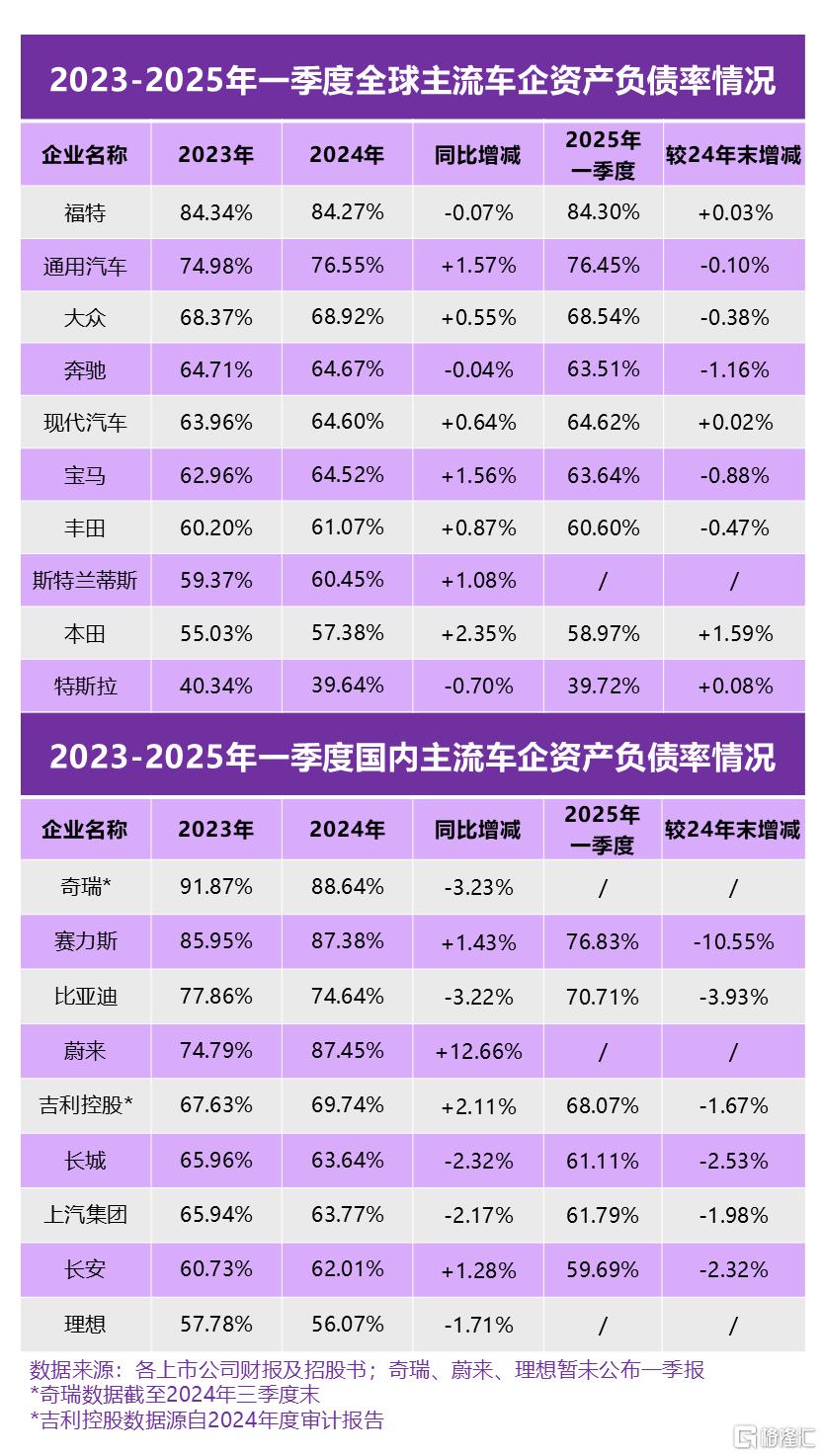
Core Viewpoint - The automotive industry is experiencing heightened concerns regarding high debt levels, with comparisons being made to the Evergrande crisis, particularly following comments from Great Wall Motors' chairman, Wei Jianjun [1][11]. Group 1: Debt Levels in the Automotive Industry - High debt levels are common in the automotive sector, with over 60% asset-liability ratios being standard among global giants; Ford's debt ratio exceeds 84%, while General Motors is over 76% [1][2]. - Domestic automakers generally exhibit lower debt levels compared to their international counterparts, with significant reductions noted; for instance, Seres' debt ratio dropped over 10% in the first quarter, and BYD's decreased by 7% in the past six months [3][6]. Group 2: Comparison of Domestic and International Debt Structures - International automakers like Toyota and Volkswagen have substantial interest-bearing debts exceeding 100 billion yuan, with Toyota's interest-bearing debt constituting 68% of its total liabilities [6]. - In contrast, domestic companies maintain much lower levels of interest-bearing debt, with BYD at only 5%, Geely at 17%, and Chery at 12% [6]. Group 3: Accounts Payable and Industry Dynamics - The disparity between domestic and international automakers is attributed to domestic firms relying more on non-interest-bearing liabilities, primarily consisting of unpaid supplier invoices [7]. - Despite the industry facing challenges of overcapacity and insufficient demand, domestic automakers have extended their accounts payable cycles; for example, BYD averages 127 days to settle accounts, while Great Wall takes 163 days [8][9]. Group 4: Industry Outlook and Strategic Concerns - The narrative surrounding the "Evergrande theory" may be more of a pressure tactic from struggling companies rather than a reflection of the actual financial health of the industry [11]. - Great Wall Motors faces strategic challenges, including failure to meet sales targets and a lack of agility in adapting to key market shifts, which raises concerns about its future competitiveness [11][14].


36氪出海·中东|连接东西方贸易:为什么迪拜是进出口业务的理想平台
3 6 Ke· 2025-05-28 11:14
Core Insights - Dubai is a vibrant global trade center with unique strategic advantages for entrepreneurs looking to establish import and export businesses [2] - In Q1 2024, Dubai's non-oil foreign trade reached $381 billion, showcasing its economic strength and entrepreneurial potential [2] - The UAE emphasizes innovation and diversification, creating a fertile environment for business development [2] Historical Context - The UAE has historically been a natural hub for international trade, connecting Asia and Europe, and has evolved significantly since the discovery of oil in 1962 [3] - The establishment of key ports and free zones has enhanced the UAE's re-export capabilities, positioning it as a global logistics hub [3] Import Opportunities - Key sectors for imports include electrical equipment, vehicles, electronics, and precious metals, with significant market demand driven by low import tariffs and a growing consumer base [6][14] Export Opportunities - The UAE's export landscape includes oil, cosmetics, aluminum, and pharmaceuticals, with notable growth in the cosmetics market projected to exceed $3 billion by 2025 [6][14] Strategic Advantages of Dubai - Dubai's geographic location at the crossroads of Asia, Europe, and Africa provides unparalleled access to emerging markets [9] - The business-friendly regulatory framework, including zero corporate tax for most activities, enhances its attractiveness for foreign entrepreneurs [15] Free Zones - The UAE's free zones offer unique operational frameworks that facilitate trade and investment, attracting foreign companies with simplified business setup processes [11] - Advantages of establishing a business in free zones include 100% foreign ownership, tax exemptions, and flexible operational hours [16] Steps to Establish an Import/Export Business - Entrepreneurs can choose to set up in either a free zone or the mainland, with specific registration processes for each option [13][22] Customs Regulations - Understanding Dubai's customs regulations is crucial for conducting import/export activities, including necessary declarations and compliance with specific product regulations [18][19]
宝马中国,踩上悬崖|深氪lite
3 6 Ke· 2025-05-28 08:31
Core Insights - The luxury car market is witnessing a brand crisis, with BMW facing challenges similar to those that led to Audi's decline [1][2] - BMW's sales strategy has shifted, leading to a significant drop in customer loyalty and brand value [4][14] - The rise of domestic brands like AITO and Li Auto is capturing market share from BMW, particularly in the SUV segment [2][3] Sales and Market Dynamics - BMW's X5, once a profitable model, has seen its price drop to 540,000 RMB, yet it struggles to sell [2][3] - The company exited the price war last year, which further alienated potential customers who perceived BMW as becoming more expensive [3][4] - The rapid expansion of BMW's dealership network from 460 to over 600 between 2014 and 2017 was initially successful but has led to internal competition among dealers [5][6][9] Dealer and Pricing Strategy - BMW's dealer model, which offers 90% of the MSRP as wholesale price, has created a competitive environment where dealers undercut each other [7][9] - The introduction of the new 5 Series has resulted in disappointing sales, with only 4,000 units sold monthly, leading to inventory pressure on dealers [10][11] - The price cuts initiated by dealers to move inventory have eroded BMW's pricing integrity, making it difficult to maintain higher price points [11][12] Brand Perception and Product Development - BMW's brand value and premium pricing ability are declining, with consumers now expecting lower prices [14][20] - The company is struggling to adapt to market changes, with its new models failing to resonate with consumers compared to competitors like Mercedes-Benz [16][20] - BMW's slow response to the electric vehicle market and reliance on traditional performance metrics have left it vulnerable to newer brands [18][19] R&D and Market Strategy - BMW's development teams in Germany are disconnected from the preferences of Chinese consumers, leading to products that do not meet local market demands [21][22] - The company is facing internal challenges regarding decision-making and product development, which are hampering its ability to compete effectively [25][26] - Competitors like Mercedes-Benz and Audi are actively adapting their strategies to better align with Chinese consumer preferences, while BMW remains stagnant [24][26]
先导智能(300450):海内外扩产共振,锂电设备龙头拐点已至
Soochow Securities· 2025-05-28 07:01
Investment Rating - The report maintains a "Buy" rating for the company [1][9] Core Views - The company has fully recognized impairment losses totaling 2.8 billion yuan for 2023 and 2024, with a significant portion related to credit and inventory [3] - The company is expected to benefit from increased overseas revenue, leading to improved overall profitability and operational conditions [3] - The first quarter of 2025 has shown a significant recovery in operating cash flow, indicating a positive trend [3] - The company has established a strong relationship with Ningde Times, with expected transaction volumes reaching 8.5 billion yuan in 2025, indicating a recovery to pre-2021 levels [8] - The report highlights the company's expansion into overseas markets, with high-margin clients and favorable cash flow conditions [8] Financial Projections - The company is projected to achieve total revenue of 13.2 billion yuan in 2025, with a year-on-year growth of 11.34% [1] - The net profit attributable to the parent company is expected to reach 1.06 billion yuan in 2025, reflecting a significant recovery from previous years [1] - The report forecasts a dynamic P/E ratio of 30.75 for 2025, decreasing to 14.59 by 2027, indicating improving valuation metrics [1][9]

银行消费贷极限逼近3%红线
第一财经· 2025-05-28 00:36
Core Viewpoint - The consumer loan business of banks is facing significant challenges due to declining loan interest rates, increased competition, and rising non-performing loan rates, necessitating a balance between interest margin management, risk control, and product innovation [1][6][10]. Group 1: Market Environment - In a competitive market, banks are offering ultra-low interest rates on consumer loans, including zero-interest car loans and renovation loans with rates as low as 2.4% [1][3]. - Regulatory measures have been implemented to halt consumer loan products with annual interest rates below 3%, prompting banks to find ways to lower effective rates through various promotional strategies [3][4]. Group 2: Consumer Behavior - Consumers are increasingly drawn to low-interest loans for significant purchases, such as home renovations and cars, despite the risks of over-borrowing [4][10]. - The trend of low-interest loans may lead to a "rate illusion," where consumers overlook their actual debt capacity, potentially increasing their financial burden [10]. Group 3: Loan Performance and Risks - The growth of personal loans has slowed, with major banks reporting lower growth rates in personal loan balances compared to overall loan growth [7][8]. - The non-performing loan rates are on the rise, with some banks experiencing significant increases in their retail non-performing loan ratios [7][9]. - The market for transferring non-performing loans has seen a dramatic increase in transaction volumes, indicating a growing concern over asset quality [8][9]. Group 4: Industry Recommendations - Industry experts suggest that banks need to balance interest margin management, risk control, and product innovation to navigate the current challenges effectively [10].

裁员计划逼近 10 万,海外车企集中 “瘦身”
晚点Auto· 2025-05-27 15:44
Core Viewpoint - The global automotive industry is facing significant challenges, including a slowdown in electrification trends, shrinking demand, intensified market competition, and an unstable international trade environment, leading to widespread layoffs among major overseas automotive brands [2][7]. Group 1: Layoff Trends - Major overseas automotive companies have announced layoffs affecting nearly 100,000 employees across key markets such as China, North America, Europe, and Japan [2]. - Volkswagen Group plans to cut approximately 35,000 jobs by 2030, with 7,000 already laid off, aiming to save €1.5 billion annually in labor costs [3][4]. - Other companies like Ford, General Motors, and Nissan are also implementing significant layoffs, with Ford cutting 4,000 jobs in Europe and Nissan planning to lay off 20,000 employees due to weak sales and trade uncertainties [3][5][6]. Group 2: Reasons for Layoffs - The layoffs are primarily driven by the need for cost reduction, increased competition, and the impact of tariffs and trade policies [3][5][6]. - Companies are restructuring to improve efficiency and adapt to changing market conditions, with many citing the need to streamline operations and reduce overhead costs [4][5][6]. Group 3: Comparison with Chinese Brands - In contrast to the layoffs among overseas brands, Chinese automotive companies are experiencing growth, with brands like BYD, Geely, and NIO increasing their workforce [7]. - The expansion of Chinese brands highlights a divergence in market performance, as they continue to capitalize on opportunities while traditional automakers face contraction [7].

“实习货币化”风波背后,私人银行增值服务边界如何守?
Bei Jing Shang Bao· 2025-05-27 12:47
Core Viewpoint - The controversy surrounding the "2025 Elite Internship Program" launched by Industrial Bank highlights the ethical concerns of linking internship opportunities to high financial thresholds, raising questions about employment fairness and resource allocation in the private banking sector [1][3][9]. Summary by Sections Program Details - The "2025 Elite Internship Program" required non-private banking clients to deposit over 10 million yuan and existing clients to add 5 million yuan to qualify for internship recommendations from top companies like JPMorgan Chase and Google [1][3][6]. - The program was marketed as a value-added service for high-net-worth clients, but the financial barriers sparked public debate about equity in resource distribution [3][4]. Company Response - Following public backlash, Industrial Bank issued an apology and suspended the program, clarifying that the final decision on internship opportunities rests with the hiring companies [3][4]. - The bank emphasized that the program was intended to provide career assessment and job information through third-party channels, not a guarantee of placement [4][5]. Market Context - The private banking sector has seen significant growth, with Industrial Bank's private banking clients increasing by 11.36% year-on-year, reaching an average of 77,017 clients [6]. - The total financial assets of private banking clients also grew by 12.40%, indicating a robust demand for private banking services [6]. Ethical Considerations - The linkage of internship opportunities to financial deposits raises ethical questions about fairness in employment, as it may create a privileged pathway for wealthy clients [9][10]. - Legal experts suggest that while private banks can offer differentiated services, they should balance commercial value with social equity to avoid exacerbating social inequalities [9][10]. Industry Trends - Other banks, such as Ping An, have also introduced similar programs, indicating a trend where financial institutions are increasingly tying internship opportunities to their private banking services [7][10]. - The competitive landscape in private banking is intensifying, with institutions exploring diverse value-added services to attract high-net-worth clients [8][10].