抖音

Search documents
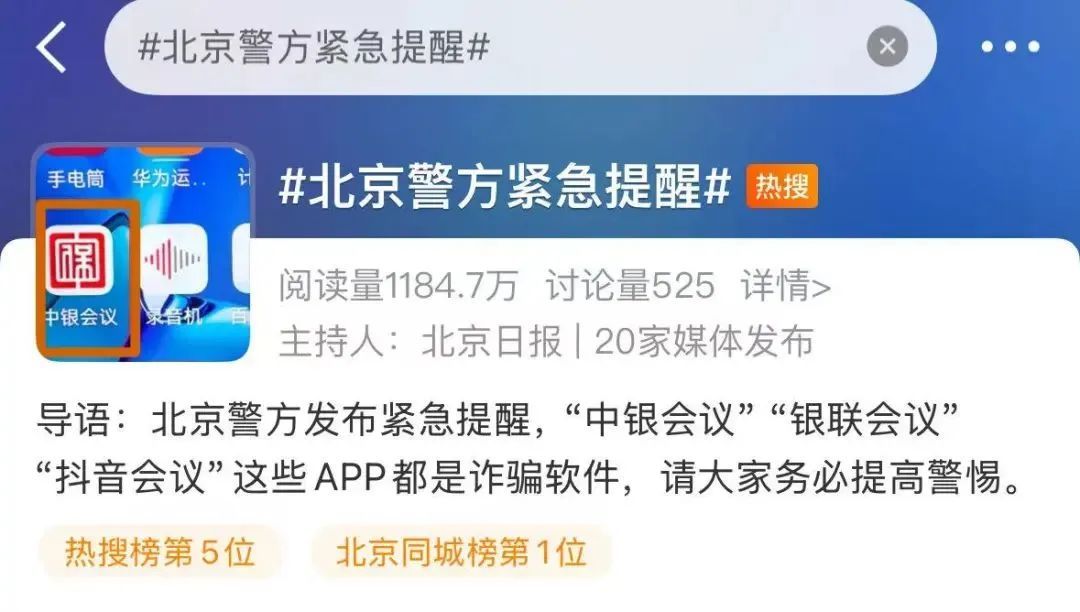
警方提醒“抖音会议”系诈骗软件,抖音回复
Qi Lu Wan Bao· 2025-07-15 08:26
Core Viewpoint - The Beijing police issued a warning about fraudulent apps such as "中银会议" (Zhongyin Meeting), "银联会议" (UnionPay Meeting), and "抖音会议" (Douyin Meeting), urging the public to remain vigilant against these scams [1][5]. Group 1: Fraudulent Activities - A 65-year-old woman, Ms. Xu, was targeted by scammers posing as customer service representatives from a short video platform, leading her to download the "中银会议" app under the pretense of canceling a service [3][5]. - The app allowed the scammers to guide Ms. Xu through sensitive banking operations, resulting in the complete theft of her bank balance [5]. Group 2: App Characteristics - The fraudulent apps are designed to appear legitimate, using terms like "会议" (meeting) and names associated with well-known financial institutions, which adds to their deceptive nature [5]. - Douyin's official statement clarified that it has never launched an app called "抖音会议," reinforcing that such apps are indeed scams [5][6]. Group 3: Safety Recommendations - Douyin has advised users to be cautious of any unsolicited requests to download unknown apps, emphasizing the importance of not downloading, transferring money, or sharing screens with unknown parties [6].

数字主播赋能电商,为产业发展注入新动能
Sou Hu Cai Jing· 2025-07-15 05:14
Core Insights - The 2025 618 shopping festival marked a significant trend where digital human anchors have transitioned from auxiliary roles to becoming the core productivity engine of e-commerce platforms, with major platforms like JD, Taobao, Douyin, and Kuaishou reporting over 200% year-on-year growth in digital human live streaming business [1][5]. Technological Breakthroughs - Digital human live streaming achieved key breakthroughs in three technological dimensions: - Intelligent interaction has significantly upgraded, with companies like Mingshun Technology leveraging advanced models to enhance content generation and interaction capabilities, achieving up to 90,000 words of precise product explanations per session and 8,300 action precisions per session, with user interaction response speed improved by 40% compared to 2024 [2]. - Cost structure has been optimized, with the cost of digital human live streaming services dropping to 300-800 yuan per hour by 2025, only one-third to one-fifth of the cost of human live streaming. JD's practice shows that its digital human costs are about one-tenth of human costs, creating opportunities for cost reduction and efficiency improvement [2]. - Application scenarios have expanded from early store self-broadcasting to various fields such as top influencer IP operations, cross-border live streaming, and professional industrial product guidance, demonstrating strong adaptability and scalability [4]. Platform Practices - JD utilized digital humans for 24-hour uninterrupted live streaming with 17,000 merchants participating, supported by Mingshun Technology's technology base, which enabled intelligent explanation strategy adjustments based on user regions, leading to a 34% increase in average transaction value. The conversion rate for high-end digital humans in luxury brand live streams exceeded 13%, 48% higher than human hosts [6]. - Taobao's strategy of "technology democratization + content scenario enhancement" positioned digital humans as core productivity, resulting in a 28% year-on-year growth in live streaming GMV during 618, with digital humans contributing over 35% of the incremental growth, helping 453 brands achieve over 100 million yuan in sales [7]. - Douyin's "live streaming + shelf" model showcased digital humans excelling in non-standard categories, with a domestic cosmetic brand's digital human achieving 26 million yuan in sales over 37 days, and the digital human's performance during off-peak hours surpassing that of peak hours by 28% [8]. - Kuaishou's digital human live streaming in cross-border and low-priced product categories achieved a 10% conversion rate, 40% higher than human hosts, driving a 210% increase in daily GMV for small and medium-sized merchants and a 72% reduction in monthly marketing costs [8]. Industry Transformation - The explosive growth of digital human live streaming is supported by robust underlying core technologies, with Mingshun Technology focusing on core digital human technologies and establishing a full-stack technical system covering modeling, intelligent driving, and scene interaction. The company has provided technical services to over 10,000 enterprises, supporting major platforms like JD, Taobao, Douyin, and Kuaishou [13]. - The rise of digital humans signifies not just an efficiency revolution but also marks the beginning of a new chapter where AI deeply integrates into the core segments of the real economy, fostering a more efficient, inclusive, and vibrant form of live e-commerce [13].



抖音投入亿级补贴加入酒旅大战
news flash· 2025-07-15 04:51
Core Insights - Douyin announced a significant investment in its local lifestyle business, committing to a billion-level platform subsidy to support various initiatives [1] Group 1: Business Initiatives - The investment will support official live broadcasts for chain brand hotels, regional matrix accounts, merchant live streams, and celebrity influencer store visits [1] - New offerings include special discount calendars for hotel bookings, hotel exchange vouchers, and membership experience voucher packages [1] - Discounted room bookings will start from 60% off [1]
南京银行泰州分行助力地方经济,激活消费新动能
Jiang Nan Shi Bao· 2025-07-15 03:17
Core Viewpoint - Nanjing Bank Taizhou Branch actively responds to national policies by leveraging financial advantages to stimulate local economic development through unique consumer scenarios and partnerships with quality merchants [1] Group 1: Local Community Engagement - Nanjing Bank Taizhou Branch focuses on local consumer needs by creating distinctive consumption scenarios and collaborating with quality merchants, enhancing consumer experiences and supporting local economic growth [2] - The bank has established a strategic partnership with the well-known local fruit chain "Xiao Jiang Ge," allowing it to launch a special section in Nanjing Bank's online mall, offering new customers benefits such as free fruit purchases and exclusive discounts [2] - A novel consumption model combining bank branches with convenience stores has been introduced, significantly increasing the penetration of consumer finance [2] Group 2: Automotive Consumption Support - The bank promotes automotive consumption growth by aligning with national and local subsidy policies, lowering loan thresholds, and enhancing loan limits [3] - Since the second quarter of this year, the bank has introduced various promotional policies, including zero down payment and no collateral, attracting numerous consumers [3] - In the first half of 2025, the bank provided automotive consumption credit support exceeding 150 million yuan to 1,174 customers [3] Group 3: Consumer Confidence Boost - Nanjing Bank Taizhou Branch has increased subsidies for online and offline consumption scenarios, launching various promotional activities during key shopping events [4] - The bank has partnered with platforms like JD.com, Alipay, Suning, and Douyin to offer substantial discounts, with the highest discount reaching 400 yuan [4] - The bank has also issued cash installment vouchers and significantly reduced credit card installment fees to enhance consumer confidence [4] Group 4: Future Outlook - Nanjing Bank Taizhou Branch plans to continue expanding local distinctive consumption scenarios and optimizing financial service ecosystems [5] - The bank aims to collaborate with more quality merchants to set a new benchmark for local consumption scenarios, providing superior and convenient financial services and consumer experiences [5]

QuestMobile2025全景生态流量半年报告:月活用户达到12.62亿,同比增速持续保持2%以上,多领域内爆点不断涌现……
QuestMobile· 2025-07-15 01:59
Core Insights - The article highlights the significant growth in mobile internet usage and user engagement in the first half of 2025, driven by advancements in AI technology and deeper integration into offline scenarios [2][12][14]. User Growth and Engagement - As of May 2025, the number of active mobile internet users reached 1.262 billion, marking a year-on-year increase of 2.2%, with monthly average usage time rising by 8% to 178.9 hours [3][12]. - Monthly active users for mobile video, mobile shopping, travel services, and lifestyle service apps reached 1.167 billion, 1.094 billion, 1.094 billion, and 0.902 billion respectively, indicating a growing trend in these sectors [3][14]. Device Usage Trends - The number of active users for smart devices reached 443 million, with a year-on-year growth of 11.6%, leading all sectors [3][14]. - Smart TV active device count stood at 288 million, with Xiaomi, Skyworth, Hisense, TCL, and Haier being the top five brands [3][19]. Tourism and Travel Services - The travel service app sector saw a monthly active user count of 176 million, up 7.2% year-on-year, with major platforms like Ctrip and Fliggy showing strong user growth [4][27]. - Ctrip and Fliggy's unique user counts reached 139 million and 40.4 million respectively, with year-on-year growth rates of 2.5% and 35.4% [29]. Financial Services - The financial management sector's active user base reached 989 million, with a notable increase in usage frequency by 14% year-on-year [54][60]. - Major banks are integrating AI technologies into their services, enhancing user experience and driving traffic growth [60][63]. Entertainment and Media - The OTT media landscape is thriving, with Mango TV's user base growing by 14.7% to 468 million, driven by innovative interactive content [38][40]. - Short dramas and games on platforms like Douyin are gaining popularity, with top short drama mini-programs exceeding 20 million in traffic [40][44]. Summary of Key Sectors - The article emphasizes the importance of multi-device collaboration and the increasing demand for intelligent experiences across various sectors, including travel, finance, and entertainment [14][15][54].

如何看外卖大战?
2025-07-15 01:58
Summary of Conference Call Records Industry Overview - The takeaway from the conference call indicates a significant reshaping of the instant retail market in 2025, with Meituan maintaining a leading position with a 50% market share, followed by Taobao Flash Purchase (33%) and JD.com (17%) [1][2]. Key Points and Arguments - **Intense Competition in Food Delivery**: The competition among food delivery platforms has intensified, with JD.com rapidly increasing order volume through substantial subsidies (5-10 RMB per order), impacting the profitability of Meituan, which previously earned around 1.5 RMB per order [1][4]. - **E-commerce Market Dynamics**: Alibaba's market share has dropped from 70% to 40%, with Pinduoduo and Douyin e-commerce emerging as significant competitors. Douyin's live-streaming e-commerce has diverted advertising spending, leading to a slowdown in Alibaba's GMV growth [1][5]. - **Meituan's Competitive Advantages**: Meituan leverages strong barriers in food delivery, localized marketing, and logistics efficiency (approximately 8 million delivery riders) to maintain its market position. The company also utilizes a dual circulation model to drive traffic [1][8]. - **Investment Plans by Alibaba**: Alibaba plans to invest 50 billion RMB to subsidize Taobao Flash Purchase to boost order volume [1][8]. - **Instant Retail's Limited Impact on E-commerce**: Instant retail currently accounts for only 6% of total e-commerce volume, expected to rise to 12% in five years. However, it effectively utilizes delivery capacity to reduce costs, with Meituan achieving profitability in instant retail for the first time last year [1][10]. Additional Important Insights - **Recent Order Volume Records**: On July 5, Taobao Flash Purchase initiated subsidies, achieving 80 million orders, while Meituan reached 120 million orders. By July 12, Meituan's instant retail orders surged to 150 million, setting a new record [2]. - **Market Share Expansion**: The main players in the food delivery market have expanded from Meituan and Ele.me to include Meituan, Taobao Flash Purchase, and JD.com, with Taobao Flash Purchase replacing Ele.me as a key brand within Alibaba [2][8]. - **Long-term Industry Outlook**: In the short term, increased competition may lead to higher costs and lower profit margins across the industry. However, in the long run, this competition may benefit leading companies by reducing market education costs and expanding market size [14]. - **Challenges in New Retail Development**: The prospects for new retail are limited due to supply and demand constraints, necessitating deeper exploration of product operations to enhance diversity and supply chain efficiency [15]. Conclusion - The conference call highlights the evolving landscape of the food delivery and e-commerce sectors, emphasizing the competitive strategies of major players like Meituan, Alibaba, and JD.com. The insights provided indicate both immediate challenges and long-term opportunities for growth and market share expansion within these industries.

即时零售主要玩家竞争更新
2025-07-15 01:58
Summary of Conference Call Records Industry Overview - The conference call discusses the competitive landscape of the instant retail and food delivery industry in China, focusing on major players such as JD.com, Alibaba, Meituan, and others. Key Points and Arguments JD.com - JD.com is revamping its non-food delivery business by subsidizing food delivery services to drive traffic, with a focus on high-frequency dining to improve order volume structure [1][2] - During the 618 shopping festival, JD.com achieved 29 million food delivery orders, but this number significantly declined afterward as the company aims to reduce losses [1][14] - JD.com is facing challenges in the instant retail sector, particularly in consumer electronics, and is accelerating its food delivery business to enhance competitiveness [2][25] - The company plans to reduce user subsidies and shift more costs to merchants to mitigate losses, with an expected annual loss of approximately 22 billion RMB [15] Alibaba - Alibaba has integrated Ele.me and Fliggy into its large consumer platform to seek growth through a combination of online and offline services [1][3] - The company is focusing on the Taobao Flash Purchase service, leveraging its large active user base to drive e-commerce purchases [1][17] - Following the organizational restructuring, Alibaba's EBITDA expectations have declined, necessitating close monitoring of its instant retail and e-commerce optimization strategies [2][33] Meituan - Meituan has implemented comprehensive insurance coverage for both full-time and part-time delivery riders, collaborating with the national social security bureau to create a pension scheme [4][5] - The company is expected to incur social security costs of 2 billion RMB in 2025, which will have a limited impact on per-order operating profit [5] - Meituan has upgraded its local life membership system to enhance user engagement and streamline membership acquisition [7] - The company is experiencing significant growth in food delivery orders, with a reported 150 million orders in July 2025, driven by subsidy strategies and new user acquisition [20] Competitive Landscape - The instant retail market is projected to reach a scale of 2 trillion RMB by 2030, with platforms like Meituan leading in non-food delivery services [22] - The competition among major players is intensifying, with Meituan's market share declining from 75% due to aggressive subsidy strategies from Alibaba [29] - The tea beverage market is experiencing inflated demand due to increased subsidies, raising concerns about the sustainability of this demand once subsidies decrease [13] Market Trends - The overall modernization of the food delivery industry is evident, with a market penetration rate of 30% as of 2024 [11] - The shift in consumer behavior is noted, with some consumers opting for online orders over dine-in due to price differences [12] - The competition in the non-food delivery sector is expected to grow, with platforms focusing on expanding low-frequency categories and improving supply chain efficiency [28] Investment Recommendations - For Meituan, a non-GAAP net profit of 38.4 billion RMB is anticipated for 2025, suggesting a buy recommendation below 600 billion RMB [33] - Alibaba's valuation is adjusted to 8-10 times EBITDA due to the integration of Ele.me, with a target valuation range of 1.6-2.2 trillion RMB [33] Other Important Insights - JD.com is restructuring its rider recruitment and delivery system to improve efficiency, with a current full-time rider count of approximately 150,000 [16] - The differences in social security policies between Meituan and JD.com highlight varying approaches to rider benefits, with Meituan offering broader coverage [4] - The impact of marketing strategies on user acquisition and retention is emphasized, with Alibaba leveraging partnerships for better e-commerce performance [18]

所有生意,都值得被即时零售重做一遍
3 6 Ke· 2025-07-14 13:04
Core Insights - The rise of instant retail signifies a fundamental shift in consumer behavior and business models, emphasizing "instant delivery" as a new standard rather than just an online presence [1][11] - Instant retail addresses the inherent pain points of traditional e-commerce, such as resource waste and the need for immediate satisfaction, thus reshaping the value chain [2][11] Market Growth and Data - The market size for instant retail surged to 650 billion in 2023, marking a year-on-year increase of 28.89%, with projections of reaching 850 billion in 2024 and potentially exceeding 2 trillion by 2030 [3] - Major players are competing fiercely, with Meituan's daily non-food orders surpassing 20 million and Taobao's flash sales achieving over 80 million daily orders within two months of launch [3] Competitive Landscape - The instant retail sector has become a battleground for major companies, each leveraging their unique strengths to enhance infrastructure and service levels [4] - Meituan focuses on a vast local merchant network and delivery capacity, while JD.com emphasizes quality and competitive pricing through its self-operated supply chain [5][6] - Alibaba aims to integrate its extensive brand resources with local delivery networks to optimize resource allocation and enhance user engagement [6] Technological Advancements - The backbone of instant retail's efficiency is driven by technology, including smart infrastructure like front warehouses and automated logistics systems [7] - Data intelligence plays a crucial role in understanding consumer behavior and optimizing inventory management, enhancing the overall user experience [7][8] Future Trends - The boundaries of instant retail are expanding, with potential growth into various categories such as clothing, home goods, and even virtual products [9] - Sustainability and technological innovation will be key focuses, with electric delivery vehicles and AI-driven solutions becoming integral to operations [10] - The competitive landscape will continue to evolve, with a focus on supply chain efficiency and ecosystem collaboration as companies seek to differentiate themselves [10]
周杰伦入驻抖音,1条视频涨粉1000万
3 6 Ke· 2025-07-14 04:07
Core Insights - Jay Chou's entry into Douyin marks a significant strategic move for the platform, aiming to enhance its content ecosystem and commercial capabilities [12][27] - The collaboration is expected to strengthen Douyin's position in the competitive short video market, especially against rivals like Kuaishou and Xiaohongshu [15][26] Group 1: Douyin's Strategic Move - Jay Chou's Douyin account "周同学" gained 1 million followers within 2 hours, setting a record for celebrity account launches on the platform [2][11] - Douyin's user engagement is substantial, with over 1 billion monthly active users as of March 2025, averaging more than 1.5 hours of video consumption daily [2][12] - The partnership with Jay Chou is seen as a strategic response to Kuaishou's previous exclusive deal with him, which is set to expire in 2025 [12][27] Group 2: Impact on Related Companies - The stock price of Giant Legend (06683.HK), a company closely associated with Jay Chou, surged over 200% following the announcement of his Douyin account, with a single-day transaction volume reaching 35.4 billion HKD [8][20] - A-share companies like Zhihong Home (603801.SH) and Fengshang Culture (300860.SZ) also experienced significant stock price increases, reflecting the market's positive sentiment towards Jay Chou's influence [8][20] - Jay Chou's commercial empire spans various sectors, including music, fashion e-commerce, and digital entertainment, which could provide Douyin with new revenue streams [16][18] Group 3: Content and E-commerce Strategy - Douyin aims to enhance its content ecosystem by potentially opening up Jay Chou's 200 songs for user-generated content, fostering a collaborative environment for music creation [13][20] - The platform is also looking to innovate in e-commerce, leveraging Jay Chou's brand to boost sales and user engagement, especially in high-frequency consumption scenarios like food and beverage [22][26] - Douyin's strategy includes integrating Jay Chou's digital persona into its offerings, which may involve collaborations in live streaming and local services [20][23] Group 4: Long-term Vision - Douyin's acquisition of PICO and its focus on VR social experiences align with its broader strategy to capture the next generation of interactive content [23][27] - The partnership with Jay Chou could serve as a model for future collaborations, enhancing Douyin's competitive edge in the evolving digital landscape [27][28]
十年过去了,为什么外卖还在大战?
虎嗅APP· 2025-07-13 09:18
Core Viewpoint - The article discusses the resurgence of intense competition in the food delivery market in China, likening it to a war driven by necessity rather than creativity, with major players like Meituan, Alibaba, and JD.com vying for control over the instant delivery infrastructure [6][33]. Group 1: Historical Context - The food delivery market in China has evolved significantly over the past decade, with initial competition focused on user acquisition and scale through heavy subsidies [4][5]. - In 2020, the focus shifted from growth to profitability, with new technologies like Web 3 and AI gaining attention, leading to a more cautious investment environment [5][6]. Group 2: Recent Developments - On July 5, 2025, a significant spike in order volume occurred, with Meituan reporting over 120 million instant retail orders and Alibaba's Taobao Flash Sale exceeding 80 million orders in a single day, resulting in estimated losses exceeding 1 billion yuan for both companies [6][7][21]. - The competition has intensified as companies aim to control the instant delivery infrastructure, moving beyond just food delivery to encompass a wider range of products [16][18]. Group 3: Strategic Shifts - The competition has shifted from merely capturing the food delivery market to controlling the entire instant delivery network, which is seen as a more valuable prize [18][19]. - JD.com initiated the latest round of competition as a strategic move to regain market share and drive traffic to its core e-commerce business, while Alibaba's response was driven by the need to consolidate its fragmented strategy [21][22]. Group 4: Market Dynamics - The current competitive landscape is characterized by a sense of urgency and fear among major players, as they face stagnating growth and the threat of being surpassed by rivals [23][33]. - The article highlights a shift in consumer perception, where the ongoing subsidy wars are viewed as routine business maneuvers rather than innovative market developments [28][29]. Group 5: Implications for Stakeholders - The intense competition has led to operational chaos for merchants and delivery riders, who experience both overwhelming demand and increased earnings during peak periods [29][30]. - The article suggests that the ongoing battles in the food delivery sector are indicative of a broader trend towards market consolidation and the establishment of a dominant player in local life services [33][34].