
易方达基金

Search documents
公募跨年布局各有“心思”翻倍基净值波动普遍收窄
Zheng Quan Shi Bao· 2025-12-07 22:07
Core Insights - The expectation for a year-end rally is increasing, but public funds have different strategies for their year-end positioning, with some aiming to preserve gains while others seek to boost returns in the limited time left [2][4] Fund Performance - As of December 5, 22 actively managed equity funds have achieved over 100% returns this year, with 永赢科技智选A leading at 202.13%, followed by 中航机遇领航A at 144.12% [3] - Other high-performing funds include 恒越优选精选A, 中欧数字经济A, and 信澳业绩驱动A, all exceeding 120% returns [3] - Funds focusing on sectors like the Beijing Stock Exchange, Hong Kong stocks, and pharmaceuticals also performed well, with 中信建投北交所精选两年定开A at 101.96% and 中银港股通医药A at 104.47% [3] Year-End Strategies - The top-performing fund, 永赢科技智选A, outperformed the second by over 50 percentage points, but the competition among other high-return funds remains tight [4] - Fund managers are looking to improve rankings in the final trading days, with a focus on achieving significant year-end returns to satisfy both external and internal performance evaluations [5][6] Market Conditions - The difficulty of achieving additional year-end gains is acknowledged due to various market and liquidity factors, with a noted shift from growth to value investing [6][7] - Recent market activity has shown a decline in trading volume, indicating a transition to stock selection rather than broad market movements [6][7] Structural Changes - The market environment is more complex this year, influenced by external factors and a potential shift in risk appetite [7] - Key policy meetings in December may impact market behavior, with historical data suggesting price fluctuations around such events [7][8] - The focus for 2025 is expected to shift towards sectors like technology innovation, consumption upgrades, and high-end manufacturing, while traditional sectors lag behind [8]

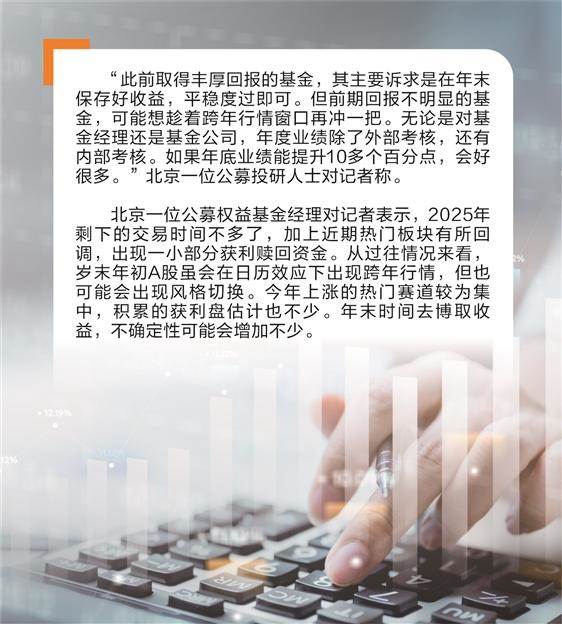
公募跨年布局各有“心思” 翻倍基净值波动普遍收窄
Zheng Quan Shi Bao· 2025-12-07 19:08
Group 1 - The core viewpoint of the articles highlights the mixed strategies of public funds as they approach year-end, with some aiming to preserve gains while others seek to boost performance in the limited time remaining [1][3][5] - As of December 5, 22 actively managed equity funds have achieved over 100% annual returns, with the top performer, Yongying Technology Smart A, boasting a return of 202.13% [2][3] - The performance gap between the top funds is significant, with Yongying Technology Smart A outperforming the second-place fund by over 50 percentage points, indicating a competitive landscape for year-end rankings [3][4] Group 2 - The difficulty of achieving additional gains as year-end approaches is emphasized, with market volatility and liquidity concerns being key factors [5][6] - Recent market trends show a shift from high-growth stocks to a focus on valuation and profit quality, influenced by institutional investment patterns [6][7] - The upcoming policy meetings in December are expected to be critical for market movements, with historical data suggesting price fluctuations around these events [7][8] Group 3 - The market is experiencing structural differentiation, with sectors like artificial intelligence, semiconductor equipment, and lithium resources performing well, while traditional real estate and consumer sectors lag [8] - Analysts suggest that the growth trend has room for expansion, but structural shifts and increased volatility are anticipated, with a potential focus on new investment opportunities in the energy and chemical sectors [8]
公募FOF年内发行规模达776亿元 创近4年新高
Zheng Quan Shi Bao· 2025-12-07 18:06
Group 1 - The FOF market is experiencing a surge in issuance, with 74 new public FOFs established in 2025, totaling 776.06 billion yuan, marking a four-year high [1] - The average issuance scale of single FOF products in 2025 reached 10.49 billion yuan, significantly higher than 1.99 billion yuan in 2023 and 3.05 billion yuan in 2024, indicating a shift from "many but scattered" to "few but refined" products [1] - A total of 13 FOF products raised over 2 billion yuan, with 24 products exceeding 1 billion yuan, showcasing the emergence of blockbuster products [1] Group 2 - The average subscription period for FOF products in 2025 was 17.9 days, with 15 products achieving rapid fundraising within 7 days, accounting for 20.3% [2] - The FOF market has evolved over more than eight years since the first public FOFs were approved in September 2017, entering a steady growth phase from 2019 to 2020 [2] - The peak of the FOF market occurred in 2021, with 94 new FOFs and a total issuance scale surpassing 1 trillion yuan, reaching 1,083.62 billion yuan [2] Group 3 - Eight public fund managers have surpassed 100 billion yuan in FOF management scale, with over 80 institutions engaged in public FOF business [3] - E Fund leads the market with a FOF management scale of 218.84 billion yuan and 31 FOF products, while China Europe Fund and Xingzheng Global Fund are closely competing with scales of 182.18 billion yuan and 182.17 billion yuan respectively [3] - Other institutions like Fuguo Fund, GF Fund, and Huaxia Fund also have FOF management scales exceeding 100 billion yuan, indicating a competitive first tier [3] Group 4 - Performance is identified as the core support for the growth of public FOFs in 2025, with 516 FOF funds achieving positive returns as of December 7 [4] - The recovery of the A-share market has increased investor demand for professional risk diversification and stable returns [4] - The acceleration of long-term capital inflows, such as pensions, along with ongoing regulatory improvements, enhances the attractiveness of FOF products as ideal investment tools [4]

大类资产与基金周报:贵金属上涨,商品基金涨幅录得1.03%-20251207
Tai Ping Yang Zheng Quan· 2025-12-07 14:42
[Table_Message]2025-12-07 金融工程周报 大类资产与基金周报(20251201-20251205)—— 贵金属上涨,商品基金涨幅录得 1.03% [Table_Author] 证券分析师:刘晓锋 电话:13401163428 E-MAIL:liuxf@tpyzq.com 请务必阅读正文之后的免责条款部分 守正 出奇 宁静 致远 [Table_Title] [Table_Summary] 执业资格证书编码:S1190522090001 . 证券分析师:孙弋轩 电话:18910596766 E-MAIL:sunyixuan@tpyzq.com 内容摘要 太 平 洋 证 券 股 份 有 限 公 司 证 券 研 究 报 告 执业资格证书编码:S1190525080001 金 融 工 程 周 报 ◼ 大类资产市场概况:1)权益:本周 A 股市场中上证指数收盘 3902.81,涨跌幅 0.37%, 深证成指、中小板指数、创业板指、上证 50、沪深 300、中证 500、中证 1000、中证 2000、 北证 50 涨跌幅分别为 1.26%、0.76%、1.86%、1.09%、1.28%、0.94% ...
[12月7日]美股指数估值数据(全球股市上涨;日元加息对全球市场会有啥影响;全球指数星级更新)
银行螺丝钉· 2025-12-07 13:43
Group 1 - The global stock market experienced a slight increase this week, with minimal volatility, particularly in the Asia-Pacific and European regions [2] - The A-share market also saw an overall rise this week [3] Group 2 - There is an increasing expectation for interest rate hikes in Japan, which may impact global markets [4] - In the late 1980s, Japan's stock market and real estate experienced a bubble, with stock prices nearing a hundred times earnings and real estate values at peak levels [5] - Following this, the Japanese stock market faced a prolonged decline lasting 19 years, with a drop of over 80% from its peak in 1989 to 2008 [6] - During this decline, the Bank of Japan attempted to stimulate the economy by lowering interest rates [7] - The yield on Japan's 10-year government bonds fell from around 8.5% in the 1980s to near zero by 2015, maintaining this low rate until 2020 [8][9] Group 3 - The low interest rates in Japan led to an international arbitrage investment strategy, borrowing yen at low costs to invest in other assets [11] - This strategy allowed investors to benefit from both currency and interest rate gains, with Warren Buffett also employing a similar approach [14] - Buffett issued low-interest yen bonds after the Japanese stock market crash in 2020, financing at less than 1% to invest in major Japanese trading companies with high dividend yields [15][16] Group 4 - Japanese companies often engage in cross-shareholding to defend against hostile takeovers and strengthen collaboration, a common practice among listed companies [17][18] - The five major trading companies in Japan have diverse business operations across various sectors and offer relatively high dividend yields, averaging around 4-5% during Buffett's investment period [20][21][22] Group 5 - If Japan enters an interest rate hike cycle, the previously successful arbitrage strategy may become less effective due to potential yen appreciation and increased borrowing costs [26] - The impact of changes in the yen's value and borrowing costs could affect assets financed through yen loans [27] Group 6 - A global stock market star rating chart indicates that the market was undervalued at 4-5 stars during certain periods in 2018, 2020, and 2022 [30] - After a significant drop in April 2025, the global stock market rating returned to 4.1-4.2 stars, followed by a rebound to over 2 stars in subsequent quarters, but currently sits around 3.0 stars [31][32] Group 7 - There are global stock index funds available in overseas markets, with a total scale exceeding one trillion dollars, but such funds are not yet available in mainland China [35] - The company has launched a "Global Index Advisory Portfolio" that diversifies investments across various stock markets, including US, UK, Hong Kong, and A-shares [36] Group 8 - A new edition of the book "The Long-Term Investment Secret" has been released, which has been influential in the investment field for 30 years and includes updated data and new chapters [41][42] - The book emphasizes that stocks are the best long-term investment for wealth accumulation, suggesting that a portion of household assets should be allocated to stocks [43]
近千名基金经理面临“降薪”
Di Yi Cai Jing Zi Xun· 2025-12-07 13:16
Core Viewpoint - The new regulatory guidelines for fund management companies are set to significantly reshape the compensation structure for fund managers, linking their pay to long-term performance and establishing a strict reward and punishment mechanism aimed at addressing the issue of fund managers profiting while investors incur losses [2][3][4]. Group 1: Regulatory Changes - The recently issued "Performance Assessment Management Guidelines for Fund Management Companies (Draft for Comments)" ties the compensation of active equity fund managers to their long-term performance, with a focus on a rigid reward and punishment system [2][3]. - Fund managers whose products underperform their benchmarks by more than 10 percentage points over three years and have negative profit margins will face a mandatory salary reduction of at least 30% [3][4]. - Conversely, fund managers whose products significantly outperform benchmarks and are profitable may receive reasonable salary increases [3][4]. Group 2: Industry Impact - As of December 5, over 1,400 active equity products have underperformed their benchmarks by more than 10 percentage points over the past three years, affecting nearly 1,000 fund managers, including well-known figures like Shi Cheng and Liu Yan Chun [2][4]. - Approximately 38.43% of the 3,757 active equity fund products analyzed have underperformed their benchmarks by over 10 percentage points, indicating a substantial number of fund managers may face salary cuts [4][5]. - In contrast, 982 active equity funds have outperformed their benchmarks by over 10 percentage points, with 146 of these funds exceeding their benchmarks by more than 50 percentage points, potentially leading to salary increases for their managers [5]. Group 3: Long-term Performance Focus - The new guidelines represent a fundamental shift from a focus on management scale and relative industry rankings to an emphasis on long-term absolute returns and the investor experience [4][6]. - The assessment framework now includes metrics such as "fund profit margin" and "percentage of profitable investors," which directly reflect the real gains and losses of investors, enhancing the accountability of fund managers [8][9]. - The guidelines also stipulate that the performance indicators for fund managers must account for at least 80% of their assessment, with benchmark comparison metrics making up no less than 30% [7][8]. Group 4: Implementation and Industry Response - The push for long-term performance assessment and compensation reform has been a focal point for regulators, with previous statements emphasizing the need for a long-term evaluation framework [6][9]. - Fund companies are beginning to implement long-term assessment practices, with some already categorizing performance evaluations into different time frames, emphasizing the importance of three-year performance metrics [9].

近千名基金经理面临“降薪”
第一财经· 2025-12-07 13:07
Core Viewpoint - The article discusses the upcoming regulatory changes in the public fund industry, specifically the new performance assessment guidelines that will significantly impact fund manager compensation, linking it closely to long-term performance and addressing the issue of fund managers profiting despite poor performance [3]. Group 1: Regulatory Changes - The new guidelines, titled "Performance Assessment Management Guidelines for Fund Management Companies (Draft for Comments)," will tie the compensation of active equity fund managers to their long-term performance, introducing a strict reward and punishment mechanism [3][4]. - Fund managers whose products underperform the benchmark by more than 10 percentage points over three years and have negative profit margins will face a mandatory salary reduction of at least 30% [4][5]. - Conversely, fund managers whose products significantly outperform the benchmark and are profitable will be eligible for reasonable salary increases [5][6]. Group 2: Impact on Fund Managers - As of December 5, over 1,400 active equity products have underperformed their benchmarks by more than 10 percentage points over the past three years, affecting nearly 1,000 fund managers [3][6]. - Notable fund managers, such as Shi Cheng and Liu Yan Chun, are among those whose products are at risk of salary reductions due to poor performance [6][7]. - In contrast, 982 active equity funds have outperformed their benchmarks by over 10 percentage points, with 146 of these exceeding 50 percentage points, indicating a clear distinction between high and low performers [7][8]. Group 3: Long-term Assessment Mechanism - The introduction of a tiered performance salary adjustment mechanism marks a shift from previous vague assessments to a more operational and clear evaluation system [4][5]. - The guidelines emphasize a long-term assessment approach, with performance indicators such as fund profit margins and the proportion of profitable investors being included in the core quantitative assessment [11][12]. - The new rules aim to strengthen the alignment of interests between fund managers and investors, ensuring that key personnel have a vested interest in the performance of the funds they manage [12].

公募REITs周报(第45期):整体下跌,成交回落-20251207
Guoxin Securities· 2025-12-07 12:11
Report Industry Investment Rating No relevant content provided. Core View of the Report - This week, the REITs index fell 1.0% throughout the week, with average weekly price changes of -0.8% for equity - type REITs and -1.1% for franchise - type REITs. In terms of the weekly price changes of major indices, CSI 300 > CSI Convertible Bond Index > CSI Aggregate Bond Index > CSI REITs Index. As of December 5, 2025, the dividend yield of equity - type REITs was 14 BP lower than the average dividend yield of CSI Dividend Stocks, and the spread between the average internal rate of return of franchise - type REITs and the 10 - year Treasury yield was 274 BP. After nearly five months of continuous volatile corrections, the allocation value of current REITs has been significantly enhanced [1]. Summary by Relevant Catalogs Secondary Market Trends - As of December 5, 2025, the closing price of the CSI REITs (closing) index was 801.18 points, with a price change of -1.0% for the week (December 1 - 5, 2025), performing worse than the CSI 300 index (+1.3%), the CSI Convertible Bond Index (+0.1%), and the CSI Aggregate Bond Index (-0.3%). Year - to - date, the price change rankings of major indices were: CSI 300 (+16.5%) > CSI Convertible Bond Index (+16.3%) > CSI REITs Index (+1.5%) > CSI Aggregate Bond Index (+0.4%) [2][6]. - In the past year, the return rate of the CSI REITs index was 4.9%, with a volatility of 7.5%. The return rate was lower than that of the CSI 300 index and the CSI Convertible Bond Index but higher than that of the CSI Aggregate Bond Index; the volatility was lower than that of the CSI 300 index and the CSI Convertible Bond Index but higher than that of the CSI Aggregate Bond Index. The total market value of REITs on December 5 was 217.8 billion yuan, a decrease of 2.1 billion yuan from the previous week; the average daily turnover rate for the whole week was 0.37%, a decrease of 0.13 percentage points from the previous week [2][8]. - Except for water conservancy facilities and new infrastructure, other types of REITs declined. In terms of different project attributes, the average weekly price changes of equity - type REITs and franchise - type REITs were -0.8% and -1.1% respectively. In terms of different project types, the top three REITs in terms of weekly price increases were Huaxia Fund CR Land Youchao REIT (+2.12%), E Fund Shenzhen Expressway REIT (+1.18%), and Huatai Nanjing Jianye REIT (+1.08%) [3][12][16]. - New infrastructure REITs had the highest trading activity. New infrastructure REITs had the highest average daily turnover rate during the period, with an average daily turnover rate of 0.6%; transportation infrastructure REITs had the highest trading volume proportion this week, accounting for 26.2% of the total REITs trading volume. In terms of the capital flow of different REIT products this week, the top three in terms of net inflow of main funds were Huaxia CR Land Commercial REIT (9.1 million yuan), CICC Anhui Expressway REIT (6.83 million yuan), and Southern Runze Technology Data Center REIT (5.27 million yuan) [3][17][18]. Primary Market Issuance - From the beginning of the year to December 5, 2025, there were 3 REIT products in the exchange at the accepted stage, 1 at the declared stage, 2 at the in -quired stage, 5 at the feedback stage, 6 products that had passed and were waiting to be listed, and 14 first - issued products that had passed and were already listed [20]. Valuation Tracking - REITs have both bond and equity characteristics. From the bond perspective, under the constraint of mandatory high dividends, the average annualized cash distribution rate of public - offering REITs was 6.39% as of December 5. From the equity perspective, the relative net asset value premium rate, IRR, and P/FFO were used to judge the valuation of REITs. Different project types of REITs had different values for these indicators [22]. - Equity - type REITs and franchise - type REITs had significant differences in asset rights, income sources, term characteristics, and risk characteristics. As of December 5, 2025, the dividend yield of equity REITs was 14 BP lower than the average dividend yield of CSI Dividend Stocks, and the spread between the average internal rate of return of franchise - type REITs and the 10 - year Treasury yield was 274 BP [25]. Industry News - China Securities Regulatory Commission Chairman Wu Qing stated that REITs should be steadily developed during the "15th Five - Year Plan" period. This indicates that REITs development will face new opportunities [4][31]. - The first urban renewal - type REITs in China was launched in Beijing Yizhuang, with a scale of 753 million yuan. The underlying assets included Borun Industrial Park and the Economic Development Zone Auto Parts Industrial Park [4][31]. - Huaxia Fund announced the expansion and issuance of Huaxia Fund CR Land Youchao REIT, which was the second approved affordable rental housing REIT expansion project in China. The expansion adopted the original holder placement method, with a placement ratio of 0.9 shares for every 1 share of the fund, and the price was set at 2.53 yuan per share, with an estimated total raised funds of 1.1385 billion yuan [4][31].
【金工周报】(20251201-20251205):指数择时多空交织,后市或中性震荡-20251207
Huachuang Securities· 2025-12-07 11:00
证 券 研 究 报 告 【金工周报】(20251201-20251205) 指数择时多空交织,后市或中性震荡 本周回顾 本周市场普遍上涨,上证指数单周上涨 0.37%,创业板指单周上涨 1.86%。 A 股模型: 短期:成交量模型所有宽基指数中性。特征龙虎榜机构模型中性。特征成交量 模型看空。智能算法沪深 300 模型看多,智能算法中证 500 模型看多。 金融工程 中期:涨跌停模型中性。上下行收益差模型所有宽基指数看多。月历效应模型 中性。 长期:长期动量模型看多。 综合:A 股综合兵器 V3 模型看空。A 股综合国证 2000 模型看空。 港股模型: 中期:成交额倒波幅模型看多。恒生指数上下行收益差模型中性。 本周行业指数涨跌互现,涨幅前五的行业为:有色金属、通信、国防军工、非 银行金融、机械,跌幅前五的行业为:传媒、房地产、食品饮料、纺织服装、 农林牧渔。从资金流向角度来说,除煤炭、建材外所有行业主力资金净流出, 其中基础化工、计算机、电子、传媒、医药主力资金净流出居前。 本周股票型基金总仓位为 97.29%,相较于上周增加了 70 个 bps,混合型基金 总仓位 86.86%,相较于上周减少了 80 ...
近千名基金经理面临“降薪”,你的基金经理也在里面吗?
Di Yi Cai Jing· 2025-12-07 10:51
Core Viewpoint - The new regulatory guidelines for fund management companies are set to significantly reshape the compensation structure for fund managers, linking their pay to long-term performance and establishing a strict reward and punishment mechanism aimed at addressing the issue of fund managers profiting despite poor performance [1][2]. Summary by Sections Performance-Based Compensation - The new guidelines stipulate that active equity fund managers will see their compensation closely tied to their long-term performance, with a mandatory reduction of at least 30% if their managed products underperform the benchmark by over 10 percentage points over three years and incur losses [1][2]. - As of December 5, over 1,400 active equity products have underperformed their benchmarks by more than 10 percentage points in the past three years, affecting nearly 1,000 fund managers, including well-known figures like Shi Cheng and Liu Yan Chun [1][2]. Shift from Scale to Performance - The guidelines introduce a tiered performance-based compensation adjustment mechanism, moving away from the previous focus on management scale and relative industry rankings to a model centered on absolute returns and investor experience [2][4]. - Approximately 38.43% of the 3,757 active equity fund products analyzed have underperformed their benchmarks by over 10 percentage points [2]. Detailed Assessment of Fund Managers - Among the underperforming products, 322 active equity funds have consistently failed to meet the benchmark, with notable examples including funds managed by Shi Cheng and Liu Yan Chun, which have significantly lagged behind their benchmarks [3]. - In contrast, 982 active equity funds have outperformed their benchmarks by over 10 percentage points, with 146 of these exceeding the benchmark by more than 50 percentage points, qualifying their managers for potential salary increases [4]. Regulatory Context and Long-term Incentives - The push for long-term performance evaluation and compensation reform has been a focus of regulatory bodies, with previous statements emphasizing the need for a robust long-term assessment framework [5][6]. - The new guidelines require that performance metrics account for at least 80% of fund manager evaluations, with specific weightings for benchmark comparisons and fund profitability [6]. Binding Interests of Fund Managers and Investors - The guidelines enhance the alignment of interests between fund managers and investors by increasing the required investment of fund managers in their own products, with a new minimum of 40% for fund managers and 60% for senior management [6][7]. - The industry is gradually implementing long-term assessment practices, with some firms already adopting multi-year performance metrics for evaluating fund managers [7].