
喜临门

Search documents
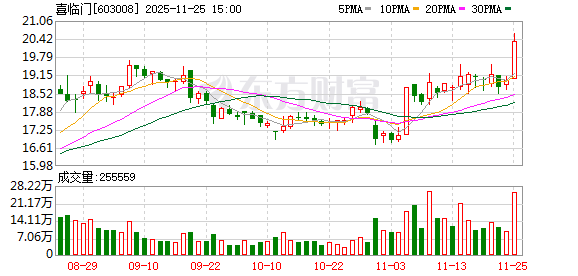
喜临门涨2.02%,成交额1.47亿元,主力资金净流出341.35万元
Xin Lang Cai Jing· 2025-12-02 03:04
Core Viewpoint - The stock of Xilinmen has shown significant growth this year, with a year-to-date increase of 32.96%, indicating strong market performance and investor interest [2]. Group 1: Stock Performance - As of December 2, Xilinmen's stock price increased by 2.02%, reaching 21.22 CNY per share, with a trading volume of 1.47 billion CNY and a turnover rate of 1.92%, resulting in a total market capitalization of 78.15 billion CNY [1]. - The stock has experienced a 5.84% increase over the last five trading days, a 26.69% increase over the last 20 days, and a 13.72% increase over the last 60 days [2]. Group 2: Financial Performance - For the period from January to September 2025, Xilinmen reported a revenue of 6.196 billion CNY, reflecting a year-on-year growth of 3.68%, and a net profit attributable to shareholders of 399 million CNY, which is a 6.45% increase year-on-year [3]. Group 3: Shareholder and Dividend Information - Since its A-share listing, Xilinmen has distributed a total of 905 million CNY in dividends, with 517 million CNY distributed over the past three years [4]. - As of October 31, 2025, the number of shareholders stood at 16,000, with an average of 23,049 circulating shares per shareholder, a slight decrease of 0.85% from the previous period [3].

备战“牛市春躁”,掘金科技主线
2025-12-01 16:03
Summary of Conference Call Records Industry Overview - The conference call discusses the technology sector, particularly focusing on the TMT (Technology, Media, and Telecommunications) industry, with a strong emphasis on AI applications and infrastructure [1][2][4]. Key Points and Arguments 1. **Market Sentiment and Economic Conditions** - After a period of low market sentiment, a rebound is expected due to an 80% probability of Federal Reserve interest rate cuts, alongside global liquidity easing and domestic monetary conditions [1][2]. 2. **Investment Opportunities in Technology** - The technology sector is anticipated to lead the market in the upcoming bull market, particularly in the AI industry chain and Google’s computing power [1][2][4]. 3. **Performance of Growth Factors** - Strong performance of mid to large-cap growth styles is expected, with the ChiNext and Sci-Tech Innovation Board showing significant investment value due to low valuations and improving earnings expectations [1][4]. 4. **Focus on TMT Sector** - Key areas of interest include AI infrastructure, particularly in computing power, storage, and electricity. Storage chip prices have surged by 360% since the beginning of the year, and DRAM contract prices have increased by up to 30% [1][4]. 5. **AI Application Growth** - Several A-share AI application companies have shown performance inflection points, with notable increases in net profit growth, indicating a rise in AI application penetration and mature business models [1][4][5]. 6. **2026 AI Industry Chain Investment Focus** - Investment in the AI industry chain will focus on power and storage capacity shortages, as well as AI application tracks. The overseas market will concentrate on Google’s computing infrastructure supply chain, while the domestic market will focus on TSMC’s allocation of computing chips [6][7]. 7. **Key Players in PCB and Optical Module Sectors** - Important companies in the PCB sector include Shenghong Technology and Huitian Technology, while leading firms in the optical module sector are expected to benefit from a supply-demand imbalance [8]. 8. **Emerging Materials Technology** - New materials technology is expected to see significant upgrades, with high-performance materials like new copper foils and quartz fabrics becoming increasingly important in both traditional electronics and new computing demands [9]. 9. **AI Edge Application Ecosystem** - The AI edge application ecosystem is projected to accelerate with improvements in large model accuracy, with companies like ByteDance and Meta making significant investments in smart glasses [10]. 10. **Consumer Electronics Market Trends** - Anticipated price increases in storage may lead to higher consumer product prices and lower shipment volumes, but strong demand from Apple and Samsung is expected to provide resilience [11][12]. 11. **Computer Sector Development** - The computer sector is poised for growth, particularly in emerging technologies like quantum computing and brain-computer interfaces, with significant market potential projected for the coming years [13][14]. 12. **Recent Advances in AI Applications** - Notable advancements in AI applications include Google’s Gemini 3 and Alibaba’s AI assistant, indicating a strong growth trajectory in the sector [15]. 13. **Trends in Autonomous Driving and Humanoid Robots** - The autonomous driving sector is witnessing significant developments, with companies like Tesla and Huawei making strides in Robot Taxi services. The humanoid robot industry is also moving towards commercialization, with several contracts signed for industrial applications [16][17]. 14. **Brain-Computer Interface Developments** - The brain-computer interface sector is gaining traction with increased policy support and the introduction of new medical devices, indicating a promising future for this technology [18]. 15. **Investment Targets in the Computer Sector** - Potential investment targets include companies involved in AI applications, humanoid robots, autonomous driving, and brain-computer interfaces, all of which show strong growth potential [19][20].
中国银河证券:布局国补受益家居股 关注包装整合与IP玩具
智通财经网· 2025-11-28 06:04
近日,第四批国补资金690亿元已下达地方,国补实施机制持续完善,补贴发放方式持续优化,看好国 补政策对全年下游需求的催化作用。国补资金已全面下达,实施机制持续完善,资金监管与拨付效率提 升,看好政策对下游消费需求持续催化作用。 智通财经APP获悉,中国银河证券发布研报称,国补资金已全面下达,看好政策对下游消费需求持续催 化作用。数据显示,家具类消费已呈现回暖态势,10月零售额同比增长9.6%,1-10月累计增长19.9%; 包装行业方面,下游需求整体平稳,原材料价格小幅波动,产业升级步伐加快;轻工消费领域,头部IP 持续推新,如泡泡玛特新品系列陆续上市,推动玩具板块保持高成长性。投资上建议关注受益国补政策 的家居龙头、包装资源整合企业及具备IP推新能力的玩具公司。 中国银河证券主要观点如下: 地产数据仍然承压,看好国补回归对下游需求拉动作用 2025年1-10月,我国商品房累计销售面积达71982.00万平方米,同比-6.8%;累计销售额达69017.06亿 元,同比-9.6%。房屋新开工面积累计值达49061.39万平方米,同比-19.8%;房屋竣工面积累计值达 34861.00万平方米,同比-16.9%。 ...

【竞争格局】中国弹簧床垫行业市场概览、投资热点及发展趋势预测报告
Sou Hu Cai Jing· 2025-11-28 02:52
Core Viewpoint - The spring mattress industry in China is experiencing rapid growth, driven by increasing consumer awareness of sleep health and rising disposable incomes, with a projected market size growth from 432 billion yuan in 2015 to 646.4 billion yuan in 2024, reflecting a compound annual growth rate (CAGR) of 4.58% [5][11]. Industry Overview - Spring mattresses, also known as "Simmons" in Chinese, are primarily categorized into various structures such as interconnected, one-wire steel, high-elasticity, independent spring packages, and independent cylinder types, which are favored for their excellent elasticity, support, breathability, and durability [1][3]. - The production capacity of spring mattress manufacturers in China has been steadily increasing, with production volume expected to rise from 72.08 million units in 2020 to 86.01 million units in 2024, representing a CAGR of 4.52% [6][11]. Market Size - The market share of spring mattresses in China is nearly 80%, making them the dominant product in the mattress market [5][11]. - The industry is projected to continue growing due to urbanization and rising income levels, leading to a broader consumer base and ongoing product upgrade demands [5][11]. Trade Situation - China primarily exports spring mattresses, with imports showing fluctuations due to external factors such as the COVID-19 pandemic. In 2021, imports reached 143,600 units, a 41.14% increase year-on-year, while in 2024, imports surged to 175,500 units, a 77.44% increase [7][13]. - Exports of spring mattresses have been on a steady rise, with 13.72 million units exported in the first three quarters of 2025, marking a 9.91% increase year-on-year [7][13]. Competitive Landscape - The spring mattress industry in China features a diverse competitive landscape, with traditional brands maintaining advantages through established channels, while emerging brands leverage online platforms and innovative products to capture market share [8][11]. - Key players in the industry include brands such as Xilinmen, Mousse, Mengbaihe, and Gujia, among others, with competition shifting from price to material research, functional design, and sleep experience [8][11]. Future Trends - The industry is expected to evolve beyond basic sleep functions towards integrated smart health management platforms, incorporating non-invasive sensors to monitor physiological data [8]. - Material innovation will focus on resolving performance conflicts of traditional materials, while sustainability will become a mandatory aspect driving the entire industry chain towards green transformation [8].

高端床垫搭载AI智能系统?喜临门回应:并非简单的“床垫插电”
Zhong Guo Jing Ying Bao· 2025-11-25 07:39
Core Viewpoint - Xilinmen Furniture Co., Ltd. is focusing on the development of AI smart mattresses, emphasizing a dual product strategy to cater to both high-end and mass-market segments, while also addressing investor concerns regarding cash flow and profitability strategies [2][3][4][5][6]. Group 1: AI Smart Mattress Development - The company has launched high-end flagship products equipped with a complete AI system, transitioning from passive support to active management [2]. - A "high-low parallel" product matrix strategy is being implemented, with high-end products serving as technology benchmarks and mass-market products designed to meet diverse consumer needs [3]. - The acceptance of smart features among users is increasing, with adjustable firmness, heating, and massage functions becoming key drivers for consumer purchasing decisions [3]. Group 2: Investment and Cash Flow - The company has experienced a net outflow of investment cash flow of 200-300 million over the past three years, primarily due to investments in new capacity and smart upgrades [4][5]. - Investments have been directed towards the construction of production bases and the upgrade of intelligent systems across multiple locations, including Northern China, Jiangxi, and Henan [5]. Group 3: Profitability Enhancement Strategies - The company has outlined a systematic plan to enhance profitability through three dimensions: scale reduction in costs, structural improvement in profits, and efficiency enhancement in expenses [5][6]. - Emphasis is placed on leveraging scale effects to reduce unit costs and improve overall performance by expanding market share and optimizing production efficiency [5]. - The company aims to increase the proportion of high-margin products by focusing on its own brand business and optimizing the business structure [6].
政策红利+海外潜力打开成长空间,家居家电ETF(515730)上市交易
Sou Hu Cai Jing· 2025-11-25 05:16
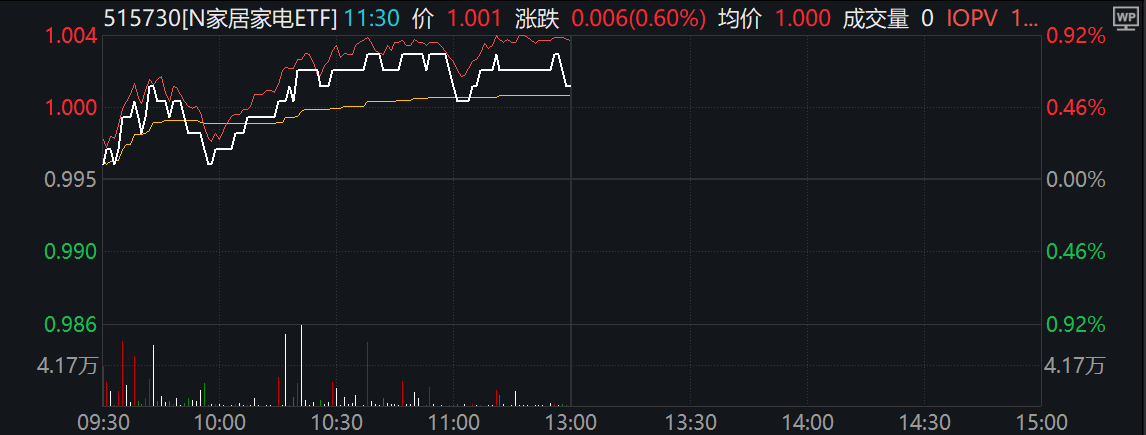
Core Viewpoint - The launch of the first ETF tracking the CSI Home Appliances Index (515730) on November 25 is expected to enhance market liquidity and investment opportunities in the home appliances sector, driven by government policies promoting consumption upgrades [1][4]. Group 1: ETF Performance - The CSI Home Appliances Index (931241) rose by 0.86% at midday, with constituent stocks such as Xilinmen (603008) and Zhaochi Co. (002429) increasing over 6% [1]. - The Home Appliances ETF (515730) saw a 0.6% increase, with a turnover rate of 20.83% and a trading volume of 110 million yuan, indicating active market participation [1]. Group 2: Government Policies - The Chinese government has introduced policies to promote the replacement of old home appliances, aiming to shorten the consumption cycle and innovate consumption scenarios [4]. - The "Action Plan for Promoting Large-Scale Equipment Updates and Replacement of Consumer Goods" supports the transition from long-term durable goods to periodic updates, thereby stimulating market consumption potential [4]. Group 3: Market Outlook - A recent meeting by the Ministry of Housing and Urban-Rural Development emphasized the importance of urban renewal in driving investment and consumption, which may positively impact the home goods sector [4]. - Analysts suggest that the home appliance industry's overseas business is expected to grow, despite anticipated declines in exports due to U.S. tariffs in 2025 and 2026 [4]. Group 4: Index Composition - The CSI Home Appliances Index covers two core areas: home appliances and home goods, with a composition of 52% in home appliances and 48% in home goods, reflecting a collaborative development across various consumer scenarios [5]. - The ETF closely tracks the CSI Home Appliances Index, allowing investors to capture consumption growth driven by policy support while diversifying individual stock risks [5].
广州三喜临门!
2 1 Shi Ji Jing Ji Bao Dao· 2025-11-24 03:23
Group 1 - Guangzhou has achieved significant recognition in the global scientific community, ranking sixth in the "2024 Nature Index - Research Cities" and accounting for 65.6% of the Guangdong Province Science and Technology Awards [1][2] - The number of technology enterprises in Guangzhou has reached 13,500, a sevenfold increase since 2015, highlighting the city's role as a leader in technological and industrial innovation [2][4] - The recent election of five scientists from Guangzhou as academicians of the Chinese Academy of Sciences and the Chinese Academy of Engineering underscores the integration of scientific research and industrial needs [2][4] Group 2 - The establishment of "Academician Workstations" in Guangzhou has facilitated deep collaboration between top scientists and local enterprises, enhancing the innovation capabilities of leading companies [4][5] - Guangzhou has developed a tiered talent cultivation system, focusing on nurturing young talents into leading innovators, with significant support for those with potential as strategic scientists [6][7] - The city emphasizes a "career retention" philosophy, fostering an environment where talents can thrive through deep integration of industry, academia, and research [8][10] Group 3 - Guangzhou is actively attracting high-level global talent, providing targeted services such as entrepreneurial subsidies and housing support during events like the "2024 Overseas Talent Exchange Conference" [11][13] - The number of foreign talents working in Guangzhou has increased by 40.3% since the end of 2019, indicating a growing appeal for international professionals [13] - The integration of technological innovation and industrial development in Guangzhou is creating a robust ecosystem, reflecting the city's dynamic growth in new productive forces [13]

东南亚多国调研精要,小米多模型构建AI端侧生态,3D打印高增
SINOLINK SECURITIES· 2025-11-23 11:39
Investment Rating - The report does not explicitly provide an investment rating for the industry Core Insights - The research highlights the significant generational differences in consumer behavior and production capabilities across Thailand, Vietnam, and Cambodia, with Thailand resembling a "miniature" version of the Western consumer market, Vietnam in a rapid growth phase, and Cambodia reflecting characteristics of less developed nations [1] - The report emphasizes the potential for investment in Southeast Asia, particularly in consumer goods and technology-driven sectors, as companies leverage local production capabilities and growing consumer markets [1][2] Summary by Sections 1. Industry Insights - Thailand is compared to a "miniature" Western market, showcasing a mature consumer culture and a well-developed service industry, making it a reference point for companies looking to expand into Western markets [1] - Vietnam is characterized as a rapidly developing economy, with a GDP projected to reach approximately 62.69 trillion VND (around 4,700 USD) in 2024, indicating a significant consumer market potential [1] - Cambodia is noted for its low average income and high income disparity, with consumer spending primarily focused on essential goods, suggesting a slower penetration of discretionary spending [1] 2. Segment Tracking - Xiaomi Group is exploring the future of smart home technology with its Xiaomi Miloco initiative, aiming to enhance user interaction and privacy through advanced AI models [9][10] - The pet food sector saw significant growth during the Double Eleven shopping festival, with sales for the brand Guibao exceeding 1 billion RMB, reflecting a trend towards premium pet products [11][12] - The AI and 3D printing industry is experiencing high demand, with companies like Tuozhu achieving record sales during major shopping events, indicating strong market potential [21][22] 3. Macro Consumption Data - In October, the Consumer Price Index (CPI) showed a year-on-year increase of 0.2%, with service sector prices rising, indicating a recovery in consumer spending [35] - The Producer Price Index (PPI) decreased by 2.1% year-on-year, but showed signs of improvement in the month-on-month trend, suggesting a potential stabilization in production costs [45] - Online sales data from major platforms indicated a decline in the home appliance sector, with specific brands like Ecovacs and Roborock showing positive growth despite overall market challenges [50]

趋势研判!2025年中国弹簧床垫行业发展历程、产量、市场规模、重点品牌及未来趋势:居民对舒适睡眠需求增加,带动弹簧床垫规模达646.4亿元[图]
Chan Ye Xin Xi Wang· 2025-11-22 02:51
Core Insights - The spring mattress market in China holds a dominant position with nearly 80% market share, driven by its excellent support, breathability, and durability [1][9] - The market size of the spring mattress industry in China is projected to grow from 43.2 billion yuan in 2015 to 64.64 billion yuan in 2024, with a compound annual growth rate (CAGR) of 4.58% [1][9] - The increasing urbanization and rising income levels in China are expected to expand the consumer base and drive continuous product upgrades in the spring mattress market [1][9] Industry Overview - Spring mattresses, also known as "Simmons," are primarily categorized into various structures such as interconnected, one-wire steel, high-elasticity, independent spring bags, and independent cylinder springs [2][3] - The production process involves assembling springs, fabric covering, and edge sewing, with quality inspections to ensure material cleanliness and structural stability [2] Industry Development History - The invention of the spring mattress dates back to the 1870s in the United States, and it was introduced to China in the early 20th century, revolutionizing the mattress market [5] Industry Supply Chain - The upstream of the spring mattress industry includes raw materials like high manganese steel, carbon steel wire, foam, memory foam, latex, and fabrics [6] - The midstream involves the manufacturing of spring mattresses, while the downstream consists of sales channels including e-commerce platforms and retail stores [6] Current Market Status - The production capacity of spring mattress manufacturers in China has been steadily increasing, with production volume projected to rise from 72.08 million units in 2020 to 86.01 million units in 2024, reflecting a CAGR of 4.52% [8][9] Import and Export Trends - In 2021, the import volume of spring mattresses reached 143,600 units, a year-on-year increase of 41.14%, while the import value was 360 million yuan, up 51.92% [9] - The export volume of spring mattresses has shown a consistent upward trend, with 13.72 million units exported in the first three quarters of 2025, a year-on-year increase of 9.91% [10][9] Competitive Landscape - The spring mattress industry in China features a diverse competitive landscape, with established brands leveraging strong distribution networks and emerging brands focusing on product innovation and targeted marketing [10] - Key players in the industry include Xilinmen, Mousse, Mengbaihe, and others, with competition shifting towards material research, functional design, and sleep experience [10] Future Trends - The industry is expected to evolve towards smart health management platforms, integrating non-invasive sensors to monitor physiological data and enhance sleep quality [14] - Material innovation will focus on combining traditional materials to resolve performance conflicts, while sustainable practices will drive a green transformation across the entire supply chain [15][16]


喜临门(603008)2025年三季报点评:25Q3收入稳健增长 AI产品矩阵逐步完善
Xin Lang Cai Jing· 2025-11-22 00:33
Core Viewpoint - The company reported its Q3 2025 results, showing revenue growth and a strategic shift towards becoming a sleep technology enterprise, despite short-term profit pressures [1][2]. Financial Performance - For the first three quarters of 2025, the company achieved revenue of 6.196 billion yuan, a year-over-year increase of 3.68%, and a net profit attributable to shareholders of 399 million yuan, up 6.45% year-over-year [1]. - In Q3 alone, the company reported revenue of 2.176 billion yuan, with a year-over-year growth of 7.78%, but a decline in net profit attributable to shareholders by 6.10% [1]. Strategic Developments - The company is accelerating its transformation into a sleep technology firm, enhancing its product matrix and deepening partnerships with top institutions like Tsinghua University to optimize sleep algorithms [2]. - The brand "aise" is expanding its domestic and overseas channels, successfully entering the Middle East market, with a total of 5,264 offline stores as of the end of Q3 [2]. Profitability and Cost Management - The gross profit margin for Q3 was 35.6%, reflecting a decrease of 0.9 percentage points year-over-year, attributed to increased promotional activities [2]. - The company’s net profit margin for Q3 was 6.1%, down 0.9 percentage points year-over-year, while management expenses showed a steady improvement [2]. Investment Outlook - The company is positioned as a leading domestic mattress brand, with expectations for net profit growth to reach 453 million yuan in 2025, 557 million yuan in 2026, and 644 million yuan in 2027, corresponding to PE ratios of 16, 13, and 11 times [3]. - A target price of 21.18 yuan per share is set for 2026, with a recommendation to maintain a "buy" rating based on the steady progress in the smart sleep business [3].