
未提及具体公司

Search documents
韧性彰显 结构优化 量质齐升——中国外贸连续八个季度实现增长
Ren Min Ri Bao Hai Wai Ban· 2025-10-14 01:39
Core Viewpoint - China's goods trade has shown resilience and achieved growth for eight consecutive quarters, with a total import and export value of 33.61 trillion yuan in the first three quarters of 2023, reflecting a year-on-year increase of 4% [1][2]. Group 1: Trade Performance - In the first three quarters, China's goods trade imports and exports grew by 1.3%, 4.5%, and 6% in the first, second, and third quarters respectively [1]. - The export and import values have shown a continuous year-on-year increase for four consecutive months as of September [2]. - The five major provinces (Guangdong, Jiangsu, Zhejiang, Shanghai, and Shandong) contributed over 80% to the national import and export growth, with a combined increase of 5.2% [2]. Group 2: Export Dynamics - The export growth rate exceeded 7% in the first three quarters, with industrial product exports maintaining a global leading share since 2008 [4]. - High-tech product exports reached 3.75 trillion yuan, growing by 11.9%, contributing over 30% to the overall export growth [4]. - The export of industrial robots surged by 54.9%, and wind power equipment exports increased by 23.9% [2][4]. Group 3: Private Sector Performance - Private enterprises accounted for 19.16 trillion yuan in imports and exports, marking a year-on-year increase of 7.8%, with exports and imports growing by 8.8% and 5.9% respectively [6]. - Private enterprises have been the mainstay of foreign trade, contributing 4.3 percentage points to overall trade growth and representing 57% of total foreign trade value [6]. - The export of high-tech products by private enterprises grew by 15.3%, making up 54.2% of the total high-tech product exports [6]. Group 4: Market Adaptation - Companies are increasingly adapting to international market demands by offering personalized and customized solutions, such as split air conditioning systems tailored for European markets [5]. - The ongoing support from domestic policies and the commitment of foreign trade enterprises to high-quality supply are expected to inject new momentum into exports [5]. Group 5: Future Outlook - The customs authority plans to deepen customs reforms, optimize regulatory services, and strengthen policy guidance to support the healthy and high-quality development of the private economy [7].
中国外贸连续八个季度实现增长(锐财经)
Ren Min Ri Bao Hai Wai Ban· 2025-10-13 22:53
Core Insights - China's goods trade has shown resilience, achieving a year-on-year growth for eight consecutive quarters, with a total import and export value of 33.61 trillion yuan in the first three quarters of 2023, representing a 4% increase [1][2]. Group 1: Trade Performance - In the first three quarters, China's exports and imports have experienced steady growth, with exports increasing by 7% and imports also showing positive trends [4]. - The contribution of major provinces such as Guangdong, Jiangsu, Zhejiang, Shanghai, and Shandong accounted for over 80% of the national trade growth, with a combined increase of 5.2% [2][3]. Group 2: Export Dynamics - The export of high-tech products reached 3.75 trillion yuan, growing by 11.9%, contributing over 30% to the overall export growth [4]. - The export of industrial robots surged by 54.9%, while wind power equipment exports increased by 23.9%, indicating a shift towards innovative and high-value products [2][4]. Group 3: Private Sector Performance - Private enterprises have emerged as a significant force in foreign trade, with a total import and export value of 19.16 trillion yuan, marking a 7.8% year-on-year increase [7]. - Private enterprises accounted for 57% of China's total foreign trade value, contributing 4.3 percentage points to overall trade growth [7]. Group 4: Market Adaptation - Companies are increasingly adapting to international market demands, with customized solutions leading to a more than 20% increase in air conditioning exports to Europe [5]. - The focus on high-quality supply to meet international needs is expected to continue driving export growth [5]. Group 5: Future Outlook - The customs authority plans to enhance clearance reforms and optimize regulatory services to support the healthy and high-quality development of the private economy [8].

日均出口新车1000辆!这里正在成为中国汽车“出海”的黄金通道
Zhong Guo Qi Che Bao Wang· 2025-10-13 06:12
Core Insights - The Horgos Port has become a crucial hub for China's automobile exports, with a record export of 258,000 vehicles from January to August this year, marking an 8.5% year-on-year increase [2][3] - The port is expected to see a significant rise in exports, reaching 421,000 vehicles in 2024, which represents a 38.6% increase compared to the previous year [3] - The growth of automobile exports from Horgos is indicative of China's transition from "Made in China" to "Intelligent Manufacturing in China," showcasing the country's automotive industry on the international stage [3][8] Export Growth and Logistics - Horgos Port is the largest land port for automobile exports in China, facilitating both rail and road transport, and has implemented a 24-hour customs clearance system to enhance efficiency [3][5] - The port's logistics capabilities are bolstered by the China-Europe Railway Express, which plays a vital role in transporting Chinese vehicles to European markets [5] - The export network is expanding beyond Central Asia to regions like West Asia and Eastern Europe, aligning with the Belt and Road Initiative [4] Market Dynamics in Central Asia - The Central Asian market is increasingly receptive to Chinese automobiles, particularly electric vehicles, which are gaining popularity due to their cost-effectiveness and technological advancements [4][6] - Kazakhstan is a key market where Chinese electric vehicles are becoming integral to the local transportation system, while Tajikistan's capital, Dushanbe, sees a dominance of Chinese electric taxis [4][6] Economic Impact - The automobile export boom from Horgos is expected to drive a 20 billion yuan increase in the related industrial chain's output value in 2024 [6] - The growth in the automotive sector is positively impacting upstream and downstream industries, including steel, rubber, and logistics services, creating a robust industrial ecosystem [6][7] International Competitiveness - Horgos Port has attracted over 400 automotive supply chain enterprises, forming a comprehensive ecosystem that enhances production efficiency and product quality [7] - The success of Chinese electric vehicles in international markets is contributing to the global competitiveness of China's automotive industry, encouraging investments in technology and brand development [7][8]

美国宣布将从芬兰采购11艘破冰船
Xin Hua Wang· 2025-10-10 10:48
Core Points - The U.S. plans to purchase 11 icebreakers from Finland, with some to be built in Finland and others in the U.S. [1] - A memorandum of understanding will be signed to establish commercial cooperation between the U.S. Coast Guard and Finnish companies [1] - The previous U.S. administration signed an agreement with Canada and Finland to jointly develop world-class polar icebreakers [1] - The U.S. aims to strengthen its presence in the Arctic by potentially ordering 48 icebreakers [1] Summary by Categories Purchase Agreement - The U.S. intends to buy 11 icebreakers from Finland, with 4 to be constructed in Finland and 7 in the U.S. [1] - The exact procurement amount has not been disclosed [1] Cooperation and Agreements - A memorandum of understanding will be signed to lay the foundation for business cooperation between the U.S. Coast Guard and Finnish enterprises [1] - The agreement aims to enhance collaboration in icebreaker manufacturing [1] Strategic Intent - The U.S. is focused on strengthening its Arctic presence, as indicated by the potential order of 48 icebreakers [1] - The collaboration with Finland is part of a broader strategy to develop advanced polar icebreakers [1]
马来西亚警告:美国取消半导体关税豁免将损害竞争力
半导体芯闻· 2025-10-10 09:37
它预计2026年的经济增长率为4%至4.5%。 如果您希望可以时常见面,欢迎标星收藏哦~ 来源:内容来自路透社 。 马来西亚政府在一份报告中警告称,美国取消对马来西亚半导体出口的关税豁免可能会损害其竞争力并 使供应链网络紧张。 唐纳德·特朗普总统的政府在8月对马来西亚出口到美国的产品征收了19%的关税,不过包括半导体在内 的一些项目目前暂时获得豁免,以等待美国进行国家安全调查。 同样在8月,特朗普提议对进口芯片征收100%的关税,尽管他表示该关税不适用于在美国拥有制造业务 或计划建立制造业务的公司。 马来西亚政府在其随2026年预算发布的经济展望报告中表示,任何取消半导体豁免的行为"可能导致反 弹、降低竞争力,并使与美国供应链紧密整合的部门紧张"。马来西亚是全球第六大半导体出口国。 报告称,由于美国的关税,马来西亚已预期其经济将受到冲击,预计国内生产总值(GDP)增长将因此 降低0.76个百分点。 报告还称,马来西亚预计明年的进口和出口将因部分关税因素而萎缩。 马来西亚在7月已将2025年的增长预测下调至4%至4.8%之间,低于其最初估计的4.5%至5.5%,理由是 贸易和关税的不确定性。 参考链接 http ...

中国钢产量常年稳居世界第一,为啥每年仍需进口几百万吨特种钢?
Sou Hu Cai Jing· 2025-10-10 02:55
Core Insights - The discussion emphasizes the importance of allowing space for smaller companies in the industry to survive while balancing the need for efficiency and profitability [1][5]. Group 1 - The steel industry faces challenges with production inefficiencies, particularly when specialized production lines are created for low-demand products, leading to underutilization [1]. - Utilizing imported materials can significantly increase profit margins by allowing for higher pricing without compromising product performance [3]. - The reduction in after-sales issues is a key advantage of using imported goods, as it shifts the responsibility of product failures away from the manufacturer to the user [3][5]. Group 2 - The current trend shows a decrease in the number of users opting for imported goods, which has led to a significant drop in import volumes [5]. - The concept of "cooperation and win-win" is highlighted, suggesting that a balanced approach where all players in the market can thrive is essential for long-term sustainability [5].
库存结构转变 碳酸锂波幅有望收窄
Qi Huo Ri Bao· 2025-10-10 01:16
Core Insights - The introduction of lithium carbonate futures and options has provided effective hedging tools for the lithium battery new energy industry to manage price volatility and achieve high-quality development [1] Supply and Demand Analysis - Lithium carbonate has been in a supply surplus cycle over the past two years, with prices dropping from over 200,000 yuan per ton at launch to below 100,000 yuan per ton [1] - In 2025, lithium carbonate prices are expected to initially decline due to tariff impacts and supply surplus, dropping from around 80,000 yuan to below 60,000 yuan, before rebounding due to unexpected demand and supply uncertainties [1] - The lithium battery industry has shown strong demand, with lithium carbonate production reaching record monthly highs of 81,530 tons, 85,240 tons, and 87,260 tons from July to September [2] - The production of lithium iron phosphate is projected to reach 2.1782 million tons from January to August, a year-on-year increase of 72% [2] Inventory Trends - As of late September, total lithium carbonate inventory was 136,825 tons, a decrease of 706 tons, marking the seventh consecutive week of decline [3] - Inventory is shifting from lithium salt enterprises to downstream sectors, with downstream inventories reaching new highs [3] Seasonal Demand Insights - The demand for lithium carbonate in the fourth quarter is expected to experience a peak followed by a decline, with retail sales of new energy passenger vehicles reaching 1.039 million units in September, a year-on-year increase of 9% [4] - Policies supporting the purchase of new energy vehicles are set to continue, with tax exemptions and reductions planned for 2024-2027, which may influence demand dynamics [4] Market Outlook - Despite strong supply and demand in the lithium battery industry, the tension in the lithium carbonate supply chain is expected to ease in the fourth quarter, leading to narrower price fluctuations [5]
建信基金:“金”光闪闪,投资如何“淘金”?
Xin Lang Ji Jin· 2025-10-09 09:38
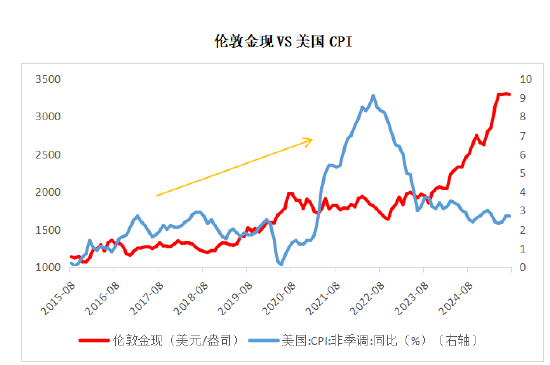
Group 1 - The core viewpoint of the article emphasizes the increasing attention investors are giving to gold assets due to significant price increases in recent years, with London gold and Shanghai gold rising by 41.33% and 40.36% respectively over the past year [1] - Factors influencing gold prices include inflation levels, real interest rates, and the performance of the US dollar [1][2][3][6] - Gold generally has a positive correlation with inflation, serving as a hedge against currency devaluation during inflationary periods [2] Group 2 - Gold prices are negatively correlated with real interest rates; when real interest rates rise, the attractiveness of gold decreases, leading to lower prices, and vice versa [3] - There is a negative correlation between gold prices and the US dollar; a stronger dollar typically results in lower gold prices, while a weaker dollar tends to increase gold prices [6][8] - The long-term trend for gold prices is upward, with Shanghai gold increasing by 210.91% since its listing in April 2016, outperforming the Shanghai Composite Index and the China Bond Index [10][13] Group 3 - Gold is an important component of asset allocation due to its low correlation with stocks and bonds, which helps in optimizing portfolio structure and diversifying investment risks [10][14] - The correlation of the Nanhua Gold Index with the Shanghai Composite Index and the China Bond Index over the past five years is 0.0328 and 0.0905 respectively, indicating low correlation [14] - Investment methods for gold include physical gold, gold spot/futures, gold stocks, and gold funds, each with distinct characteristics suitable for different types of investors [14][15] Group 4 - A recent initiative in Beijing aims to promote high-quality development in the public fund industry, focusing on investor education and protection, and enhancing the industry's ability to serve the real economy [1]
小身板农机,闯出大市场(神州看点)
Ren Min Ri Bao· 2025-10-08 22:11
Core Insights - The article highlights the development and testing of advanced unmanned agricultural machinery in the hilly regions of Dazhou, Sichuan, aimed at enhancing agricultural mechanization and addressing the challenges of uneven terrain [3][4]. Group 1: Industry Development - The Dazhou Modern Agricultural Machinery Equipment Industrial Park was established to promote the research and manufacturing of lightweight agricultural machinery suitable for hilly areas, with a focus on intelligent agricultural practices [4][6]. - As of the end of last year, the comprehensive mechanization rate for major crops in Dazhou reached 68%, indicating significant progress in agricultural mechanization [4]. Group 2: Technological Innovations - The unmanned rotary tiller can be remotely controlled from a distance of up to 300 meters and is designed for both dry and paddy fields, showcasing its versatility [5]. - The development of a new intelligent correction system allows the machinery to maintain a stable trajectory even in challenging terrains, addressing the issue of maintaining a straight line during operation [6]. Group 3: Market Potential - The Dazhou industrial park has signed contracts with 12 companies and established 18 production lines, producing 34 types of products, including smart agricultural machinery and agricultural robots [6]. - The lightweight modern agricultural machinery has gained popularity not only in various provinces within China but also in international markets, including Canada and New Zealand, indicating a strong market demand for these innovative products [6].

【环球财经】法国农业部:2025年葡萄酒产量预计维持低位
Xin Hua Cai Jing· 2025-10-08 01:50
Core Viewpoint - The French Ministry of Agriculture forecasts a significant decrease in wine production for 2025, estimating it at 36 million hectoliters, which is approximately 16% lower than the average of the past five years [1] Production Forecast - The wine production for 2024 is expected to remain stable compared to 2023, which is already at a low level [1] - The adverse weather conditions, particularly high temperatures in August, have severely impacted the production potential across most wine regions in France [1] Weather Impact - Last year's production was affected by insufficient rainfall, drought, and late frosts, and this year's climate conditions continue to be unfavorable [1] - The high temperatures and drought in August accelerated grape maturation but inhibited fruit growth, resulting in smaller grapes with lower juice content [1] - Rainfall at the end of September did not effectively alleviate the adverse conditions [1] Regional Production Insights - The production of AOP (Appellation d'Origine Protégée) wines is projected to increase by about 5% compared to 2024, mainly due to higher yields in regions such as Champagne, Burgundy, Loire Valley, Corsica, and the southeastern areas [1] - Despite the regional increases, the overall production remains approximately 11% lower than the average from 2020 to 2024 [1]