
茶百道

Search documents
开年消费市场“暖意融融” 多元业态折射经济活力
Xin Hua Cai Jing· 2026-01-12 17:05
Group 1 - The consumer market in China is experiencing a strong start to the new year, with significant growth in various sectors such as travel, dining, and entertainment, indicating a robust recovery in service consumption as the Spring Festival approaches [1] - Data from Meituan shows that during the New Year's holiday, there was a substantial year-on-year increase in core consumption indicators, with the leisure and entertainment sectors performing particularly well; for instance, the bathing industry saw a 57% increase in order volume, while KTV orders surged by 74% [1] - Dining consumption is also showing a clear recovery trend, with Meituan reporting a 142% year-on-year increase in traffic for its "must-eat" list during the New Year's holiday, and nearly 100% growth in cross-regional traffic, highlighting the strong impact of inter-regional travel on consumption [1] Group 2 - The enthusiasm in the consumer market reflects not only an increase in quantity but also a pursuit of quality and innovation in supply; for example, the brand Tea Baidao reported a significant rise in sales of its fresh fruit tea, particularly the recently reintroduced mulberry series, which sold nearly 200,000 cups on its first day [2] - Long-distance travel bookings have notably increased ahead of the Spring Festival, with over 3 million domestic flight tickets booked by January 9, 2026, representing a 20% year-on-year increase in daily bookings compared to the same period in 2025 [2] - Popular travel destinations have seen substantial growth in flight bookings, with Haikou leading the top 10 cities with a 120% year-on-year increase, and Sanya experiencing a 90% growth; other cities like Lhasa and Aletai also reported booking increases of 1 to 2.5 times [2]
“投资21万,一天卖不到300元”,第一批糖水铺开始关店?
东京烘焙职业人· 2026-01-12 08:33
Core Viewpoint - The sugar water market is experiencing a stark contrast between the rapid expansion of leading brands and the struggles of many single-store operators, leading to a challenging environment for independent businesses [6][10][39]. Group 1: Market Dynamics - The sugar water sector has seen unprecedented heat this year, with major brands like Gu Ming, Cha Bai Dao, and CoCo entering the market, while new brands like Mai Ji and Tang Xu are rapidly expanding, opening nearly 1,000 new stores [9][10]. - Social media has popularized visually appealing sugar water, making it a "social currency" among young consumers, which has encouraged many entrepreneurs to enter the market [11][10]. - Despite the apparent market prosperity, many single-store operators are struggling to maintain their businesses, with reports of daily sales failing to exceed 300 yuan [14][13]. Group 2: Challenges Faced by Single-Store Operators - Operators face four main challenges: 1. **Category Limitations**: Sugar water is not a necessity and has a lower consumption frequency compared to milk tea, making it harder to attract repeat customers [19][20]. 2. **Competition from Chains**: The influx of chain brands has led to price competition, with similar products being offered at lower prices, making it difficult for independent stores to compete [25][26]. 3. **High Operating Costs**: The preparation of sugar water is labor-intensive and time-consuming, leading to high operational costs and low profit margins [31][34]. 4. **Seasonal Fluctuations**: Sugar water sales are highly seasonal, with significant drops in winter, making it challenging for operators to maintain consistent revenue [35]. Group 3: Future Outlook - There is a debate about the future of sugar water, with some believing it aligns with the "light health" trend due to its traditional ingredients, while others argue it cannot replicate the success of milk tea due to its lower consumption frequency [39][41]. - The boundaries between tea drinks and sugar water are blurring, as tea brands introduce sugar water products, suggesting that sugar water may become a supplementary category rather than a standalone one [43][44]. - Despite the challenges, there remains potential in the market, especially in underdeveloped areas, for brands that can differentiate themselves and understand consumer needs [46].


“药食同源”“冬吃黑”“新中式”……新年养生消费市场持续升温
Yang Zi Wan Bao Wang· 2026-01-09 14:11
Group 1 - The trend of health-conscious consumption among young people is rising, with a focus on integrating ingredients like black sesame and black mulberry into new tea drinks and health foods [1] - The demand for health and quality in food is becoming a nationwide trend, as indicated by the recently released "2025 Consumption Power Report" [1] - Retailers are responding to this trend by introducing a variety of health-oriented products, such as portable herbal pastes and herbal teas, appealing to the younger demographic [1] Group 2 - Young consumers are increasingly seeking "ritualistic health" as a form of self-care amidst their busy lifestyles, reflecting a desire for personal well-being [2] - Experts emphasize the importance of personalized health choices based on individual body types and conditions, suggesting that professional guidance is beneficial for selecting appropriate health foods [2] - Maintaining a balanced lifestyle through proper diet and sleep is crucial for achieving health and balance in a fast-paced environment [2]
2025餐饮业复盘:新茶饮IPO年,资本盛宴后的供应链暗战
3 6 Ke· 2026-01-09 13:02
Group 1 - The core viewpoint of the article emphasizes that the new-style tea beverage industry is transforming from a "restaurant model" to a "retail model," focusing on large-scale, multi-channel sales to achieve greater market size and stable cash flow [1][2] - In 2025, the new-style tea beverage industry is characterized by a significant capital influx, with four major brands going public, marking it as the "IPO year" for the industry [3][6] - The industry is experiencing a dual trend of store closures and expansions, with 5,788 stores shutting down, indicating a shift towards high-quality development and a "survival of the fittest" market environment [6][19] Group 2 - The article outlines six key strategies for the new-style tea beverage industry, including product standardization, vertical supply chain integration, and online-offline integration to enhance customer retention [10][12][16] - The competitive landscape is diversifying, with leading brands adopting different operational models: efficiency-driven, quality-premium, and digital balance strategies [7][19] - The profitability logic of the industry is primarily driven by the franchise model, allowing rapid expansion with lower risks, while direct-operated models face higher operational costs and slower adjustments [26][30] Group 3 - The article highlights the importance of supply chain management as a core competitive advantage, suggesting that the future competition will focus on efficiency and innovation in supply chain operations rather than just front-end store battles [21][24] - The new-style tea beverage market is characterized by high gross margins and quick product turnover, allowing for potential price reductions while maintaining profitability [28][30] - The article concludes that the industry's future will depend on balancing efficiency and customer experience, with a focus on sustainable profitability for franchisees and consumer satisfaction [32][33]
新茶饮一年消失15.7万家,品类选错了?
3 6 Ke· 2026-01-09 12:39
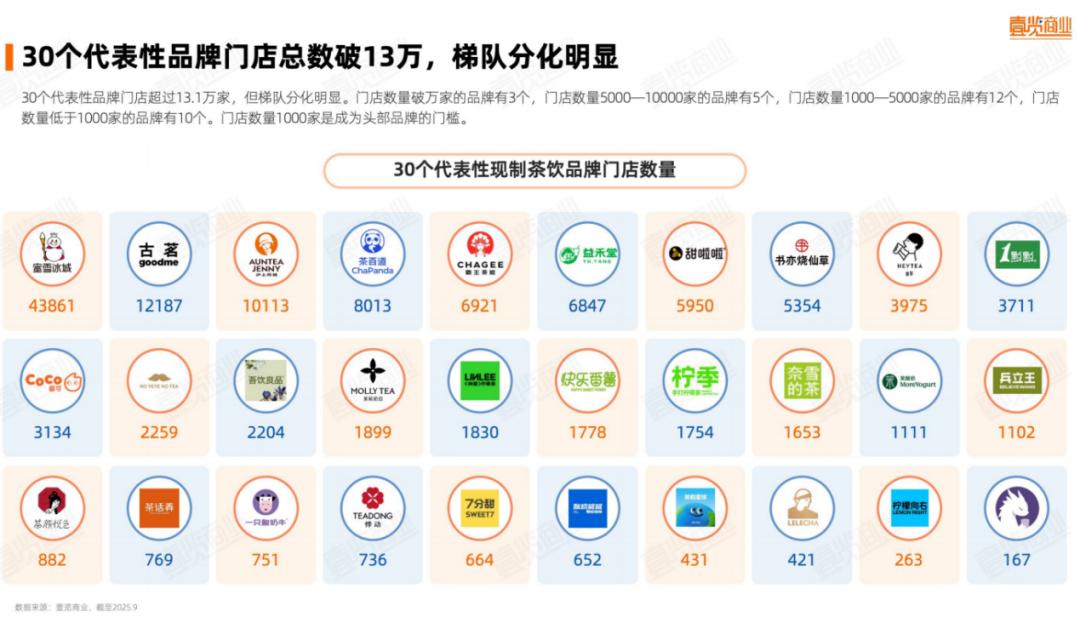
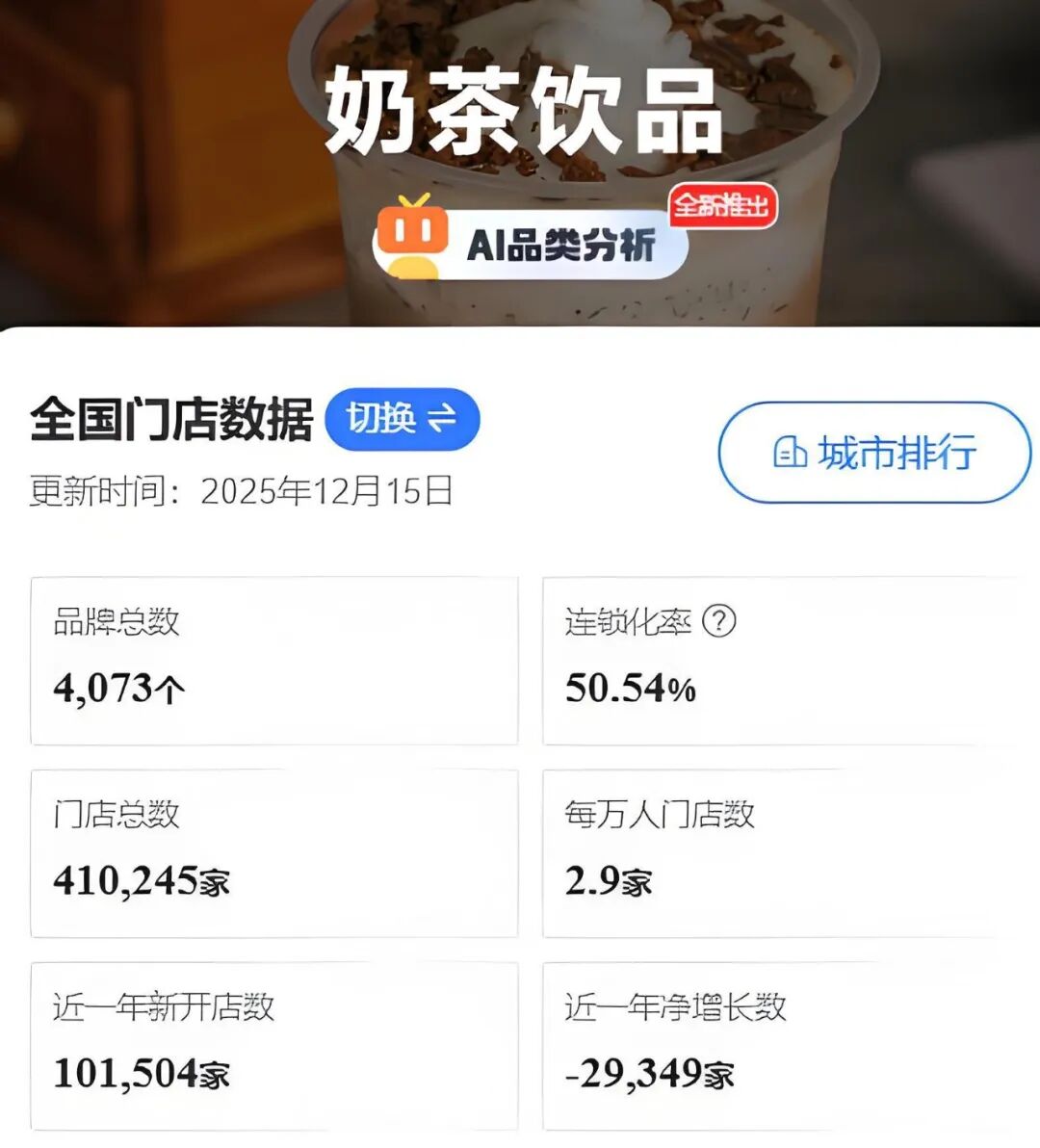
Core Insights - The new tea beverage sector in China has seen significant growth, with major brands like Mixue Ice City, Gu Ming, and others successfully going public, leading to the emergence of the "New Tea Beverage Six Dragons" [1][10] - The total number of tea beverage stores in China has surpassed 400,000, but the industry is experiencing a rapid "survival of the fittest" phase, with 157,000 stores closing in the past year [1][3] Industry Overview - The new tea beverage industry is characterized by a high chain rate of 50.54%, with a total of 410,245 stores and a net decrease of 29,349 stores in the past year [3] - The development of the tea beverage sector has evolved from low-cost, low-quality products in the 1980s to a focus on high-quality tea and innovative flavors in recent years [4][7] Brand Development - Major brands have adopted different strategies, with some focusing on single-hit products while others diversify their offerings [9][10] - The "single-hit" strategy has allowed brands like Shuyi Burned Fairy Grass to optimize their product development and operational efficiency, but it also poses risks if consumer preferences shift [11][13] Product Innovation - The introduction of unique products like cheese milk cap tea has revolutionized the market, leading to a focus on high-quality tea bases and innovative flavor combinations [5][7] - Brands are increasingly exploring the use of fresh fruits and unique ingredients to differentiate their products, although this also complicates supply chain management [8][17] Market Challenges - The rapid expansion of the new tea beverage market has led to intense competition and a high rate of store closures, indicating a need for brands to innovate continuously [1][13] - Supply chain complexities are increasing as brands strive to maintain quality and manage costs, with some companies investing in their own ingredient sourcing [17][18]
霸王茶姬还没做成“东方星巴克”,先得了星巴克的病
3 6 Ke· 2026-01-09 10:24
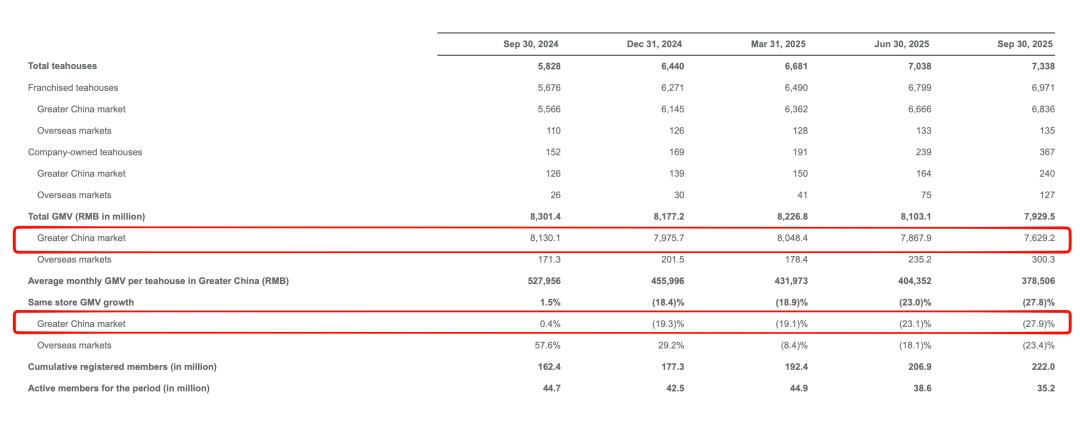
Core Viewpoint - The company BaWang Tea Ji, which went public on NASDAQ less than a year ago, is reportedly considering a secondary listing in Hong Kong, although it has denied these rumors. The company is experiencing a significant slowdown in revenue and profit growth, raising concerns about its market position and brand image [1][3][4]. Financial Performance - BaWang Tea Ji's revenue and profit growth have noticeably slowed over the past year, with growth rates declining for three consecutive quarters. In Q3 of the previous year, the company reported a revenue decline of 9.4% year-over-year and a nearly 40% drop in net profit, marking the first time its quarterly GMV turned negative [1][5]. - The average monthly GMV per teahouse in Greater China has been declining for seven consecutive quarters, with the same-store GMV growth rate falling into negative territory for four quarters, reaching a decline of nearly 28% in Q3 [1][2]. Market Position and Brand Image - BaWang Tea Ji has faced multiple public relations crises that have damaged its high-end brand image, including controversies over product ingredients and employee behavior. The company is known for its significant marketing expenditures, which have helped it establish a premium position in the market [3][4][11]. - The company has refrained from participating in the aggressive food delivery subsidy wars that have benefited competitors, which has contributed to its revenue decline. While other brands like MiXue Ice City and GuMing have seen substantial growth, BaWang Tea Ji's revenue growth has sharply decreased since Q2 of the previous year [5][6][7]. Expansion and Future Strategy - BaWang Tea Ji has expanded its store count significantly, from 1,087 in 2022 to 6,440 in 2024, but the pace of new store openings is expected to slow in 2025 [8][10]. - The company is exploring overseas markets, where it has seen better performance, with GMV in international markets exceeding 300 million RMB, reflecting a year-over-year growth of 75.3% [22]. Stock Performance - Since its peak market valuation of over $7 billion, BaWang Tea Ji's stock price has dropped by more than 60%, with a current market cap of approximately $2.366 billion [23].
霸王茶姬,不止困在“失眠”里
3 6 Ke· 2026-01-09 10:07
Core Viewpoint - The recent controversies surrounding Bawang Chaji, including concerns over high caffeine content in its products, have led to significant market reactions, including a drop of over 14% in its stock price, marking the largest single-day decline since its IPO. The company is facing declining performance metrics, raising questions about its competitive strength and the overall market for new tea beverages [1][8]. Group 1: Caffeine Controversy - The debate over Bawang Chaji's caffeine levels has been ongoing since the popularity of its product "Boya Juexian" in 2021, which was associated with sleep disturbances due to its high tea polyphenol content [2]. - A recent post by a blogger highlighted the caffeine content in Bawang Chaji's drinks, leading to widespread discussions on social media about the brand's "sleep assassin" reputation [2][3]. - Bawang Chaji claims that its caffeine content is lower than that of a cup of Americano, but the caffeine levels in its drinks, such as 117.2 mg in "Boya Juexian" and 210 mg in "Wanli Mulian," are significantly higher than common energy drinks [3][4]. Group 2: Market Performance - Since its peak market value of approximately $76.7 billion in April 2025, Bawang Chaji's stock has declined over 70%, with its third-quarter revenue dropping by 9.4% year-on-year to 32.08 billion yuan and net profit falling by 35.8% [8][9]. - The brand's rapid expansion has led to a decline in single-store performance, with average monthly GMV decreasing for five consecutive quarters [8]. - The company has struggled to introduce new blockbuster products following the success of "Boya Juexian," which previously accounted for 60%-70% of its total revenue [9][10]. Group 3: Consumer Awareness and Brand Strategy - Bawang Chaji has attempted to address caffeine concerns by launching "light caffeine" versions of its products, but the impact on sales has been limited compared to its regular offerings [6][7]. - Other brands, such as Heytea, have begun to disclose caffeine content more transparently, which has been well-received by consumers, highlighting a shift in consumer expectations for information on beverage ingredients [6][7]. - The current market trend indicates that consumers are increasingly concerned about health implications, leading to a demand for clearer labeling and information regarding caffeine content in beverages [7].
霸王茶姬回应赴港上市传闻,美股上市至今股价已跌近五成
Sou Hu Cai Jing· 2026-01-08 07:33
Core Viewpoint - The Chinese tea beverage chain BaWang ChaJi is considering an IPO in Hong Kong, with potential fundraising amounting to several hundred million dollars, although the plan is still under discussion and may not proceed [2] Group 1: Company Overview - BaWang ChaJi was founded by Zhang Junjie in June 2017 in Kunming and has since opened over 7,000 stores globally, with registered members exceeding 200 million [2] - The company went public on NASDAQ in April 2025, making it the first Chinese new tea beverage brand to list on the US stock market [3] Group 2: Financial Performance - For Q3 2025, BaWang ChaJi reported a net revenue of 3.208 billion yuan, a year-on-year decline of 9.4%, and a net profit attributable to shareholders of 394 million yuan, down 35.8% [3] - The net profit margin for Q3 was 12.4%, compared to 18.3% in the same period last year, while the operating profit margin was 14.2%, down from 22.4% [3] - For the first three quarters of 2025, the company achieved a net revenue of 9.933 billion yuan, a year-on-year increase of 9.5%, but the net profit attributable to shareholders fell by 37.6% [3] Group 3: Market Challenges - Despite ongoing store expansion, BaWang ChaJi faces pressure on same-store sales, which declined by 27.9% domestically and 23.4% internationally, primarily due to high base effects from the previous year and intensified competition [4] - The company maintains a low store closure rate, indicating a stable franchisee base, but anticipates continued pressure on same-store GMV growth in the short term [4] Group 4: Strategic Outlook - The CFO highlighted that the strategic focus will be on driving long-term sustainable value for shareholders, emphasizing product innovation and strategic brand investments to enhance market share [4]

霸王茶姬回应:暂无计划赴港上市
新华网财经· 2026-01-08 07:21
Core Viewpoint - The Chinese tea beverage brand Bawang Chaji is reportedly considering a secondary listing in Hong Kong, with preliminary discussions with investment banks indicating a potential fundraising of several hundred million dollars, although the plan may not proceed and requires regulatory approval [1]. Group 1 - Bawang Chaji has responded to rumors of a Hong Kong listing, stating that there are currently no plans for such an action [2]. - The brand was founded by Zhang Junjie in June 2017 and has since opened over 7,000 stores globally, with registered members exceeding 200 million [2]. - Bawang Chaji became the first Chinese new tea beverage brand to list on NASDAQ in April 2025, with Zhang Junjie making his debut on the Hurun Rich List at the age of 30, with a wealth of 13.5 billion yuan [2]. Group 2 - The tea beverage market has become increasingly competitive, with several companies such as Hushang Ahyi, Mixue Group, Guming, Chabaidao, and Nayuki Tea having successfully listed in Hong Kong [2]. - Unlike other tea brands that have gone public in Hong Kong, Bawang Chaji's unique position as the first to enter the US stock market highlights its pioneering status in the industry [2].

霸王茶姬否认赴港上市传闻:暂无相关计划
Jin Rong Jie· 2026-01-08 07:06
近日,有市场消息称中国新茶饮品牌霸王茶姬正考虑在香港进行二次上市。该公司已就此事与多家投资 银行展开初步沟通,潜在融资金额或达数亿美元,相关讨论仍在进行中,最终方案尚需获得监管机构批 准。 针对上述传闻,霸王茶姬方面已明确回应,表示目前暂无相关计划。 霸王茶姬于2017年在昆明创立,2025年4月成功登陆美国纳斯达克,成为首个在美股上市的中国新茶饮 品牌。根据公开信息,截至2025年底,该品牌在全球已开设超过7000家门店,注册会员数量突破2亿。 其创始人张俊杰在2025年发布的《胡润百富榜》中以135亿元财富首次上榜,成为该榜单最年轻的"黑 马"。 近期,新茶饮行业赴港上市热度不减,包括沪上阿姨、蜜雪集团、古茗、茶百道、奈雪的茶在内的多家 品牌已陆续在港交所挂牌。与此同时,霸王茶姬在2025年第三季度的财务表现面临一定压力。财报数据 显示,公司当季净收入为32.08亿元,同比下滑9.4%;归母净利润为3.94亿元,同比下滑35.8%。公司首 席财务官黄鸿飞在财报电话会上指出,尽管门店持续扩张,但现有门店GMV面临压力,国内和海外同 店销售额均出现同比下滑,主要受去年同期高基数及行业竞争加剧影响。 声明:市场 ...