
易方达基金

Search documents
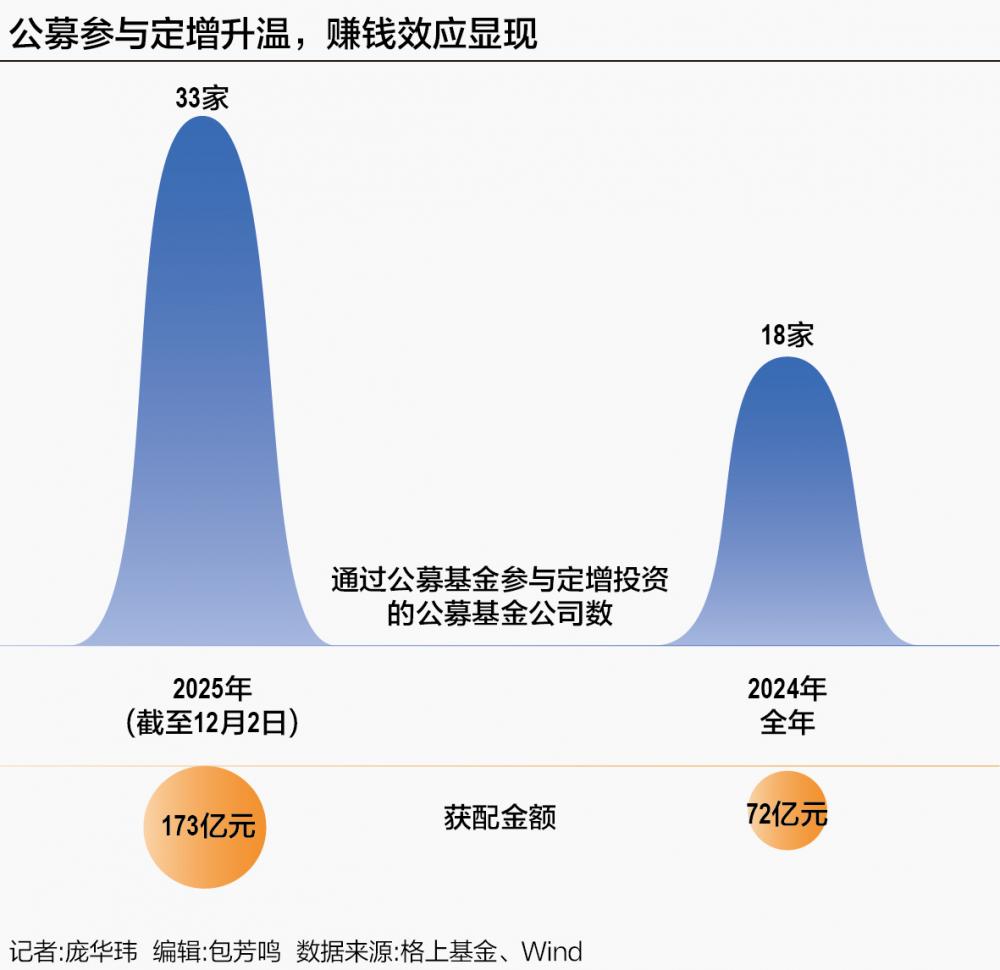
豪掷173亿 年内33家公募参与定增,硬科技成“最强磁场”
2 1 Shi Ji Jing Ji Bao Dao· 2025-12-03 00:01
Core Insights - The A-share private placement market is experiencing significant participation from public funds in 2025, with a total allocation amount reaching 17.3 billion yuan, marking a 140% increase compared to the entire year of 2024 [1][7]. Group 1: Market Participation - A total of 33 public fund companies have participated in private placements in 2025, with the leading company, E Fund, securing 3.687 billion yuan [3][10]. - Other notable participants include GF Fund, Fortune Fund, and China Universal Fund, with allocations of 2.288 billion yuan, 1.529 billion yuan, and 1.463 billion yuan respectively [3][10]. - The trend shows a competitive landscape where larger firms dominate, but smaller firms are also actively participating [3][10]. Group 2: Investment Focus - Public fund investments are heavily concentrated in hard technology sectors, particularly semiconductors, artificial intelligence, and innovative pharmaceuticals [5][12]. - In the electronics sector, public funds have allocated 7.45 billion yuan, while in the biopharmaceutical sector, the allocation reached 5.6 billion yuan [5][13]. - Key companies receiving significant allocations include Baile Tianheng, Cambricon, Chipone, and Dizhe Pharmaceutical, each exceeding 1 billion yuan in public fund allocations [5][14]. Group 3: Drivers of Growth - The resurgence in private placements is driven by three main factors: policy incentives, a safety margin from discounts, and significant profit potential [6][14]. - The favorable policy environment encourages capital market support for the real economy, particularly in technology sectors [6][14]. - The overall performance of public funds in private placements has been strong, further motivating institutional participation [6][14].





A股定增市场迎来公募基金深度参与
2 1 Shi Ji Jing Ji Bao Dao· 2025-12-03 00:01
Core Viewpoint - The A-share private placement market is experiencing significant participation from public funds in 2025, with a total allocation amount reaching 17.3 billion yuan, marking a 140% increase compared to the entire year of 2024 [1][3][5] Group 1: Participation and Investment Trends - A total of 33 public fund companies have participated in private placements in 2025, with the total allocation amount reaching 17.3 billion yuan, a substantial increase from 7.2 billion yuan in 2024 [3][9] - Leading public fund institutions, such as E Fund, GF Fund, and others, are taking the lead in this investment trend, with E Fund alone allocating 3.687 billion yuan [3][10] - The investment focus is heavily on hard technology sectors, particularly semiconductors, artificial intelligence, and innovative pharmaceuticals, reflecting a strong market sentiment [4][11] Group 2: Fund Allocation and Sector Focus - Public funds have allocated 7.45 billion yuan in the electronics sector and 5.6 billion yuan in the biopharmaceutical sector, targeting key companies like Cambricon and Dize Pharmaceutical [4][11][12] - The most favored private placement projects in 2025 include companies like Baile Tianheng and Cambricon, each receiving over 1 billion yuan in public fund allocations [12] Group 3: Drivers of Market Activity - The resurgence of private placements is driven by three main factors: policy incentives, a safety margin from discounts, and significant profit potential [5][13] - Policies encouraging capital market support for the real economy, especially in technology, have created a favorable environment for refinancing [6][13] - The overall performance of public funds in private placements has been strong, further motivating institutional participation [6][13]

增量资金在路上!公募扎堆上报科技类ETF
Guo Ji Jin Rong Bao· 2025-12-02 15:29
Core Viewpoint - The public offering of technology-focused ETFs, particularly in the AI sector, has intensified, with multiple fund companies launching similar products simultaneously, indicating a strong market interest in AI and related technologies [1][7]. Group 1: ETF Launch and Approval - Seven public fund companies have launched AI-focused ETFs, with one company ending its fundraising early due to reaching the 1 billion yuan limit [1][7]. - The first batch of AI ETFs was approved on November 21, with additional thematic ETFs for robotics and semiconductors also being reported [2][4]. - A total of 19 ETFs targeting robotics and semiconductors have been reported in the week following November 24, reflecting a focus on the hottest AI sector [4]. Group 2: Investment Opportunities and Market Sentiment - Industry insiders emphasize that computing power and algorithms are core investment opportunities within the AI industry, but investors should approach the current hype with caution [3][10]. - The first batch of AI ETFs tracks the CSI Innovation and Entrepreneurship AI Index, which includes 50 leading companies in AI technology development and application [7]. - If all reported ETFs reach their fundraising limits, they could inject over 30 billion yuan into the AI and technology sectors [8]. Group 3: Long-term Investment Trends - The convergence of supportive policies, market performance, and competitive dynamics has fueled the enthusiasm for technology-focused ETFs [10]. - Fund companies are leveraging these themes as a key differentiator to attract new capital and align with the long-term trend of product specialization in the public fund industry [10]. - Despite short-term volatility concerns, AI remains a favored long-term investment area, alongside sectors like semiconductors, biotechnology, and clean energy [10][11].

11月新发公募环比增6.62% FOF创年内单月新高
Cai Jing Wang· 2025-12-02 14:12
Group 1 - The issuance of public funds continues to recover, with 145 public funds launched in November, representing a 6.62% month-on-month increase from 136 in October [1] - Equity funds dominate the issuance market in November, with 69 stock funds accounting for 47.59% and 31 equity-mixed funds making up 21.38%, totaling 100 funds or 68.97% of the month's total issuance [1] - Passive index funds lead the stock fund category, with 49 issued in November, making up 33.79% of total fund issuance, while enhanced index funds accounted for 12.41% and ordinary stock funds only 1.38% [1] Group 2 - Bond fund issuance saw a significant month-on-month increase, with 23 bond funds launched in November, up 64.29% from 14 in October, and mixed bond funds comprising 65.22% of this category [1] - FOF products showed remarkable performance in November, with 17 launched, marking a monthly record for the year, and a total of 76 new FOFs established this year, exceeding last year's total by more than double [1] - The market remains confident despite fluctuations in A-shares, supporting stable issuance of equity funds [2] Group 3 - In November, 71 public institutions issued products, with 38 institutions launching one product each and 33 institutions issuing two or more [2] - Guangfa Fund and E Fund led the issuance with 9 public funds each, primarily focusing on stock ETFs, while Penghua Fund and China Europe Fund followed with 6 funds each, all of which were mixed funds [2]
豪掷173亿!年内33家公募参与定增,硬科技成“最强磁场”
2 1 Shi Ji Jing Ji Bao Dao· 2025-12-02 12:40
Core Insights - The A-share private placement market is experiencing significant participation from public funds in 2025, with 33 fund companies involved and a total allocation amounting to 17.3 billion yuan, representing a 140% increase compared to the entire year of 2024 [1][2] Group 1: Market Participation - Public funds have shown a marked increase in enthusiasm for private placements, with a total allocation of 17.3 billion yuan in 2025, up from 7.2 billion yuan in 2024, indicating a growth of over 10 billion yuan [2] - Leading public fund institutions, such as E Fund, GF Fund, and Fortune Fund, have emerged as key players, with allocations of 3.687 billion yuan, 2.288 billion yuan, and 1.463 billion yuan respectively [2] Group 2: Investment Focus - The investment focus of public funds is heavily concentrated in hard technology sectors, particularly in semiconductors, artificial intelligence, and innovative pharmaceuticals, reflecting a strong alignment with the ongoing "technology bull" market [3][4] - Notable allocations include 7.45 billion yuan in the electronics sector and 5.6 billion yuan in the biopharmaceutical sector, with key companies like Cambricon, Chipone, and Bairi Tianheng receiving significant funding [3] Group 3: Drivers of Growth - The resurgence of private placements is driven by three main factors: policy incentives, a safety margin due to pricing discounts, and significant profit-making potential observed by participating institutions [4] - The overall performance of public funds in private placements has been strong, which has further encouraged institutional participation [5]
基金公司发展趋势:回归投研本身,大而全和小而美均值得期待
Zheng Quan Ri Bao· 2025-12-02 11:27
Core Viewpoint - The Chinese economy is transitioning from high-speed growth to high-quality development, with public funds playing a crucial role in supporting the real economy and stabilizing the market [1] Group 1: Strategic Positioning of Fund Companies - The development landscape of public funds will further optimize, with a clear differentiation between large comprehensive fund companies and small specialized fund companies [1][2] - Large fund companies will focus on being "big and comprehensive," while small fund companies will adopt a "small and beautiful" strategy [1] Group 2: Industry Structure and Trends - The public fund industry will continue to concentrate towards the top, highlighting a "Matthew Effect" where strong companies become stronger [2] - Large fund companies will benefit from brand effects, research resources, and sales channels, leading to increased concentration in equity and index products [2] Group 3: Development Strategies for Comprehensive Fund Companies - Comprehensive fund companies should maintain their strengths while expanding into other product types, as demonstrated by E Fund and Huaxia Fund, which have seen significant growth in non-monetary management scale [3] - E Fund's non-monetary scale growth rate is approximately 79% since the end of 2020, while Huaxia Fund's growth rate is around 147% [3] Group 4: Development Strategies for Specialized Fund Companies - Small fund companies should pursue differentiated development strategies, focusing on their unique strengths, as seen with Guojin Fund and Pengyang Fund [4] - Guojin Fund's non-monetary management scale grew from 10.2 billion to 37.2 billion, a 265% increase, by focusing on quantitative and fixed-income investments [4] Group 5: Research and Investment System Construction - Strengthening research and investment capabilities is essential for fund companies to enhance investor returns, with a push towards a "platform-based, integrated, multi-strategy" research system [5] - Fund companies are shifting from relying on star fund managers to building a comprehensive research brand [6] Group 6: Enhancing Efficiency through AI - Talent development is crucial for fund companies' core competitiveness, with a focus on long-term assessment and a robust training system [7] - Employee stock ownership plans are still in early stages in China, and enhancing these plans can improve team stability and operational efficiency [8] - AI is becoming essential for optimizing workflows, enhancing customer experiences, and improving investment performance across the entire business chain of fund companies [9]
熊市不慌,牛市能涨!十年‘双十’基金经理名单曝光
Sou Hu Cai Jing· 2025-12-02 11:22
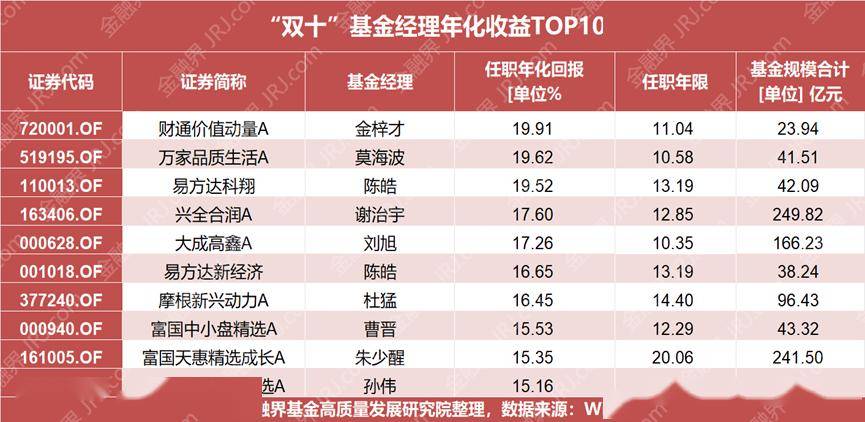
Core Insights - The Shanghai Composite Index has reached the 4000-point mark for the first time in ten years, indicating a resurgence in market enthusiasm and a rise in the net value of many actively managed equity funds [1] - The "Double Ten" fund managers, defined as those with over ten years of management experience and an annualized return exceeding 10%, have proven to be resilient in various market conditions [1] Fund Manager Performance - The top ten "Double Ten" fund managers include notable figures from mid-sized fund companies, such as Jin Zicai from Caitong Fund and Mo Haibo from Wanji Fund, showcasing their strong performance over the years [1][2] - Jin Zicai's Caitong Value Momentum Fund and Mo Haibo's Wanji Quality Life Fund have demonstrated strong offensive capabilities during bull markets while maintaining a maximum drawdown of around 20% during market corrections, reflecting good risk management [2][3] Annualized Returns - The annualized returns for the top fund managers in 2025 show Caitong Value Momentum A at 63.10% and Wanji Quality Life A at 61.63%, indicating robust performance in the current year [3] - Historical performance data reveals significant fluctuations, with Caitong Value Momentum A achieving a return of 70.96% in 2019 and a decline of -23.09% in 2023, while Wanji Quality Life A had a peak return of 35.04% in 2021 [3] Long-Term Management - Zhu Shaoxing from Fortune Fund exemplifies long-term management, having managed the Fortune Tianhui Growth Mixed Fund since 2005, maintaining an annualized return of over 15% [4]
港股红利板块逆势走强,恒生红利低波ETF(159545)全天净申购超1亿份
Mei Ri Jing Ji Xin Wen· 2025-12-02 11:15
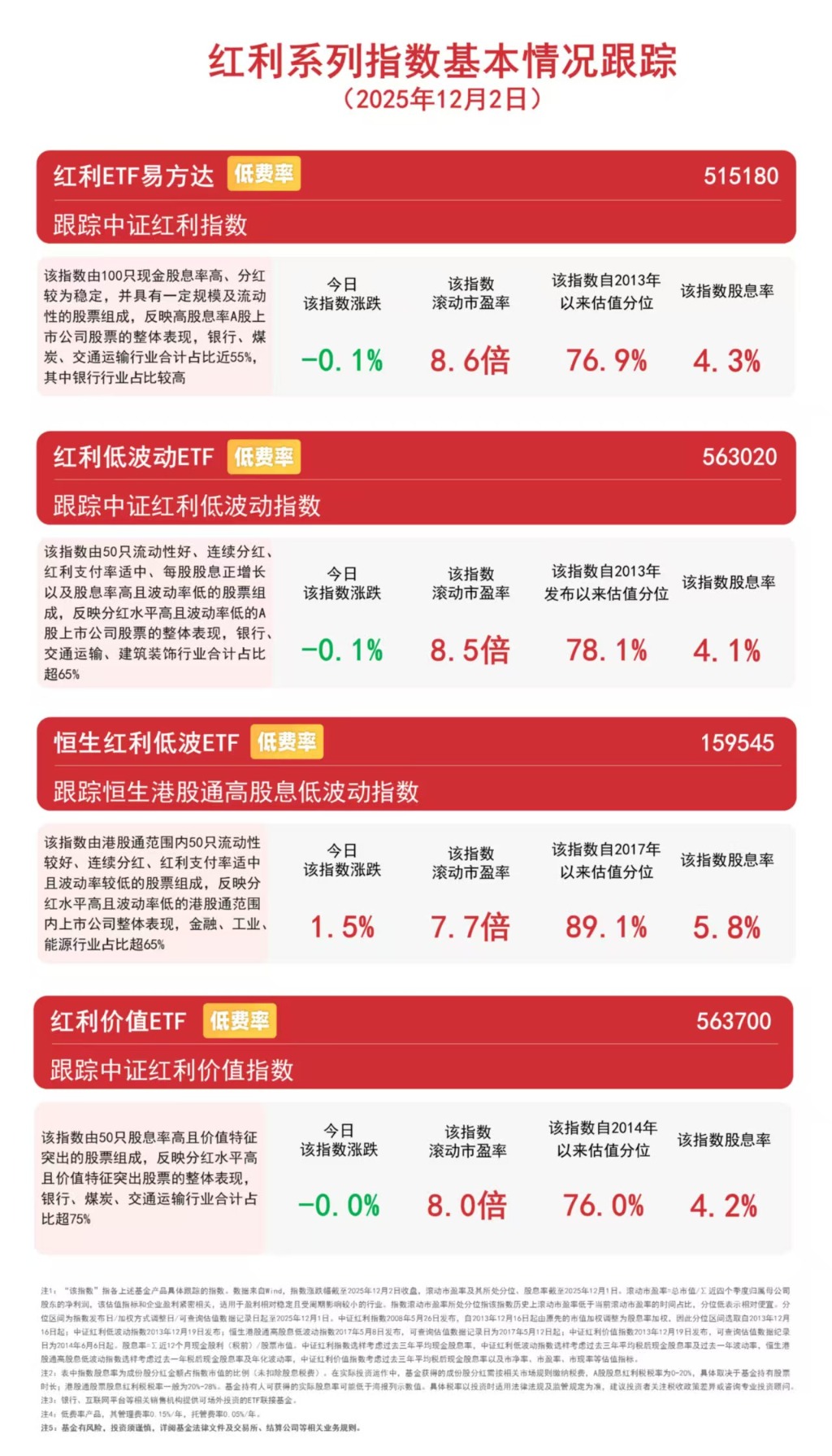
Group 1 - The Hong Kong dividend sector showed resilience with Jiangnan Buyi rising over 6% and China Gas increasing over 4%, while the Hang Seng High Dividend Low Volatility Index rose by 1.5% [1] - In contrast, the A-share dividend sector remained volatile, with the CSI Dividend Value Index down by 0.01% and both the CSI Dividend Index and CSI Low Volatility Dividend Index down by 0.1% [1] - There is a clear trend of capital allocation, as the Hang Seng Low Dividend ETF (159545) saw a net subscription of over 100 million units throughout the day [1] Group 2 - E Fund is currently the only fund company offering all its dividend ETFs at a low fee rate, with management fees for various products including the Hang Seng Low Dividend ETF (159545) set at 0.15% per year [1] - The E Fund Dividend ETF (515180) tracks the CSI Dividend Index, which consists of 100 stocks with high cash dividend yields and stable dividends, with the banking, coal, and transportation sectors accounting for nearly 55% of the index [3] - The E Fund Low Volatility Dividend ETF (563020) tracks the CSI Low Volatility Dividend Index, composed of 50 stocks with good liquidity and continuous dividends, with the banking, transportation, and construction sectors making up a significant portion of the index [3][7]
从巴西到泰国……公募拓展全球朋友圈!国际化迈向第4阶段
券商中国· 2025-12-02 11:01
Core Viewpoint - The Chinese fund industry is actively expanding its global presence, entering a new phase of internationalization characterized by policy-driven growth, diverse products, and two-way capital flow [1][4][6]. Group 1: Internationalization Stages - The internationalization of public funds has progressed through three stages since 2006: the initial stage (2006-2014) focused on breaking into overseas markets with QDII funds and establishing overseas subsidiaries [5]. - The expansion stage (2015-2019) saw the launch of mutual recognition mechanisms between mainland and Hong Kong funds, allowing for two-way capital flow [6]. - The acceleration stage (2020-2024) has led to a more diverse product offering and the establishment of subsidiaries in various countries, moving beyond just Hong Kong [6][7]. Group 2: Recent Developments - In November, significant developments included the listing of the first Thai ETF linked to the ChiNext 50 Index and the launch of two Brazilian ETFs in China, enhancing cross-border investment opportunities [2][3]. - The signing of a cooperation memorandum between the China Securities Investment Fund Industry Association and the German Federal Association of Investment and Asset Management indicates growing international collaboration [2][3]. Group 3: Future Outlook - The future of public fund internationalization is expected to feature global network expansion, differentiated product strategies, and deeper interconnectivity [7]. - The cross-border ETF market is projected to grow significantly, with a notable increase in scale and penetration rates observed in recent years [7]. - Investment firms are encouraged to adopt a global perspective in asset allocation, emphasizing the importance of professional research support for cross-border ETF strategies [7].

天府证券ETF日报2025.12.02-20251202
天府证券· 2025-12-02 09:37
Report Industry Investment Rating - No relevant content found Core View of the Report - On December 2, 2025, the A-share market generally declined, with the Shanghai Composite Index down 0.42%, the Shenzhen Component Index down 0.68%, and the ChiNext Index down 0.69%. The trading volume of A-shares in the two markets was 1606.7 billion yuan. Different sectors and ETFs showed various trends [2][6]. Summary by Related Catalogs Market Overview - The Shanghai Composite Index closed at 3897.71 points, down 0.42%; the Shenzhen Component Index closed at 13056.70 points, down 0.68%; the ChiNext Index closed at 3071.15 points, down 0.69%. The top - rising industries were petroleum and petrochemicals (0.71%), light manufacturing (0.55%), and household appliances (0.43%), while the top - falling industries were media (-1.75%), non - ferrous metals (-1.36%), and computers (-1.34%) [2][6]. Stock ETF - The top - trading - volume stock ETFs included Huaxia CSI A500 ETF (down 0.69%, premium rate -0.68%), Cathay CSI A500 ETF (down 0.60%, premium rate -0.63%), and E Fund CSI A500 ETF (down 0.59%, premium rate -0.62%) [3][7]. Bond ETF - The top - trading - volume bond ETFs were Haifutong CSI Short - Term Financing ETF (up 0.01%, premium rate -0.00%), Huaxia CSI AAA Science and Technology Innovation Corporate Bond ETF (down 0.04%, premium rate -0.13%), and Harvest CSI AAA Science and Technology Innovation Corporate Bond ETF (down 0.01%, premium rate -0.03%) [4][9]. Gold ETF - Gold AU9999 was down 0.37% and Shanghai Gold was down 0.44%. The top - trading - volume gold ETFs were Huaan Gold ETF (down 0.53%, premium rate -0.56%), E Fund Gold ETF (down 0.50%, premium rate -0.52%), and Bosera Gold ETF (down 0.49%, premium rate -0.50%) [12]. Commodity Futures ETF - Huaxia Feed Soybean Meal Futures ETF was down 0.20%, premium rate 0.59%; Dacheng Non - Ferrous Metals Futures ETF was up 0.11%, premium rate 0.33%; and Jianxin Yisheng Zhengzhou Commodity Exchange Energy and Chemical Futures ETF was down 0.32%, premium rate 0.18% [13]. Cross - border ETF - The previous trading day, the Dow Jones Industrial Average was down 0.90%, the Nasdaq was down 0.38%, the S&P 500 was down 0.53%, and the German DAX was down 1.04%. On this day, the Hang Seng Index was up 0.24% and the Hang Seng China Enterprises Index was up 0.11%. The top - trading - volume cross - border ETFs were E Fund CSI Hong Kong Securities Investment Theme ETF (down 0.29%, premium rate -0.34%), Huatai - Peregrine Hang Seng Technology ETF (down 0.54%, premium rate -0.36%), and Huaxia Hang Seng Technology ETF (down 0.66%, premium rate -0.59%) [15]. Money ETF - The top - trading - volume money ETFs were Yin Hua Day - to - Day Interest ETF, Hua Bao Add - Benefit ETF, and Money ETF Jianxin Add - Benefit [17].