江淮汽车

Search documents
聚合智能融合发展 成新能源产业壮大关键路径
Xin Lang Cai Jing· 2025-09-17 22:42
Core Insights - The rapid development and application of artificial intelligence technologies have positioned smart vehicles, low-altitude travel, and embodied robots as key carriers of AI applications, with a consensus emerging on the importance of scaling smart vehicle components to empower these sectors [1][2] - The concept of "aggregated intelligence" is characterized by the deep coupling of technology, industry chains, and application scenarios, which is seen as a new direction for the renewable energy industry to break through single development bottlenecks and unlock trillion-yuan market potential [1][4] Technology and Industry Chain Interconnectivity - There is significant "homogeneity" among smart vehicles, embodied robots, and low-altitude economy, with AI as the core support for underlying technologies, forming an AI-based terminal industry chain [2][3] - The supply chain overlap exceeds 60%, with some companies estimating it to be as high as 70%, allowing components from smart vehicles to directly support robots and low-altitude aircraft [2][3] - The cost of laser radar has dramatically decreased from 100,000 yuan in 2019 to 800 yuan today, showcasing the potential for cost reduction in robotics and low-altitude economies through supply chain integration [2][3] Practical Applications and Industry Initiatives - Companies like Beijing Horizon Robotics have successfully integrated smart vehicle technology into robotics, with over 10 million units of their chips deployed in vehicles and applications in various robotic platforms [3] - Zhixing Technology has entered the robotics field through acquisitions, developing the world's first domestic mid-to-high computing power robot controller based on intelligent driving technology [3] Scene Integration and Ecosystem Development - The shift from a single product mindset to an ecosystem approach is gaining traction in the renewable energy sector, exemplified by initiatives like the "robot soccer league" that fosters a developer ecosystem [4][5] - The low-altitude economy is being redefined through innovative transportation solutions, with electric flying cars expected to reduce costs significantly from millions to around 200,000 yuan [5][6] - Companies like Sichuan Wofei Chang Kong are actively developing electric flying vehicles and have secured substantial orders, indicating strong market demand for low-altitude travel solutions [5][6] Strategic Collaborations and Future Outlook - Jianghuai Automobile Group is pursuing an "all-chain" ecosystem strategy by collaborating with universities and leading companies in robotics and low-altitude economies to extend the automotive industry chain into new fields [6] - The aggregation of smart vehicles, embodied robots, and low-altitude economies is projected to form a trillion-yuan export force in the next five years, with integrated development being the key to seizing this opportunity [6]
“破局者”江淮汽车:掀起科技型新能源豪车变革
Shang Hai Zheng Quan Bao· 2025-09-17 19:28
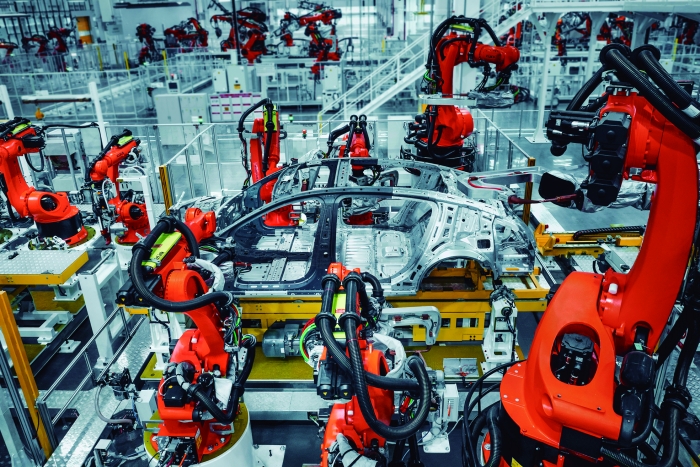
尊界超级工厂自动化焊接生产线 ◎记者 刘一枫 秦春刚 "一切为了尊界,为了尊界的一切。"尊界超级工厂的冲焊车间101会议室墙壁上,这句口号被印成条幅 挂在醒目位置。 这款江淮汽车与华为携手打造的车型还有多处设计尽显"超豪华"定位,包括星空顶、水晶灯、激光投 影、三连屏等。"超豪华"也不仅体现在外观上——它的系统搭载华为途灵二代龙行平台,形成智能驾 驶、智能座舱、智能域控的"三智"融合。 作为尊界首款车型,S800于今年5月30日正式首发上市,推出增程和纯电两种动力模式,售价在70.8万 元至101.8万元之间。 "尊界上市以来,根据我们对客户画像数据的比对,有两个'没想到'。"项兴初向记者介绍,一是没想到 车型的选配比例高,七成以上销售订单选择了百万级顶配,智能星空顶、40英寸隐私巨幕、隐私光幕玻 璃、后排智能可变空间隔断等都是高比例选配项;二是没想到车主年轻化,购买尊界S800的车主 中,"90后"占比颇高。 "与预想不同,这款车型40%左右的应用场景是家庭使用,而非商务接待或私营企业主专用。家庭场景 对安全系数的要求更高,这要求我们在质量方面做到极致,包括安全、智能、便捷等方面。"项兴初 说。 9月16日 ...


“徽”创未来——实探锐意创新转型升级的“皖企样本”
Shang Hai Zheng Quan Bao· 2025-09-17 19:28
Group 1 - Anhui's industrial revenue is projected to grow from 3.8 trillion yuan in 2020 to 5.49 trillion yuan by 2024, moving from 12th to 6th place nationally, increasing its share from 3.6% to 4% [2] - The region has maintained its position as a leader in innovation capabilities for 13 consecutive years, focusing on becoming a significant technology innovation hub [2] - Key sectors driving innovation include quantum information, fusion energy, and deep space exploration, with traditional industries integrating new technologies to enhance quality [2] Group 2 - The "Zun Jie Super Factory," launched in June, features automated production lines capable of producing vehicles in 15 different colors, showcasing advanced flexible manufacturing [4] - Jianghuai Automobile is committed to transforming its manufacturing processes to achieve "atomic-level quality management" and flexible intelligent manufacturing [4] - Conch Cement has successfully transitioned from a single cement factory to a global top 500 company, leveraging market operations and digital upgrades to enhance performance [4][5] Group 3 - Chujiang New Materials has achieved steady growth for 25 years, with annual revenue surpassing 50 billion yuan, focusing on copper processing and expanding into high-tech fields [5] - Yongxin Co., a leader in the soft packaging industry, has seen a tenfold increase in performance since its listing, emphasizing internationalization and smart manufacturing for high-quality development [6] - In the first half of the year, 152 out of 186 A-share listed companies in Anhui reported profits, with a total revenue of 722.08 billion yuan, reflecting the region's economic vitality [6]

聚合智能融合发展成新能源产业壮大关键路径
Zheng Quan Ri Bao· 2025-09-17 16:09
Core Insights - The rapid development and application of artificial intelligence technologies have made smart vehicles, low-altitude travel, and embodied robots key carriers of AI applications, with a consensus emerging on the importance of scaling smart vehicle components to empower these sectors [1][2] - The concept of "aggregated intelligence" is characterized by deep coupling of technology, industry chains, and application scenarios, which is seen as a new direction for the new energy industry to break through single development bottlenecks and unlock trillion-yuan market potential [1][7] Group 1: Technological Synergy and Industry Chain Interconnectivity - Smart vehicles, embodied robots, and low-altitude economy share significant "homogeneity" in their underlying technologies, all supported by artificial intelligence, leading to a unified terminal industry chain [2][3] - The supply chain overlap exceeds 60%, with some companies estimating it to be as high as 70%, allowing components from smart vehicles to directly support robots and low-altitude vehicles [2][3] - The cost reduction in components, such as LiDAR, has been significant, with prices dropping from 100,000 yuan in 2019 to 800 yuan today, demonstrating the potential for cost-effective solutions in robotics and low-altitude travel [3] Group 2: Scene Integration and Ecological Co-construction - The shift from a single product mindset to an ecological thinking is becoming a consensus among professionals in the new energy sector, with examples like the "robot football league" showcasing developer ecosystems [5] - The low-altitude economy is showing great potential in reconstructing transportation scenarios, with electric flying cars expected to reduce costs significantly from millions to around 200,000 yuan [6] - Companies like Sichuan Wofei Chang Kong Technology are actively developing electric flying vehicles and have plans for commercial operations by 2026, indicating a growing market for low-altitude travel solutions [6][7] Group 3: Strategic Collaborations and Future Outlook - Companies like Jianghuai Automobile Group are exploring collaborative ecosystems by sharing technologies and resources across smart vehicles, robots, and low-altitude travel [7] - The integration of smart vehicles, embodied robots, and low-altitude economy is expected to form a trillion-yuan "new trio" export force in the next five years, emphasizing the importance of fusion development [7]
全国首批L3级“真自动驾驶”汽车要来了!
Mei Ri Jing Ji Xin Wen· 2025-09-17 13:07
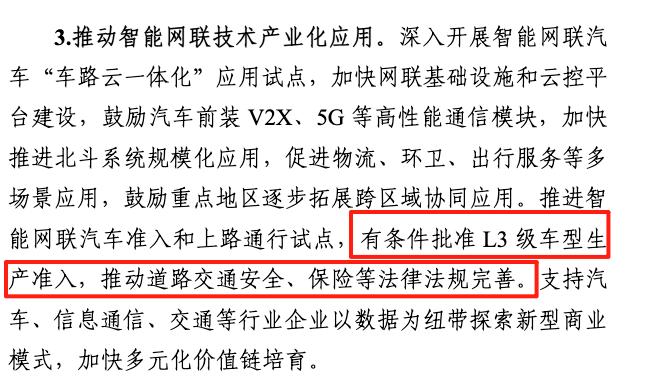
Core Viewpoint - The recent introduction of the "Automobile Industry Stabilization Growth Work Plan (2025-2026)" allows for conditional approval of L3 autonomous vehicle production, signaling a significant step towards the commercialization of L3 autonomous driving technology in China [1][10]. Industry Developments - The automotive industry is gearing up for the launch of L3 autonomous vehicles, with several companies, including XPeng Motors and GAC Group, planning to release L3 models by the end of this year [3][4]. - Various automakers have announced their timelines for L3 technology, with GAC Group stating it will mass-produce its first L3 vehicle in Q4 of this year, while other companies like Chery and Huawei are also targeting similar timelines for their L3 offerings [3][4][5]. Technical Challenges - Despite advancements, the rollout of L3 technology faces challenges related to infrastructure, regulatory frameworks, and the definition of responsibility in case of accidents [2][6][11]. - Experts emphasize that L3 technology requires extensive testing and validation to ensure safety and reliability before widespread consumer adoption [5][7]. Regulatory Framework - The Ministry of Science and Technology has issued ethical guidelines for the development of autonomous driving technologies, clarifying the responsibilities of drivers and systems under different levels of automation [6][10]. - Local governments are actively working on regulations to support the testing and deployment of L3 vehicles, with over 50 cities having introduced pilot policies or local regulations for autonomous driving [14]. Consumer Implications - The transition from L2 to L3 autonomous driving represents a significant shift in consumer experience, moving from driver assistance to full vehicle control under specific conditions [6][7]. - The cost of L3 vehicles is expected to be higher than L2 models due to advanced hardware and safety features, which may affect consumer adoption [15]. Future Outlook - Industry experts predict that 2030 will be a critical period for the large-scale application of L3 and L4 autonomous driving technologies, with expectations for rapid advancements in the coming years [16].


全国首批L3级“真自动驾驶”汽车要来了,高速能脱手、堵车能歇气,但权责怎么分?专家解答
3 6 Ke· 2025-09-17 12:08
Core Viewpoint - The introduction of the "Automobile Industry Stabilization Growth Work Plan (2025-2026)" allows for conditional approval of L3 autonomous vehicle production, indicating a significant step towards the commercialization of L3 autonomous driving technology in China [1][2][4]. Summary by Sections L3 Autonomous Driving Technology - L3 autonomous driving allows drivers to completely disengage from vehicle control under specific conditions, although they must be ready to take over at any moment [2][10]. - The technology is expected to be commercially available by the end of 2023, with several automakers planning to launch L3 vehicles [4][6][7]. Industry Developments - Companies like XPeng Motors, GAC Group, and Chery are set to release L3 autonomous vehicles within the next year, with significant advancements in hardware and software required for these models [5][6][8]. - The automotive industry is experiencing a competitive race to develop and market L3 autonomous vehicles, with expectations for consumer availability in the fourth quarter of 2023 [4][24]. Challenges and Concerns - Experts highlight that the technology still requires extensive validation, and issues such as infrastructure readiness and liability definitions remain significant challenges [2][9][16]. - The operational design domain (ODD) for L3 vehicles will initially be limited to specific conditions, necessitating further testing and regulatory frameworks to ensure safety [17][22]. Regulatory and Safety Framework - The Ministry of Science and Technology has issued guidelines clarifying the responsibilities of users and autonomous systems in L3 and L4 driving scenarios [10][15]. - Local governments are actively working on regulations to support the deployment of L3 technology, with over 50 cities having introduced relevant policies [22]. Market Implications - The anticipated higher costs of L3 vehicles compared to L2 models may deter some consumers, but the regulatory changes are expected to enhance consumer trust and stimulate market demand [24][25]. - The shift towards L3 technology is seen as a potential growth driver for the automotive industry, with predictions of rapid advancements in autonomous driving capabilities over the next decade [24][25].


汽车产业绿色转型不变,智能化+全球化或成“十五五”谋篇布局的关键
Hua Xia Shi Bao· 2025-09-17 09:53
Group 1 - The year 2025 is a critical year for China's automotive industry, marking the end of the "14th Five-Year Plan" and the beginning of the "15th Five-Year Plan," focusing on high-quality development and new energy vehicle innovation [2] - The 21st China Automotive Industry Development International Forum was held in Tianjin, emphasizing themes of enhancing momentum, initiating new chapters, and promoting global collaboration in the automotive sector [2] - During the "14th Five-Year Plan," China's automotive ownership increased by 25%, while emissions of nitrogen oxides and volatile organic compounds decreased by 31% and 13%, respectively, indicating a successful transition towards high-quality development [3] Group 2 - The production and sales of vehicles in China from January to August reached 21.05 million and 21.12 million units, respectively, with year-on-year growth of 12.7% and 12.6%, maintaining its position as the world's largest automotive market [3] - The sales of new energy vehicles reached 9.62 million units, reflecting a year-on-year increase of 36.7%, with domestic brands capturing a market penetration rate of 68.8% [3] - The automotive industry is transitioning into an era of intelligent electric vehicles, with significant advancements expected in solid-state batteries and vehicle-to-network interactions [4] Group 3 - Challenges facing the automotive industry include technological bottlenecks in high-end chips, the need for scalable applications in intelligent connected vehicles, and emerging international trade barriers [5] - The Ministry of Industry and Information Technology emphasizes the importance of green and low-carbon transformation in the automotive sector, focusing on planning, technology development, and enhancing international cooperation [5] Group 4 - China's automotive exports reached 4.292 million units from January to August, with a year-on-year increase of 13.7%, and new energy vehicle exports surged by 87.3% [6] - The forum included discussions on global automotive industry trends, national policies, and international market opportunities, aiming to support high-quality overseas strategies for Chinese automotive companies [6] Group 5 - The complexity of certification requirements across different countries poses significant challenges for automotive manufacturers, necessitating a focus on adaptive standards and compliance [7] - The increase in automotive exports has been accompanied by rising risks, including legal challenges faced by companies like XPeng and BYD in international markets [7][8] - The automotive industry is encouraged to build a comprehensive support network for intellectual property services to facilitate overseas expansion [8] Group 6 - The internationalization of the automotive industry is viewed as a transformative process that encompasses various dimensions, including market insights, technology development, and local production [8] - Recommendations for enhancing international cooperation include participating in global governance and standard-setting, particularly in areas like intelligent networking and carbon reduction [9]

前8个月皮卡销量38.7万辆,西部市场占45% 乘联分会:商用车需求提升可带动乘用车市场恢复
Mei Ri Jing Ji Xin Wen· 2025-09-17 09:24
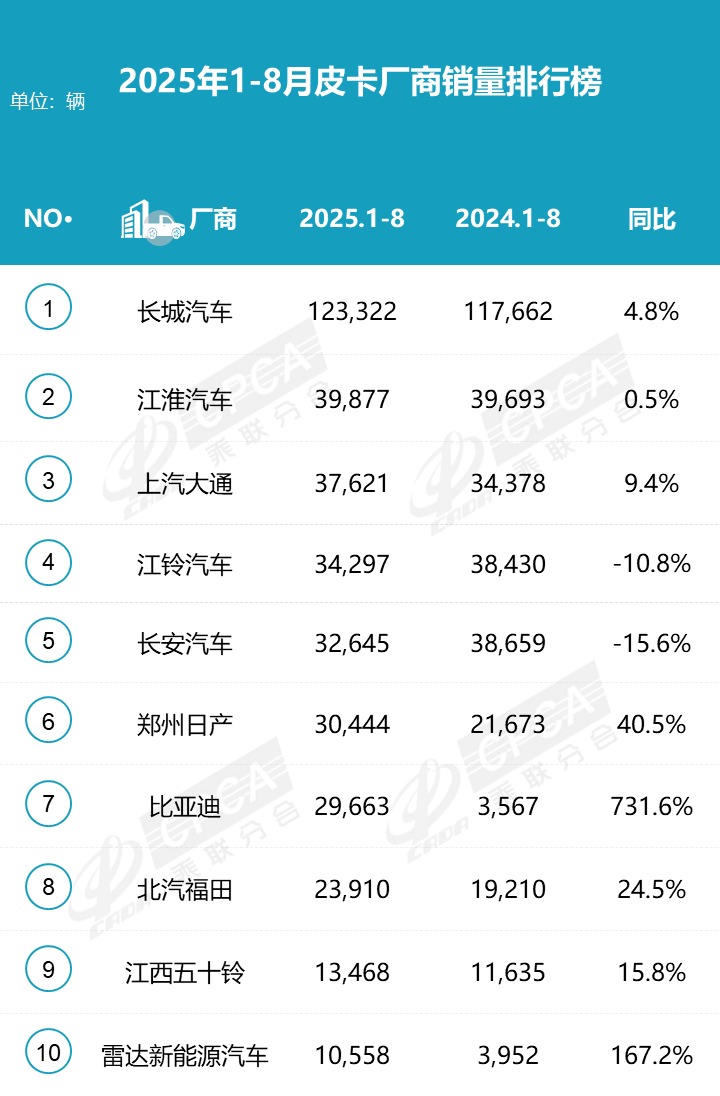
Market Overview - In August, domestic pickup truck sales in China were approximately 40,000 units, a year-on-year decrease of 0.3%, but still at a mid-to-high level compared to the past five years; total pickup truck sales for the first eight months of the year reached about 387,000 units, representing a year-on-year growth of 12.7% [1] - The main sales regions for pickups are in the southwest and northwest, with these areas accounting for 45% of total demand in August, indicating a strong market presence in small cities and rural areas [2] Company Performance - Great Wall Motors reported cumulative pickup truck sales of approximately 123,000 units in the first eight months of the year; JAC Motors and SAIC Maxus recorded sales of about 40,000 and 38,000 units respectively, with SAIC Maxus experiencing a year-on-year growth of 9.4% [1] - New energy vehicle manufacturers like BYD and Radar have shown significant growth in pickup sales, with increases of 731.6% and 167.2% respectively, although their sales bases are relatively small [1] Market Trends - The demand for pickups in rural areas has recently surged, prompting manufacturers to focus on the mid-western markets [2] - The commercial vehicle market's demand increase suggests improvements in infrastructure in certain regions, which may positively impact the passenger vehicle market recovery [4] Product Development - SAIC Maxus has launched the "Star Plan" with an investment of 15 million yuan to assist farmers in purchasing utility vehicles, addressing the financial barriers such as down payments [4] - The company has also enhanced the pickup truck's chassis height and load capacity to cater to the diverse transportation needs of farmers, including customized models for fresh produce and cold chain logistics [4]


乘联分会:9月1-14日全国乘用车市场零售73.2万辆 同比下降4%
智通财经网· 2025-09-17 09:01
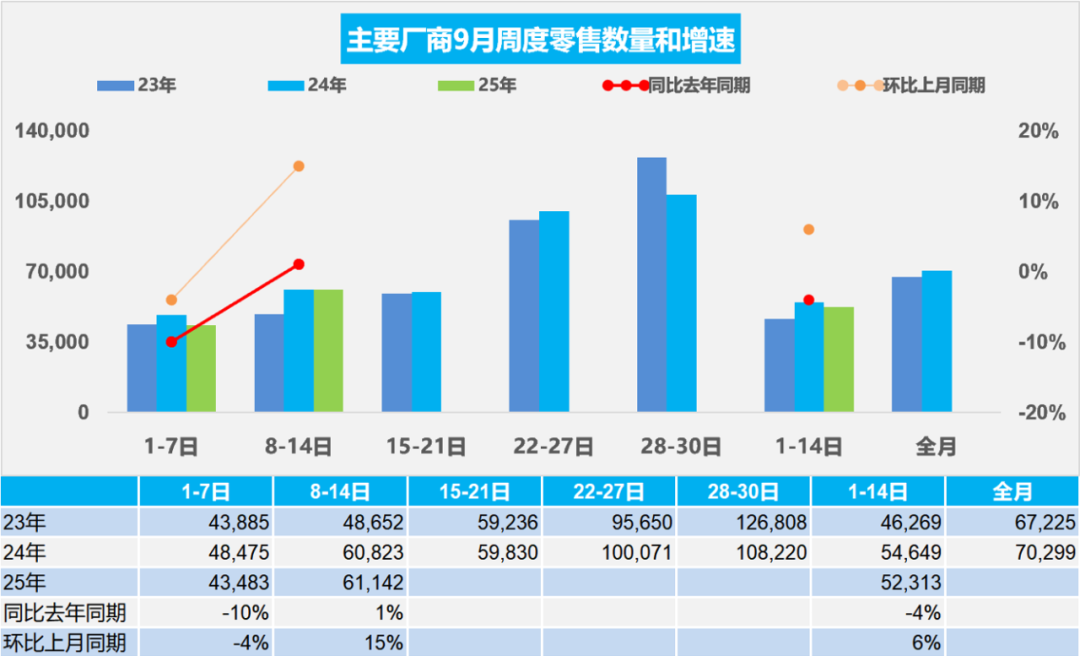
Group 1: Market Performance - From September 1 to 14, the national passenger car market retail reached 732,000 units, a year-on-year decrease of 4%, but a month-on-month increase of 6%. Cumulative retail for the year reached 15.497 million units, a year-on-year increase of 9% [1][5] - During the same period, wholesale of national passenger car manufacturers was 774,000 units, a year-on-year decrease of 3%, but a month-on-month increase of 18%. Cumulative wholesale for the year reached 18.816 million units, a year-on-year increase of 12% [1][9] Group 2: New Energy Vehicles - In the new energy sector, retail sales from September 1 to 14 reached 438,000 units, a year-on-year increase of 6% and a month-on-month increase of 10%. The penetration rate for new energy vehicles in the passenger car market was 59.8%, with cumulative retail for the year at 8.008 million units, a year-on-year increase of 25% [1][5] - Wholesale of new energy vehicles from manufacturers during the same period was 447,000 units, a year-on-year increase of 10% and a month-on-month increase of 21%. The cumulative wholesale for the year reached 9.39 million units, a year-on-year increase of 32% [1][9] Group 3: Market Trends and Challenges - The market is experiencing a mixed performance, with the "Golden September and Silver October" traditional peak season approaching, alongside the implementation of national and local purchase subsidies. However, the focus on high-priced models in local subsidy policies may hinder the growth of the mainstream market [5] - The introduction of new models at the Chengdu Auto Show has generated significant interest, but the lack of popular entry-level models has limited their contribution to overall sales [5][9]
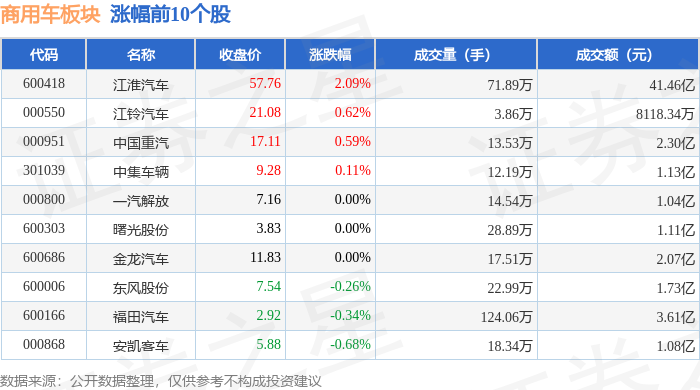
商用车板块9月17日涨0.49%,江淮汽车领涨,主力资金净流出6427.39万元
Zheng Xing Xing Ye Ri Bao· 2025-09-17 08:42
Market Overview - The commercial vehicle sector increased by 0.49% on September 17, with Jianghuai Automobile leading the gains [1] - The Shanghai Composite Index closed at 3876.34, up 0.37%, while the Shenzhen Component Index closed at 13215.46, up 1.16% [1] Stock Performance - Jianghuai Automobile (600418) closed at 57.76, with a rise of 2.09% and a trading volume of 718,900 shares, amounting to a transaction value of 4.146 billion yuan [1] - Other notable stocks include: - Jiangling Motors (000550) at 21.08, up 0.62% [1] - China National Heavy Duty Truck Group (000951) at 17.11, up 0.59% [1] - Zhongshun Vehicle (301039) at 9.28, up 0.11% [1] - FAW Jiefang (000800) at 7.16, unchanged [1] - Shuguang Co. (600303) at 3.83, unchanged [1] - King Long Motor (600686) at 11.83, unchanged [1] - Dongfeng Motor (600006) at 7.54, down 0.26% [1] - Foton Motor (600166) at 2.92, down 0.34% [1] - Ankai Bus (000868) at 5.88, down 0.68% [1] Capital Flow - The commercial vehicle sector experienced a net outflow of 64.274 million yuan from institutional investors, while retail investors saw a net inflow of 63.9394 million yuan [2] - The capital flow for individual stocks shows: - China National Heavy Duty Truck Group had a net outflow of 27.7444 million yuan from institutional investors [3] - Jianghuai Automobile saw a net inflow of 14.5642 million yuan from institutional investors [3] - Other stocks like Foton Motor and Dongfeng Motor also experienced net outflows from institutional investors [3]