伊利股份

Search documents
伊利股份9月30日现1笔大宗交易 总成交金额600.16万元 溢价率为0.00%
Xin Lang Cai Jing· 2025-09-30 10:17
Group 1 - The core point of the article highlights the trading activity of Yili Co., which saw a slight increase in stock price and a notable block trade on September 30, with a closing price of 27.28 yuan and a total transaction amount of 6.0016 million yuan [1] - The first block trade involved 220,000 shares at a price of 27.28 yuan, with a premium rate of 0.00%, indicating no price increase over the previous trading price [1] - Over the past three months, Yili Co. has recorded a total of four block trades, amounting to 67.0359 million yuan, reflecting ongoing trading interest [1] Group 2 - In the last five trading days, Yili Co. experienced a cumulative decline of 0.37%, suggesting a slight downward trend in stock performance [1] - The net outflow of main funds totaled 232 million yuan, indicating a potential concern regarding investor sentiment and capital movement [1]

“老登股”与“小登股”之争,你站那一边?
Sou Hu Cai Jing· 2025-09-30 09:58
Group 1 - The A-share market is currently experiencing a bull market, with the Shanghai Composite Index having 28 trading days above 3,800 points in 2025, a significant indicator of market strength [1] - The debate between "Old Deng stocks" and "Young Deng stocks" reflects extreme market differentiation, with "Young Deng stocks" representing technology growth sectors like AI and semiconductors, while "Old Deng stocks" include traditional industries such as liquor and real estate [1][2] - The performance of "Young Deng stocks" has been remarkable, with companies like "Yizhongtian" in the optical module sector seeing significant price increases, while traditional sectors like liquor have faced declines, as evidenced by a 5% drop in the Wande Liquor Index in 2025 [2] Group 2 - The divergence in market performance is attributed to fundamental differences in investment philosophy, with "Old Deng" investors favoring value investing principles, while "Young Deng" investors lean towards growth investing [3] - Macro and industry trends are driving this market split, with technological advancements and domestic substitution creating a favorable narrative for tech growth sectors, while traditional industries face structural challenges [4] - The self-reinforcing nature of capital flows is exacerbating market polarization, as rising prices in "Young Deng stocks" attract more short-term investors, while "Old Deng stocks" suffer from a lack of attention and declining prices [4] Group 3 - The technology growth sectors represented by "Young Deng stocks" are seen as critical for economic transformation and future development, with significant potential for world-class companies to emerge [5] - A diversified investment approach is recommended, considering the potential of both "Young Deng stocks" and quality assets within "Old Deng stocks" to capture long-term value [6] - The market's focus may shift back to undervalued "Old Deng stocks" as the bull market progresses, highlighting the importance of maintaining a long-term perspective on investment choices [6]
伊利股份今日大宗交易平价成交22万股,成交额600.16万元
Xin Lang Cai Jing· 2025-09-30 09:44
Core Insights - On September 30, Yili Co., Ltd. executed a block trade of 220,000 shares, with a transaction value of 6.0016 million yuan, accounting for 0.43% of the total trading volume for the day, with a transaction price of 27.28 yuan, which was consistent with the market closing price of 27.28 yuan [1][2] Summary by Categories - **Transaction Details** - The block trade involved 220,000 shares at a price of 27.28 yuan per share [1] - The total transaction amount was 6.0016 million yuan [1] - This transaction represented 0.43% of the total trading volume on that day [1] - **Market Context** - The transaction price was equal to the market closing price, indicating stable market conditions for Yili Co., Ltd. on that date [1][2]


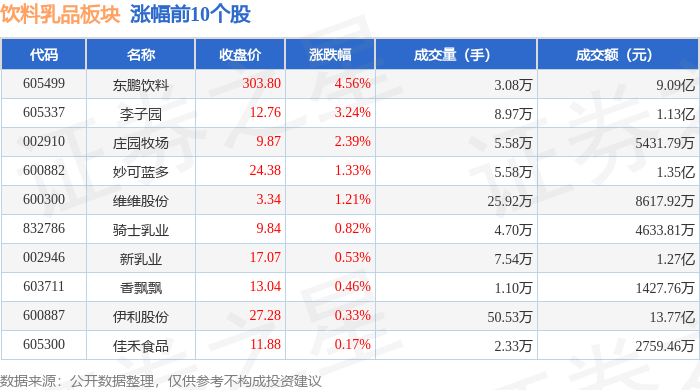
饮料乳品板块9月30日涨1.35%,东鹏饮料领涨,主力资金净流入6113.99万元
Zheng Xing Xing Ye Ri Bao· 2025-09-30 08:42
Core Insights - The beverage and dairy sector experienced a rise of 1.35% on September 30, with Dongpeng Beverage leading the gains [1] - The Shanghai Composite Index closed at 3882.78, up 0.52%, while the Shenzhen Component Index closed at 13526.51, up 0.35% [1] Sector Performance - Dongpeng Beverage (605499) closed at 303.80, up 4.56% with a trading volume of 30,800 lots and a transaction value of 260.6 million [1] - Liziyuan (605337) closed at 12.76, up 3.24% with a trading volume of 89,700 lots and a transaction value of 113 million [1] - Zhuangyuan Pasture (002910) closed at 9.87, up 2.39% with a trading volume of 55,800 lots and a transaction value of 54.32 million [1] - Other notable performers include Miaokelan (600882) up 1.33% and Wewei (600300) up 1.21% [1] Capital Flow - The beverage and dairy sector saw a net inflow of 61.14 million from main funds, while retail funds experienced a net outflow of 52.40 million [2] - Main funds showed significant inflows into Yili (600887) with 84.83 million and Dongpeng Beverage with 80.06 million [3] - Liziyuan (605337) also attracted 15.31 million from main funds, indicating strong institutional interest [3]


吃喝板块节前震荡,白酒龙头集体下挫!板块估值跌至冰点,布局时机或至?
Xin Lang Ji Jin· 2025-09-30 05:47
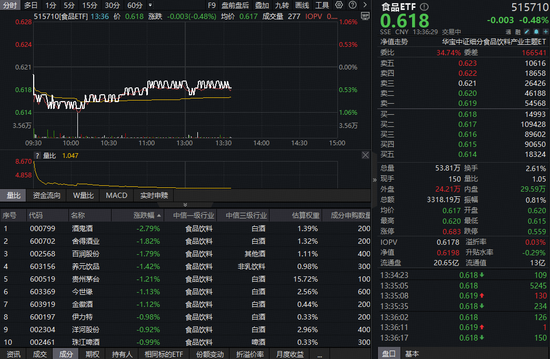
Core Viewpoint - The food and beverage sector is experiencing a continued low-level fluctuation, with the Food ETF (515710) showing a decline of 0.48% as of the report date, primarily driven by significant drops in liquor stocks [1][3]. Group 1: Market Performance - As of September 30, the Food ETF (515710) has decreased by 0.48%, reflecting the overall downward trend in the food and beverage sector [1]. - Major liquor stocks such as Guizhou Moutai, Wuliangye, and others have seen declines, with some stocks like JiuGui Jiu dropping nearly 3% [1][3]. - The food and beverage sector's valuation remains low, with the food ETF's price-to-earnings ratio at 20.49, indicating a potential good entry point for investors [3]. Group 2: Industry Outlook - The liquor industry is expected to remain in an adjustment phase through the second half of 2025, with gradual stabilization anticipated as the macroeconomic environment improves [4]. - Companies are adapting to market pressures by innovating products and reforming channels to maintain market share, with some positive sales trends noted for brands like Moutai and Fenjiu [4]. - The Food ETF (515710) is heavily weighted towards leading high-end liquor stocks, with approximately 60% of its portfolio in top liquor brands, suggesting a focus on quality assets in the sector [4].

探秘光明乳业“无人工厂”
Jing Ji Wang· 2025-09-30 03:48
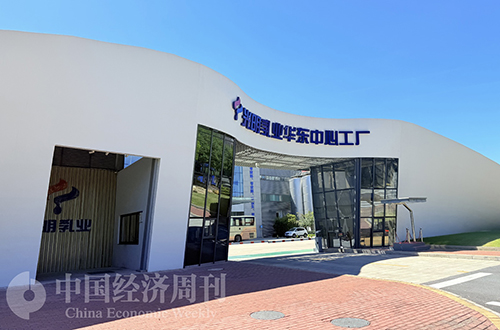
Core Insights - The article highlights the advanced automation and efficiency of Bright Dairy's East China Center factory, showcasing a "no human factory" model that relies heavily on technology and data [1][4][10] Company Overview - Bright Dairy's East China Center factory produces 1,000 tons of liquid milk daily, with a highly automated process that requires only 10 operators [1] - The factory's production line can output 1,200 bottles of milk per minute, generating 3.25 million data points per minute [1][4] Automation and Technology - The factory features nearly 18,000 automatic control valves, creating a closed-loop system for milk processing, which eliminates visible raw milk during production [3][4] - Cows at the associated farms wear pedometers to monitor their activity, with real-time data uploaded to ensure health and productivity [4] Energy Efficiency and Sustainability - The factory implements a full-chain low-carbon practice, utilizing a rooftop solar power system with a capacity of 5MW, generating an average of 3.9 million kWh annually, equivalent to saving 1,100 tons of standard coal and reducing carbon emissions by approximately 3,017 tons [8][9] - Key projects include a steam temperature and pressure reduction station that reduces nitrogen oxide emissions by 95.5% and sulfur dioxide by 24.87%, saving 3,400 tons of standard coal annually [9] Industry Trends - The Chinese dairy industry is at the forefront of global food industry automation, with over 80% of production lines automated, and leading companies like Bright Dairy achieving over 95% automation [10][11] - Quality control is enhanced through smart technologies, with Bright Dairy conducting 44 automated tests on raw milk before processing, significantly improving efficiency and accuracy [11] Challenges and Collaboration - The industry faces challenges such as data silos between manufacturing execution systems (MES) and enterprise resource planning (ERP) systems, which hinder decision-making and execution [11][12] - There is a consensus in the industry for open collaboration, with examples of partnerships among leading companies to enhance smart automation and technology integration [12][13] Future Outlook - The potential for further smart manufacturing in the dairy industry remains significant, with a focus on promoting smart practices among small and medium enterprises and enhancing AI applications in quality control [13]

2025年第39周:食品饮料行业周度市场观察
艾瑞咨询· 2025-09-30 00:07
Group 1 - Consumer acceptance of prepared dishes varies significantly based on dining scenarios, with over 50% acceptance in fast food chains and only 8.8% in high-end restaurants, highlighting concerns over food safety and pricing [3] - The iced tea market is experiencing a resurgence, with brands like Nongfu Spring and Yuanqi Forest entering the space, focusing on "sugar reduction" and "carbonation" innovations, and the market is projected to reach 300 billion yuan by 2024 [4] - The global food and beverage industry sees PepsiCo reclaiming the top spot with revenues exceeding 90 billion USD, driven by product innovation and AI technology, while Nestlé and JBS follow closely [5] Group 2 - The rise of "supermarket canteens" and "restaurant supermarkets" reflects a trend towards blending dining experiences, driven by consumer demand for value and fresh ingredients, although it increases operational complexity [6] - The dairy market faces challenges with liquid milk experiencing a decline, while powdered milk and cheese show growth, indicating a shift in consumer preferences towards plant-based alternatives [8] - The tea beverage industry is shifting towards fast-moving consumer goods, with brands like Mixue Ice Cream rapidly expanding, while competition intensifies in lower-tier cities [9] Group 3 - Bamboo sugar and reed root water have emerged as popular health drinks, driven by trends towards natural, low-sugar products and cultural resonance, with a projected compound annual growth rate exceeding 88% over the next five years [10] - The night economy is becoming a significant growth driver for the restaurant industry, with cities like Shanghai and Chengdu seeing nighttime consumption rates reach 60% [14] - The tea restaurant sector is undergoing transformation due to innovation challenges, with a market size expected to exceed 300 billion yuan by 2025 [15] Group 4 - The bottled beverage market is seeing a rise in "construction site drinks," favored for their affordability and large volume, despite health concerns [16] - The ice cream market is diversifying, with mini and cultural-themed ice creams gaining popularity, reflecting a shift towards health-conscious and personalized consumption [17] - The instant noodle market is projected to grow, with China accounting for 37.2% of global demand, emphasizing the need for product innovation [19] Group 5 - The launch of a new high-end sugar-free tea by Master Kong sold out rapidly, indicating strong consumer demand for premium products in the sugar-free beverage market, which is expected to reach 401.6 billion yuan in 2023 [20] - The sugar-free beverage market is evolving, with consumers seeking transparency in ingredients and health benefits, leading to increased competition among brands [21] - Subway's collaboration with Michelin-star chefs to launch a new series of sandwiches reflects a deepening localization strategy in the Chinese market [22] Group 6 - Three Squirrels has introduced a new quality standard for pine nut products, aiming to enhance industry standards and meet consumer demand for high-quality nuts [24] - Wahaha's rebranding to "Wah Xiaozong" under the leadership of Zong Fuli aims to attract younger consumers while addressing compliance issues [25] - Zhou Hei Ya's promotional campaign targeting college students highlights efforts to regain market share amid declining revenues [26] Group 7 - The beverage brand Bawang Chaji has gained international recognition by winning multiple awards at the 2025 World Beverage Innovation Awards, showcasing the potential of Chinese tea brands [28] - Pupu Supermarket's launch of an affordable meal delivery service aims to capture market share in the competitive food delivery sector [29] - Yili's new concept store emphasizes fresh, made-to-order products, reflecting a shift in consumer preferences towards quality and innovation [30]

前三季度科技成长股领涨 四季度市场风格如何演绎
Shen Zhen Shang Bao· 2025-09-29 23:55
Group 1 - The A-share market experienced a volatile upward trend in the first three quarters, with the Shanghai Composite Index reaching 3,800 points, led by technology growth stocks, while consumer and cyclical stocks performed poorly [1] - Among the 31 primary sub-industries, only coal and oil & petrochemicals saw declines, while the other 29 sub-industries recorded gains, with the top five performing industries being communication, electronics, non-ferrous metals, media, and comprehensive, all exceeding a 60% increase [1] - The communication industry surged by 105% and the electronics sector rose by 87%, significantly outperforming other sectors, with leading companies like Zhongji Xuchuang and Xinyisheng seeing increases of 2.4 times and 3.7 times respectively [1] Group 2 - The consumer sector, including hotels, restaurants, and liquor, has shown weak performance, with companies like Jinjiang Hotels and Kweichow Moutai experiencing declines of over 12% and 2% respectively [1] - The cyclical sectors, particularly coal and oil & petrochemicals, also underperformed, with China Shenhua down by 7% and both China Petroleum and China Petrochemical seeing declines of nearly 20% [1] - Looking ahead to the fourth quarter, market styles are expected to rebalance, with cyclical styles entering a trading window and previously lagging sectors likely to see a rebound [2][3]
四季度市场风格如何演绎
Sou Hu Cai Jing· 2025-09-29 23:13
Group 1 - The A-share market experienced a volatile upward trend in the first three quarters, with the Shanghai Composite Index reaching 3,800 points, led by technology growth stocks, while consumer and cyclical stocks performed poorly [1] - According to WIND statistics, only the coal and oil & petrochemical sectors declined among the 31 primary sub-industries in the first three quarters, while the other 29 sectors saw increases, with the top five performing sectors being communication, electronics, non-ferrous metals, media, and comprehensive, all exceeding a 60% increase [1] - The communication sector had a remarkable increase of 105%, and the electronics sector surged by 87%, significantly outperforming other sectors [1] Group 2 - The hospitality, liquor, and food sectors showed weak performance this year, with major companies like Jinjiang Hotels, Kweichow Moutai, and Yili Group experiencing declines of over 12%, 2%, and 6% respectively [1] - The cyclical sectors, including coal and oil & petrochemical, also underperformed, with China Shenhua down 7% and both China Petroleum and China Petrochemical facing declines, the latter by nearly 20% [1] Group 3 - Looking ahead to the fourth quarter, market styles are expected to rebalance, with cyclical styles entering a trading window and previously lagging sectors likely to see a rebound [2] - Historical data from Dongwu Securities indicates that sectors that performed well in the first three quarters typically rank lower in the fourth quarter, suggesting a potential shift in market dynamics [2] Group 4 - Certain low-valuation and early-cycle sectors are expected to perform better in the fourth quarter, with a historical probability of over 65% for these sectors to rise, and a 60% chance of outperforming the CSI 300 index [3] - Analysts suggest that the technology sector will remain a key focus, with investment themes coexisting, and internal rotations within growth sectors expected to accelerate, particularly in AI applications, solid-state batteries, energy storage, and innovative pharmaceuticals [3]
中国乳业交出“硬核”成绩单,伊利引领中国乳业迈向全球价值链高端
凤凰网财经· 2025-09-29 12:38
Core Viewpoint - The article highlights the significant advancements and achievements of the Dairy Technology Innovation Center (乳业国创中心) led by Yili Group, emphasizing its role in driving innovation and self-sufficiency in China's dairy industry [2][15]. Group 1: Event Overview - The third annual meeting of the Dairy Technology Innovation Center was held on September 27 in Hohhot, attended by global dairy experts and industry representatives [1]. - Key figures such as Liu Chunxi, Senior Executive Vice President of Yili Group, and various renowned experts participated in the event, showcasing the center's global leadership in dairy technology [1][2]. Group 2: Innovation and Achievements - The Dairy Technology Innovation Center has established a comprehensive innovation chain to support the dairy industry's development, achieving significant milestones under the leadership of local government and industry experts [2]. - The center has created the world's first Mongolian Plateau livestock genetic resource bank and regional dairy cattle breeding database, preserving 175 breeds and over 75,262 resource samples, making it the largest regional dairy cattle breeding database in China [6]. - The center has pioneered the development of proprietary fermentation strains and their applications, leading to the creation of functional dairy products, with projected annual sales exceeding 700 million yuan [6]. Group 3: Breaking Foreign Monopolies - The center has developed efficient separation and preparation technologies for lactoferrin, significantly increasing its retention rate from 10% to over 90%, allowing domestic dairy products to capture high-value markets [8]. - Several core technologies have been developed, including efficient hydrolysis of whey protein and green preparation of β-casein, positioning China at or above the global advanced level in these areas [8]. Group 4: Consumer Impact - The innovations from the Dairy Technology Innovation Center are making significant contributions to consumer health, with products like lactose-free milk powder addressing lactose intolerance issues [13]. - The center's achievements have been recognized in international publications, reflecting the deep integration of scientific research and industry practice in China's dairy sector [8]. Group 5: Future Outlook - The Dairy Technology Innovation Center and Yili Group are poised to lead China's dairy industry into a new era of high-quality development, with a focus on self-sufficiency and innovation [15].