牧原股份

Search documents
牧原股份:公司使用豆粕作为饲料原料,不直接采购大豆
Mei Ri Jing Ji Xin Wen· 2025-11-03 03:53
Core Viewpoint - The company is adapting its feed formulation strategy by reducing soybean meal usage and exploring low-soy diets to enhance cost efficiency and reduce reliance on imported soybeans [2]. Group 1: Soybean Procurement and Usage - The company does not directly procure soybeans but uses soybean meal as a feed ingredient, with soybean meal accounting for approximately 7% of its feed usage this year [2]. - There is potential for further reduction in soybean meal usage in the company's feed formulations, which will be determined based on market prices of soybean meal and amino acids [2]. Group 2: Cost Optimization and Profit Impact - The company is implementing low-soy diet technology, utilizing synthetic amino acids to replace soybean meal, which is expected to improve the economic efficiency of feed formulations [2]. - The impact of these cost optimizations on the company's annual net profit is yet to be quantified, but the focus remains on enhancing profitability through these strategies [2].


牧原股份:没有向肉制品深加工业务拓展的计划
Mei Ri Jing Ji Xin Wen· 2025-11-03 03:42
Core Viewpoint - The company, Muyuan Foods, has no plans to expand into deep processing of meat products or establish its own brand retail channels, focusing instead on its core business and exploring new growth opportunities such as overseas development and supporting farmers [1] Group 1: Business Strategy - The company's current customer base for its slaughtering and meat business primarily consists of large agricultural wholesalers, chain supermarkets, chain restaurants, food processing companies, and new retail enterprises, targeting B-end clients [1] - The company aims to continuously reduce costs and improve efficiency while enhancing the quality of its development [1] Group 2: Future Growth Opportunities - Muyuan Foods is exploring new growth spaces, including overseas development and initiatives to support farmers, rather than venturing into high-end processed meat products like gourmet sausages and hams [1]
猪价周度反弹超7%,猪肉股集体走强,畜牧养殖ETF(516670)放量上涨1.12%
2 1 Shi Ji Jing Ji Bao Dao· 2025-11-03 02:49
Group 1 - The core viewpoint of the articles highlights a significant rebound in pork prices, leading to a collective rise in pork-related stocks, with notable increases in companies like Luoniushan and Muyuan Foods [1][2] - The livestock farming ETF (516670) experienced a 1.12% increase, with a substantial net inflow of 390 million yuan over the past ten trading days, indicating strong investor interest [1] - According to the Ministry of Agriculture and Rural Affairs, the average price of live pigs increased by 6.1% from 11.8 yuan/kg to 12.52 yuan/kg within a week, and the weekly average price rose by 7.3% from 11.5 yuan/kg to 12.34 yuan/kg [1] Group 2 - The reduction in losses for pig farming is evident, with the profit from purchased piglets and self-breeding pigs narrowing to -89.33 yuan/head and -179.72 yuan/head respectively, indicating an improvement from the previous week [2] - The industry is witnessing a proactive reduction in production capacity despite the narrowing losses, with a focus on enhancing quality and efficiency in the long term, suggesting a potential upward shift in domestic pig price levels [2] - The livestock farming index covers the entire pig farming industry chain, with over 60% of the index weight attributed to pig-related stocks, and nearly 40% related to upstream and downstream sectors such as vaccines and feed [2]
生猪去化或将加速,继续布局龙头
2025-11-03 02:35
Summary of Conference Call on Swine Industry Industry Overview - The swine market is currently experiencing a dual increase in supply and demand, but supply pressure remains significant. The number of new piglets is expected to rise in the first half of 2025, leading to increased fattening output in Q4 2025. However, the breeding group has a pessimistic outlook for 2026, compounded by high Q4 output, which continues to exert supply pressure [1][4]. Key Financial Insights - The swine industry faced losses at the end of Q3 and the beginning of Q4 2025, with cash costs around 11 RMB/kg. Small and medium-sized farmers are losing approximately 16 RMB and 34 RMB per pig, respectively, while those purchasing piglets are facing losses of 257 RMB per pig. The overall profitability of the industry is under pressure, and production capacity is entering a phase of reduction [1][5]. Production Capacity and Market Predictions - It is anticipated that swine production capacity will continue to decrease in the near term. In September 2025, the number of breeding sows decreased by 90,000 compared to the end of Q2. The industry is expected to face losses again in Q4 2025 and the first half of 2026, accelerating the capacity reduction process under government encouragement to control production [1][6]. Investment Recommendations - The company recommends investing in Muyuan Foods, which maintains industry-leading costs and is increasing its dividend levels while reducing its debt ratio, indicating potential for value re-evaluation. Other recommended companies include Wens Foodstuff Group and several second-tier firms with good growth potential, low costs, and attractive valuations, such as Dekang Bange, Shennong Group, Juxing Agriculture, Tiankang Co., and Lihua Co. These companies have relatively stable debt ratios and are expected to have advantages in the next cycle [1][7][8]. Market Trends and Opportunities - The current market price trend for swine is in a clear downward phase, with prices dropping below expectations post-October. Although there has been a recent rebound to 12.2 RMB/kg, this is primarily due to previous sharp declines and absorption by the breeding group. Overall, supply remains high, and prices are expected to remain under pressure in the coming months [3][4]. Historical Context and Future Outlook - Historical data indicates that excess returns in each cycle often occur during the capacity reduction phase. The current situation presents a critical opportunity for investment, as industry losses and accelerated capacity reduction lay the groundwork for future upward cycles [2][9].
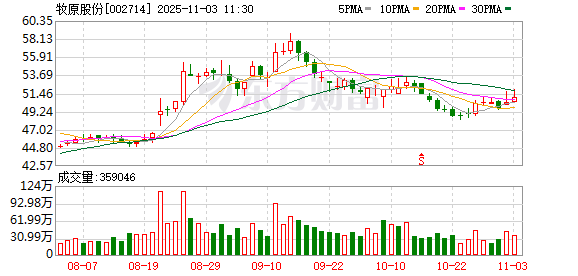
牧原股份涨2.03%,成交额6.01亿元,主力资金净流入4701.35万元
Xin Lang Cai Jing· 2025-11-03 02:09
资金流向方面,主力资金净流入4701.35万元,特大单买入1.01亿元,占比16.80%,卖出5174.42万元, 占比8.61%;大单买入1.46亿元,占比24.25%,卖出1.48亿元,占比24.61%。 11月3日,牧原股份盘中上涨2.03%,截至09:57,报51.32元/股,成交6.01亿元,换手率0.31%,总市值 2803.49亿元。 牧原股份今年以来股价涨38.85%,近5个交易日涨2.13%,近20日跌0.45%,近60日涨14.31%。 资料显示,牧原食品股份有限公司位于河南省南阳市卧龙区龙升工业园区,香港铜锣湾希慎道33号利园1 期19楼1920室,成立日期2000年7月13日,上市日期2014年1月28日,公司主营业务涉及生猪的养殖销 售、生猪屠宰。主营业务收入构成为:生猪98.68%,屠宰、肉食产品25.30%,饲料原料1.63%,其他 0.49%。 牧原股份所属申万行业为:农林牧渔-养殖业-生猪养殖。所属概念板块包括:猪肉概念、生态农业、合 成生物、乡村振兴、融资融券等。 分红方面,牧原股份A股上市后累计派现265.76亿元。近三年,累计派现165.94亿元。 机构持仓方面,截止2 ...
国信证券晨会纪要-20251103
Guoxin Securities· 2025-11-03 02:07
证券研究报告 | 2025年11月03日 | 晨会纪要 | | --- | | 数据日期:2025-10-31 | 上证综指 | 深证成指沪深 | 300 指数 | 中小板综指 | 创业板综指 | 科创 50 | | --- | --- | --- | --- | --- | --- | --- | | 收盘指数(点) | 3954.79 | 13378.21 | 4640.66 | 14359.78 | 3894.66 | 1415.52 | | 涨跌幅度(%) | -0.80 | -1.13 | -1.47 | -0.30 | -0.67 | -3.13 | | 成交金额(亿元) | 10311.04 | 12866.87 | 6807.12 | 4592.33 | 5915.29 | 949.50 | 【重点推荐】 行业与公司 登海种业(002041.SZ) 财报点评:玉米种业短期景气低迷,Q3 末合同负 债同比-11% 【常规内容】 宏观与策略 宏观周报:宏观经济周报-从"短期促销"到"长效治本" 宏观周报:多资产周报-如何看待铜价创历史新高? 固定收益专题研究:短期纯债基金三季报分析-规模缩水,杠杆 ...
聚焦“十五五”规划《建议》中的科技关键词 高水平自立自强,河南如何破题?
He Nan Ri Bao· 2025-11-02 23:41
Core Viewpoint - The article discusses how Henan province aims to achieve high-level technological self-reliance and seize new development opportunities as it approaches the "14th Five-Year Plan" period, emphasizing key areas such as original innovation, core technology breakthroughs, and digital economy construction [1]. Group 1: Original Innovation and Core Technology - Henan is focusing on enhancing original innovation and tackling key core technologies, particularly in the field of artificial intelligence and drug development, to address challenges in data accuracy and integration [2]. - The "ranking and answering" mechanism has been established to foster collaboration between industries, enterprises, and research institutions, leading to breakthroughs in critical technologies [3]. - The province's R&D expenditure reached 127.51 billion yuan in 2024, marking a 5.2% increase from the previous year, with R&D intensity stabilizing at 2.01% [4][5]. Group 2: Integration of Technological and Industrial Innovation - The successful launch of advanced tunneling machinery by China Railway Engineering Equipment Group highlights the importance of independent innovation in the shield tunneling industry [6]. - Henan has recognized 39 innovation alliances to enhance collaboration between leading enterprises and research institutions, driving the transition from manufacturing to creation [7]. - The establishment of technology transaction markets and the increase in technology transfer contracts demonstrate the province's commitment to integrating technological innovation with industrial needs [8]. Group 3: Education and Talent Development - The introduction of new academic programs in response to industry demands reflects the province's efforts to align education with emerging sectors such as low-altitude economy and aviation [9][11]. - By 2027, Henan plans to cultivate over 200 new interdisciplinary programs to support strategic emerging industries, with a focus on artificial intelligence and biotechnology [11]. - The increase in higher education institutions and the number of graduates is expected to provide a steady supply of skilled talent to drive innovation [12][13]. Group 4: Digital Economy Development - The Zhengzhou Coal Machinery Smart Park exemplifies the integration of advanced technologies like IoT and cloud computing, resulting in significant improvements in production efficiency [14]. - The digital economy in Henan is projected to exceed 2 trillion yuan by 2024, accounting for over 30% of the GDP, with a forecasted growth of over 40% by 2025 compared to 2020 [15][16]. - The province is actively promoting digital transformation across industries, focusing on the application of artificial intelligence to enhance productivity and innovation [16].
牧原股份售价下降单季盈利降56% 前九月负债总额减少98亿提前达标
Chang Jiang Shang Bao· 2025-11-02 23:17
Core Viewpoint - The ability of Muyuan Foods ("牧原股份") to withstand cyclical risks remains to be improved, as indicated by its financial performance in the first three quarters of 2025, which shows revenue growth but a significant decline in profit in the third quarter [2][5]. Financial Performance - In the first three quarters of 2025, the company achieved revenue of 111.79 billion yuan, a year-on-year increase of 15.52%, and a net profit attributable to shareholders of approximately 14.8 billion yuan, up 41% year-on-year [3][4]. - The revenue and profit growth rates have slowed compared to the same period last year, where the net profit for the first three quarters of 2024 was approximately 10.5 billion yuan, reflecting a staggering growth of 668.90% [2][5]. - The third quarter of 2025 saw a revenue of 35.33 billion yuan, a year-on-year decrease of about 11%, and a net profit of approximately 4.2 billion yuan, down about 56% year-on-year [2][4]. Price Fluctuations - The significant decline in profit in the third quarter is directly related to the drop in pig sales prices, with the average selling price in September 2025 being 12.88 yuan per kilogram, down from over 14 yuan per kilogram in the first seven months of 2025 [2][5]. Operational Metrics - The company sold 57.32 million pigs in the first nine months of 2025, a year-on-year increase of 27% [6]. - The company has adjusted its expected piglet sales for the full year 2025 from a range of 8 million to 12 million to a new range of 12 million to 14.5 million [6]. Cost Management - Despite a slight increase in feed prices, the overall production cost of pig farming has been decreasing, reaching 11.6 yuan per kilogram in September, down 1.5 yuan from January [8]. - The company has achieved a historic profitability in its slaughtering business, with a total of 19.16 million pigs slaughtered in the first nine months of 2025, a 140% increase year-on-year, and a capacity utilization rate of 88% [9]. Debt Management - The company has reduced its total liabilities by approximately 9.8 billion yuan since the beginning of the year, achieving its annual debt reduction target ahead of schedule [13]. - As of the end of the third quarter of 2025, the company's total liabilities stood at 100.32 billion yuan, down from 110.11 billion yuan at the beginning of the year [13]. - The company aims to lower its debt-to-asset ratio to below 50% in the long term [13].
农林牧渔行业2025年第44周周报:2025年三季报收官,农业板块总结和展望-20251102
Tianfeng Securities· 2025-11-02 14:46
Investment Rating - Industry Rating: Outperform the market (maintained rating) [11] Core Views - The agricultural sector is experiencing a mixed performance with significant opportunities in various sub-sectors, particularly in pig farming, cattle, pets, poultry, and planting industries. The report emphasizes the importance of focusing on leading companies with strong profitability and market positioning [3][4][5][6][8][26]. Summary by Relevant Sections 1. Pig Farming Sector - The decline in pig prices has led to a divergence in profitability among companies, highlighting the need to focus on expected differences in the pig farming sector. The average selling price of pigs in Q3 2025 was between 13-14 CNY/kg, down from 14-15 CNY/kg in H1 2025 [3][15]. - Key companies to watch include leading players like Muyuan Foods and Wens Foodstuff, with valuations at historical low levels [3][16]. 2. Cattle Sector - The raw milk price is stabilizing, while the beef cattle sector may be entering a super cycle. The average price for beef cattle in Q3 2025 was 25.88 CNY/kg, up 2.34% from the previous quarter [4][17]. - Companies with mother cow resources or those adopting a "milk-meat linkage" model are expected to have stronger profitability [4][18]. 3. Pet Sector - The pet economy is thriving, with domestic brands rapidly rising. Major pet food companies reported revenues of 4.737 billion CNY for Guibao Pet and 3.860 billion CNY for Zhongchong Co., with growth rates of 29% and 21% respectively [5][19]. - Recommended companies include Guibao Pet, Zhongchong Co., and Petty Co. [5][20]. 4. Poultry Sector - The white chicken segment is under pressure, with a focus on the need for improved breeding practices. The average price for white chicken was reported to be 3.5 CNY/kg, with a slight increase [6][21]. - The yellow chicken market is expected to see price recovery due to seasonal demand, with companies like Lihua and Wens showing improved performance [6][23]. 5. Planting Sector - The seed industry is anticipated to recover, with a focus on the commercialization of genetically modified corn. Leading companies in the seed sector include Longping High-Tech and Dabeinong [8][26]. - The report emphasizes the importance of agricultural technology and innovation in enhancing competitiveness [8][27]. 6. Feed and Animal Health Sectors - The feed sector has shown revenue and profit growth among leading companies, with Haida Group reporting a revenue increase of 13.24% [8][28]. - The animal health sector is facing challenges due to competition, but there are opportunities for innovation in vaccine development [8][32].

生猪养殖持续亏损,产能去化或加速
CAITONG SECURITIES· 2025-11-02 13:13
Core Insights - The report maintains a positive outlook on the agricultural sector, particularly in pig farming, despite ongoing losses in the industry [1][3] - The report highlights a potential acceleration in capacity reduction due to supply pressures and policy guidance [6][19] Group 1: Pig Farming - The number of breeding sows decreased by 0.20% month-on-month in September, with a total of 40.35 million sows reported [20][21] - Pig prices have been on the rise, with the average price for market pigs reaching 12.22 CNY/kg on October 30, reflecting a week-on-week increase of 7.10% [29][30] - The profitability of pig farming remains negative, with losses of 89.33 CNY per head for self-bred pigs and 179.72 CNY per head for purchased piglets as of October 31 [35][37] Group 2: Poultry Farming - The average price for white feather broilers increased to 7.09 CNY/kg on October 31, marking a week-on-week rise of 3.05% [39][42] - The report notes a significant increase in the number of breeding stock, with a 143.18% month-on-month rise in the number of grandparent stock updated in October [39][40] Group 3: Animal Health - The demand for animal health products is expected to rebound, driven by a recovery in breeding cycles and an increase in livestock numbers [48] - The report mentions that several companies are actively developing new products, which may enhance growth prospects for the sector [48] Group 4: Seed Industry - The average prices for wheat, soybean meal, and corn have increased, with wheat and soybean meal rising by 0.9% and 1.3% respectively as of October 31 [52][53] - The report emphasizes the importance of food security and the promotion of biotechnology in the seed industry [52][56] Group 5: Pet Industry - Pet food exports amounted to 823 million CNY in September, showing a year-on-year decline of 6.8% [57][60] - Domestic sales of pet food have continued to grow, with a combined growth rate of 3% across major e-commerce platforms in September [60]