
龙湖集团

Search documents
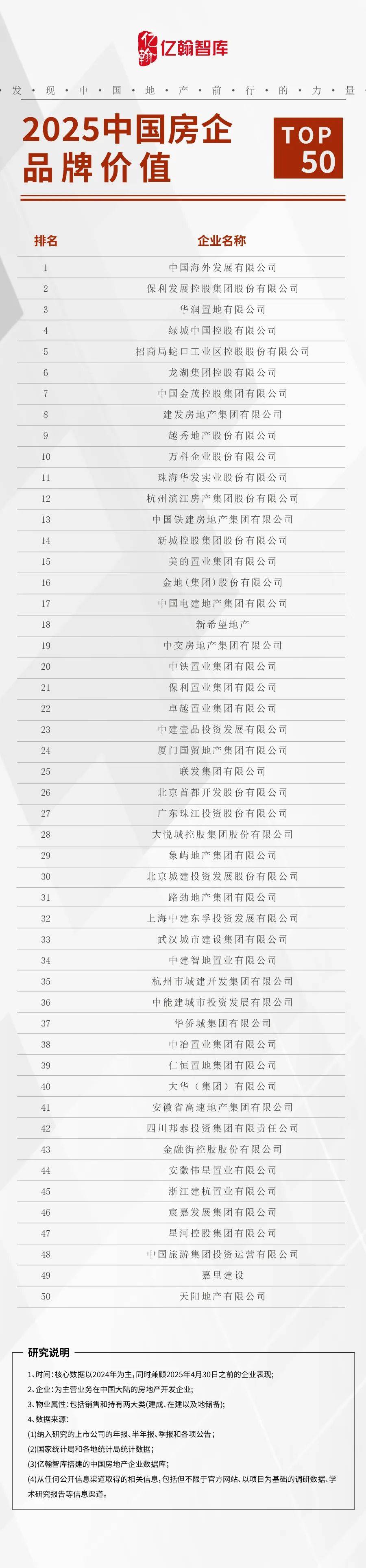
2025中国房企品牌价值研究报告重磅发布!
Sou Hu Cai Jing· 2025-05-28 19:01
Core Viewpoint - The 9th CRS Summit "C9·2025 China Industry Resource Strategy Summit" was held on May 28, focusing on the transformation paths and development opportunities in the real estate industry under the dual-track system, with the release of significant research reports including the "2025 China Real Estate Company Brand Value TOP 50" [1] Industry Overview - The summit gathered experts and industry leaders from real estate, property management, and rental housing sectors to discuss the industry's transformation and opportunities [1] - The new "Good House" regulations will be implemented from May 1, 2025, setting higher standards for residential projects, which is expected to positively impact the real estate market [31] - Major cities like Hangzhou, Shenzhen, and Shanghai are witnessing a rise in high-end residential sales, indicating a market recovery [31] Brand Value Rankings - The "2025 China Real Estate Company Brand Value TOP 50" report highlighted leading companies such as China Overseas Development, Poly Developments, and China Resources Land [4][5][8][11][13][16] - In Beijing, the top-ranked companies include China Overseas, China Merchants Shekou, and Poly Developments [10][11] - In Guangzhou, Poly Developments and Yuexiu Property lead the rankings [13] Research Methodology - The core data for the brand value assessment is primarily based on 2024 performance, with consideration for data up to April 30, 2025 [7][10][20] - The research includes data from annual reports, statistical data from national and local statistics bureaus, and a database built by Yihan Think Tank [7][10][20] Market Dynamics - Major state-owned enterprises like China Overseas, Poly, China Resources, and China Merchants dominate the market in key cities, with sales exceeding 100 billion [32][33] - Local companies have also achieved significant success by focusing on their local markets, such as Hangzhou's Binjiang Group and Shenzhen's Hongrongyuan [33] Product Development - Real estate companies are constructing differentiated "Good House" product systems based on four core standards: safety, comfort, green, and smart [35] - Companies like Yuexiu and Greenland are implementing comprehensive standards to enhance product quality and brand image [35] Brand Ecosystem - Companies are diversifying their business models to create a brand ecosystem that integrates development, operation, and service [39] - The focus is on building a community ecosystem that encourages user co-creation and enhances customer engagement [48] Marketing Strategies - Real estate firms are adopting youth-oriented marketing strategies to engage younger demographics through social media and immersive experiences [44] - AI tools are being utilized for promotional activities, enhancing brand visibility and engagement [47]





王健林 “卖卖卖” 背后的万达命运:轻资产革命与债务困局的博弈
Sou Hu Cai Jing· 2025-05-28 11:30
Core Insights - Wang Jianlin sold 48 core Wanda Plazas for 50 billion yuan, marking the largest single asset transaction since Wanda Group's asset-light transformation began in 2017, reflecting both personal and industry challenges [1][2][3] Financial Situation - The sale of the 48 Wanda Plazas, located in major cities like Beijing and Guangzhou, was a response to Wanda's liquidity crisis, with a cash shortfall of 28.4 billion yuan against 40 billion yuan in maturing debt [2][3] - As of June 2024, Wanda's interest-bearing liabilities stood at 137.56 billion yuan, with short-term debt accounting for 21.99%, while operating cash flow was only 1.6 billion yuan, indicating severe debt repayment challenges [3][5] Asset-Light Transformation - Since initiating its asset-light strategy in 2015, Wanda has sold over 80 plazas, increasing the proportion of asset-light projects from under 20% in 2017 to over 60% in 2025, transitioning from an asset holder to a commercial manager [4][12] - The recent transaction allows Wanda to retain operational rights and generate stable income through brand licensing and management fees, despite losing ownership [4][5] Financial Performance - In 2024, Wanda's management fee income reached 8.9 billion yuan, tripling over four years, with a profit margin of 35%, significantly higher than the traditional model [5][12] - The asset-light model has helped Wanda reduce its debt ratio from 82% to 65.2% by converting 240 billion yuan of on-balance-sheet debt into off-balance-sheet management fee income [5][12] Risks and Challenges - The asset-light transformation poses risks such as brand dilution and a reliance on management fees, which only cover 50% of capital expenditures, raising sustainability concerns [6][13] - The competitive landscape is intensifying, with rivals like China Resources and Longfor accelerating their asset-light strategies, potentially eroding Wanda's first-mover advantage [6][13] Strategic Partnerships - The consortium acquiring the plazas includes major players like TPG, Tencent, and JD, indicating a strategic interest in offline retail and digital integration [8][9] - Tencent and JD aim to leverage their platforms to enhance consumer experiences at Wanda Plazas, while insurance firms see long-term value in core commercial real estate [10][11] Industry Context - The commercial real estate sector is undergoing significant changes, with a shift towards experience-driven retail and challenges from e-commerce, leading to increased vacancy rates and stagnant rental growth [11][12] - Wanda's asset-light model aligns with the broader trend of "de-real-estate" in commercial real estate, positioning it closer to international peers like Simon Property Group [12][14] Future Outlook - Wanda's ability to navigate its debt crisis hinges on successful listing of its subsidiary, enhancing profitability of its asset-light model, and deepening collaborations with tech partners [14][15] - The ongoing transformation reflects broader industry trends and the need for companies to adapt to survive in a challenging market environment [15][16]
优质土储联合行动 | 2025年5月房地产企业新增土地储备报告
Sou Hu Cai Jing· 2025-05-26 11:51
Core Insights - The report highlights a competitive landscape among real estate companies for acquiring quality land reserves, with a notable increase in land acquisition activities during the first four months of the year [5][12][15]. Group 1: Land Acquisition Trends - The top companies in land acquisition from January to April include Poly Developments, China Overseas, and Greentown China, with land reserves of 145.57 million square meters, 128.22 million square meters, and 126.75 million square meters respectively [11][12]. - The total land area acquired by the top 50 real estate companies in April was 454.01 million square meters, reflecting a month-on-month increase of 30.85% [8][12]. - The total investment in land acquisition by leading companies during this period was significant, with Greentown China leading at 291.44 billion yuan, followed closely by China Overseas at 272.91 billion yuan [12][13]. Group 2: Market Dynamics - The supply of residential land in first, second, and third-tier cities has decreased, with 450 plots offered, totaling 2,504.16 million square meters, representing a month-on-month decline of 9.13% and a year-on-year decline of 19.04% [16][18]. - The average transaction price for residential land increased to 6,579.75 yuan per square meter, with a month-on-month increase of 12.5% and a year-on-year increase of 26.37% [22][24]. - The competitive bidding for core land plots has intensified, with several major companies forming alliances to secure high-quality land [6][35]. Group 3: Government Policies and Support - The central government has emphasized the need for high-quality housing supply and has initiated policies to optimize the land supply structure, which is expected to stabilize the market [16][18]. - The government is also supporting urban renewal projects, with significant funding allocated to improve old residential areas, particularly in cities like Shijiazhuang and Shanghai [7][36][39]. - Local governments are increasingly collaborating with state-owned enterprises to enhance urban renewal efforts, indicating a shift towards more integrated development strategies [15][37].


内资VS港资VS资管VS区域龙头:分庭抗礼,各自进化
3 6 Ke· 2025-05-26 02:16
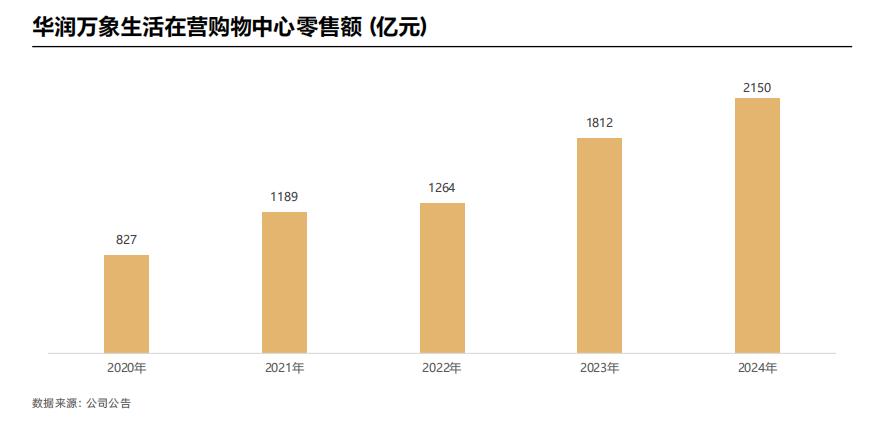
Group 1: Domestic Leading Enterprises - China Resources Vientiane Life achieved significant growth with total retail sales of 215 billion yuan from 122 shopping centers, averaging 17.6 billion yuan per center, and a 21.4% increase in revenue to 6.274 billion yuan in FY2024 [1][4] - The shopping center segment showed resilience with a 30% year-on-year increase, outperforming the overall retail sales growth [1][4] - Longfor Commercial reported a 7.4% increase in operating income to 26.71 billion yuan, with a significant contribution from shopping mall operations [9][10] - Longfor's rental income growth is driven by new projects, with 6 out of the top 7 projects being in the cultivation phase [10][11] Group 2: Hong Kong Capital Enterprises - Swire Properties reported a 3% increase in rental income from mainland retail properties, totaling 44.89 billion HKD, while Hong Kong properties saw a 3% decline [15][16] - The rental rates for Swire's properties in Beijing and Shanghai showed resilience, with Beijing Sanlitun Taikoo Li increasing from 94% to 98% [16][17] - Hang Lung Properties faced challenges in high-end malls, with significant declines in revenue and tenant sales in Shanghai, while lower-tier malls showed stable growth [18][19] Group 3: Regional Enterprises - Wushang Group achieved 3.749 billion yuan in revenue from 10 shopping centers in Hubei and Jiangxi, demonstrating strong local market presence [24] - China International Trade Center maintained stable rental income of 2.88 billion yuan, with a slight decline of 1.14% year-on-year, showcasing resilience in a challenging market [25][27] - Dennis established itself as a leading luxury mall operator in Zhengzhou, achieving significant market share through strategic positioning [28][29] Group 4: Asset Management Enterprises - CapitaLand announced plans to launch its first public REIT focused on consumer infrastructure, marking a significant development in China's REIT market [30][32] - Link REIT reported a 6.4% increase in revenue and a 5.8% increase in net property income, focusing on essential retail spaces and adapting to changing consumer preferences [33][34]
从“囤地”到“求生”:百强房企土储全面缩表
3 6 Ke· 2025-05-26 02:05
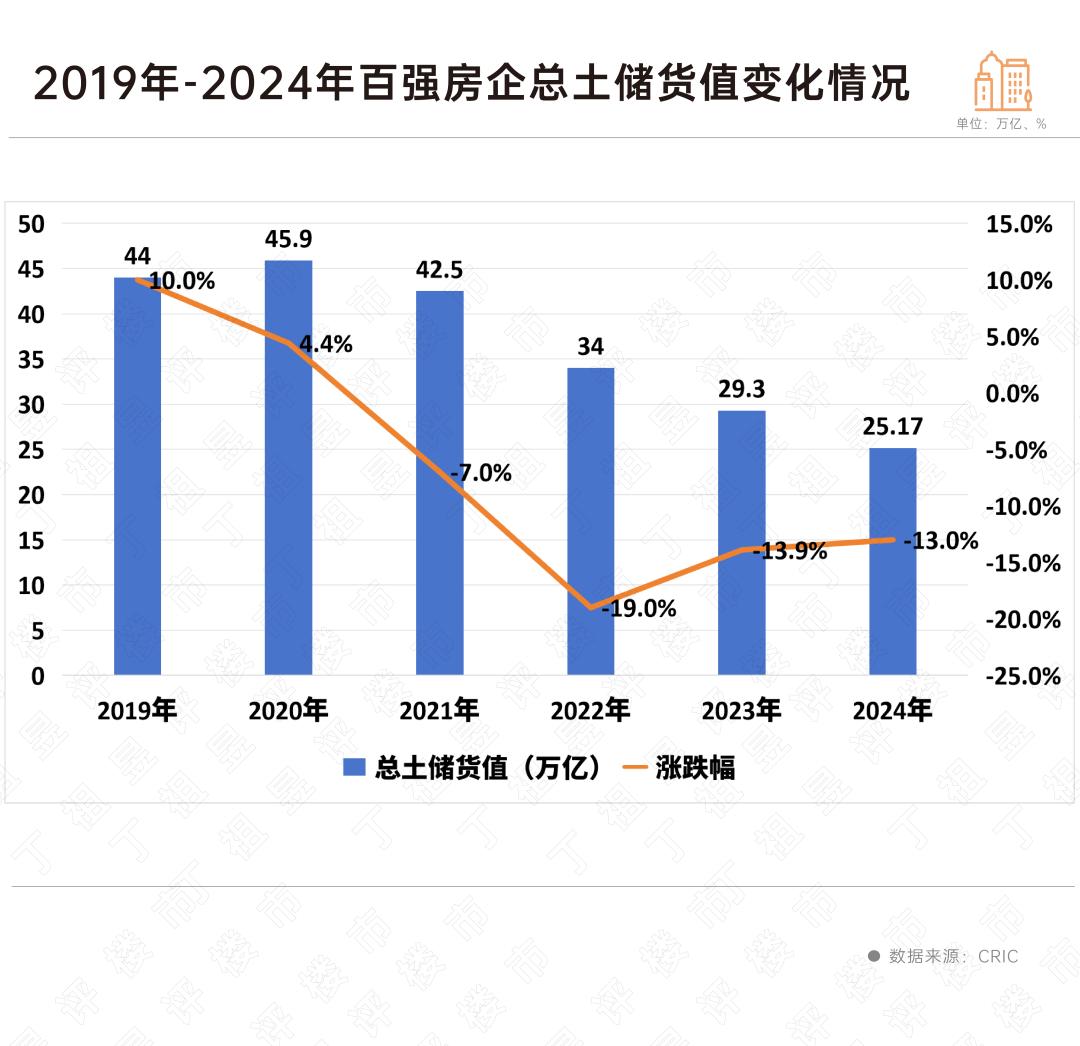
CRIC披露最新数据显示,截止2024年末TOP100房企土储总量收缩明显:总土储货值25.17万亿元,同比下降13%;总土储建面15.73亿平米,同比下降 12%。 具体到房企来看,百强房企中有96家房企总土储货值下降,降幅超过20%的房企数量占比达到15%。 不过,由于房企销售降幅大于土储总量收缩的速度,房企仍然面临较大的存货去化压力。百强房企截止2024年末的土储货值去化周期加权值以6.93年创历 史新高。货值规模在1000亿至3000亿房企的去化周期高达9.01年。 房企的投资逻辑被重构,货值规模高不再是优势,而小体量、健康的存货储备或是保障企业稳健运营的关键。 百强总土储货值同比降13% 龙头房企"瘦身"明显 百强房企总土储货值和建面双降。 截止2024年末,TOP100房企总土储货值和总土储建面分别为25.17万亿元和15.73亿平米,较去年分别下降13%和12%。 自房地产行业开启新一轮"去库存"以来,百强房企总土储货值自2020年达到峰值后逐年下降,到2024年百强房企总土储货值较2020年高峰期已下降了 45.2%。 2024年总土储货值排名前十的房企中,货值规模下降较大的分别为万科地产、碧 ...




房地产行业最新观点及25年1-4月数据深度解读
CMS· 2025-05-25 10:25
Investment Rating - The report maintains a recommendation for the real estate industry, indicating a cautious outlook with potential for gradual recovery in the market [3]. Core Insights - The real estate market continues to experience low-level fluctuations, with construction completions showing a year-on-year decline, indicating a challenging environment for developers [1][42]. - New construction starts are expected to gradually decrease in their rate of decline throughout the first half of 2025, driven by stabilizing housing demand and strategic adjustments by developers [2][43]. - The report highlights the importance of government policies aimed at stabilizing the real estate market, with a focus on urban renewal and optimizing existing property acquisition strategies [40][41]. Summary by Sections Sales and Market Performance - In April, the year-on-year growth rate of sales area adjusted for the base period was -2.1%, reflecting ongoing low market activity and suppressed buyer sentiment [7][13]. - The total sales area for January to April was 28.26 million square meters, with a cumulative year-on-year decline of 2.8% [9][14]. - The sales amount for April was 270.35 billion yuan, showing a year-on-year decrease of 3.2% [9][14]. Construction and Investment - The new construction area in April saw a year-on-year decline of 22.1%, with expectations for a gradual narrowing of this decline in the coming months [2][43]. - The total investment in real estate development for April was 277.30 billion yuan, reflecting a year-on-year decrease of 10.3% [9][12]. - The completion area in April decreased by 27.9% year-on-year, indicating a faster-than-expected decline in construction completions [42][46]. Financial Indicators - The funding index for the real estate sector showed a downward trend, currently at a historically low level, suggesting potential improvements in cash flow for some companies [2][9]. - The funding sources for real estate development in April totaled 325.96 billion yuan, with a year-on-year decline of 4.1% [12][41]. Price Trends - The new home prices in 70 cities fell by 0.12% month-on-month in April, with an increasing number of cities experiencing price declines [10][11]. - The average price of new homes was 9,566 yuan per square meter, reflecting a slight year-on-year decrease of 0.4% [12][14].


每周精读 | 2024年中国房企总土储货值排行榜TOP100发布;《阿联酋房地产住宅市场白皮书》重磅发布(5.19-5.23)
克而瑞地产研究· 2025-05-25 01:47
Core Insights - The article discusses the current state and future trends of the Chinese real estate market, highlighting significant declines in inventory value and profitability among major real estate companies [4][6]. Group 1: Inventory and Profitability - The total inventory value of 50 typical listed real estate companies in 2024 is reported at 7.98 trillion yuan, reflecting a substantial decrease of 15% compared to the end of the previous year [4]. - The industry's gross profit margin has dropped to 10%, with 72% of real estate companies reporting net profit losses [6]. - In 2024, the confirmed inventory impairment loss reached 167.7 billion yuan, marking a significant increase of 26% from 2023 [6]. Group 2: Debt and Liquidity - The liquidity pressure in the industry continues to escalate, with 84% of the 50 sample real estate companies having reduced cash holdings compared to the beginning of the period [7]. - 62% of companies have seen a deterioration in their adjusted unrestricted cash to short-term debt ratio, with the proportion of companies on the brink of default increasing by 2 percentage points to 72% [7]. Group 3: Market Trends and Recovery - The real estate market is expected to achieve a phase of "stabilizing expectations" by the first half of 2025, driven by financial policies, special bond storage, and improving indicators such as land auction enthusiasm, housing prices, and inventory reduction [9]. - The second-hand housing market in major cities like Beijing, Shanghai, Shenzhen, and Hangzhou is anticipated to continue its fluctuating trend, with stable demand for high-end and luxury properties [10]. - More than half of the monitored residential communities have seen a month-on-month increase in housing prices, indicating signs of stabilization in the second-hand housing market [11]. Group 4: International Market Insights - The UAE real estate market is analyzed as a high-growth emerging market, with favorable purchasing policies and a welcoming investment environment for global investors [14][15]. - Dubai's real estate market is characterized by active trading and a growing transaction scale, supported by a young population and a high proportion of expatriates [15]. - Abu Dhabi is emerging as a strategic investment hotspot, leveraging economic transformation, population vitality, and real estate appreciation potential [16]. Group 5: Regional Opportunities - Five key areas in Dubai (Downtown, Business Bay, Palm Jumeirah, Dubai Hills, and Al Furjan) are highlighted for their unique advantages and attractive projects [17].

信用利差周度跟踪:存款利率下调信用债表现强势,中长端信用利差显著压缩-20250524
Xinda Securities· 2025-05-24 13:43
存款利率下调信用债表现强势 中长端信用利差显著压缩 —— 信用利差周度跟踪 [[Table_R Table_Report eportTTime ime]] 2025 年 5 月 24 日 请阅读最后一页免责声明及信息披露 http://www.cindasc.com 1 歌声ue 证券研究报告 债券研究 [Table_ReportType] 专题报告 | [Table_A 李一爽 uthor固定收益首席分析师 | ] | | --- | --- | | 执业编号:S1500520050002 | | | 联系电话:+86 18817583889 | | | 邮 | 箱: liyishuang@cindasc.com | 朱金保 固定收益分析师 执业编号:S1500524080002 联系电话:+86 15850662789 联系电话:+86 15850662789 箱: zhujinbao@cindasc.com 信达证券股份有限公司 CINDA SECURITIES CO.,LTD 北京市西城区宣武门西大街甲 127 号金隅 大厦B 座 邮编:100031 3存款利率下调信用债表现强势 中长端信用利差显著压 ...
代建双周报 | 远洋建管代建广州南香雅居项目首开热销;龙湖龙智造纾困项目成都西璟台交付(2025.5.10-5.23)
克而瑞地产研究· 2025-05-24 01:28
Group 1 - Wuhan Urban Construction Group aims to enhance cooperation with Huangpi District in areas such as comprehensive development, infrastructure construction, industrial transformation, and urban function improvement, focusing on high-quality residential development and urban renewal [2] - Greentown Management has reached a strategic cooperation agreement with Daduqiao District in Chongqing, indicating a commitment to urban development projects [1][6] - Longfor's Longzhizao has signed a contract for the construction of a project in Bao'an District, Shenzhen, showcasing its expansion in the construction sector [1] Group 2 - Longfor's Longzhizao has successfully delivered the Chengdu Xijingtai project, which had been stalled for eight years, involving 852 creditors and 857 undelivered properties [7] - The Guangzhou Nanxiang Yaju project by Yuanyang Construction Management achieved strong sales shortly after its opening, with over 986 visits and more than 3,000 viewings of the model room [8] - The total land area for the project managed by Greentown Management in Shijiazhuang is approximately 69,200 square meters, with a floor price of 10,253 yuan per square meter [6]
如何打造“好房子”
经济观察报· 2025-05-23 14:00
Core Viewpoint - The article emphasizes that real estate companies are shifting their focus from traditional development models to addressing the real needs of customers by creating "good houses" that solve common pain points in the housing industry [1][3]. Pain Points - According to the 2024 residential quality complaint report by the China Index Academy, common complaints include water leakage (18%), noise issues (15%), and insufficient storage space (12%), which are now key areas for real estate companies to address in their "good house" product lines [5]. - China Overseas Land & Investment has developed a "6633" living demand framework based on 33,000 customer cases, focusing on 101 high-frequency pain points among 172 identified needs, prioritizing basic quality issues in housing [5][6]. Solutions to Pain Points - China Overseas has implemented specific solutions in their "good house" products, such as advanced waterproofing techniques that reduce leakage rates by approximately 80% compared to industry averages, and noise reduction systems that decrease complaints by 87% [7]. - Other companies like China Resources Land have also focused on addressing resident pain points, such as using soundproofing materials to enhance living conditions [7][8]. Resource Integration - Real estate companies are increasingly integrating internal and external resources to enhance product offerings and brand recognition, with examples including the collaboration between Dalian Wanda and COFCO to incorporate health concepts into real estate projects [10][11]. - Companies like Longfor Group are leveraging their resources in commercial, elderly care, and rental sectors to enrich the value of their residential offerings [11]. Core Competitiveness - The transition from traditional housing to "good houses" is supported by the resources and technologies of parent companies, with examples including China Overseas leveraging its parent company's engineering and green building technologies [15][16]. - Companies are developing unique product identities and competitive advantages through the integration of cultural and operational resources, such as Poly Developments' focus on cultural integration within communities [16].
