
三全食品

Search documents
一个月连遭两起食安事件 门店增速放缓 锅圈食汇怎么了?
Xin Jing Bao· 2025-11-06 04:50
Core Insights - The rapid expansion of Guoquan Shihui's store count has significantly slowed down, attributed to increased competition in the hot pot sector and declining average spending per customer [1][7] - Recent food safety complaints have raised concerns about product quality, with multiple incidents reported involving foreign objects in food items [2][4] - The franchise model has been a key driver for Guoquan Shihui's growth, but it has also led to management challenges as the number of stores exceeds 10,000 [5][6] Group 1: Business Performance - Guoquan Shihui's store count grew from 1,441 in 2020 to over 10,000 by October 2023, achieving this milestone in just six years [3][5] - The company reported that as of September 2023, 99.9% of its stores were franchises, with only six being company-owned [5] - The growth rate of franchise stores has declined, with a drop from 2,859 in 2020 to 1,086 in 2023, indicating a slowdown in expansion [5][6] Group 2: Food Safety Issues - Recent complaints include finding a fly in beef tripe and a cigarette butt in a mushroom product, highlighting ongoing food safety concerns [2][4] - Consumers have reported various issues, including expired products and foreign objects in food, leading to increased scrutiny and complaints on platforms like Black Cat [2][4] Group 3: Market Competition - The hot pot industry is facing intensified competition, with major players like Haidilao and Xiaobai Xiaobai reducing their average spending per customer [7] - Guoquan Shihui must compete not only with traditional hot pot brands but also with platforms like Hema and Dingdong Maicai, which are gaining market share [7][8] Group 4: Strategic Recommendations - Industry experts suggest that Guoquan Shihui needs to optimize its product structure and consider expanding into overseas markets or developing a second brand to sustain growth [7][8] - The company is seen as a typical pre-prepared food business, and as consumer expectations rise, it must ensure high quality and cost-effectiveness in its offerings [8]

地方政府与城投企业债务风险研究报告:河南篇
Lian He Zi Xin· 2025-11-04 12:20
1. Report Industry Investment Rating No information provided in the content. 2. Core Viewpoints of the Report - Henan Province has a high - level economic development with a leading GDP in China, but a relatively low per - capita GDP and urbanization rate. The province has taken measures to prevent and resolve government debt risks, and has completed the implicit debt resolution plan for seven consecutive years since 2018 [4]. - There is a high degree of differentiation in the development of cities in Henan. Zhengzhou has an absolute advantage in economic and fiscal strength, and Luoyang also maintains a leading position. Some cities have relatively high government debt ratios and need to pay attention to the credit risks of urban investment enterprises [4]. - Most of Henan's bond - issuing urban investment enterprises still face significant short - term debt repayment pressure, and the bond maturity scale of provincial - level, Zhengzhou, and Luoyang urban investment enterprises in 2026 is large. Attention should be paid to the credit risks of urban investment enterprises with relatively heavy local government debt burdens, low debt - repayment and support capabilities, and insufficient refinancing capabilities [4]. 3. Summary by Relevant Catalogs 3.1 Henan's Economic and Fiscal Strength 3.1.1 Regional Characteristics and Economic Development - Henan is located in the central - eastern part of China, with superior transportation location and prominent resource endowment. It has a high - level economic development, a leading GDP, a middle - lower per - capita GDP, and a low urbanization rate. The industrial structure is "tertiary - secondary - primary", and strategic opportunities such as the construction of the Central Plains Urban Agglomeration help the regional development [5]. - Henan has a large population, with a permanent population of 97.85 million in 2024, ranking third in China. The urbanization rate is 59.22%, lower than the national average, with large room for development [9]. - In 2024, Henan's GDP was 6.358999 trillion yuan, ranking sixth in China, with a growth rate of 5.1%. The per - capita GDP was 64,900 yuan, lower than the national level. The industrial and service industries have good development momentum, and investment in fixed assets and industry has increased [10][14][15]. 3.1.2 Fiscal Strength and Government Debt - In 2024, Henan's general public budget revenue decreased slightly year - on - year, ranking in the upper - middle level in China. The fiscal self - sufficiency rate is low, and the government - funded revenue continued to decline. The provincial government debt ratio and liability ratio are in the middle in China, but the liability level is rising rapidly [23]. - In 2024, Henan's local government debt ratio and liability ratio were 169.48% and 33.51% respectively, ranking 15th and 10th in China, up 26.36 and 3.25 percentage points from the end of the previous year [24]. 3.2 Economic and Fiscal Conditions of Prefecture - Level Cities in Henan 3.2.1 Economic Strength of Prefecture - Level Cities - There is a high degree of imbalance in the development of cities in Henan. Zhengzhou is the only city with a GDP of over one trillion yuan, and Luoyang and Nanyang also have obvious leading advantages. Most cities have a lower urbanization rate than the national average [26]. - The economic development levels of cities in Henan are highly differentiated, showing a ladder - like distribution. In 2024, most cities' GDP rankings remained the same as in 2023. In terms of per - capita GDP, Zhengzhou and Jiyuan lead, and Zhoukou ranks last. In terms of urbanization rate, Zhengzhou has the highest level [35][36]. 3.2.2 Fiscal Strength and Government Debt of Prefecture - Level Cities - The fiscal strength of cities in Henan is highly differentiated. Zhengzhou leads in terms of fiscal revenue scale and fiscal self - sufficiency rate. In 2024, the general public budget revenue of some cities fluctuated, and more than half of the cities' government - funded revenue decreased. The superior subsidy income contributes significantly to the comprehensive financial resources [38]. - In 2024, the government debt balance of all cities in Henan increased, with Zhengzhou having the largest balance. The government debt ratio and liability ratio of all cities increased, and the debt burden is relatively heavy. Shangqiu, Puyang, Xuchang, and Zhoukou had a relatively large increase in the government debt ratio [48][49]. 3.2.3 Debt Resolution - Henan has taken various measures to prevent and resolve government debt risks, and the overall debt risk is controllable. It has optimized the debt structure and reduced the risk level. Since 2024, the spread of urban investment bonds in Henan has shown a downward trend [50][53]. 3.3 Debt Repayment Ability of Urban Investment Enterprises in Henan 3.3.1 Overview of Urban Investment Enterprises - There are bond - issuing urban investment enterprises in Henan at the provincial level and in 18 cities. The administrative levels of these enterprises are mainly at the prefecture - level and district - county levels, and they are mainly distributed in Zhengzhou and its surrounding cities. The credit levels of Zhengzhou's urban investment enterprises are relatively high [55]. - As of the end of September 2025, there were 148 bond - issuing urban investment enterprises in Henan, with a total balance of outstanding bonds of 768.689 billion yuan. High - credit - level enterprises are mainly concentrated at the provincial level and in Zhengzhou, and AA - level enterprises account for the highest proportion [56][57]. 3.3.2 Bond Issuance - In 2024, the number of bonds issued by Henan's urban investment enterprises decreased year - on - year, while the scale increased. Most cities maintained a net inflow of bond financing. From January to September 2025, the bond issuance rhythm slowed down, and regional differentiation intensified [63]. 3.3.3 Debt Repayment Ability Analysis - At the end of 2024, most of Henan's bond - issuing urban investment enterprises faced significant short - term debt repayment pressure, and the bond maturity scale of provincial - level, Zhengzhou, and Luoyang urban investment enterprises in 2026 is large. The debt burden of some cities' urban investment enterprises is relatively heavy [68][71]. 3.3.4 Support and Guarantee Ability of Local Fiscal Revenue for Urban Investment Enterprises' Debt - At the end of 2024, the ratio of "total debt of bond - issuing urban investment enterprises + local government debt" to comprehensive financial resources in Henan cities was at least about 220.15%. Zhengzhou had the highest ratio, and the support and guarantee ability of some cities was under pressure [76].
大众品2025年三季报总结:成长分化,蓄势向好
Soochow Securities· 2025-11-04 11:57
Investment Rating - Maintain "Buy" rating for the food and beverage industry [1] Core Views - The food and beverage industry is experiencing differentiated growth, with certain segments showing strong potential for recovery [1] - The report emphasizes the importance of continuous growth and valuation switching for investment decisions [1] Summary by Sections 1. Snack Foods - The snack food sector showed a leading growth rate in Q3 2025, with three companies (Wancheng Group, Youyou Food, and Ximai Food) achieving over 15% year-on-year revenue growth [11][13] - Most companies improved their profitability in Q3 2025, with Wancheng Group benefiting from scale effects and the recovery of minority shareholder rights [28] - Investment recommendations include Wancheng Group, Youyou Food, Ximai Food, and others, focusing on companies with strong brand power and product innovation capabilities [32] 2. Frozen Foods - The frozen food sector is witnessing a recovery in net profit margins, with major players like Lihai Food and Baoli Food maintaining strong year-on-year growth [33] - Companies are shifting from price competition to product innovation and customized demand to align with current consumer trends [55] - Recommended investments include leading companies like Anji Food and Lihai Food, with a focus on their stable market positions and growth potential [55] 3. Chain Dining Industry - The chain dining sector is showing signs of recovery, with companies like Baba Food and Guoquan demonstrating improved performance [62] - The report highlights the positive trend in single-store revenue for Baba Food and Guoquan, indicating a recovery in the dining chain segment [62] - Profitability improvements are noted for Baba Food and Huashanghuan, driven by cost reductions and enhanced capacity utilization [68]
一个月连遭两起食安事件,门店增速放缓,锅圈食汇怎么了?
Bei Ke Cai Jing· 2025-11-04 06:41
Core Viewpoint - The company, Guoquan Shihui, known as the "Mi Xue Bing Cheng of hot pot ingredients," is facing significant food safety issues, including complaints about foreign objects in their products, which could impact their brand reputation and growth potential [1][2][5]. Group 1: Food Safety Issues - Recent complaints have surfaced regarding food safety, including the discovery of a cigarette butt in a dried mushroom product and a fly in a beef tripe package [2][3]. - Consumers have reported various issues on complaint platforms, such as expired products and foreign objects in food items, raising concerns about the company's quality control [2][3][4]. Group 2: Business Growth and Challenges - Guoquan Shihui has rapidly expanded its store count, reaching over 10,000 locations within six years, primarily through a franchise model [3][4]. - The franchise model, while effective for rapid growth, has led to increased management challenges, including inconsistent product quality and service levels across locations [5][6]. Group 3: Market Competition - The hot pot industry is becoming increasingly competitive, with established players like Haidilao and Xiaobawang lowering their average customer spending [6][7]. - Guoquan Shihui faces competition not only from traditional hot pot restaurants but also from online grocery platforms, which could further pressure its market position [6][7]. Group 4: Product Strategy and Market Position - Experts suggest that Guoquan Shihui needs to optimize its product structure and may need to explore international markets or develop a second brand to sustain growth [6][7]. - The company is perceived as a typical pre-prepared food business, and as consumer expectations rise, it must ensure its products meet safety and quality standards [7][8].
河南供应链,有多厉害?
3 6 Ke· 2025-11-04 01:08
Core Insights - The article emphasizes the emergence of Henan as a significant player in China's food supply chain, transforming it into a vital hub for food production and distribution, often referred to as the "kitchen of the nation" [1][17] - Henan's food supply chain is characterized by a comprehensive and efficient network that supports local brands and facilitates their growth on a national scale [1][8] Group 1: Key Players in Henan's Food Industry - Notable food brands from Henan, such as Sanquan, Si Nian, Shuanghui, and Baixiang, have successfully penetrated national markets, showcasing the effectiveness of the local supply chain [2][3] - Sanquan Foods, established in 1992, has become a leader in China's frozen food industry, leveraging Henan's agricultural resources and transportation networks for rapid expansion [2][3] - Si Nian Foods has developed a sustainable agricultural supply chain model, establishing order-based agricultural bases that enhance the quality and standardization of local produce [5][7] Group 2: Supply Chain Advantages - Henan's food industry benefits from a complete supply chain ecosystem, with over 7,800 small and medium-sized enterprises supporting the frozen food sector [3][10] - The region's population of 100 million provides a vast market and diverse consumer demands, contributing to the competitive edge of local brands like Sanquan [3][10] - The success of the acid-spicy noodle industry in Tongxu County exemplifies Henan's ability to create a full-cycle industrial ecosystem, integrating production, logistics, and retail [8][10] Group 3: Retail and Distribution Innovations - The local supermarket chain, Pang Dong Lai, exemplifies the integration of local agricultural production with retail, achieving significant cost reductions and quality control through direct sourcing [13][14] - Pang Dong Lai's collaboration with local suppliers has led to the development of customized products, enhancing its market position and supporting local businesses [14][16] - The establishment of logistics bases, such as the JD Logistics Supply Chain Base in Xuchang, further strengthens the efficiency of Henan's food supply chain [14][16] Group 4: Government Support and Infrastructure - The Henan provincial government prioritizes the development of the food industry, aiming to build a trillion-level modern food cluster by 2025 [16] - Continuous improvements in transportation infrastructure, including a comprehensive high-speed rail and highway network, facilitate efficient logistics and distribution [16][17] - The Zhengzhou Airport Economy Comprehensive Experimental Zone enhances the region's capability to export products nationally and internationally, supporting the growth of Henan's food supply chain [16][17]



从三季报看速冻食品行业的积极变化-巴比、安井、三全
2025-11-03 15:48
Summary of Frozen Food Industry Conference Call Industry Overview - The frozen food industry is gradually recovering after nearly two years of downturn, with leading companies significantly increasing their market share [1][12] - The industry is currently at a historical low valuation, approximately between 16 to 18 times earnings, with specific companies like Anjuke having even lower valuations and a dividend yield close to 5% [12] Key Companies and Developments Babi Food - Babi Food has shown improvement since July 2025, with new store performance exceeding expectations [1][4] - The company plans to open 20 new stores in the Shanghai and Jiangsu-Zhejiang-Shanghai regions by the end of 2025, aiming to accelerate store expansion by 2026 [1][4] - New store formats have significantly increased daily sales, with some locations achieving daily revenues of 19,000 to 20,000 yuan [4] Sanquan Food - Sanquan Food has faced significant revenue and profit pressures, particularly in its direct-to-consumer channels [5] - The company has adapted to the trend of customization in supermarkets, introducing a new management team and achieving over 50 million yuan in customized revenue in Q3 2025, with expectations for doubling in Q4 [5][6] - The B-end channel has maintained over 20% growth, while the small B channel is expected to recover in Q4 [5] Mountain Spring Food - Mountain Spring Food has innovated in its low-end product lines and introduced health-focused products in the tangyuan category, targeting younger consumers [7] - The company established a meat product division at the end of 2025, aiming to become the second-largest hot pot meat brand in the C-end market, with a goal of achieving billion-level single product sales [8] - The company has reduced online advertising costs, improving e-commerce profitability and expecting revenue to turn positive from Q4 2025 to Q1 2026 [9][10] Anjuke Food - Anjuke Food's main business revenue has improved quarter-on-quarter, although its frozen prepared food segment saw a slight year-on-year decline of 0.5% [11] - Despite this, the company has gained market share compared to competitors, with stable performance in new and secondary products and a gross margin maintained at around 50% [11] - Expectations for Q4 include continued single-digit revenue growth, with potential profit pressure due to high cost and last year's base [11] Market Dynamics - The demand for frozen food has shown signs of recovery, particularly in the C-end market, following a decline in June due to external events [2] - The competitive landscape has stabilized, with less aggressive price wars compared to the previous year, allowing for improved promotional strategies [2][3] - The overall outlook for the frozen food industry is positive, with potential catalysts from policy changes or recovery in dining demand, which could lead to valuation recovery and improved revenue and profit [12]
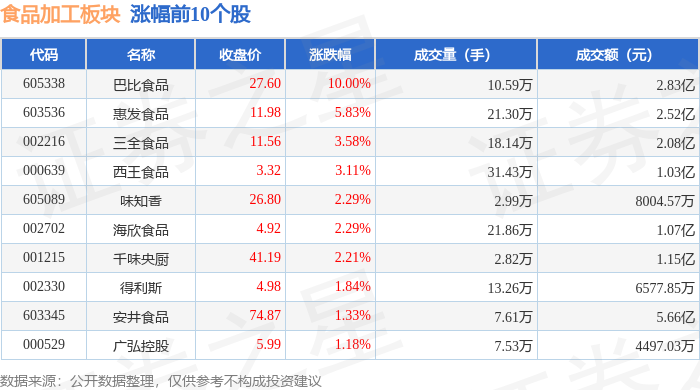
食品加工板块11月3日涨1.37%,巴比食品领涨,主力资金净流入4358.53万元
Zheng Xing Xing Ye Ri Bao· 2025-11-03 08:47
Group 1 - The food processing sector increased by 1.37% on November 3, with Babi Food leading the gains [1] - The Shanghai Composite Index closed at 3976.52, up 0.55%, while the Shenzhen Component Index closed at 13404.06, up 0.19% [1] - Babi Food's stock price rose by 10.00% to 27.60, with a trading volume of 105,900 shares and a transaction value of 283 million yuan [1] Group 2 - The main capital inflow in the food processing sector was 43.5853 million yuan, while retail investors experienced a net outflow of 31.5317 million yuan [1] - The top three stocks by main capital inflow were: - Sanquan Food with 24.9626 million yuan [2] - Anjixin Food with 24.7157 million yuan [2] - Huifa Food with 21.2119 million yuan [2] - Retail investors showed significant outflows in several stocks, including Babi Food with a net outflow of 23.7499 million yuan [2]

今日110只股长线走稳 站上年线
Zheng Quan Shi Bao Wang· 2025-11-03 07:32
Market Overview - The Shanghai Composite Index closed at 3976.52 points, above the annual line, with a gain of 0.55% [1] - The total trading volume of A-shares reached 21,329.04 million yuan [1] Stocks Breaking Annual Line - A total of 110 A-shares have surpassed the annual line today, with notable stocks including: - Deer Chemical with a deviation rate of 14.65% - Yabao Chemical at 11.35% - Fushi Holdings at 10.87% [1] Top Stocks by Deviation Rate - The following stocks had the highest deviation rates from the annual line: - Deer Chemical: 20.75% increase, latest price 16.06 yuan, deviation rate 14.65% [1] - Yabao Chemical: 11.98% increase, latest price 8.13 yuan, deviation rate 11.35% [1] - Fushi Holdings: 13.39% increase, latest price 5.76 yuan, deviation rate 10.87% [1] Additional Stocks with Notable Performance - Other stocks with significant performance include: - Meirui New Materials: 19.99% increase, latest price 18.97 yuan, deviation rate 9.48% [1] - Intercontinental Oil and Gas: 10.13% increase, latest price 2.61 yuan, deviation rate 9.37% [1] - Tianjin Pulin: 10.00% increase, latest price 22.23 yuan, deviation rate 7.84% [1]


今日222只个股突破半年线
Zheng Quan Shi Bao Wang· 2025-11-03 07:32
Market Overview - The Shanghai Composite Index closed at 3976.52 points, above the six-month moving average, with an increase of 0.55% [1] - The total trading volume of A-shares reached 21,329.04 million yuan [1] Stocks Breaking the Six-Month Moving Average - A total of 222 A-shares have surpassed the six-month moving average today [1] - Notable stocks with significant deviation rates include: - Baose Co., Ltd. (300402) with a deviation rate of 16.81% and a price increase of 19.99% [1] - Meirui New Materials (300848) with a deviation rate of 11.80% and a price increase of 19.99% [1] - Deer Chemical (920304) with a deviation rate of 10.57% and a price increase of 20.75% [1] Stocks with Smaller Deviation Rates - Stocks with smaller deviation rates that have just crossed the six-month moving average include: - Zhuhai Port, Tianhong Shares, and New Energy Tai Shan [1] - The table lists various stocks with their respective trading performance, including: - Academic shares (300261) with a deviation rate of 9.21% and a price increase of 11.98% [1] - Dahongli (300865) with a deviation rate of 7.54% and a price increase of 11.29% [1]



食品加工制造板块午后持续走高
Mei Ri Jing Ji Xin Wen· 2025-11-03 05:27
Core Viewpoint - The food processing and manufacturing sector experienced a significant rise in stock prices, with notable gains from several companies on November 3rd [1]. Group 1: Stock Performance - Babi Foods reached the daily limit increase in stock price [1] - Huifa Foods and Baoli Foods saw stock price increases exceeding 8% [1] - Other companies such as Sanquan Foods, Tianwei Foods, Richen Co., and Ziyan Foods also experienced stock price increases [1]


