
陕西煤业

Search documents
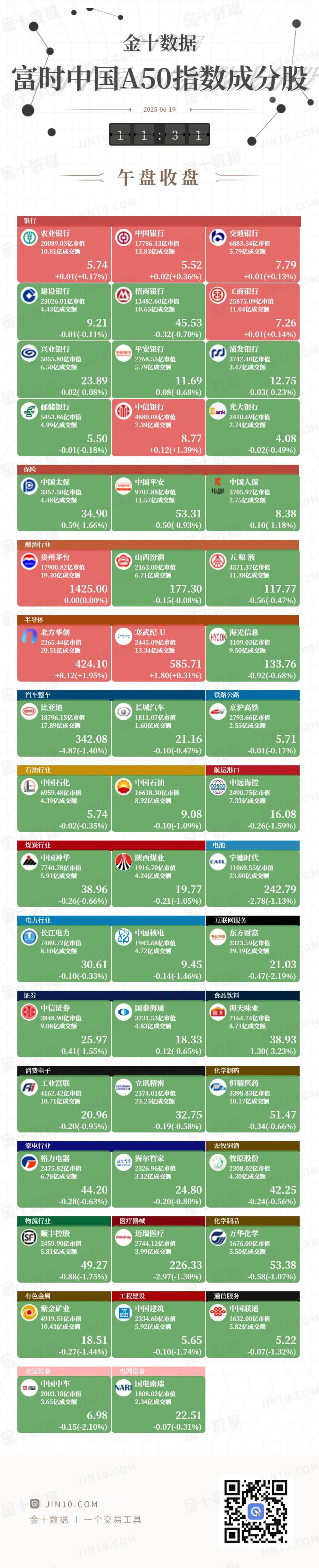
金十图示:2025年06月19日(周四)富时中国A50指数成分股午盘收盘行情一览:汽车、石油、电力和煤炭行业全体下挫,银行股涨跌不一
news flash· 2025-06-19 03:37
Market Overview - The FTSE China A50 index components showed a decline in sectors such as automotive, oil, electricity, and coal, while bank stocks exhibited mixed performance [1][6]. Automotive Sector - Great Wall Motors and BYD reported market capitalizations of 1,879.61 billion and 181.11 billion respectively, with Great Wall Motors experiencing a decrease of 4.87 (-1.40%) [3]. Oil Sector - China Petroleum and China Shipping reported market capitalizations of 695.95 billion and 1,661.83 billion respectively, with China Petroleum declining by 0.02 (-0.35%) [3]. Coal Sector - China Shenhua and Shaanxi Coal and Chemical Industry had market capitalizations of 191.67 billion and 774.08 billion respectively, with China Shenhua decreasing by 0.21 (-1.05%) [3]. Electricity Sector - Yangtze Power and China Nuclear Power had market capitalizations of 943.68 billion and 1,943.68 billion respectively, with Yangtze Power declining by 0.10 (-0.33%) [4]. Semiconductor Sector - Northern Huachuang and Cambrian reported market capitalizations of 226.54 billion and 310.90 billion respectively, with Northern Huachuang increasing by 8.12 (+1.95%) [3]. Insurance Sector - China Pacific Insurance and Ping An Insurance had market capitalizations of 370.60 billion and 335.75 billion respectively, with China Pacific Insurance decreasing by 0.59 (-1.66%) [3]. Food and Beverage Sector - Kweichow Moutai and Shanxi Fenjiu reported market capitalizations of 1,790.08 billion and 216.30 billion respectively, with Kweichow Moutai remaining unchanged [3]. Electronics Sector - Industrial Fulian and Luxshare Precision had market capitalizations of 416.24 billion and 237.40 billion respectively, with Industrial Fulian decreasing by 0.20 (-0.95%) [4]. Construction Sector - China State Construction reported a market capitalization of 491.95 billion, with a decline of 0.27 (-1.44%) [4]. Communication Services Sector - China Unicom had a market capitalization of 163.20 billion, with a decline of 0.07 (-1.32%) [4]. Summary of Trading Volumes - The trading volumes for major companies varied, with Kweichow Moutai leading at 19.30 billion, followed by China Pacific Insurance at 4.48 billion [3].

国海证券晨会纪要-20250619
Guohai Securities· 2025-06-19 01:35
Group 1: Global Gas Turbine and Aerospace Engine Demand - The demand for gas turbines is expected to surge, with GE Vernova projecting a backlog of 60GW by the end of 2025, with orders signed until 2028 [3][4] - In Q1 2025, GE Vernova added 7.1GW in new gas turbine orders, a 44.9% year-on-year increase, primarily from heavy-duty gas turbine orders [3][4] - The aerospace engine market is experiencing robust demand, with Boeing reporting a net addition of 300 aircraft orders in May 2025, raising its backlog to 5943 aircraft [5][6] Group 2: High-Temperature Alloy and Chromium Salt Industry - The growth in gas turbine and aerospace engine demand is driving the need for high-temperature alloys, with domestic manufacturers poised to benefit from supply chain constraints [9][13] - Companies like Zhenhua Co. and Sry New Materials are expanding their production capabilities and reporting significant revenue growth from overseas markets [9][10] - The high-temperature alloy sector is rated as "recommended" due to the increasing demand for core components amid supply chain shifts towards China [13] Group 3: Coal Industry Dynamics - In May 2025, China's industrial raw coal production reached 400 million tons, a year-on-year increase of 4.2%, indicating a recovery in the coal supply [15][18] - The industrial electricity generation in May 2025 showed a positive shift, with coal-fired power generation increasing by 1.2% year-on-year, reversing a previous decline [19][22] - The coal market is witnessing a gradual improvement in supply-demand dynamics, with coal prices stabilizing and inventory levels decreasing [21][23] Group 4: Real Estate and Land Market Factors - The land market's performance is influenced by five key factors, including financing environment, new housing market stability, inventory reduction, sales model changes, and land supply rules [24][27] - The first quarter of 2025 showed a significant recovery in the real estate market, with new housing transactions positively impacting land market activity [29][30] - The land market is entering a "dual concentration" phase, with significant activity concentrated in major cities and among top real estate firms [25][26] Group 5: Company-Specific Developments - Xiaogoods City (600415.SH) is leveraging its position in Yiwu to enhance its global trade capabilities, with a projected revenue growth of 25% from 2025 to 2027 [36][39] - Huayi Group is diversifying its operations across five core business areas, reporting a revenue increase of 9.3% in 2024 [40]
陕西煤业(601225) - 陕西煤业股份有限公司2024年年度权益分派实施公告
2025-06-18 09:45
证券代码:601225 证券简称:陕西煤业 公告编号:2025-025 陕西煤业股份有限公司 2024年年度权益分派实施公告 本公司董事会及全体董事保证本公告内容不存在任何虚假记载、误导性陈述或者重大遗 漏,并对其内容的真实性、准确性和完整性承担法律责任。 重要内容提示: 一、 通过分配方案的股东大会届次和日期 本次利润分配方案经公司2025 年 6 月 10 日的2024年年度股东大会审议通过。 二、 分配方案 截至股权登记日下午上海证券交易所收市后,在中国证券登记结算有限责任公司上海分 公司(以下简称"中国结算上海分公司")登记在册的本公司全体股东。 3. 分配方案: 本次利润分配以方案实施前的公司总股本9,695,000,000股为基数,每股派发现金红利 1.136元(含税),共计派发现金红利11,013,520,000元。 每股分配比例 A 股每股现金红利1.136元 相关日期 | 股份类别 | 股权登记日 | 最后交易日 | 除权(息)日 | 现金红利发放日 | | --- | --- | --- | --- | --- | | A股 | 2025/6/24 | - | 2025/6/25 | 20 ...

山西证券研究早观点-20250618
Shanxi Securities· 2025-06-18 02:44
Core Insights - The report highlights the emergence of new investment opportunities in the 3D printing sector, particularly driven by the popularity of LABUBU, which is expected to boost demand for PLA materials [7][9][10] - The report discusses the impact of geopolitical tensions on commodity prices, particularly in the energy sector, and suggests that these tensions may lead to increased volatility in oil and gas prices [10][14] - The report emphasizes the importance of monitoring macroeconomic indicators, such as inflation and employment data, which are expected to influence monetary policy decisions by the Federal Reserve [6][10] Market Trends - The domestic market indices showed slight declines, with the Shanghai Composite Index closing at 3,387.40, down 0.04% [4] - The new materials sector experienced a 0.68% increase, outperforming the ChiNext Index by 0.47% [9] - The report notes a significant drop in coal imports, with a 17.75% year-on-year decrease in May, indicating a tightening supply [17][20] Industry Commentary Chemical Raw Materials - The report indicates that the demand for PLA is set to rise due to the popularity of LABUBU, which has sparked interest in 3D printing [7][9] - The prices of key materials such as amino acids and vitamins remained stable, with some minor fluctuations noted [9] Power Equipment and New Energy - The report discusses advancements in smart elderly care robots and their potential applications in various settings, highlighting a strategic partnership between Kepler and Hanwei Technology Group [10] - The report also mentions the National Energy Administration's initiatives to explore off-grid hydrogen production, which could reshape the energy landscape [10] Basic Chemicals - The report notes that the contract price for potassium fertilizer has increased to $346 per ton, up from $273 per ton last year, reflecting rising global commodity prices [12][14] - The report suggests that geopolitical tensions may disrupt the supply of certain chemicals, particularly those imported from Iran and Israel [14][15] Coal - The report highlights a slight increase in coal production, with a total output of 1.985 billion tons from January to May, marking a 6.0% year-on-year increase [17] - The report anticipates a potential rebound in coal prices during the summer, driven by seasonal demand [20] Home Appliances - The report indicates that the home appliance sector is transitioning from explosive restocking to stable demand, with export growth slowing [21][22] - Rising shipping costs are impacting the industry, with significant increases in freight rates observed across various shipping routes [21][22] Investment Recommendations - The report recommends focusing on companies involved in the production of PLA and those benefiting from the growth of the 3D printing market, such as Haizheng Biomaterials and Jindan Technology [7][9] - In the coal sector, companies like Shanxi Coal International and Jincheng Anthracite Mining are highlighted as potential investment opportunities due to their positioning in a recovering market [20] - The report suggests monitoring companies in the home appliance sector, particularly those with strong dividend yields and limited downside potential, such as Midea Group and Gree Electric Appliances [22]
朝闻国盛:百年复盘,寻找当下黄金的历史坐标
GOLDEN SUN SECURITIES· 2025-06-18 01:17
Core Insights - The current ten-year government bonds have high investment value, optimizing risk-return performance in portfolios and showing low correlation with other assets like stocks and gold [2][3] - The macroeconomic environment is favorable for ten-year bonds, with a loose monetary policy and weak credit demand, leading to better performance compared to other assets during this phase [2][3] Ten-Year Government Bond Historical Analysis - The long-term trend indicates a downward shift in interest rates, primarily driven by declining real returns, with expectations of lower financing costs due to weakening prices [3] - Financial institutions are experiencing a downward trend in earnings, with deposit and investment product yields decreasing further from the beginning of the year [3] - Supply-demand dynamics and central bank liquidity support are expected to drive interest rates lower, with a potential asset shortage emerging as bond supply slows [3] Ten-Year Government Bond Advantages - Interest rates are anticipated to reach new lows, with expectations of the ten-year bond yield dropping to 1.4%-1.5% within the year [4] - The ten-year bond serves as a crucial benchmark rate, balancing long and short-term funding needs and is a key reference for pricing other financial products [4] - The 国泰上证 10-year government bond ETF is the only ETF tracking the ten-year bond index, utilizing an optimized sampling method to enhance liquidity and reduce trading costs [4][5] ETF Characteristics - The 国债 ETF operates on a T+0 trading mechanism, allowing for same-day buying and selling, which facilitates multiple trading opportunities within a single day [5] - The ETF maintains transparency in holdings, with daily disclosures, making it suitable for conservative long-term investors [5] - The ETF has low fees, high liquidity, and a strong historical performance, managed by experienced fund managers [5] Industry Performance Overview - The steel industry saw a 6.9% year-on-year decline in crude steel production in May, indicating a need for further observation regarding production strength [14] - The coal industry experienced a continued decline in imports, with a slight increase in thermal power generation, suggesting a potential rebound in demand [15]
当前时点如何看煤炭?
2025-10-23 15:20
摘要 西部区域产能利用率小幅下滑,但沿海地区旺季日耗显著高于淡季,6 月初以来 25 省电厂日耗环比上涨 18%,北方三港库存加速去化,电厂 库存同比偏低,表明煤炭需求端边际改善,支撑煤价。 煤炭板块因其防守性强和资金轮动需求而具吸引力。经济数据疲弱导致 风险偏好下降,煤炭板块跌幅大,PB 估值处于近两年低位,具备防守性。 煤炭持仓比例偏低,高股息特性使其成为资金配置选择。 对煤炭板块持续性持积极看法。借鉴发达国家经验,工业化后周期用电 增长仍可持续。风光替代效应放缓,总用电量提升可能导致火电达峰时 间延长,中长期需求韧性较强。 供给方面,山西省煤炭资源枯竭比例较高,全球增量国情况各异,印度 需求增速快于供给,印尼老岛资源枯竭,俄罗斯受制裁,澳洲产量进入 平台期,中长期供给增量有限。 短期内动力煤板块前景积极,供需存在边际改善预期,且今年以来跌幅 最大、PB 估值最低。地缘冲突引发油价反弹,煤炭和原油存在联动效应, 增加市场不确定性,利好防守风格。 Q&A 煤炭板块近期上涨的主要原因是什么? 煤炭板块近期上涨主要有两个原因:一是短期基本面改善,二是资金的高低切 换需求。基本面方面,短期供需改善的拐点正在临近。 ...
煤炭行业中期投资策略
2025-06-18 00:54
摘要 煤炭板块跑输大盘,但长协政策稳定动力煤价格,叠加政策加码和行业 协会倡议,有助于减少煤价非理性波动,较低煤价有望促成自上而下的 减产,维持合理季节性波动。 2025 年一季度动力煤市场受暖冬影响需求偏弱,但夏季旺季电煤和非 电煤需求叠加释放,有望带动煤炭价格触底反弹,进口煤受限预计难有 增量。 长协政策通过提高覆盖率和两大协会的倡议,有效应对市场价格下滑, 长协价成为稳定器,保障电厂利润,预计 2025 年季节性波动维持在合 理范围内。 煤炭行业具备反弹基础,较低财政压力和企业现金流亏损将促成减产, 联动机制在一定程度上保住了电厂利润,长线支撑偏强。 煤炭股估值整体处于较低水平,截至 2025 年 6 月 3 日 PE 为 11 倍, PB 为 1.32 倍,小于中位数 1.65 倍,在经济转型和政策支持下,核心 价值有望提升。 Q&A 如何评价 2025 年煤炭行业的投资价值? 2025 年煤炭行业的投资价值主要体现在其高股息和多频次的高分红兼备,凸 显出防御性红利价值。尽管国内经济缓慢修复,煤炭板块跌幅明显,从 2025 年年初到 6 月 3 日,煤炭板块累计跌幅 11.98%,跑输沪深 300 指 ...
“保险系”私募基金扎堆设立,钱都会投向哪里?
Di Yi Cai Jing· 2025-06-17 12:40
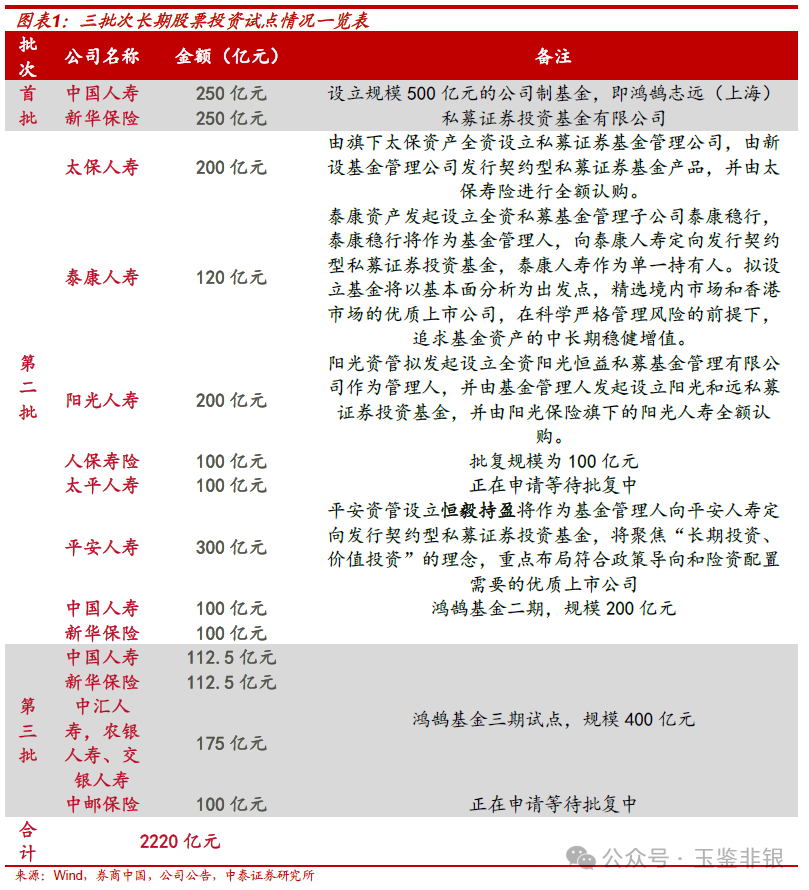
Core Viewpoint - The establishment of "insurance系" private equity funds is driven by regulatory guidance for long-term capital market entry and the actual needs of insurance companies to adapt to a low-interest-rate environment [1][2]. Group 1: Fund Establishment and Scale - Xinhua Insurance plans to invest up to 15 billion yuan in the Honghu III private equity fund, co-established by Xinhua Asset and China Life Asset [2][3]. - Since May, at least seven "insurance系" private equity funds or products have been established, indicating a surge in activity among insurance companies [3][4]. - The Honghu III fund has a total scale of 22.5 billion yuan, with Xinhua Insurance and China Life each contributing 11.25 billion yuan [3]. Group 2: Long-term Investment Strategy - The establishment of these private equity funds reflects the results of the insurance capital's "long money long investment" strategy, driven by policy support and the need for better asset allocation in a declining interest rate environment [5]. - The long-term investment pilot program initiated in 2023 allows insurance companies to set up private equity funds primarily targeting the secondary market stocks for long-term holding [5][6]. Group 3: Investment Focus and Trends - The investment focus of these funds is expected to be on high-dividend, low-volatility stable assets, with an emphasis on companies with strong governance and good business models [10][11]. - The first phase of the Honghu fund primarily invested in key industries related to national interests, while the second phase is set to focus on large-cap A+H shares [10][11]. - Other insurance companies are also expected to follow similar investment strategies, focusing on stable, high-quality listed companies [11][12]. Group 4: Regulatory and Market Context - The pilot program for long-term investment is expected to expand by 2025, with several insurance companies already approved to participate [6][7]. - The total approved scale for the three batches of long-term investment reform trials is estimated to reach 222 billion yuan, with expectations for further increases in approved scales [7].



“巨鳄”已至!私募界诞生“新四大天王”
华尔街见闻· 2025-06-17 11:01
Core Viewpoint - The Chinese private equity industry is undergoing a significant generational shift, with new players emerging and established firms facing challenges [1][4]. Group 1: Industry Changes - The private equity sector has evolved over the past two decades since the inception of "sunshine private equity" in the early 2000s, leading to noticeable changes in the industry landscape [2]. - New hedge funds and specialized institutions are forming a new frontline in the industry, with subjective investment firms also seeing the rise of new leaders [3]. Group 2: Leading Firms - The top subjective long-only private equity firms include Gao Yi Asset, Jinglin Asset, and Ningquan Asset, each managing client assets in the range of 60 billion to 100 billion RMB [6]. - These firms have different backgrounds and investment styles, with Jinglin being the oldest, Gao Yi focusing on a platform model, and Ningquan adopting a core-satellite approach [8][16]. Group 3: New Entrants - A new private equity firm, Guofeng Xinghua, has emerged as a strong competitor, quickly amassing a projected scale of over 90 billion RMB within 18 months of establishment [11][13]. - Guofeng Xinghua is backed by major insurance asset management companies, which has contributed to its rapid growth and significant capital inflow [15][16]. Group 4: Investment Strategies - Guofeng Xinghua's investment strategy involves substantial investments in select stocks, with notable allocations to China Telecom, Yili Group, and Shaanxi Coal and Chemical Industry [20]. - The firm aims to optimize insurance fund asset-liability matching and enhance long-term investment returns through a low-frequency trading and long-holding strategy [30]. Group 5: Market Dynamics - The traditional private equity firms primarily attract retail clients, while Guofeng Xinghua combines both domestic and foreign capital sources [34][35]. - The shift in the market is influenced by the increasing competition from quantitative strategies, which have gained traction since 2018, leading to a decline in the popularity of subjective long-only strategies [39][41]. Group 6: Future Outlook - The insurance sector is expected to play a crucial role in the private equity landscape, with predictions of significant capital inflows from insurance funds in the coming years [43]. - The anticipated increase in insurance capital allocation to equity assets could reshape the private equity market in China, potentially leading to a new era of investment dynamics [44].

5月:进口收缩速度加快,关注夏季煤价
Shanxi Securities· 2025-06-17 09:20
Investment Rating - The coal industry is rated as "synchronous with the market" [1] Core Viewpoints - The sentiment in the coal industry has improved, leading to a rebound in the secondary market performance [4] - In the first five months of 2025, the cumulative production of raw coal reached 1.985 billion tons, a year-on-year increase of 6.0%, with May's production at 403 million tons, up 4.2% year-on-year [4][5] - The demand side is supported by manufacturing and infrastructure, with fixed asset investment growing by 3.7% year-on-year, manufacturing investment up 8.5%, and infrastructure investment up 5.6% [4] - Coal prices are nearing the bottom, with a decline in the average prices of various coal types since the beginning of 2025 [5] Summary by Relevant Sections Supply and Demand Analysis - In the first five months of 2025, raw coal supply showed a slight increase, while coal imports decreased significantly, with a cumulative import volume of 18.867 million tons, down 7.9% year-on-year [5][7] - The demand for non-electricity sectors is stronger than that for electricity, with thermal power cumulative growth at -3.1% and coke cumulative growth at 3.3% [4][5] Price Trends - The average price of Shanxi premium mixed 5500 thermal coal has decreased since the beginning of 2025, indicating a downward trend in coal prices [5][6] Investment Recommendations - The report suggests focusing on companies in the coking coal sector such as Huai Bei Mining, Pingmei Shenma, and Shanxi Coking Coal, while for thermal coal, companies like Shanxi Coal International, Jinko Coal, and Yanzhou Coal Mining are highlighted [6][7]