
美的集团

Search documents
如果只能买一只票
集思录· 2025-12-10 14:14
Group 1 - The article discusses the challenges of achieving a 10% annual return on investments, particularly in the context of low bank interest rates and the performance of bank ETFs [1] - It highlights the historical performance of various sectors in Japan from 1991 to 2020, noting that healthcare, information technology, and consumer sectors performed the best, while financial and telecommunications sectors lagged [3] - The article suggests that the current market conditions favor large-cap stocks, but there is potential in small-cap stocks as well, with specific mention of companies like Huahong Semiconductor [8] Group 2 - The article mentions the potential benefits of investing in dollar-denominated bond funds, especially with the anticipated interest rate cuts by the Federal Reserve [9] - It emphasizes the importance of specific stock selections, indicating that many popular recommendations may not yield the best returns [5] - The article also references the long-term performance of Midea Group, suggesting an annualized return of 9% [4]


预见未来家:2025年度家电行业十大趋势
Xin Lang Cai Jing· 2025-12-10 14:00
Group 1 - The core viewpoint of the articles highlights the transformative impact of AI and green technology on the home appliance industry, driven by policies such as the "old-for-new" initiative, which has invigorated the market and accelerated technological upgrades [1][25][48] - The integration of AI into home appliances has shifted from optional enhancements to fundamental redefinitions of product forms and user experiences, marking a new phase in the industry [3][27] - The sales growth of smart home products has been significant, with a reported increase of 940.7% in new smart home product barcodes, indicating a robust market trend [4][30] Group 2 - The trend towards personalized and flexible customization in home appliances is emerging, exemplified by the popularity of products like the "three-tub washing machine," which responds to consumer feedback [8][33] - The green upgrade of home appliances is gaining momentum, with a reported sales increase of over 10% for first-level energy-efficient products, reflecting a shift in consumer awareness towards sustainable living [11][36] - The aging population in China is driving the demand for elder-friendly appliances, with new standards and products being developed to cater to this demographic [13][38] Group 3 - The "Good House" initiative is fostering a deep integration of home appliances with home design, pushing for a seamless experience in kitchen and living spaces [14][39] - The trend of collaboration among major appliance brands, such as the strategic partnership between Hisense and Midea, signifies a shift from competition to "co-opetition" in the industry [19][44] - The globalization of the Chinese home appliance industry is accelerating, with companies expanding their presence through mergers and international marketing strategies, including partnerships with global sports events [21][46]







股权财政与产业适配性简析
Lian He Zi Xin· 2025-12-10 11:21
Overview of Equity Finance - Equity finance has rapidly expanded in scale, becoming a crucial method for local governments to enhance fiscal revenue and support industrial development[4] - In 2024, China's general public budget revenue, government fund budget revenue, and state capital operation budget revenue are projected to be CNY 21.97 trillion, CNY 6.21 trillion, and CNY 0.68 trillion, with growth rates of 1.3%, -12.2%, and 0.6% respectively[5] Regional Distribution and Investment Trends - By the end of 2024, a total of 2,178 government guidance funds have been established nationwide, with a total target scale of CNY 12.84 trillion, reflecting a 25% increase from CNY 6.16 trillion in 2021[9] - The proportion of equity investment-related expenditures in total fiscal expenditures increased from approximately 0.99% in 2021 to 1.46% in 2024, indicating a growing weight of equity finance in the fiscal system[9] Case Studies of Different Cities - Hefei, as a technology innovation city, has established a fund matrix exceeding CNY 156 billion, focusing on new energy vehicles and integrated circuits, achieving significant returns through strategic investments[16] - Foshan, a manufacturing cluster city, has created a fund system with a total scale of no less than CNY 1.2 trillion, focusing on advanced manufacturing and technology upgrades, with over 60% of investments in these areas[17] - Yulin, a resource-based city, has developed a fund cluster of nearly CNY 10 billion, focusing on green transformation and product value enhancement in traditional resource industries[19] Challenges and Recommendations - Challenges include unclear identification of industrial advantages, insufficient market-oriented operations, and imbalances between risks and returns[20] - Recommendations for improvement include establishing a scientific evaluation system for industrial advantages, enhancing market-oriented operational mechanisms, and perfecting risk-return balance mechanisms[21]
复购率高出1倍、用真实消费数据投票,2025京东金榜在沪揭晓
Sou Hu Cai Jing· 2025-12-10 10:13
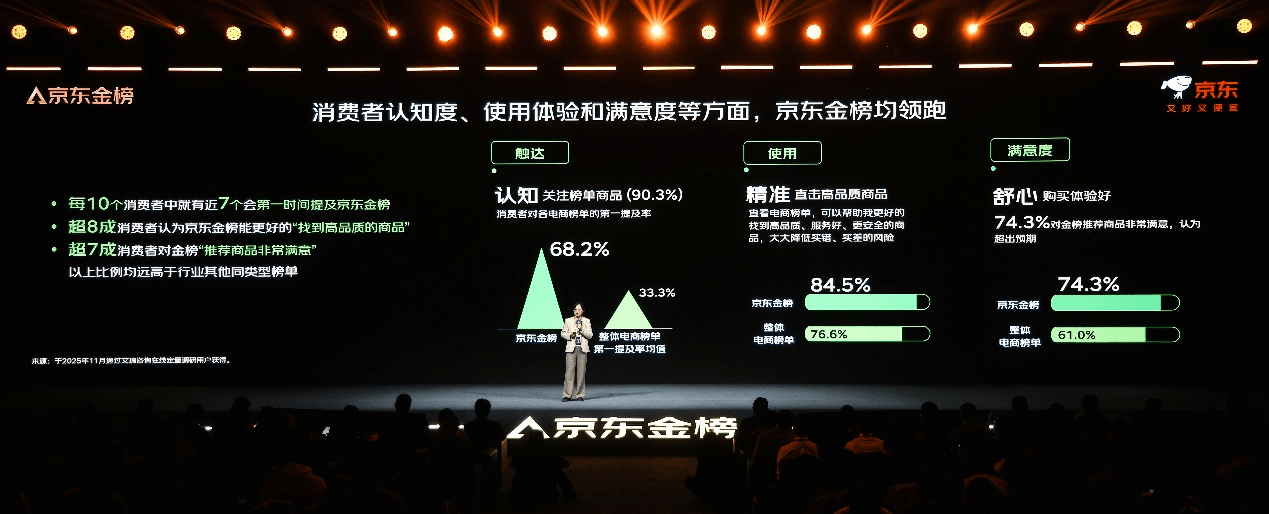
Group 1 - The core viewpoint of the article highlights the emergence of the JD Gold List as a significant consumer decision-making tool in the context of a rationalizing market and information overload, with over 1 billion consumers expected to follow the list for their purchases by 2025 [2][3] - The sales conversion rate of products listed on the JD Gold List is 12 times higher than that of ordinary products, with a repurchase rate that is double, indicating a strong correlation between the list's authority and consumer purchasing behavior [3] - An example of a product, a men's denim jeans from Hailan Home, saw a 600% increase in exposure and a 500% increase in sales in the first month after being listed, demonstrating the positive cycle of high exposure leading to high sales and repurchase [3] Group 2 - The JD Gold List's credibility is derived from its "zero human intervention" selection mechanism, which relies on dynamic tracking of sales, reputation, and popularity, establishing a rigorous standard for quality measurement [4] - Over 80% of users believe the JD Gold List helps them find high-quality, well-serviced, and safer products, positioning it as a leader in consumer recognition, experience, and satisfaction within the industry [4] - The introduction of stricter professional testing standards in collaboration with quality laboratories further enhances the list's credibility, exemplified by the TiPlus7100 solid-state drive winning the "Annual Quality Gold Award" due to its superior performance [4] Group 3 - The article discusses the transformation of the shopping experience through AI, moving from static, standardized lists to dynamic, personalized recommendations based on user data, termed "one list for each person" [5] - JD has innovated its business model by opening IP licensing for collaboration, leading to successful co-branded products, such as the collaboration with Nongfu Spring, which saw a 120% year-on-year sales increase [5] - This "list + brand" collaboration not only provides new growth opportunities for brands but also strengthens the market influence of the JD Gold List [5]

小家电售后困境:刚过质保期就坏,坏了找不到地方修
Xin Lang Cai Jing· 2025-12-10 09:23
Group 1 - The core issue highlighted is the increasing perception of small household appliances as "disposable" items due to their short lifespan and difficulties in repair after warranty expiration [1][3][6] - Consumers are facing challenges in finding repair services for small appliances, with many companies reducing or eliminating physical repair locations, leading to a reliance on costly and inconvenient mail-in repairs [2][4][5] - There is a growing concern among consumers regarding the declining durability of small appliances, with many reporting failures shortly after the warranty period, contrasting with the longevity of older models [3][6] Group 2 - The business logic behind the decline in repair services is that the cost of repairs often exceeds the cost of replacement, prompting companies to adopt mail-in repair or replacement policies instead of maintaining physical repair centers [4][5] - The perception that cheaper small appliances are more prone to failure is prevalent, with some consumers expressing that even moderately priced items should last longer than they currently do [5][6] - Experts suggest that the industry needs to improve product durability and after-sales service, advocating for regulatory oversight to ensure quality standards and protect consumer rights [6]
2025年上海市家用燃气灶产品质量监督抽查结果公布
Zhong Guo Zhi Liang Xin Wen Wang· 2025-12-10 09:10
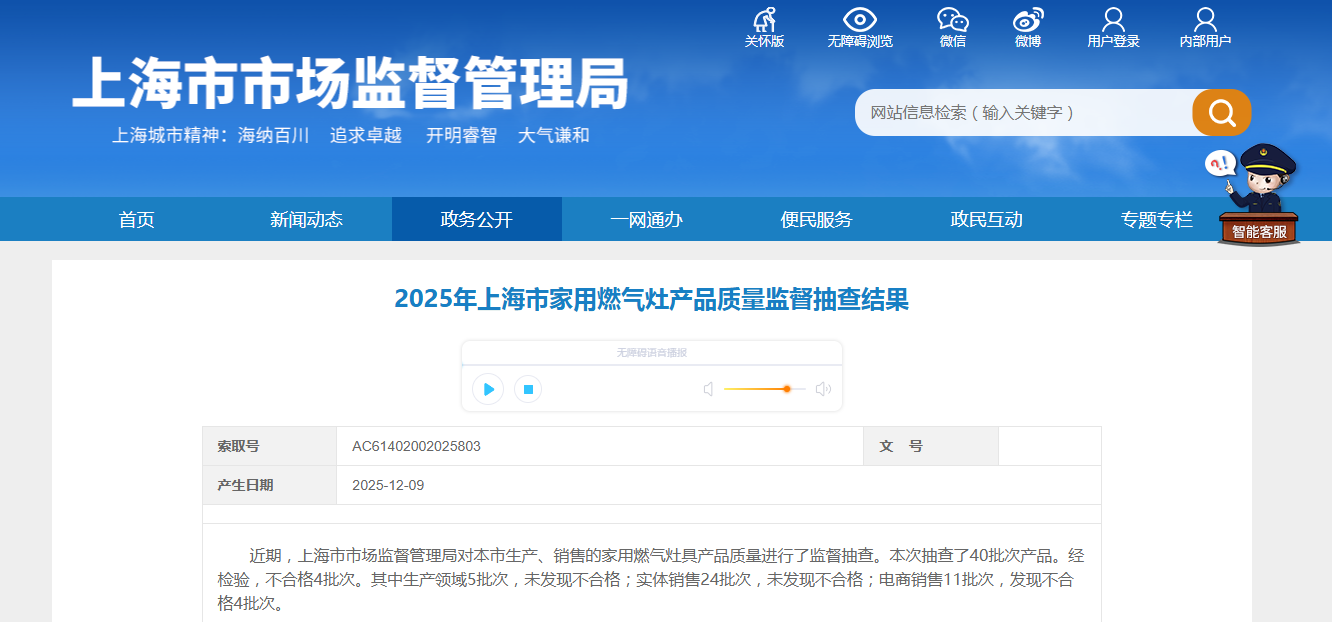
中国质量新闻网讯 近日,2025年上海市家用燃气灶产品质量监督抽查结果公布。 附原文: 2025年上海市家用燃气灶产品质量监督抽查结果 近期,上海市市场监督管理局对本市生产、销售的家用燃气灶具产品质量进行了监督抽查。本次抽查了40批次产品。经检验,不合格4批次。其中生产领域5 批次,未发现不合格;实体销售24批次,未发现不合格;电商销售11批次,发现不合格4批次。 本次抽查所抽样品产地涉及上海市、广东省、江苏省、浙江省等5个省市。其中抽查到标称上海市生产企业共9批次,未发现不合格;抽查到标称外省市 生产企业共31批次,发现不合格4批次。 本次监督抽查依据SHSSXZ0048-2025《家用燃气灶上海市产品质量监督抽查实施细则》组织实施。 本次抽查发现的不合格产品已移交被抽样生产者、销售者所在地市场监管部门依法进行处理。具体抽查结果如下: 2025年上海市家用燃气灶产品质量监督抽查所检项目符合相关标准的产品 | 样品标称名称 | 标称商标 | 标称规格型号 | 标称生产日 | 标称生产者名称 | 被抽样生产者、销售者 | 被抽样销售者所在 | 认证机构 | | | | --- | --- | --- | --- ...
白色家电板块12月10日跌0.05%,美的集团领跌,主力资金净流出9066.54万元
Zheng Xing Xing Ye Ri Bao· 2025-12-10 09:04
Group 1 - The white goods sector experienced a slight decline of 0.05% on December 10, with Midea Group leading the drop [1] - The Shanghai Composite Index closed at 3900.5, down 0.23%, while the Shenzhen Component Index closed at 13316.42, up 0.29% [1] - A detailed table of individual stock performance in the white goods sector is provided [1] Group 2 - The white goods sector saw a net outflow of main funds amounting to 90.6654 million yuan, with retail funds experiencing a net inflow of 183 million yuan [2] - The net outflow from speculative funds was 91.8769 million yuan [2] - A detailed table of fund flows for individual stocks in the white goods sector is included [2]

【财经分析】中国家电品牌在南美最大市场的竞逐与挑战
Xin Hua Cai Jing· 2025-12-10 08:07
Core Insights - Chinese home appliance companies are transitioning from traditional manufacturers to participants in the green energy transformation, particularly in Brazil, which is the largest appliance market in South America [1][2] - The COP30 conference highlighted the focus on green technologies, with Gree Electric Appliances launching a global initiative to accelerate green alternatives across various sectors [1][2] - The Brazilian market presents significant growth potential for Chinese brands, driven by rising middle-class consumption and ongoing upgrades in air conditioning and television markets [2][10] Group 1: Market Dynamics - Brazil is the largest white goods market in Latin America and a key emerging consumer market globally, with high temperatures and rising energy costs driving demand for air conditioning and televisions [2][10] - The air conditioning penetration rate in Brazil is below 25%, indicating substantial market potential compared to the global average [1] - The competitive landscape is shifting from price-based advantages to value competition focused on technological innovation, localized manufacturing, and brand building [1][2] Group 2: Company Strategies - Gree Electric Appliances has established a strong local presence since 2001, with a production base in Manaus, and reported a 38% revenue growth in 2024, maintaining its leading position in the air conditioning sector [4][10] - TCL has rapidly expanded its air conditioning business, leveraging its television channel advantages, with a projected growth rate exceeding 40% in 2025 [5][6] - Hisense, despite entering the Brazilian market later, achieved approximately 1 billion Brazilian Reais in sales in its first year and plans to expand its product offerings significantly by 2025 [6][7] - Midea operates multiple production bases in Brazil and is investing heavily in local manufacturing, with a goal to become a leading brand in the refrigerator sector within four years [8][10] Group 3: Challenges and Opportunities - The Brazilian market is considered one of the most challenging for home appliance companies due to complex tax systems, high labor costs, and fluctuating currency rates [10][11] - Companies must navigate a fragmented retail structure and establish robust after-sales service networks to build consumer trust [10][11] - The next two to three years are critical for reshaping the competitive landscape in Brazil, with companies needing to excel in energy-saving technologies and localized service networks to gain market share [11][12]
梅卡曼德邵天兰谈机器人行业瓶颈:要改造环境来适应机器人,而不是让机器人去适应环境
Xin Lang Cai Jing· 2025-12-10 06:57
Group 1 - The 2025 China Entrepreneur Influence Entrepreneur Annual Conference is held from December 5 to 7 in Beijing, focusing on the theme "Emergence·Infinity - Co-creating New Forms of Intelligent Business" [1][5] - The founder and CEO of Mech-Mind Robotics, Shao Tianlan, highlighted that the robotics industry is relatively small, with total industrial robot sales reaching 500,000 units last year, and the combined revenue of all related companies is less than two-thirds of Midea Group's revenue [3][7] - Shao emphasized that the robotics sector is not merely about selling products but involves complex projects requiring various engineering expertise, which leads to significant customization and high costs [3][7] Group 2 - To address the issue of robots not being intelligent enough, Shao suggested that the environment should be modified to accommodate robots rather than forcing robots to adapt to existing environments, which presents a major bottleneck [3][7] - He pointed out that theoretically, robots can perform many tasks if sufficient funding is available, but economic constraints prevent the widespread use of customized engineering solutions [3][7] - Shao illustrated the cost disparity between mass-produced and customized products, stating that while a mass-produced sofa may cost 2,000 yuan, a customized version could be priced at 20,000 yuan, reflecting similar dynamics in the robotics industry [3][7] - He concluded that 99.5% of the potential capabilities of robots remain untapped due to extensive customization, and the current demand in large-scale manufacturing is 100 times greater than the existing robot supply [3][7]


梅卡曼德邵天兰:机器人全行业收入不及美的三分之二,但大型制造业需求已是当下百倍
Xin Lang Cai Jing· 2025-12-10 06:57
Group 1 - The 2025 China Entrepreneur Influence Entrepreneur Annual Conference is held in Beijing from December 5 to 7, with the theme "Emergence·Infinity - Co-creating New Forms of Intelligent Business" [1][5] - The founder and CEO of Mechaman, Shao Tianlan, attended and delivered a speech at the conference [1][5] Group 2 - The robotics industry is described as very small, with total industrial robot sales reaching 500,000 units last year, and the combined revenue of all component manufacturers, robot body companies, and solution system integrators being less than two-thirds of Midea Group's revenue [3][7] - The demand for robots is not the issue; rather, the challenge lies in the fact that robots are not standalone products but projects that require extensive customization and engineering support [3][7] - Shao Tianlan emphasizes the need to adapt environments to suit robots instead of forcing robots to adapt to existing environments, which presents a significant bottleneck [3][7] - The economic feasibility of deploying numerous customized engineers is questioned, highlighting the importance of generalization in robotics to reduce costs and facilitate project implementation [3][7] - An analogy is made comparing the cost of mass-produced items versus customized products, illustrating that the robotics industry faces similar challenges in terms of cost and customization [3][7] - It is noted that theoretically, robots can perform many tasks, but due to extensive customization, 99.5% of their capabilities remain untapped, with current demand in large manufacturing being 100 times the existing robot supply [3][7]