
天弘基金

Search documents
降息落地,金融板块持续反弹,银行ETF天弘(515290)开盘涨近1%,最近一周涨幅达0.92%
Xin Lang Cai Jing· 2025-05-20 02:37
Core Viewpoint - The banking sector is experiencing a rebound, supported by recent monetary policy adjustments and positive market sentiment following trade negotiations [1][2]. Group 1: Market Performance - As of May 20, the China Securities Bank Index (399986) rose by 0.51%, with notable increases in stocks such as Shanghai Pudong Development Bank (1.67%) and Ningbo Bank (1.58%) [1]. - The Tianhong Bank ETF (515290) increased by 0.63%, with a recent weekly gain of 0.92%, and its latest scale reached 40.12 billion [1]. - The Tianhong Bank ETF has shown a 26.48% increase in net value over the past year, ranking in the top 2 among comparable funds [3]. Group 2: Monetary Policy Impact - The People's Bank of China announced a reduction in the one-year Loan Prime Rate (LPR) to 3% from 3.1% and the five-year LPR to 3.5% from 3.6%, which is expected to lower financing costs for the real economy [1]. - Economic analysts believe that the LPR cut will help stabilize the economic fundamentals by reducing overall financing costs [1]. Group 3: Fund Performance Metrics - The Tianhong Bank ETF has a Sharpe ratio of 1.63, ranking in the top 3 among comparable funds, indicating higher returns for the same level of risk [4]. - The maximum drawdown for the Tianhong Bank ETF this year is 5.45%, which is relatively low compared to its benchmark [4]. - The fund's management fee is 0.50%, and the custody fee is 0.10%, with a tracking error of 0.111% over the past two years, the highest precision among comparable funds [5]. Group 4: Top Holdings - As of April 30, the top ten weighted stocks in the China Securities Bank Index accounted for 65.11% of the index, including major banks like China Merchants Bank and Industrial and Commercial Bank of China [5].
权益类基金发行节奏加快 本周将新发14只指数产品
Zheng Quan Ri Bao· 2025-05-19 16:18
Group 1 - The issuance of equity funds is accelerating, with an average of less than half a month for a product to complete the fundraising to establishment process [1] - As of May 19, 2023, at least 23 new products are expected to be launched this week, with 16 being equity products, accounting for approximately 70% of the total [1] - The average subscription period for these equity products is 12.56 days, indicating strong market interest [1] Group 2 - The recent issuance includes 14 stock-type funds, all of which are index or enhanced index funds, reflecting a strong demand for low-cost, high-transparency passive investment tools [2] - The China Securities Regulatory Commission has introduced a plan to enhance the scale and proportion of equity investments in public funds, optimizing the registration process for equity funds [2] - As of May 19, 2023, 345 equity funds have been established this year, representing a year-on-year increase of 30.19% [2] Group 3 - The structural characteristics of the market reflect a recovery in market confidence and the penetration of passive investment concepts in asset allocation [3] - Current policies, upgraded demand, and product innovation are creating a favorable ecosystem for the development of equity funds, particularly index-based tools [3]
近一周获资金净流入超4.53亿元,信用债ETF天弘(159398)盘中成交额突破24亿元
Sou Hu Cai Jing· 2025-05-19 06:32
Group 1 - The core viewpoint of the articles highlights the strong performance and liquidity of credit bond ETFs, particularly Tianhong (159398), amidst a volatile bond market [1][2] - Tianhong credit bond ETF has seen a net inflow of over 453 million yuan in the past week, indicating active trading and investor interest [1] - In contrast to interest rate bond ETFs, credit bond ETFs have shown better performance during market fluctuations, with an annualized yield of 1.53%, compared to negative yields for long-term government bonds [1] Group 2 - The trading activity in the interbank market increased from 432 billion yuan to 550 billion yuan, while the exchange market also saw a rise from 234 billion yuan to 336 billion yuan [2] - Short-term credit bond yields are expected to have limited room for decline, suggesting that investors should wait for more favorable market conditions to engage in trading [2] - The focus should be on opportunities with certain coupon payments, considering absolute yield perspectives for investment [2]
上周股票ETF净流出超380亿元,债券型ETF“吸金”超90亿,科创50ETF连续第二周获资金净申购
Ge Long Hui· 2025-05-19 03:30
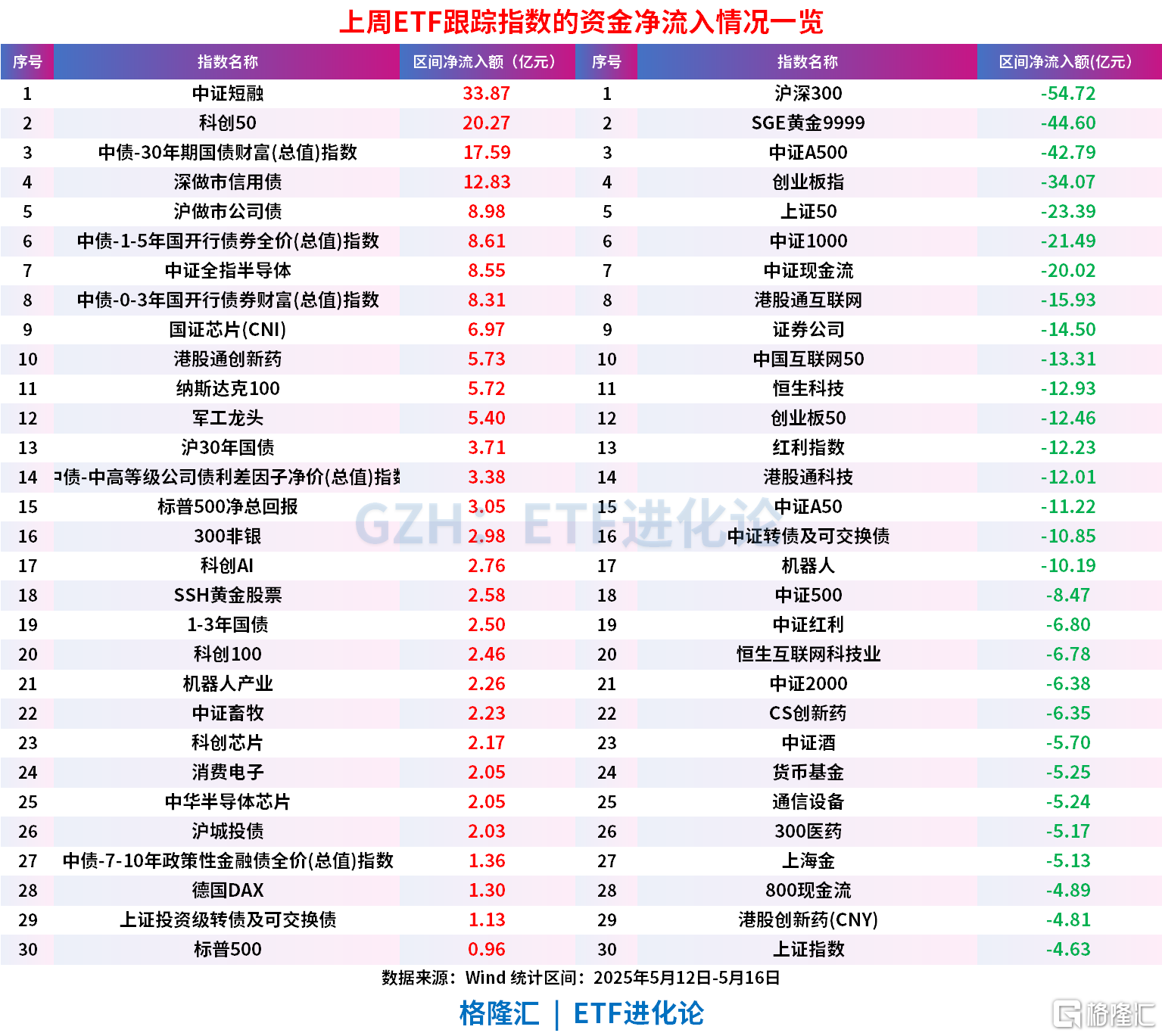
一、市场概况 上周沪深300、中证A500、创业板指、科创板50涨跌幅分别为1.12%、0.81%、1.38%、-1.10%。行业上看,上周美容护理、非银金融、汽车涨跌幅居前,分 别为3.08%、2.49%、2.40%。计算机、国防军工、传媒涨跌幅居后,分别为-1.26%、-1.18%、-0.77%。 二、资金流向 上周ETF市场净流出350.3亿元,其中股票ETF净流出387.4亿元,商品型基金净流出49.85亿元,货币基金小幅净流出5.25亿元,债券型基金净流入92.2亿元。 从指数角度来看,多只利率债、信用债相关指数上周获得资金净申购,中证短融、中债-30年期国债财富(总值)指数、深做市信用债、沪做市公司债、中 债-1-5年国开行债券全价(总值)指数、中债-0-3年国开行债券财富(总值)指数、沪30年国债、中债-中高等级公司债利差因子净价(总值)指数上周分别净流入 33.87亿元、17.59亿元、12.83亿元、8.98亿元、8.61亿元、8.31亿元、3.71亿元、3.38亿元。 | 序号 | 指数名称 | 区间净流入额(亿元) | 序号 | 指数名和 | | --- | --- | --- | -- ...

这类基金近两年未新增产品;张坤卸任副总经理丨天赐良基
Mei Ri Jing Ji Xin Wen· 2025-05-19 01:10
Group 1 - On May 15, Baodao Fund announced a share transfer where original shareholder Shi Wei transferred 3% of the company's shares to Yang Meng, resulting in Yang Meng holding over 5% of the company's shares directly and indirectly through an employee stock ownership platform [1] - After the share transfer, the shareholding structure of Baodao Fund is as follows: Mo Taishan holds 35%, Shanghai Baodao Investment Management Co., Ltd. holds 25.5%, Shen Bin and Zhang Yingjun hold 8.25% and 4.9% respectively, while three limited partnerships hold 4.5% each [1] Group 2 - Over 20 fund companies, including Shangyin, Taixin, and Jianxin, have announced varying degrees of purchase limits on their money market funds, primarily adjusting large purchase limits for institutional investors or directly suspending large purchases [2] - For instance, Shangyin Fund announced that starting May 15, it will limit single or cumulative purchases exceeding 2 million yuan for its Shangyin Huiying Money Market Fund [2] Group 3 - As of May 15, there have been no new LOF (Listed Open-Ended Fund) products launched in nearly two years, with the total scale being less than 20% of ETF scale [3] - The total number of LOF products established in the market is 398, covering various investment types, including equity, bond, commodity, FOF, and QDII [3] - Despite some LOF products performing well this year, the growth in scale remains insignificant [3] Group 4 - Tianhong Fund announced a name change for eight of its ETFs effective May 12, following similar announcements from other fund companies like Huaxia and Ping An [4] - The recent changes in fund names are aimed at better reflecting the fund managers, investment directions, and market trends, which may enhance product recognition and sales [4] Group 5 - On May 16, Yifangda Fund announced that Zhang Kun has resigned as deputy general manager to focus on investment management [5] - Zhang Kun has been in the position since June 2020, alongside other notable fund managers [5][6] - As of the end of the first quarter, Zhang Kun managed four funds with a total scale of approximately 608 billion yuan [7] Group 6 - Recently, Huang Weixuan, the original fund manager of several funds at Tongtai Fund, resigned due to personal reasons, and the funds have been taken over by different managers [8] - Huang Weixuan joined Tongtai Fund in April 2021, and prior to his resignation, the total management scale of the funds was less than 200 million yuan [8] Group 7 - As of May 8, data shows that Shi Bo's managed funds, including the Southern Xingrun Value One-Year Holding Mixed Fund and Southern Performance Growth Stock Fund, have reduced their holdings in Changhong Meiling by 500,000 shares each compared to the end of the first quarter [9] Group 8 - On May 16, the market experienced fluctuations, with the Shanghai Composite Index falling by 0.4% and the Shenzhen Component Index by 0.07%, with a total trading volume of 1.09 trillion yuan, a decrease of 629 billion yuan from the previous trading day [10] - The leading sectors included automotive parts, jewelry, and chemical pharmaceuticals, while sectors like chemical fiber, logistics, and insurance saw declines [10][11] - The S&P Consumer ETF led the gains with an increase of 3.65%, while several financial-related ETFs were among the biggest losers [12]
逐鹿“空中蓝海” 公募密集布局航空航天主题ETF
Zhong Guo Zheng Quan Bao· 2025-05-18 21:27
Core Viewpoint - The low-altitude economy sector is experiencing significant growth driven by favorable policies, leading to a surge in related ETF products in the market [1][2][4] Group 1: ETF Market Activity - Multiple fund companies, including Huaxia, Fuguo, and E Fund, have launched or reported new ETFs focused on the general aviation and aerospace sectors, with 6 ETFs tracking the National Index for General Aviation and 4 ETFs tracking the National Index for Aerospace [1][2] - The total scale of the listed related ETFs has exceeded 1.2 billion yuan, with a mix of individual and institutional investors among the top holders [3] Group 2: Industry Characteristics - The National Index for General Aviation reflects the price changes of listed companies in the general aviation sector, covering key players in the low-altitude economy, including large aircraft and commercial space [2] - The National Index for Aerospace focuses on core military companies and emphasizes low-altitude economy and large aircraft concepts [2] Group 3: Market Trends and Performance - Despite initial strong performance, several ETFs have faced net outflows this year, with some products dropping below 100 million yuan in scale shortly after launch [3] - The low-altitude economy is characterized by strong innovation, a long industrial chain, and diverse application scenarios, with significant progress in manufacturing, infrastructure, and operational services [4] Group 4: Policy Impact - Continuous policy support is expected to drive substantial market growth in the low-altitude economy, with recent developments including the issuance of operational certificates for manned civil drones and the establishment of low-altitude economic innovation cities [4][5]
新规下首批浮动管理费产品申报【国信金工】
量化藏经阁· 2025-05-18 16:28
Market Review - The A-share market showed a mixed performance last week, with the ChiNext Index, CSI 300, and Shanghai Composite Index yielding returns of 1.38%, 1.12%, and 0.76% respectively, while the STAR 50, CSI 1000, and CSI 500 indices had negative returns of -1.10%, -0.23%, and -0.10% respectively [6][10] - The automotive, non-bank financial, and retail sectors performed well, with returns of 2.71%, 2.67%, and 2.23% respectively, while the defense, computer, and comprehensive finance sectors lagged with returns of -1.61%, -1.40%, and -0.79% respectively [16][17] Fund Performance - Last week, the median returns for active equity, flexible allocation, and balanced mixed funds were 0.34%, 0.17%, and 0.16% respectively. Year-to-date, alternative funds have performed the best with a median return of 4.85% [28][30] - The median excess return for index-enhanced funds was 0.14%, while quantitative hedging funds also had a median return of 0.14%. Year-to-date, the excess median return for index-enhanced funds was 1.50% [31][32] Fund Issuance - A total of 15 new funds were established last week, with a total issuance scale of 6.345 billion yuan, which is a decrease from the previous week. Additionally, 27 funds entered the issuance phase, and 31 funds are set to begin issuance this week [3][40] - The first batch of 26 new floating management fee products was submitted for approval, which will link management fees to fund performance for eligible investors [5] Bond Market - As of last Friday, the central bank's reverse repos netted a withdrawal of 350.1 billion yuan, with a total of 836.1 billion yuan maturing and a net open market injection of 486 billion yuan. The pledge-style repo rates increased, with the 1-day rate rising by 12.92 basis points [18][19] ETF Index Series - On May 14, the China Securities Index officially launched several new ETF index series, including the CSI A500 and CSI cash flow indices, providing diversified benchmarks and investment targets for fund companies [9]

连续七年!冲击1000亿大关
Zhong Guo Ji Jin Bao· 2025-05-18 12:24
Core Insights - The domestic ETF market has seen new issuance reach nearly 100 billion yuan for seven consecutive years, driven by favorable policies, market conditions, and investor behavior [1][3][4] Policy Impact - The implementation of asset management regulations has shifted funds from non-standard assets to standardized investment tools, with ETFs being favored for their low cost and high transparency [3][4] - The new "National Nine Articles" has clarified the strategic position of ETFs, leading to a significant reduction in fees and an increase in institutional holdings [3][4] Market Environment - The variety of ETF products available has catered to diverse investor needs, contributing to rapid growth in ETF scale [3][4] - Innovative ETFs, such as credit bond ETFs and industry-specific ETFs, have become popular among various investors [4][6] Investor Behavior - Institutional investors have increased their ETF holdings significantly, with a 38.8% year-on-year growth expected by the end of 2024, reaching 1.54 trillion shares [6] - Individual investors tend to prefer industry and strategy-based ETFs, reflecting their higher risk tolerance and smaller capital size [7][8] Product Strategy - Fund managers are focusing on creating a diverse range of ETF products and enhancing customer experience through tailored marketing strategies [1][8] - Companies like CICC and Hai Fu Tong are developing a product matrix that includes both basic and specialized ETFs to meet varying investor needs [8]
跑赢基准100个百分点?基金公司密集“纠偏”!什么情况?
券商中国· 2025-05-18 10:38
Core Viewpoint - The China Securities Regulatory Commission (CSRC) has released an action plan to promote the high-quality development of public funds, emphasizing the importance of performance benchmarks for funds [1][7]. Group 1: Changes in Performance Benchmarks - A significant increase in the number of funds changing their performance benchmarks has been observed this year, with 82 funds making changes compared to only 37 in the same period last year [3]. - Several North Exchange theme funds have updated their performance benchmarks to align with relevant indices, although five companies have yet to make these necessary adjustments [3][6]. - The Tianhong Qingxiang Fund and Zheshang Huijin Quantitative Fund have both adjusted their performance benchmarks to better reflect their investment strategies, moving away from indices that do not accurately represent their risk-return profiles [4][5]. Group 2: Importance of Performance Benchmarks - Performance benchmarks are crucial for evaluating fund performance, yet many funds have benchmarks that do not serve their intended purpose, leading to a lack of accountability for fund managers [6][9]. - The CSRC's action plan aims to enforce stricter guidelines for setting and modifying performance benchmarks, linking them to fund company performance assessments and manager compensation [7][10]. - The current benchmarks often reflect a simplistic approach, with a high concentration of funds using major indices like the CSI 300, which may not accurately represent the diverse market landscape [9][11]. Group 3: Future Implications - The action plan is expected to lead to more refined management of performance benchmarks, encouraging fund companies to reassess their benchmarks and align them more closely with their investment strategies [8][10]. - As the industry evolves, there is a push for more sophisticated benchmark selection, including the potential use of composite indices instead of relying solely on broad indices [11].

ETF兵器谱、金融产品每周见:债券ETF全景图:实物申赎、质押融资、T+0交易三位一体-20250518
Shenwan Hongyuan Securities· 2025-05-18 09:41
Report Industry Investment Rating No relevant content provided. Core Viewpoints of the Report - In 2025, the bond ETF market expanded with 29 products across credit bonds, interest - rate bonds, and convertible bond index funds, reaching a total scale of 256.546 billion yuan. Credit bond index ETFs grew rapidly after adding 8 market - making bond ETFs at the beginning of the year [2][7][10]. - The 8 market - making credit bond/company bond ETFs have differences in index characteristics and fund investment. Both indexes are better than the medium - and long - term pure bond fund index and may be a better choice for investors to allocate credit bond funds [2]. - Bond ETFs have advantages in trading mechanisms over over - the - counter products, with higher trading efficiency and "T + 0" trading, and some support physical redemption [2]. - In 2025, eligible credit bond ETFs can be included in the pledge - style repurchase pool, marking a new stage in China's bond market liquidity management tools [2]. - Bond ETFs generally use sampling replication and active management strategies, but it is difficult to obtain excess returns, with most products underperforming the benchmark index [2]. - China's bond ETF market mostly shows discount trading, and the discount/premium level is positively correlated with the liquidity of the underlying bond market, while other factors can also affect it [2]. Summary According to the Directory 1. 2025 Bond ETF Market Expansion - There are 29 bond ETF products in total, covering credit bonds, interest - rate bonds, and convertible bond index funds, with a total scale of 256.546 billion yuan. Credit bond index ETFs have 11 funds with a scale of 112.192 billion yuan, interest - rate bond index ETFs have 16 funds with a scale of 102.964 billion yuan, and there are 2 convertible bond index ETFs with a scale of 41.389 billion yuan [7][10]. 2. Differences Among 8 Market - Making Credit Bond/Company Bond ETFs - Divided into two types based on tracking indexes, with a total scale of 4.2403 billion yuan. Both indexes perform better than the medium - and long - term pure bond fund index [13]. - Index characteristic differences are reflected in industry distribution, enterprise nature, and duration. For example, the Shenzhen market - making credit bond index and the Shanghai market - making company bond index have different selection methods, component bond quantities, and weighted methods [15][22]. - Fund investment differences are shown in investment concentration, leverage level, and duration. Different products have different characteristics in these aspects [25]. 3. Differences in Bond ETF Trading Mechanisms Compared to Over - the - Counter Products - Bond ETFs have significant advantages in trading convenience, allowing trading in both the primary and secondary markets with "T + 0" trading, suitable for trading - oriented investors [30]. - There are two redemption methods: cash redemption and single - market physical redemption. Only a few products support only cash redemption, while others support single - market physical redemption [31]. 4. Bond ETFs Eligible for Pledge - Style Repurchase - Currently, 13 products including treasury bond ETFs, local government bond ETFs, or policy - financial bond ETFs can participate in pledge - style repurchase. In 2025, eligible credit bond ETFs can also be included in the pledge - style repurchase pool, with specific requirements for eligible credit bond funds [33][34]. 5. Sampling Replication + Active Management Strategy of Bond ETFs - Bond ETFs generally use sampling replication due to the large number of component bonds, fast portfolio adjustment, and weak liquidity of bond indexes. They also use strategies such as increasing duration, adding leverage, investing in treasury futures, and band trading to enhance returns, but it is difficult to obtain excess returns, with most products underperforming the benchmark index [36][37][50]. 6. Regularity of Bond ETF's Discount/Premium Rate - China's bond ETF market mostly shows discount trading, with over 60% of trading days of most products in a discount state. - The discount/premium level is positively correlated with the liquidity of the underlying bond market. For example, local government bond ETFs often trade at a discount with larger standard deviations of discount rates, and credit bond ETFs have more significant changes in discount/premium rates than interest - rate bond ETFs, except for the stable performance of newly - listed market - making credit bond ETFs in 2025 [53][56][59]. - Market sentiment, supply - demand relationship, policy environment, etc., can also affect the discount/premium of bond ETFs. For example, the discount/premium rate of urban investment bond ETFs has narrowed rapidly since Q3 2023 [61].