
中国移动

Search documents
2025 年 Q3 全球蜂窝物联网模组出货量同比增长 10%,印度引领市场扩张
Counterpoint Research· 2025-12-19 01:10
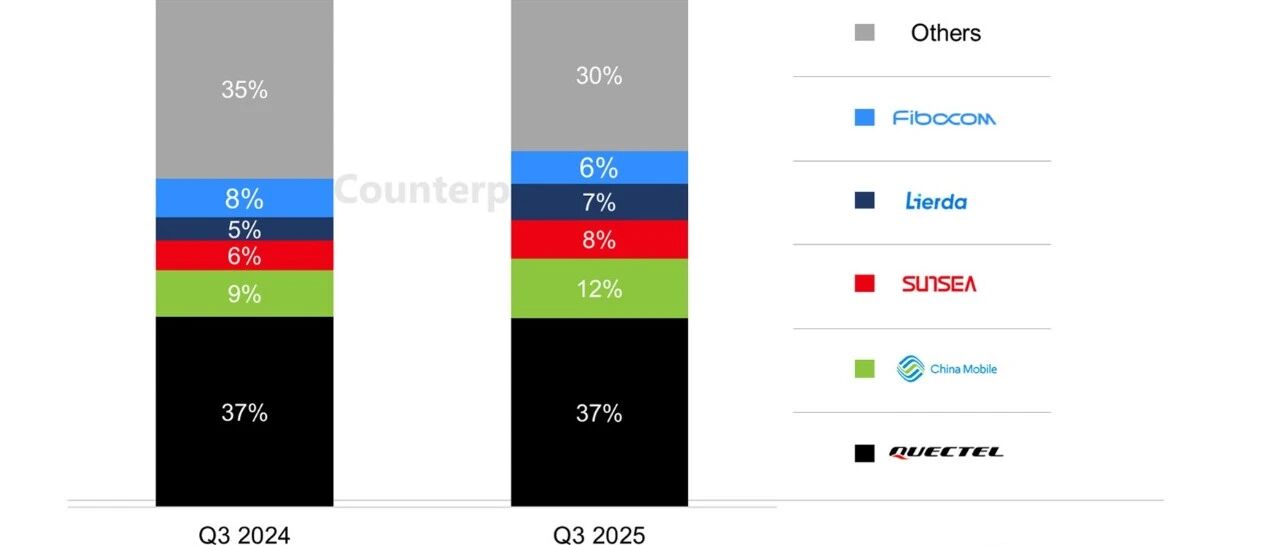
Core Insights - The global cellular IoT module shipments are projected to grow by 10% year-on-year in Q3 2025, driven by strong demand in smart meters, asset tracking, routers/CPE, and automotive applications [4][7] - Emerging markets, particularly India with a 40% year-on-year growth, are leading the growth, while mature markets like China and Europe show moderate increases [4][6][7] Market Trends - The transition from traditional RF/PLC systems to cellular networks is accelerating, laying the groundwork for capability-centric IoT deployments [4] - The average selling price (ASP) is declining, making cash flow strength a key differentiator among suppliers [4][7] - Cat-1 bis technology has solidified its position as a major contributor to global shipments, accounting for nearly half of the total [7][8] Supplier Performance - Quectel maintains its leading position globally, benefiting from strong market shares in both China and overseas [6] - China Mobile ranks second, driven by domestic demand, while SIMCom and Longsung rank third, propelled by shipments of POS and smart meters [6] - Lierda has seen a 73% year-on-year growth, leveraging Cat-1 bis technology and increased adoption in South Korea and Southeast Asia [6] Technological Developments - AI-enabled IoT modules are experiencing significant demand across various sectors, including monitoring, automotive, industrial, and retail [8] - The industry is shifting focus towards higher-value, AI-powered IoT solutions, with suppliers investing in edge intelligence, security software, and 5G-ready combinations [7][8] - RedCap is entering the commercial phase, but substantial scaling will depend on its pricing competitiveness with Cat-4/Cat-6 levels and broader 5G standalone network coverage [8]

智通港股沽空统计|12月19日
智通财经网· 2025-12-19 00:22
Group 1 - The core point of the article highlights the top short-selling ratios and amounts for various companies, indicating significant market interest in these stocks [1][2]. - China Resources Beer (80291), Anta Sports (82020), and Great Wall Motors (82333) have the highest short-selling ratios at 100% [1][2]. - Xiaomi Group (01810), Tencent Holdings (00700), and Alibaba-SW (09988) lead in short-selling amounts, with 1.229 billion, 1.054 billion, and 830 million respectively [1][2]. Group 2 - The top ten short-selling ratios include China Resources Beer (100.00%), Anta Sports (100.00%), and Great Wall Motors (100.00%) [2]. - The top ten short-selling amounts show Xiaomi Group at 1.229 billion, Tencent Holdings at 1.054 billion, and Alibaba-SW at 830 million [2]. - The highest deviation values are led by Bank of China Hong Kong (48.85%), Alibaba-SW (34.26%), and China Resources Beer (32.32%) [1][2].





中原证券晨会聚焦-20251219
Zhongyuan Securities· 2025-12-19 00:18
分析师:张刚 登记编码:S0730511010001 zhanggang@ccnew.com 021-50586990 晨会聚焦 资料来源:聚源,中原证券研究所 -12% -6% 0% 6% 12% 18% 24% 30% 2024.12 2025.04 2025.08 2025.12 上证指数 深证成指 | 国内市场表现 | 指数名称 | 昨日收盘价 | 涨跌幅(%) | | | | | | --- | --- | --- | --- | --- | --- | --- | --- | | 上证指数 | 3,876.37 | 0.16 | 深证成指 | 13,053.97 | -1.29 | | | | 创业板指 | 2,022.77 | -0.47 | 沪深 | 300 | 4,552.79 | -0.59 | | | 上证 | 50 | 2,443.97 | -0.52 | 科创 | 50 | 891.46 | 0.14 | | 创业板 | 50 | 1,924.26 | -0.67 | 中证 | 100 | 4,410.53 | -0.69 | | 中证 | 500 | 7,100.84 | -0.5 ...
中金:披沙剖璞,公募基金港股投资策略解构
中金点睛· 2025-12-18 23:58
Core Viewpoint - The Hong Kong stock market is increasingly favored by mainland public funds due to its deep value opportunities, potential for future growth, and global diversification, leading to a rise in public fund participation in Hong Kong stocks [2][10]. Market Overview - As of Q3 2025, the number of equity funds including Hong Kong stocks reached 2,689, with a total scale of 2.63 trillion yuan. Active management funds dominate in both quantity and proportion, indicating a strong willingness from public institutions to flexibly allocate to the Hong Kong market [2][22]. - Active products show a steady increase in Hong Kong thematic funds, while balanced allocation funds have expanded significantly, with thematic and balanced funds numbering 92 and 872 respectively by Q3 2025 [2][31]. - Passive products are led by thematic funds, which have seen rapid growth, reaching 108 funds by Q3 2025, driven by the accelerated return of Chinese concept stocks and structural market trends [2][32]. Institutional Landscape - The concentration of management scale among different types of Hong Kong equity funds is gradually dispersing. As of Q3 2025, the CR5 for thematic, balanced, and minor participation funds stands at 60.3%, 35.8%, and 30.2% respectively [3][33]. - Passive products exhibit higher concentration due to scale effects and first-mover advantages, with CR5 for thematic, balanced, and minor participation funds at 67.0%, 67.9%, and 81.0% respectively [3][33]. Performance Analysis - Active management products show significant internal differentiation, indicating varying levels of management capability. Thematic funds have better upward momentum, while the advantages of active management are not prominently displayed [3][37]. - The median returns for passive and active thematic funds this year are 28.2% and 25.5%, respectively, suggesting that thematic focus may yield better market performance [3][37]. Strategy Characteristics - Thematic funds maintain a high Hong Kong stock position of around 90%, focusing on long-term trends rather than short-term fluctuations. They prefer H-shares with a balanced sector distribution [4]. - Minor participation funds view the Hong Kong market as a tactical allocation, focusing on short-term trading and flexible adjustments, with a preference for new economy sectors like technology and consumption [5]. - Balanced allocation funds maintain a Hong Kong stock position of 30-40%, frequently adjusting their allocations to capture excess returns through active cross-market timing [6]. Investment Value - The Hong Kong stock market has reversed its previous weak performance, with the Hang Seng Index rising 28.9% this year and 51.7% over the past two years, leading global major market indices [10]. - The market's flexible trading mechanisms and diverse funding structures position it uniquely to attract both domestic and international capital, enhancing its long-term investment value [10][15]. - As of November 30, 2025, the Hang Seng Index's PE ratio is 11.9, indicating a valuation advantage compared to other global markets, alongside a dividend yield of 3.0%, making it an attractive investment option [16][17].

一份报告,勾勒AI迈向2049之路
3 6 Ke· 2025-12-18 23:53
Core Insights - The article discusses the historical significance of the Lunar Society in the context of the Industrial Revolution and draws parallels to the current AI technology explosion, emphasizing the need for collaboration between academia and industry to overcome commercialization challenges [3][12][25] Group 1: Historical Context and Significance - The Lunar Society, formed in Birmingham in 1765, consisted of 14 scientists and inventors, including Watt and Priestley, and aimed to create a platform for cross-disciplinary dialogue [1] - The society facilitated a "production-academia-research" loop that directly contributed to the improvement of the steam engine and its commercialization, highlighting the importance of open communication for scientific discoveries to translate into industrial applications [3][12] Group 2: Current Technological Landscape - The report "Technology Forecast and Future Vision 2049" outlines ten technological visions and future scenarios, including human-machine symbiosis, universal robots, and AI-driven molecular medicine [4][6] - The concept of the "intelligent agent internet" is highlighted as a key area of focus, predicting that by 2030, the number of global intelligent agents will exceed 200 billion, with trillions of network nodes by 2049 [8] Group 3: Challenges and Opportunities in AI - The report identifies five core challenges for universal robots, including data scarcity and high costs, predicting that these issues will gradually be resolved by 2030, allowing robots to enter households by 2049 [9] - The article emphasizes the disconnect between rapid technological advancements and their application in real-world scenarios, with only 36% of companies reporting improved profitability from AI [18][21] Group 4: Future Scenarios and Implications - Future transportation is expected to evolve significantly, with autonomous driving projected to begin trial applications by the end of 2027 and achieve widespread use by 2049, alongside the development of intelligent traffic infrastructure [11] - The report serves as a call to action for collaboration across sectors to bridge the gap between technology and application, ensuring that advancements in AI benefit humanity [24][25]

智通港股通资金流向统计(T+2)|12月19日
智通财经网· 2025-12-18 23:36
Core Insights - On December 16, Xiaomi Group-W (01810), Xpeng Motors-W (09868), and Beike-W (02423) led the market in net inflows, with amounts of 633 million, 342 million, and 247 million respectively [1][2] - Alibaba-W (09988), China Mobile (00941), and SMIC (00981) experienced the highest net outflows, with amounts of -637 million, -461 million, and -460 million respectively [1][2] - In terms of net inflow ratios, the top three were BZ Hong Kong 100 (02825) at 100.00%, Xinhua Wencuan (00811) at 85.85%, and ICBC South China (03167) at 85.71% [1][2] Net Inflows - Xiaomi Group-W (01810) had a net inflow of 633 million, representing a 10.64% increase, with a closing price of 40.900, down 2.25% [2] - Xpeng Motors-W (09868) saw a net inflow of 342 million, with a 15.08% increase, closing at 72.400, down 1.83% [2] - Beike-W (02423) recorded a net inflow of 247 million, with a significant 52.21% increase, closing at 42.900, down 2.37% [2] Net Outflows - Alibaba-W (09988) faced a net outflow of -637 million, a -3.75% decrease, with a closing price of 144.200, down 2.96% [2] - China Mobile (00941) had a net outflow of -461 million, representing a -25.62% decrease, closing at 84.300, down 0.94% [2] - SMIC (00981) experienced a net outflow of -460 million, with an -11.28% decrease, closing at 63.450, down 1.93% [2] Net Inflow Ratios - BZ Hong Kong 100 (02825) achieved a net inflow ratio of 100.00%, with a net inflow of 5.88 billion and a closing price of 29.400, down 2.00% [3] - Xinhua Wencuan (00811) had a net inflow ratio of 85.85%, with a net inflow of 11.9078 million and a closing price of 10.370, down 1.14% [3] - ICBC South China (03167) recorded a net inflow ratio of 85.71%, with a net inflow of 20.3 thousand and a closing price of 67.560, down 1.83% [3]




资费升易降难、合约暗藏玄机……手机套餐套路调查
Ren Min Ri Bao· 2025-12-18 23:17
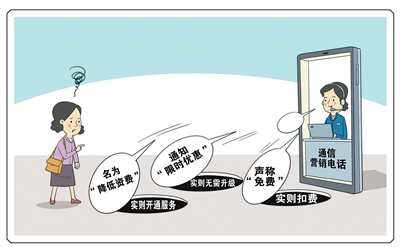
Core Viewpoint - The article highlights the difficulties consumers face when trying to change their mobile communication plans, despite the promotion of "speeding up and reducing costs" in the telecommunications industry. Consumers often encounter obstacles such as high cancellation fees, misleading sales practices, and preferential treatment for new users over existing ones [1][11][12]. Group 1: Consumer Experiences - Consumers like Mr. Huang and Mr. Wang express frustration over the inability to switch to lower-priced plans without incurring additional costs or penalties [1][2]. - Many consumers report being locked into high-priced contracts due to unclear terms and conditions presented at the time of signing [6][8]. - The article notes that customer service representatives often offer limited options for existing users, pushing them towards higher-priced plans or requiring them to open new accounts to access better deals [2][4][9]. Group 2: Sales Practices and Contractual Obligations - The practice of "contract bundling" is identified as a common tactic used by telecom operators to retain high-spending customers, often leading to increased costs for consumers who wish to downgrade their plans [5][8]. - Misleading promotions, such as "free phones" or "exclusive offers," often come with hidden costs and long-term commitments that are not clearly communicated to consumers [8][10]. - The article emphasizes that many consumers are unaware of the penalties associated with early contract termination, which can significantly impact their decision-making [6][9]. Group 3: Regulatory and Industry Response - The article discusses the legal framework protecting consumer rights, including the Consumer Rights Protection Law and the Telecommunications Regulations, which mandate transparency and fair practices from service providers [11][13]. - Regulatory bodies are taking steps to address these issues, including initiatives to simplify service offerings and ensure that consumers are fully informed before making decisions [11][12]. - Experts suggest that ongoing regulatory oversight and consumer education are essential to combat deceptive practices and enhance consumer rights in the telecommunications sector [13][14].
中国移动支付世界第一,欧美却还用现金?为何欧美不用移动支付?
Sou Hu Cai Jing· 2025-12-18 23:15
Core Viewpoint - The widespread adoption of mobile payment in China contrasts sharply with its limited use in developed countries, primarily due to concerns over data security and privacy, as well as entrenched payment habits and infrastructure issues [1][11][19]. Group 1: Data Security and Privacy Concerns - In developed countries, data security and privacy protection are major public concerns, leading to higher operational costs and legal risks for payment institutions [3]. - A data breach incident in the EU resulted in the exposure of personal information for approximately 1.2 million users, significantly eroding consumer trust in mobile payments [5]. - Continuous reports of mobile payment fraud and data breaches heighten the sensitivity around financial and personal data protection in developed nations [7]. Group 2: Infrastructure and Technological Limitations - The lack of stable network infrastructure in some developed regions, particularly rural areas, hampers the reliability of mobile payment systems [13]. - Users often experience failed transactions due to unstable signals, reinforcing the reliance on cash payments in these areas [13]. Group 3: Established Payment Habits - Consumers in developed countries have long-standing habits of using credit cards and cash, which creates a barrier to adopting mobile payment systems [15]. - Small businesses may be reluctant to invest in mobile payment technology, preferring the simplicity and lower costs associated with cash transactions [15]. Group 4: Industry Resistance and Economic Interests - The credit card industry in the U.S. generates over $80 billion annually, with a significant portion derived from transaction fees, leading to resistance against mobile payment adoption [19]. - German banks express concerns that mobile payments could disrupt the existing financial system, resulting in a lack of proactive support for mobile payment technologies [21]. Group 5: Comparative Analysis with China - In China, mobile payment has rapidly penetrated various sectors, supported by a cooperative mechanism between banks and third-party payment platforms, facilitating widespread adoption [23]. - The Chinese government has implemented measures to ensure that the promotion of mobile payment does not disrupt financial order while protecting user rights [23]. - Continuous improvements in addressing risks associated with mobile payments, such as fraud and data breaches, are being made in China, including the establishment of compensation funds and risk monitoring systems [27].
手机套餐 少些套路(民生探针)
Ren Min Ri Bao· 2025-12-18 22:17
Core Viewpoint - The article highlights the difficulties consumers face when trying to change their mobile communication plans, emphasizing that while it is easy to sign up for new plans, switching to more affordable options is often complicated by hidden fees and restrictive contracts [1][6][12]. Group 1: Consumer Experiences - Consumers like Mr. Huang and Mr. Wang express frustration over being unable to switch to lower-priced plans without incurring penalties or being restricted to options that do not meet their needs [1][2]. - Many consumers report being unaware of the existence of early termination fees and other binding clauses when they initially signed up for their plans, leading to dissatisfaction when they attempt to change [6][7][8]. Group 2: Industry Practices - The article reveals that telecom operators employ tactics such as differentiating between new and existing customers, making it easier for new users to access discounts while keeping existing users locked into higher-priced plans [6][10]. - There is a noted trend of "contract bundling," where consumers are tied to long-term agreements that make it difficult to switch plans or cancel services without incurring significant costs [8][9]. Group 3: Regulatory and Legal Framework - The article references the Consumer Rights Protection Law and the Telecommunications Regulations, which state that consumers should have the right to choose their services freely and be informed about all terms and conditions [10][11]. - Experts suggest that regulatory bodies need to enhance oversight and create clearer guidelines to protect consumers from misleading sales practices and ensure transparency in service agreements [12][13]. Group 4: Recommendations for Improvement - The article discusses ongoing initiatives by regulatory authorities to simplify service offerings and improve customer service response times, aiming to ensure that consumers can easily change their plans within a specified timeframe [12][13]. - Legal experts recommend that consumers remain vigilant about promotional offers and be aware of the potential pitfalls associated with long-term contracts, encouraging them to report any violations of their rights [13][14].
大厂多模态Agent能力激战正酣
Zheng Quan Ri Bao· 2025-12-18 15:40
Core Insights - Volcano Engine officially launched Doubao-Seed-1.8 and Seedance1.5Pro at the FORCE conference, marking a significant advancement in the multi-modal agent landscape [1] - The daily token usage of Doubao model has surpassed 50 trillion, representing over a tenfold increase compared to the same period last year, with more than 100 enterprise clients using over 1 trillion tokens [1] Group 1: Product Development - Doubao-Seed-1.8 focuses on enhancing the capabilities of multi-modal agents, optimizing for complex instruction adherence and operational capabilities [2] - The model's video understanding capability has been upgraded to process 1280 frames per video, enabling high-precision analysis of lengthy visual information [2] - Seedance1.5Pro showcases advanced multi-modal integration, achieving millisecond-level audio-visual synchronization and addressing long-standing issues in AI video generation [2] Group 2: Industry Trends - The launch signifies a shift in the large model industry from parameter competition to a focus on multi-modal agents, emphasizing full-chain execution capabilities [3] - The IT infrastructure is transitioning from function-driven to intelligence-driven paradigms, with Volcano Engine's AI cloud-native architecture indicating a future dominated by agent-centric intelligent networks [3] - Large model applications are overcoming scalability barriers related to cost and stability [3] Group 3: Competitive Landscape - Major cloud vendors are shifting their strategic focus to multi-modal intelligent agent platforms, leading to a multi-dimensional competition encompassing full-stack technology and industry applications [4] - Alibaba Cloud has upgraded its AI ecosystem, achieving high scores in agent tool invocation capabilities and enhancing development efficiency through new frameworks [4] - Baidu has also upgraded its AI capabilities, supporting various modalities for creative tasks, indicating a competitive push in the multi-modal space [4] Group 4: Strategic Initiatives - Volcano Engine has upgraded its enterprise AI agent platform, AgentKit, covering the entire lifecycle from development to management [5] - The introduction of HiAgent workstation aims to facilitate scalable management and application of agents for enterprises [6] - The company has launched an "AI Savings Plan" promising up to 47% cost savings for pay-as-you-go enterprises, reflecting a commitment to enhancing model capabilities and infrastructure [6]